The moment I stopped trying to manage my parents’ emotions, I reached for Tyler and Megan with one purpose: get both children out of that dining room.
I was still on the hardwood, my throat burning where my father’s hand had been, and every breath felt too small.
Tyler was only a few feet away after Richard had kicked him for trying to protect me, his navy Thanksgiving sweater pulled crooked across one shoulder.
Megan stood beside the table with her palm pressed against the cheek Elaine had just slapped, staring at me because every other adult in the room had already shown her what they were willing to do.
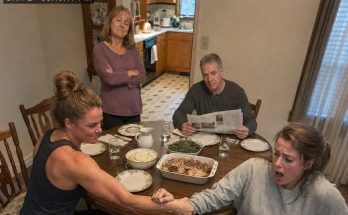
And behind them, around a table covered with turkey, polished silver, crystal glasses, and gravy spilled across a white tablecloth, some of my relatives were laughing.
That sound did something the violence itself had not managed to do.
It ended my confusion.
Until then, part of me had still been trying to understand the scene as an explosion, something sudden and terrible that might somehow be separated from the family I had spent years trying to keep.
Maybe Richard had lost his temper.
Maybe Elaine was caught up in defending Natalie.
Maybe everyone else was frozen because things had happened too quickly.
But people who are helpless do not laugh when an eight-year-old is kicked to the floor.
People who are horrified do not watch a ten-year-old get slapped and then stay comfortably seated.
The people around that table were not trapped in the moment with us.
They were participating in it by deciding that what was happening to my children was acceptable.
And all of it had started over a demand that I pay $5,000 every month so my thirty-four-year-old sister could keep an apartment she could not afford.
The cruelty of that number still felt almost absurd when I looked at Tyler lying on the floor.
Five thousand dollars.
Not for emergency surgery.
Not because Natalie had lost everything in some disaster.
Not because she had nowhere else to go.
She wanted to remain in a luxury apartment, and my parents had decided the obvious solution was to make me fund it.
A few hours earlier, none of us had walked into that house expecting violence.
Tyler had been excited about Thanksgiving because he had chosen a navy sweater that made him feel grown-up.
Before we left home, he asked me three separate times whether it looked nice.
Megan, who was ten and had recently discovered that being an older sister gave her permission to act like an unpaid stylist, helped him comb his hair while the two of them laughed at how seriously he was taking dinner.
I remember watching them and thinking that, whatever complicated history I had with my parents and Natalie, my kids deserved a normal holiday.
That was what I kept trying to give them.
Normal.
A warm meal, cousins and relatives, familiar voices, too much food, and a few hours in which nobody had to think about school calls, work schedules, mortgage payments, grocery lists, copays, or all the small emergencies that filled our regular weeks.
I was raising Tyler and Megan alone, and my life depended on planning because there was no second dependable parent standing behind me when something went wrong.
If school called while I was working, I figured it out.
If Tyler got sick, I rearranged whatever could be rearranged.
If Megan needed me during a shift, I calculated lost hours against whatever bill was closest to being due.
I packed lunches, paid the mortgage, bought groceries, remembered appointments, handled forms, washed clothes, answered school messages, and tried to make sure my children never felt like the ordinary demands of their lives were burdens to me.
Elaine, my mother, called all of that normal responsibility.
Natalie’s problems were different.
Natalie overspent, and everyone was supposed to understand that she was stressed.
Natalie left another job, and everyone was supposed to understand that she was overwhelmed.
Natalie needed money, and suddenly her financial choices became a family emergency.
The pattern had existed for so long that everyone seemed to know their assigned part before Natalie even asked for anything.
She struggled.
My parents rescued.
The rest of us were expected to contribute or stay quiet.
I had spent years refusing to name the arrangement too clearly because naming it would have forced me to admit that there was one standard for Natalie and another for me.
Thanksgiving made that impossible to ignore.
Elaine’s dining room looked perfect when we arrived.
There was a white tablecloth, polished silver, crystal glasses, good china, bright candles, and a turkey that looked as if someone had spent all afternoon making sure it would be admired before anyone touched it.
Butter and cinnamon hung in the warm air beneath Elaine’s expensive perfume.
Richard sat at the head of the table with a beer while Uncle Warren talked loudly enough for three conversations, Aunt Linda complained about her knee, Cousin Michael kept checking his phone, and Uncle James and Aunt Susan smiled whenever the conversation came close to becoming uncomfortable.
It looked exactly like the kind of family gathering people imagine when they say they want everyone together for the holidays.
Natalie arrived late.
She wore a cream dress and glossy heels and carried no food, flowers, or apology.
“I almost didn’t make it,” she announced. “It has been the worst week.”
Elaine immediately reached for her arm.
“Oh, sweetheart.”
Tyler leaned toward me and whispered, “Is Aunt Natalie sick?”
“No. Just tired.”
That answer seemed harmless at the time.
For nearly an hour, everyone behaved as though dinner really was the reason we had gathered.
Food moved around the table, relatives talked, my children answered questions about school, and the people who would later laugh while they were hurt passed them rolls and spoke to them by name.
Then Elaine cleared her throat.
“We need to discuss Natalie’s financial situation.”
There was something about the way she said it that made me understand immediately that this was not a discussion Natalie had unexpectedly brought to dinner.
This was planned.
Richard looked directly at me.
“Your sister needs help with rent. Five thousand a month. You’re going to cover it.”
For a second, I genuinely believed I had misunderstood him.
“I’m sorry?”
“Don’t make me repeat myself.”
Elaine explained that Natalie was under too much stress to move.
That was the argument.
Not that there were no cheaper apartments.
Not that Natalie could not work.
Not that she had some emergency preventing her from making a different choice.
Moving would be stressful, therefore somebody else should spend $5,000 every month to prevent her from experiencing that stress.
“She lives in a luxury apartment,” I said. “If she can’t afford it, she needs to move somewhere she can afford.”
Natalie’s eyes filled almost immediately.
“See? I told you she’d say that. She doesn’t care if I end up homeless.”
The word homeless landed on the table as if everyone were expected to accept it without examining what it meant.
“Homeless? Natalie, you could rent a cheaper place tomorrow.”
Elaine looked at me as though I had missed something obvious.
“You have a house.”
“I have a mortgage.”
“You have stability.”
“I worked for it.”
That was when Natalie said something so detached from my actual life that I almost laughed.
“You have children. People feel sorry for single mothers. Everyone helps you.”
I thought about every school call I had answered alone.
I thought about the times Tyler had been sick and I had scrambled to leave work.
I thought about the hours I had lost because Megan needed me and there was nobody else available.
I thought about asking a neighbor for help because the relatives now staring at me across Thanksgiving dinner had not been the people I could depend on.
“I am not paying your rent,” I said.
Elaine’s expression changed.
“You will not embarrass this family by letting your sister struggle.”
“Her rent is more than my mortgage.”
“Then budget better.”
“I have two children.”
“And Natalie is my child.”
There are sentences that clarify years of confusion in a few words.
That was one of them.
Elaine had not accidentally overlooked what my responsibilities cost me.
She simply believed Natalie’s comfort deserved greater protection than mine.
I turned toward my sister.
“Move somewhere you can afford.”
The wounded expression disappeared from Natalie’s voice.
“You always thought you were better than me. The grades, scholarships, your little house, your responsible act. You behave like you earned everything.”
“I did earn it.”
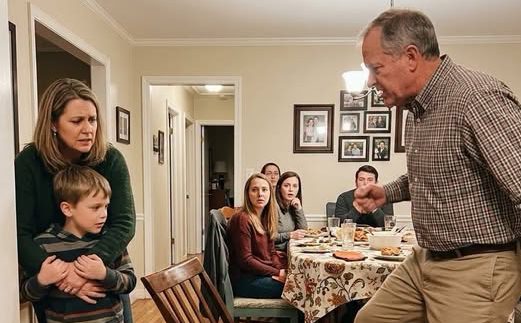
Richard’s fist hit the table.
The glasses jumped.
Forks stopped moving, and gravy slipped onto the white tablecloth while everyone around us got a clear view of my father standing from his chair.
Nobody stepped between us.
He came toward me because I had refused to pay my adult sister’s luxury rent.
“Your mother asked you to help your sister.”
“No. She demanded that I pay for Natalie’s choices.”
His hand closed around my throat.
My shoulder struck the wall first, and then the back of my head hit the framed family photograph hanging behind me.
I caught his wrist and tried to pull his hand away while my body fought for air.
He leaned close enough that I could hear every word clearly.
“Useless daughter. After everything we did for you, this is how you repay us?”
Megan screamed.
Elaine did not tell Richard to stop.
“Maybe now she’ll listen,” she said.
And Natalie made a sound I knew immediately was not fear.
She was not shocked that our argument had become physical.
She sounded satisfied.
Then came the scrape of Tyler’s chair against the hardwood.
“Let her go!” he shouted. “You’re hurting my mom!”
Richard released me, and I dropped toward the floor, coughing and reaching for my son.
Tyler was already running toward us with both arms out.
He was eight years old, wearing the sweater he had worried so much about before dinner, and he was moving toward a grown man because he thought his mother needed him.
Richard turned before I could reach Tyler.
Then my father kicked my son and sent him to the floor.
Megan screamed Tyler’s name.
I remember trying to force air into my lungs while my mind struggled to keep up with what I was seeing.
My father had attacked me.
My eight-year-old had tried to stop him.
My father had responded by hurting the child who was protecting me.
Then Elaine stood and moved toward Megan.
My daughter barely had time to turn before her grandmother slapped her across the face.
Megan stumbled sideways and lifted one hand to her cheek.
She looked at Elaine with the stunned expression of a child discovering that an adult’s favorite lesson can mean absolutely nothing when that adult is the one being tested.
Elaine had spent years saying family was supposed to protect family.
Now Megan knew there had apparently been conditions attached to that sentence.
I was still trying to breathe.
Tyler remained down a few feet away.
Megan stood near the table with her hand against her face.
Then somebody laughed.
I wish I could say it sounded nervous.
It did not.
Another person joined in.
The same relatives who had asked my children about school and eaten Thanksgiving dinner beside them were watching two kids get hurt because their mother had refused to finance Natalie’s apartment, and laughter was the reaction some of them chose.
Richard looked around the room as if their response confirmed his authority.
Elaine did not reach for Megan.
Natalie did not check Tyler.
Nobody suddenly remembered that these were children.
That was when the structure of the whole evening became painfully simple.
This was bigger than Richard losing his temper.
It was bigger than Elaine defending Natalie.
It was bigger than one ridiculous argument about $5,000 in rent.
Every adult in that room had reached a point where a choice was available.
Some could intervene.
Some could object.
Some could get up and help Tyler.
Some could go to Megan.
At the absolute minimum, they could refuse to treat violence against two children as entertainment.
Their choices told me more than any family speech ever had.
Tyler finally tried to push himself up.
Megan kept looking at me instead of at the adults surrounding her.
Neither child needed to ask aloud what came next.
Their faces were asking me anyway.
What are we supposed to do now?
For years, my instinct around my parents had been to reduce conflict.
Explain more carefully.
Choose softer language.
Avoid saying the thing that would make Elaine defensive.
Ignore Natalie’s latest complaint because arguing would only make the evening worse.
Treat Richard’s temper as something everyone else had to navigate instead of something he was responsible for controlling.
I had told myself that keeping peace was part of being an adult.
On that dining room floor, I finally saw the cost of that habit from my children’s side.
Tyler had watched his grandfather put a hand around his mother’s throat and decided an eight-year-old needed to intervene because the adults would not.
Megan had watched her little brother get knocked down, then been struck by her grandmother while other relatives remained seated.
My children had been placed in the middle of a family system I had spent years trying to manage politely.
That realization hurt differently from my throat.
I could not undo what they had already seen.
I could not make Richard’s hand disappear from their memory, or erase the moment Tyler ran toward him, or take away the look on Megan’s face after Elaine slapped her.
But I could stop treating the feelings of the adults in that room as the problem I needed to solve first.
My children were the priority.
Not Natalie’s rent.
Not Elaine’s definition of family embarrassment.
Not Richard’s demand for obedience.
Not Uncle Warren, Aunt Linda, Michael, James, Susan, or anyone else who had decided remaining comfortable mattered more than standing up for two kids.
I reached toward Tyler.
His sweater was still twisted sideways, the navy fabric bunched where his shoulder had hit the floor.
Then I reached toward Megan.
Her palm was still pressed against her cheek.
I did not look around the table for permission.
I did not try to find the perfect sentence that would make my parents understand what they had done.
There was nothing left to negotiate about Natalie’s apartment, because the argument had already exposed something far more important than money.
At the beginning of dinner, my parents had wanted me to prove I cared about family by sacrificing my financial stability for Natalie.
By the end of it, my children had learned who was actually willing to protect whom.
The white tablecloth was still there.
The candles were still bright.
The turkey was still sitting in the middle of the table, surrounded by all the careful details Elaine had arranged to make the evening look like a family holiday.
But the picture no longer worked.
I put one arm toward Tyler and extended the other toward Megan.
This time, instead of trying to pull the family back together, I turned my children toward the way out.