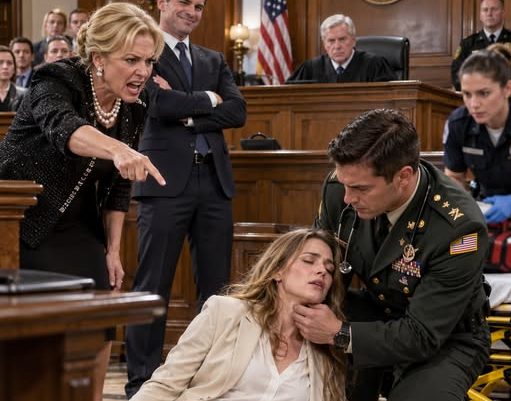
My mother-in-law pointed at me in open court and said, “She’s faking it.” My husband sat beside his attorney, smirked, and told the judge I pulled this kind of thing
whenever I didn’t get my way. Less than a minute later, my legs gave out beneath me—and the one person in that courtroom who understood what was happening was a military doctor I had never met.
I was standing near the witness box with one hand wrapped around the wooden railing because the room would not stop tilting. The fluorescent lights buzzed overhead, every whisper sounded painfully loud, and I could feel my heartbeat doing something I could not explain. Judge Richard Hanley looked
over his glasses and asked whether I was able to continue. I wanted desperately to say yes, because Daniel had spent the entire morning convincing everyone that weakness was the same thing as dishonesty.
The custody hearing had already become a nightmare. Daniel’s attorney had taken months of dizziness, blackouts, emergency room visits, and unexplained exhaustion and turned them into proof that I was unstable. Because several doctors had failed to give me a definite diagnosis, Daniel argued that there was nothing physically wrong with me at all. Patricia, his mother, sat behind him nodding as if every frightening moment I had lived through was simply another performance she had finally caught me staging.
What made it worse was that I had come to court alone. My attorney had withdrawn two weeks earlier after Daniel emptied our joint account and I could no longer keep up with the retainer payments. I had spent that morning trying to explain why our seven-year-old daughter, Lily, cried before going to Daniel’s house and why she had started hiding her backpack on transition days. Every time I tried to describe Lily’s fear, Daniel’s lawyer objected, and every objection made me feel as if my own child were slowly disappearing behind legal words I could not fight.

Then the floor shifted again. I whispered, “Your Honor, I need a minute,” and Daniel gave a quiet laugh like I had just proved his entire case for him. Patricia shook her head and said, “Drama,” while Judge Hanley reminded me that the court had already been patient. I remember looking at Daniel and seeing two of him, then three, before the railing slipped out of my hand.
My shoulder hit the floor hard, but for a few seconds I barely felt it. Voices stretched into the distance, chairs scraped, and someone rushed toward me from the back benches. A tall man in a dark green uniform dropped to his knees beside me and pressed two fingers against my neck. His name tag read CARTER, and the calm expression on his face disappeared the moment he found my pulse.
“Ma’am, can you hear me?” he asked. I tried to answer, but my tongue felt heavy and my lips barely moved. Behind him, Daniel stood up and said, “She’s fine. She does this.” The man looked over his shoulder and said, “I’m Colonel Aaron Carter, U.S. Army Medical Corps,” in a voice that made the entire room go quiet.
Patricia scoffed that he didn’t know me. Colonel Carter ignored her, checked my pulse again, lifted one eyelid, and asked how long I had been having dizziness and blackouts. When I managed to whisper, “Months,” his expression became even more serious. Then he looked toward the judge and said, “She needs an ambulance.”
Nobody moved quickly enough. Maybe they were shocked, or maybe after listening to Daniel and Patricia call me a liar all morning, they had forgotten what a real medical emergency looked like. Colonel Carter’s voice suddenly thundered through the courtroom: “CALL 911!” The bailiff grabbed the phone, Judge Hanley came down from the bench, and Patricia finally stopped talking.
The paramedics arrived with oxygen, wires, a blood-pressure cuff, and a monitor they pressed against my chest. One of them stared at the screen and said my heart rate was thirty-six, while another called out a blood pressure so low that even I knew it was wrong. Daniel, standing several feet away, finally asked, “Is she actually—” but he could not finish the sentence. Colonel Carter looked directly at him and said, “Sir, she is not pretending.”
Those four words almost hurt more than hitting the floor. For a year I had been begging doctors, family members, and eventually myself to believe that something real was happening inside my body. Daniel had told me I was anxious, Patricia had called me dramatic, and every normal test had made their version of me sound more convincing. Now a stranger who had known me for less than five minutes was the first person to say out loud what I had almost stopped believing.
Judge Hanley immediately suspended the hearing. Daniel tried to protest, but the judge cut him off and said custody would be discussed only after I was medically capable of participating. As the paramedics lifted me onto the stretcher, I caught one last glimpse of Patricia standing beside her son. For the first time that day, neither of them looked confident.
At the hospital, I woke with wires attached to my chest and a nurse telling me a cardiologist wanted to speak with me. Dr. Priya Shah pulled a chair beside my bed and asked whether the blackouts had always come and gone without warning. I told her about the muffled hearing, the narrowing vision, the strange moments when my heart seemed to race and then suddenly slow. She nodded, looked at the monitor, and said, “That is exactly why this has been so easy to miss.”
I stared at her, afraid to ask what she meant. Dr. Shah explained that several earlier ECGs could have looked normal because my problem did not happen every second of every day. Continuous monitoring, however, had caught something my previous visits had missed. Then she turned the screen slightly toward me and said, very carefully, “Your heart is periodically beating dangerously slowly.”
PART 2:
I stared at Dr. Shah because I had spent so long hearing that nothing was wrong that the truth felt almost impossible to accept. She explained that the electrical signal inside my heart was sometimes failing to travel the way it should, causing my pulse to drop far below a safe rate. Stress could make people feel dizzy, she said, but stress could not explain what the monitor had recorded while I was lying quietly in a hospital bed. For the first time, my symptoms were not an opinion—they were numbers on a screen.
Then she said I might need a pacemaker. I was thirty-four years old, and the word sounded like something meant for someone else’s life. I asked whether I was dying, and she told me no, but she did not soften the seriousness of what they had found. They were keeping me overnight because they needed to see whether the rhythm problem happened again.
My phone arrived a little later with missed calls from Daniel and Patricia. Daniel’s first messages asked what the doctors had found, but the last one said, “Your stunt has now delayed everything.” Patricia’s message was worse in a quieter way: “You frightened everyone today. Let us know when you are ready to behave reasonably about custody.” I took screenshots of both before I could talk myself into deleting them.
That decision mattered because deleting cruel messages had become one of my worst habits during our marriage. Daniel would say something awful, apologize later, and I would erase the proof because I wanted the kinder version of him to be the real one. Lying in that hospital bed, I realized how many times I had helped him clean up the story after he hurt me. So I created a folder on my phone and started saving everything.
Then the court clerk called. Judge Hanley had suspended the custody hearing until I was medically cleared, but he had also issued a new order requiring both sides to preserve the complete medical records used during the hearing. The word “complete” stayed in my head long after the call ended. Daniel’s attorney had shown the judge pieces of my records, but I suddenly remembered one hospital visit from months earlier that had not sounded nearly as dismissive as he claimed.
I logged into my patient portal and found the note from May. A doctor had written that my recurrent near-fainting episodes needed additional cardiac evaluation and specifically recommended an ambulatory heart monitor. The note also said an intermittent arrhythmia could not be ruled out. Daniel had been sitting in that room when the doctor told me to follow up.
In court, however, his attorney had emphasized only the line saying I had been discharged in stable condition. He had used that sentence to make it sound as though the doctors had already proved I was fine. Nobody had read the recommendation for cardiac monitoring, and nobody had mentioned that a physical cause was still being investigated. The truth had not been completely erased—it had simply been trimmed until it told the story Daniel wanted.
That night the monitor beside my hospital bed sounded an alarm while I was asleep. There was no argument, no courtroom, no audience, and nobody for me to manipulate. My heart rate had dropped into the thirties again while I was doing nothing but sleeping. By morning, Dr. Shah had stopped saying I “might” need treatment.
“You need a pacemaker,” she told me. I asked her one last time whether panic or anxiety could have caused what they recorded, because some part of me still needed permission to believe my own body. She shook her head and said, “You cannot decide to create the conduction abnormality we captured.” Then she added, “Being frightened does not mean you imagined the reason you were frightened.”
Before they took me for the procedure, I downloaded every medical record I could find. I saved the May note, the emergency room visits, the reports of blackouts, and the recommendation Daniel had heard with his own ears. For months I had thought my only problem was getting doctors to find the right diagnosis. Now I realized I had another problem waiting in court: someone had already taken an incomplete medical story and used it to decide what kind of mother I was.
PART 3:
The pacemaker left a small scar below my collarbone, but the strangest thing happened the morning after the procedure. I stood beside the hospital bed expecting the room to darken the way it always did, yet nothing happened. I took ten slow steps down the hallway without grabbing a wall or waiting for my hearing to fade. I started crying simply because I was standing upright and my body was finally staying with me.
Daniel came to the hospital that afternoon. He looked at the bandage and actually asked, “You really got one?” as if there were still a chance the whole thing had been theater. When I reminded him that he had testified there was nothing seriously wrong with me, he said he had only believed what the earlier tests showed. Then I asked him about the doctor who recommended cardiac monitoring in May.
For one second, his eyes shifted away from mine. He said he did not remember the conversation, but when I repeated the doctor’s warning about an intermittent rhythm problem, Daniel replied, “Doctors write things like that to protect themselves.” The answer came too fast. He might not have known my final diagnosis, but he clearly remembered that someone had warned us there could be a physical problem.
That was the moment my anger changed. I had spent months wondering whether Daniel truly believed I was imagining everything or whether he had simply found that explanation convenient. Now I knew he had heard at least one doctor say more testing was needed, yet he still sat in court while his attorney described my symptoms as proof of instability. I stopped trying to make him admit what he had done and started preparing to prove what had happened.
The court appointed a guardian ad litem named Susan Bell to look after Lily’s interests. Susan met with me, Daniel, and Lily separately, and she made it clear that her job was not to decide who had been the better spouse. She wanted to know how the conflict was affecting our seven-year-old daughter. That frightened me more than any medical test.
When Susan later called, she told me Lily had been exposed to adult conversations about whether my illness was real. I felt sick all over again. Lily had apparently heard people discussing my dizziness, my hospital visits, and whether I was pretending. Susan would not give me every detail over the phone, but she said one thing that stayed with me: “Lily should never be placed in the position of evaluating whether your medical condition is real.”
The report arrived the next morning. Lily loved her father, enjoyed spending time with him, and was not claiming he physically hurt her. But she was anxious about transitions, felt pressure when she missed me, and believed she was supposed to notice whether I looked tired or sick. The conflict between Daniel and me had started becoming a job our child thought she had to manage.
Then I reached the sentence that made my hands go cold. Lily had told Susan, “Grandma says Mommy gets sick when she wants people to feel sorry for her.” Patricia had not limited her contempt to the courtroom. She had carried it into my daughter’s world.
I looked through the doorway at Lily sitting on the couch with her plastic dinosaurs spread around her. She was seven years old, still slept with the same stuffed rabbit she had loved for years, and should never have been asked to decide which adults were telling the truth. That night I made a decision that changed the way I approached the case. I would not ask the court to destroy Lily’s relationship with her father; I would ask the court to stop adults from making her choose sides.
I built a timeline using only facts. Emergency room visit, recommendation for heart monitoring, blackout, another medical visit, Daniel’s custody filing calling my symptoms psychosomatic, courtroom collapse, pulse in the thirties, telemetry findings, pacemaker. When I saw everything arranged by date, I understood how dangerous the missing pieces had been. My story had never been empty—it had been edited.
The next hearing was set for October 3. The night before, Lily climbed onto my bed and asked whether I was going to fall down in court again. I told her I did not think so, because now the doctors knew what was wrong and I knew what to do if I felt sick. Then she leaned against me and whispered, “I knew you weren’t pretending.”
I held her tightly and told her she never had to prove that to anyone. After she went to sleep, I sat at the kitchen table with five folders in front of me: medical records, financial records, custody documents, saved messages, and my timeline. The first time I went to court, I had tried to convince everyone I was a good person. This time I was bringing facts they could not dismiss.
PART 4:
The courtroom looked smaller when I returned. Daniel was already seated beside his attorney, Patricia was in the gallery, and Colonel Carter—the military doctor who had rushed to me when I collapsed—sat quietly near the aisle. Judge Hanley confirmed that I was medically cleared to continue. Then Daniel’s attorney stood and tried to say they had never intended to suggest my newly diagnosed heart condition was fabricated.
Judge Hanley removed his glasses and said, “Counsel, I was present.” Nothing else needed to be said. For the first time, the confidence on Daniel’s side of the room looked forced rather than powerful. The hearing continued, and Colonel Carter was called first.
Daniel’s attorney tried to minimize his testimony by pointing out that he had never treated me before the day I collapsed. Colonel Carter agreed that he could only testify to what he personally observed. Then he calmly added, “I observed a woman experiencing a genuine medical emergency while people around her stated she was pretending.” Daniel stopped looking at him after that.
When it was my turn, I asked Colonel Carter whether I had known he was a doctor, whether I had ever met him, and whether I could have predicted he would be sitting in the courtroom that morning. His answer to each question was no. Then I asked whether someone could simply decide to make their pulse drop to roughly thirty-six beats per minute. He answered, “Not by simply deciding to.”
Next came the medical record from May. Judge Hanley read the recommendation for cardiac monitoring and asked Daniel’s attorney whether that record had been available before the earlier hearing. The attorney admitted it had. The judge reminded him that telling the court there had been no objective reason to suspect a physical cause was not the same thing as saying there had been no final diagnosis.
Daniel testified that he never intentionally misled anyone. He insisted he thought my symptoms were connected to anxiety because that was how they looked to him. I showed him the hospital message where he called my courtroom collapse a “stunt,” and he said he had been angry because the hearing was delayed. I asked why my medical emergency made him angry, and for once he had no clean answer.
Then I asked him the question I had carried since the day I hit the floor. “When I collapsed, why didn’t you come to me?” His attorney objected, but Judge Hanley allowed the question. Daniel finally said, “I thought you were doing what you always do—making things bigger than they are.”
Patricia’s testimony was almost worse because she tried to soften everything after the fact. She claimed that when she said I was “faking,” she had only meant I was exaggerating. I asked what medical training she had, whether she had read my complete records, and how she could possibly have known I was pretending before I even collapsed. She looked toward Daniel and answered, “I knew you.”
That answer told me everything. She had not needed evidence because she had already decided what kind of woman I was. Every symptom had been filtered through that judgment until nothing I said could possibly count as truth. I sat down and let the silence after her words do more work than an argument ever could.
Susan Bell testified last. She told the court that Lily loved both of us and needed both parents, but she also explained that our daughter was carrying a loyalty conflict no seven-year-old should have to manage. Daniel’s home had allowed negative comments about my health to reach Lily, and Lily had begun treating my symptoms like evidence she was responsible for interpreting. Susan said Daniel’s biggest problem was not whether he could feed, shelter, or love Lily—it was whether he could separate his anger toward me from Lily’s relationship with her mother.
Judge Hanley listened without interrupting. Then he announced a recess before issuing temporary custody orders. Outside the courtroom, Daniel came toward me and said, “You made me look terrible.” I told him, “I asked questions. The answers did the rest.”
The bailiff opened the doors and called us back inside. Daniel walked to his table, Patricia sat behind him, and I returned to the same place where I had once needed a railing just to stay upright. Judge Hanley entered carrying several pages of handwritten notes. Then he looked directly at both of us and began to speak.
PART 5:
Judge Hanley set his notes on the bench and looked out over the courtroom the way a man looks at a house he has finally finished repairing. He did not raise his voice. He did not need to. Every person in that room had already learned, over the last two hearings, that his quiet was more dangerous than anyone’s shouting.
“I have presided over family court for nineteen years,” he said, “and I have rarely seen a case where the medical record and the courtroom record told two such different stories. That gap did not happen by accident. It happened because someone chose, more than once, to show me only the parts of the truth that served them.”
Daniel’s attorney started to rise. Judge Hanley did not even look at him.
“Sit down, counsel. You will have your turn, but I am speaking now.”
He turned a page, though I suspected he already knew every word on it. “In May, a physician recommended cardiac monitoring for this mother after repeated episodes of near-fainting. That recommendation was known to the father. It was known to his attorney. Neither of them disclosed it to this court. Instead, this court was told, repeatedly, that there was no medical basis for the mother’s symptoms, and that her collapses, her dizziness, and her exhaustion were forms of manipulation designed to gain advantage in a custody dispute.”
He looked at Daniel now. Daniel did not look back.
“Three weeks ago, in this very courtroom, this mother’s heart rate dropped to thirty-six beats per minute in front of everyone present. A military physician who had never met her before that morning recognized a medical emergency within seconds. The people who had known her for years, who had shared a home and a marriage and a child with her, called it a performance. I do not say this to humiliate anyone. I say it because it is the single most important fact in this case, and I intend to treat it that way.”
I felt Colonel Carter shift slightly in the gallery behind me, not moving, just present. I did not turn around. I kept my eyes on the judge, because for the first time in this entire ordeal, I was not the one who needed to prove anything in this moment. I only needed to listen.
“I want to be clear about something,” Judge Hanley continued. “Custody decisions are not punishments. I am not interested in deciding who was crueler, or who said the worse thing, or who deserves to suffer for what happened in this courtroom. I am interested in one question only: what arrangement allows this child, Lily, to grow up safe, loved, and free from the burden of managing the conflict between her parents.”
He set the pages down.
“The guardian ad litem’s report makes it clear that Lily loves her father. It also makes it clear that Lily has been placed, repeatedly, in the position of evaluating her mother’s medical credibility — a task no seven-year-old should ever be asked to perform. She has heard herself, apparently more than once, that her mother ‘gets sick when she wants attention.’ I do not know whether that sentence was said maliciously or carelessly. I only know that a child should never hear it about her own parent.”
Patricia’s chin lifted slightly, the way it always did when she was preparing to disagree with something. But she stayed silent. She had learned, finally, that this was not a room where her certainty carried weight anymore.
“Effective today,” the judge said, “primary physical custody of Lily will remain with the mother. The father will retain regular, structured visitation, because I have no evidence before me that he poses a danger to his daughter’s physical safety, and I will not sever a relationship a child clearly values without cause. However, that visitation will be supervised for a period of ninety days, not because of any single act of violence, but because both the father and the paternal grandmother have demonstrated, in this courtroom and apparently in front of the child, an inability to separate their anger at the mother from their responsibility to protect Lily from that anger.”
Daniel’s jaw tightened. I watched the muscle move along the side of his face, the same tell I had learned to read across nine years of marriage.
“The paternal grandmother,” Judge Hanley continued, and this time his eyes moved to Patricia directly, “will have no unsupervised contact with the child until she completes a course in coparenting communication approved by this court, and until Ms. Bell confirms that Lily is no longer repeating statements that frame her mother’s illness as fabricated. I want to be plain about why. A grandmother is allowed to disagree with her son’s ex-wife. She is not allowed to teach a seven-year-old to distrust her own mother’s body.”
Patricia opened her mouth, and for the first time in this entire case, I watched her decide not to speak. It was such a small thing, but it told me more than anything she had said in two hearings.
“The father will also be required to attend individual counseling, focused specifically on communication during medical or emergency situations, given his response — both at the time of the mother’s collapse and afterward in written messages — which this court found deeply concerning for a co-parent.”
He paused, and for just a moment, his voice softened, not toward Daniel, but toward the room in general, the way a person softens when they are about to say something they believe matters beyond the paperwork.
“I want to say one more thing, and I am saying it for Lily, even though she is not in this room. Children do not need their parents to be perfect. They need their parents to be honest, and they need the adults around them to stop turning their mother’s or father’s pain into a weapon. That is the only thing I am ordering here that I consider truly non-negotiable.”
He signed the order in front of us, the pen scratching against the paper in a silence so complete I could hear it. Then he looked up one last time.
“This matter will be reviewed in ninety days. I would encourage everyone in this room to spend that time proving to me, and more importantly to Lily, that you understand what almost happened here.”
He stood, and the bailiff called the room to order, and it was over — not in the dramatic way I had imagined during all those sleepless nights building my timeline at the kitchen table, but in the quiet, procedural way that real endings usually arrive. No one clapped. No one cried. Daniel gathered his files. Patricia stood without looking at me. And I sat there for a moment with my hand pressed flat against my chest, feeling the small hard shape of the device that had, in the most literal sense, kept me alive long enough to be believed.
PART 6:
Colonel Carter found me in the hallway outside the courtroom. He was out of uniform that day, just a gray sweater and jeans, and without the insignia he looked less like the man who had shouted “CALL 911” across a stunned courtroom and more like someone’s kind neighbor.
“You did well in there,” he said.
“You did the hard part,” I told him. “You believed me before anyone else did.”
He shook his head slightly. “I didn’t believe you. I checked your pulse. Belief wasn’t required.” Then he softened. “But for what it’s worth, in twenty-two years of practicing medicine, I’ve learned that the people accused of exaggerating their symptoms are almost never the ones exaggerating. It’s usually the opposite. They’ve learned to minimize, because minimizing is safer than being disbelieved again.”
I thought about that sentence for a long time afterward. It explained so much about the year before my diagnosis — the way I had downplayed the blackouts to Daniel, softened the ER visits when I described them to friends, apologized for needing to sit down when the room tilted. I had spent a year making myself smaller so that my illness would be easier for other people to accept.
“Why did you come to the second hearing?” I asked him. “You didn’t have to.”
“Because Susan Bell asked if I’d be willing to testify, and because I kept thinking about your daughter,” he said. “I have two kids of my own. If a doctor watched something happen to their mother and then just went home and forgot about it, I don’t think I could live with that.”
Lily was waiting for me in the car with my sister, who had driven up for the hearing and taken her for ice cream during the worst of it. When I opened the door, Lily looked up at me with chocolate at the corner of her mouth and an expression that was trying very hard to be casual.
“Did the judge say I still get to see Daddy?”
“Yes,” I said, climbing in beside her. “Just — for a little while, someone else will be there too, to make sure everybody’s being kind to each other.”
She considered this with the seriousness only a seven-year-old can produce. “Like a referee?”
“Kind of like a referee.”
“Good,” she said. “Because sometimes Grandma isn’t very kind.”
I did not push her to say more. Susan Bell had warned me that pulling information out of Lily, even gently, risked teaching her that her job was still to report on the adults around her. So I only said, “You don’t have to figure any of that out anymore, baby. That’s the grown-ups’ job now.”
She nodded, satisfied, and went back to her ice cream, and I drove home with my daughter beside me and my heart — my newly, mechanically reliable heart — beating in a rhythm I could finally trust.
PART 7:
The next three months did not look like a movie montage. There was no single triumphant morning where everything became easy. There were court-ordered supervised visits that felt stiff and awkward at first, a case worker sitting in the corner of a family visitation room while Daniel tried to build a puzzle with Lily under fluorescent lighting that reminded me too much of the courtroom. There were nights Lily woke up asking if my heart was going to “do the bad thing again,” and I had to explain, in words a seven-year-old could hold onto, what a pacemaker actually was — that it was like a tiny, patient helper living just under my skin, always watching, always ready to nudge my heart back into rhythm if it forgot how.
“So it’s like your heart has a friend now,” she said one night, tracing the small scar below my collarbone with one finger.
“Exactly like that,” I told her, and something about hearing it phrased that way, in her voice, made the whole ordeal feel less like a wound and more like something that had, in its own strange way, protected me.
Daniel’s counseling sessions started slowly. I did not attend them, obviously, but Susan Bell kept me informed of his general progress as part of her ongoing role. The first update was almost comically minimal — he had attended, he had been “resistant to full engagement.” The second was slightly better. By the third, something had genuinely started to shift.
I saw it myself during a pickup in week six. He arrived early, which was new, and instead of the clipped, defensive tone he’d used with me since the divorce filing, he said, “Can I ask you something? Not for the case. Just — for me.”
I braced myself, but I said, “Okay.”
“When you were on the floor,” he said, “and I said you were fine — did you hear me?”
“I heard you,” I said. “I couldn’t see straight, but I heard you.”
He looked down at his hands. “I’ve been thinking about that a lot in counseling. About why my first instinct was to protect myself from looking foolish instead of checking if you were okay.” He paused. “I don’t have a good answer yet. But I wanted you to know I’m not pretending it didn’t happen.”
It was not an apology, not exactly. But it was the first honest thing he had said to me in over a year, and I found that I could accept it for what it was without needing it to be more.
Patricia’s progress was slower and less convincing. She completed the required course, technically, but Susan Bell noted in her reports that Patricia’s engagement felt performative — she said the right things in structured settings and reverted quickly outside them. The ninety-day supervised period for her was extended. I did not take pleasure in that. I only felt a kind of tired relief that the system built to protect Lily was, imperfectly but genuinely, doing its job.
Meanwhile, my own health became something I finally understood instead of feared. Dr. Shah adjusted the pacemaker settings twice in the first two months, fine-tuning until the dizziness disappeared almost entirely. I started walking again — real walking, the kind where you don’t scan every hallway for something to grab onto. I went back to work part-time, then full-time. I stopped flinching every time I stood up too quickly.
And slowly, I started telling people. Not everyone, not all at once, but enough. I told my sister the whole story, start to finish, including the parts where I had almost believed Daniel and Patricia myself. I told a support group for people with cardiac arrhythmias, where a woman named Renata told me she had been diagnosed with anxiety for six years before a monitor finally caught her own conduction problem. “They call it the invisible illness club,” she said, half-joking, “except everyone in it has scars to prove they’re not making it up.”
I started keeping a folder — not the one full of screenshots and evidence, but a new one, digital, just for me. In it, I put the note from Dr. Shah about my monitor settings, a photo of Lily grinning gap-toothed outside the courthouse the day the temporary order was signed, and eventually, a printed copy of Judge Hanley’s final custody ruling. Not because I needed to prove anything to anyone anymore. Just because I wanted, someday, to be able to show Lily exactly how far we had come, in case she ever needed reminding that hard things can still end somewhere good.
PART 8:
The ninety-day review hearing in October was almost anticlimactic, which felt, after everything, like its own kind of victory.
Susan Bell’s follow-up report noted real improvement. Lily had stopped repeating statements about my illness being fabricated. She talked about her father’s house more easily, without the tight, careful phrasing she’d used before, the sentences that always sounded rehearsed for an audience of adults deciding her fate. Daniel had completed his counseling requirement and, more importantly, had begun requesting extra time with Lily specifically around ordinary things — school pickups, a Saturday at the science museum — rather than only the minimum contact the court required.
Patricia’s supervised status remained in place a little longer, at Susan’s recommendation, but even there, small signs of change had begun to show. She sent a card for Lily’s school art show. She did not attend, per the current order, but she sent it, and inside she had written, simply, I’m proud of you, sweet girl. Love, Grandma — no mention of me, no undertone, just an ordinary grandmother’s sentence. It was such a small thing. It should not have made me cry in my kitchen, holding a seven-year-old’s watercolor painting of a dinosaur wearing a birthday hat, but it did.
Judge Hanley reviewed the file with the same careful, unhurried attention he’d given it the first time. “This is exactly the trajectory I was hoping to see,” he said, closing the folder. “I’m going to lift the supervision requirement for the father’s visitation, effective immediately, and continue the grandmother’s supervised status for another sixty days, with a check-in from Ms. Bell rather than a full hearing, assuming the current progress continues.”
He looked at me directly then, something he had not really done since the day I collapsed in front of him. “I want to say, for the record, that this court takes seriously what happened here. A woman was disbelieved, in this very room, while experiencing a life-threatening medical event. I hope that this case serves as a reminder — to me as much as to anyone — that the absence of an immediate diagnosis is not evidence of dishonesty. It is often simply evidence that we have not looked hard enough yet.”
I did not expect an apology from a judge. I had stopped expecting apologies from almost anyone by that point. But something in that sentence settled a part of me that had been unsettled since the moment Patricia pointed at me across a courtroom and called me a liar.
Outside, in the hallway, Daniel caught up with me before I reached the elevator.
“I owe you an actual apology,” he said. “Not the half version I gave you at the pickup that one time. A real one.”
I waited.
“I was so angry about the divorce, about the money, about everything falling apart, that it was easier to believe you were doing this to hurt me than to admit something might actually be wrong with you. It’s a terrible thing to say out loud. But it’s true, and I think you deserve to hear me say it plainly instead of letting you keep guessing.”
“Thank you,” I said, and I meant it, even though it did not erase a single dizzy afternoon or a single humiliating minute on that courtroom floor. Some apologies don’t undo the damage. They just make it possible to stop carrying the damage alone.
“I want to be better,” he added. “For Lily. And — I don’t expect this to matter to you, but for you too. You didn’t deserve what happened in that first hearing.”
“No,” I agreed quietly. “I didn’t. But I think, for Lily’s sake, I’d rather you spend the energy proving it than talking about it.”
He nodded, and for the first time since our marriage had started falling apart, I felt something close to peace standing next to him — not forgiveness exactly, not yet, but the absence of the constant, exhausting vigilance I had carried for over a year, waiting for the next accusation, the next dismissal, the next moment where my own body would be used as evidence against me.
PART 9:
Winter came, and with it, the kind of ordinary life I had almost forgotten was possible. Lily turned eight in December. We had a small party — my sister, two friends from Lily’s class, Susan Bell stopping by briefly with a gift because she said she’d grown fond of “keeping an eye on the happy endings, not just the hard cases.” Daniel came for an hour, brought a telescope because Lily had gone through a sudden, fierce obsession with space, and left before the cake, respecting the boundaries we’d carefully built back into shared space.
Patricia’s supervision requirement was fully lifted in January, after Susan Bell confirmed six consecutive months without a single concerning comment reaching Lily. Patricia asked, through Daniel, whether she could take Lily to see a children’s theater production of a story about a girl who builds a rocket. I said yes. It was not an act of forgiveness so much as an act of trust in the systems that had, slowly and imperfectly, done what they were designed to do — protect a child while giving the adults around her room to actually change.
I do not know if Patricia and I will ever be close. I suspect we won’t. But the last time I saw her, at a school event in the spring, she approached me in the hallway, and instead of the sharp, dismissive tone she’d used in the courtroom, she said, simply, “You look well.” I told her I was. She nodded once, and that was the entire conversation, and somehow it felt like more progress than a hundred long apologies would have.
As for me — I went back to school myself that spring, finishing the certification I’d abandoned years earlier when things with Daniel started falling apart. I started dating again, slowly, months later, a man named Marcus who, on our second date, asked thoughtful questions about the small scar below my collarbone instead of treating it like an inconvenient detail. When I told him the whole story — the courtroom, the collapse, Colonel Carter, the pacemaker, the custody fight — he didn’t say any of the things I had braced myself to hear. He just said, “That’s an unbelievable amount to survive,” and let me sit with the fact that surviving it did not require anyone else’s permission to matter.
Colonel Carter and I stayed in touch, in the loose way strangers who share a life-altering moment sometimes do. He sent a card when the final custody order became permanent, just a short note: Glad the numbers on the monitor finally told the story everyone needed to hear. I keep it in the folder, along with everything else.
Lily is nine now. She still sleeps with the same stuffed rabbit, though it has been through the washing machine so many times its fur has gone soft and pale. She knows the basic shape of what happened to me — that my heart used to skip and slow in ways that scared everyone, that a doctor found it, that I have a small machine that helps it now. She does not know every detail of the courtroom, and I do not plan to tell her every detail until she is old enough to understand it without carrying it as her own burden. But she knows this much, because I have told her plainly, more than once:
“Nobody gets to decide what’s happening inside your body except you and your doctors. Not even people who love you. If you’re ever scared like I was, you don’t have to convince anyone. You just have to keep telling the truth until the right person listens.”
She asked me once, not long ago, why Colonel Carter had believed me so fast when everyone else in the courtroom hadn’t.
“Because he checked,” I told her. “He didn’t guess. He didn’t assume. He just checked.”
I think about that a lot — how the whole difference between being disbelieved and being saved came down to one stranger who chose to check instead of assume. I have tried, in the years since, to carry that lesson forward in smaller ways — with friends who mention symptoms doctors have brushed off, with a coworker who once quietly admitted she’d been told her chronic pain was “probably just stress.” I don’t diagnose anyone. I just tell them what I learned the hardest way possible: that an absent diagnosis is not the same thing as an absent illness, and that the people who love you the most can still, sometimes, be the last ones to believe you.
The pacemaker interrogation last month showed everything working exactly as it should. Dr. Shah, scrolling through months of steady, uneventful rhythm data, smiled at me the way she had the very first day she told me the truth I’d needed someone to say out loud.
“Boring readouts,” she said. “Best kind there is.”
I laughed, and I meant it, because there is a particular kind of joy in an ordinary heartbeat once you have known what it feels like to lose one. I drove home that afternoon with the windows down, picked Lily up from school, listened to her tell me, in exhaustive detail, about a science project involving baking soda and vinegar, and felt my own heart — steady, unremarkable, mine — carrying me quietly through an entirely unremarkable, entirely wonderful afternoon.
That, I have come to understand, is what winning actually looks like. Not a single dramatic verdict, not a courtroom gasp, not even the moment Judge Hanley signed the final order. It looks like Tuesdays. It looks like a child who no longer has to guess whether her mother is telling the truth. It looks like a heartbeat nobody has to argue about anymore.
And somewhere in a folder on my phone, next to the screenshots I once thought I’d need as ammunition, there is a photo Lily took of me last summer, laughing on the porch, sunlight catching the thin white line of scar just visible above my collar. I never intended to keep it. But now, whenever I need reminding of everything we survived to get here, I open it, and I remember: I was never pretending. I was only waiting for someone to check.