The metal dispenser in the corner of the restroom was jammed, so the nurse had brought me a stack of brown paper towels from the hallway cart. The gray paper towel tore when I rubbed my palms together.
Black soot from the steering wheel had ground deep into the creases of my skin, stubborn and dry. I tried to scrub it away, but the paper only crumbled into small gray rolls on the white porcelain of the sink. My hands smelled like motor oil and burned rubber, a sharp scent that filled the small room.
The chapel smelled of lemon polish and old carpet. A single stained-glass window of a blue pitcher let in a rectangle of pale light that fell across the row of empty wooden pews.
The nurse, a woman named Sarah with soft gray hair and a silver name tag, stood by the door holding a small paper cup of cold water.
“Drink a little, Claire,” she said, her voice low and steady.
I shook my head and rubbed my bare ring finger, feeling the pale, empty skin where my gold wedding band usually sat. The band was in a tiny plastic bag in my purse, cold and heavy.
“The doctor will be back in five minutes,” she said.
She reached out with a fresh, wet paper towel and touched my temple, where a small smear of grease had dried. I drew back, cold from the water, and she lowered her hand with a quiet sigh.
I looked at the black soot under my fingernails, wanting to wash it but knowing it would not come out without real soap and a brush.
“I need a telephone,” I said.
She pointed toward the heavy oak double doors of the chapel.
“The public booth is just past the elevators,” she said, setting the untouched cup on a small wooden table near the hymnals. “They have directories there if you need to find a number.”
The hallway was quiet, smelling of floor wax and cold air.
I walked toward the lighted sign of the phone booth, my wet sneakers squeaking on the white linoleum with every step.
I pulled three quarters from my pocket and lined them up on the metal ledge under the rotary dial.
My hand did not shake until I reached for the heavy black receiver hanging from its metal cord.
I dialed my parents’ home number from memory, counting the seven digits in my head.
My father answered on the fourth ring.
In the background, I heard the bright clink of wine glasses and the steady murmur of laughter, rising and falling like a wave from the dining room.
“Arthur speaking,” he said.
“Dad,” I said. “It is Claire.”
There was a brief pause, the sound of a heavy chair scraping against the hardwood floor in the hallway as he walked away from the table.
“Claire, sweetheart,” he said, his voice dropping slightly. “Is everything all right?”
“The highway by the state line,” I said, my voice flat and quiet. “A truck crossed the median. Ethan and the children did not survive.”
The line went completely quiet except for the distant sound of a jazz record playing in his house.
“Arthur?” my mother’s voice called out from somewhere near him. “Is that the caterer about the dessert?”
I heard him cover the mouthpiece with his palm, muffling his reply to her.
When he spoke back into the line, his voice was tight and low.
“Claire, where are you exactly?” he asked.
“Richmond Memorial,” I said. “I am in the chapel. The funeral home needs to make arrangements tomorrow morning.”
He cleared his throat, a long, dry sound that came through the receiver, the way he did when we talked about the cost of college or the oil change on the car.
“Tomorrow is Saturday,” he said.
“They said we have to sign the papers by nine,” I said.
I heard him adjust his watch, the metal links clicking against the receiver as he shifted the phone to his other ear.
“But today is your sister’s birthday, we can’t come,” he said.
I pressed my forehead against the cold glass of the booth, closing my eyes.
“Dad,” I said. “The children are gone.”
“Melissa has been planning this dinner for six months, Claire,” he said, his voice rising slightly in pitch. “We have twenty people in the dining room right now, and your mother spent three days on the cake.”
I looked down at the three quarters on the metal ledge, my finger tracing the edge of the silver metal.
“She is thirty years old,” I said.
“We will call you tomorrow afternoon,” he said. “After the guests leave.”
The line went dead with a flat, electronic click.
I stood in the booth for two minutes, holding the heavy receiver against my ear until the dial tone started.
I hung up the phone and looked at the two unused quarters on the ledge.
The elevator doors slid open with a soft chime at the end of the hall.
Margaret, Ethan’s mother, ran out before the doors had finished opening.
Her coat was unbuttoned, swinging behind her as she hurried down the long corridor, her heels clicking on the tile.
She did not stop to ask the nurse at the desk for directions.
She wore a blue cardigan with one button missing near the hem, and she had driven all the way from her cottage in Goochland without her glasses.
When she saw me standing near the water fountain, she did not speak.
She reached out and pulled me into her arms, holding me so tightly my ribs ached under my shirt.
Her breath was hot against my neck, and her body shook with heavy, ragged sobs that seemed to come from deep inside her.
“My boys,” she whispered into my hair. “My sweet boys.”
She did not ask me what happened or who was at fault in the crash.
She was in the middle of canning peaches when the state police called her, and she still had a smear of sugar on her apron.
She only held me, her hands gripping the back of my coat as if she could keep us both from falling through the floor.
Her grief was loud and heavy, filling the empty hallway.
I looked over her shoulder at the quiet hallway, where a janitor was slowly pushing a yellow bucket.
“My parents are not coming,” I said.
Margaret pulled back, her face wet, her eyes rimmed in bright red.
She took both of my hands in hers, her grip tight and warm.
“I am here,” she said, her voice raspy and thick. “I am not going anywhere, Claire.”
She did not let go of my hands as we walked back toward the small room with the green vinyl chairs.
We sat there for hours, her fingers laced through mine, until the lawyer from the insurance company arrived.
The taxi dropped me off at the end of the asphalt driveway at four o’clock.
The air was still warm with the heat of late August, and the smell of cut grass hung over the yard.
The front door of my red brick house was unlocked, just as we had left it at seven that morning.
I walked up the concrete steps toward the front porch.
Under the dark pine bench where we kept the garden tools, a small blue shoe lay on its side.
It was Noah’s sneaker, the one with the frayed Velcro strap he always forgot to fasten.
The other shoe was missing, probably lost in the grass by the sandbox.
I knelt on the rough concrete and reached under the bench to touch the blue canvas.
A silver sedan turned into the driveway, its tires quiet on the asphalt.
My Aunt Ruth got out of the driver’s seat, holding her plain black purse tightly against her stomach.
She wore her dark gray wool skirt, even though the afternoon was warm, and her black sedan had a dent in the passenger door from three summers ago.
She lived alone on the other side of the river, in a small house with a screened porch, and she never went anywhere without that purse.
She did not look at the house or the yard, only at me kneeling on the porch.
She walked up the steps without a sound, her low heels clicking softly.
She did not say a word about the accident or the hospital.
She simply sat down beside me on the wooden bench and put her arm around my shoulders.
“I saw the news on the television,” she said.
“Dad said they had a dinner party,” I said.
Ruth tightened her grip on her black purse, her knuckles turning white.
“They did,” she said.
We sat together in the quiet yard while the shadows of the maple trees stretched across the lawn.
The sun began to slip behind the roofline of the neighbor’s garage.
I looked down at the porch floor, staring at the sight of Noah’s blue sneakers sitting sideways under the wooden bench in the fading afternoon light.
Margaret sat at my kitchen table, her fingers curled around a mug of lukewarm chamomile tea that had gone untouched for twenty minutes. The hum of the refrigerator was the only sound in the small brick house, which my husband Ethan and I had bought back in 1998, with its pale yellow walls and the vinyl floor that always felt cold underfoot.
On the counter next to the sink sat Ethan’s ceramic coffee mug. It was dark blue with a small chip near the handle, still holding two inches of dried, dark liquid from Tuesday morning when he had rushed out the door to beat the highway traffic.
Margaret stood up and turned on the tap, letting the water run until steam began to rise from the drain. She reached for the blue mug, a green sponge in her other hand, her shoulders tense under her gray cardigan.
“Margaret, don’t,” I said, my voice dry.
She stopped, her hand hovering an inch above the rim. She turned to look at me, her eyes red and heavy, her face pale in the gray morning light that filtered through the blinds. Her voice was soft and raspy when she spoke.
“I can clean it, Claire,” she whispered. “It is okay.”
I took her wrist and gently pulled her hand back from the sink. She did not argue or try to pull away. Instead, she turned and held both of my hands with her own, her palms warm and dry, gripping them with a quiet strength.
“We don’t have to wash it today,” she said, her voice barely audible.
We stood there for several minutes while the water ran down the drain, steam rising against the kitchen window. I could not look away from the dried ring inside the mug, the small brown spots on the porcelain.
“Arthur called,” I said, looking down at our joined hands. “He is coming by this afternoon.”
Margaret let go of my hands and wiped her cheek with the back of her sleeve. “Is Beatrice coming with him?”
“He said she was helping Melissa with her wedding registry,” I said. “They are looking at venues in Richmond.”
Margaret looked toward the hallway, where the quiet of the house felt like a physical weight. “They should be here with you, Claire.”
She left at noon to go back to her own empty house across town, leaving her tea half-finished on the table.
At two o’clock, a dark sedan pulled into the driveway, the engine idling for a long moment before it finally went silent. My father, Arthur, got out of the driver’s seat, carrying a cardboard box taped at the bottom.
I opened the front door before he reached the steps. He paused on the concrete porch, his eyes shifting immediately to the wooden bench where Noah’s blue sneakers still sat sideways in the fading afternoon light.
“Claire,” he said, clearing his throat before he spoke. He did not step forward to hug me.
“Dad,” I said, holding the screen door open.
He held out the box, his arms stiff. “I found these in the attic. Your mother thought you might want them. Your old schoolbooks.”
I took the box from his arms. It was heavier than I expected, the smell of damp paper and old cardboard rising from the open flaps. I saw the faded spine of my middle school French textbook on top.
“You aren’t coming in?” I asked, looking at his clean leather shoes.
Arthur adjusted his gold watch, sliding the metal band an inch up his wrist. He looked past my shoulder into the dark hallway of my house, his eyes darting back to the driveway.
“We have that dinner tonight,” he said, his voice dropping as he cleared his throat again. “For Melissa. Her thirty-first is tomorrow, and Beatrice has been planning this for weeks.”
“The funeral is Friday,” I said. “I need help with the arrangements, Dad. I called Aunt Ruth, but she hasn’t called me back.”
Arthur cleared his throat again, a sharp, dry sound that seemed to escape him before he could stop it. He looked down at the porch floor.
“I thought you had already called your aunt, Claire,” he said.
“I did,” I said. “Three times yesterday.”
He checked his watch again, his thumb rubbing the gold bezel with a quick, repetitive motion. “Well. We have to get to the restaurant. Your mother is waiting in the car at the house.”
He turned and walked down the steps, his pace quick and uneven. He did not look back as he got into his car and backed out into the street, leaving a small patch of dry concrete where his car had been.
At four o’clock, a blue station wagon stopped at the curb. Aunt Ruth sat behind the wheel, her face pale behind her wire-rimmed glasses, her gray hair pulled back in a neat bun.
I left the box of books on the hallway table and went out to meet her. When I climbed into the passenger seat, the smell of peppermint and old vinyl filled the car, a familiar scent that went back to my childhood.
Ruth did not put the car in drive immediately. She sat with both hands gripping her plain black purse against her knees, her knuckles white.
“Where are we going?” she asked, her voice low and steady, never rushing.
“The florist on Broad Street,” I said. “They need the order finalized by five if they are going to have the arrangements ready.”
She shifted into gear and pulled away from the curb. Her hands on the steering wheel were spotted with age, but her grip was tight, her knuckles remaining pale against the dark plastic.
“I only found out this morning, Claire,” she said, keeping her eyes fixed on the road ahead.
I turned in my seat to look at her profile. “What do you mean?”
“The accident,” Ruth said. “The woman from the grocery store told me when I went in for milk. She saw the notice in the morning paper.”
My throat went dry, and I had to swallow twice before I could speak. “My mother didn’t call you?”
“No,” Ruth said. She turned the indicator on, the rhythmic clicking filling the cabin as we approached the intersection. “Neither did your father.”
“They told me they were too busy with Melissa’s birthday,” I said, looking out the window at the brick houses passing by.
Ruth stopped the car at a red light. She turned her head slowly to look at me, her eyes dark and serious behind her glasses.
“They have known since Tuesday, Claire,” she said.
I looked down at my bare ring finger, rubbing the skin where the gold band used to sit before the hospital. The light turned green, but Ruth did not immediately press the gas, allowing a car behind us to honk its horn.
The lawyer’s office sat on the third floor of a brick building near the Richmond courthouse. The oak door was heavy, the glass pane frosted with David’s name in gold letters that had begun to peel at the corners.
David sat behind a wide mahogany desk piled with thick manila folders and yellow legal pads. He was a man in his fifties with a quiet, tired voice that made the large room feel small and hushed.
“The state police report came in this morning,” David said, sliding a thin stapled document across the polished wood toward me.
I did not touch the paper, staring instead at the black-and-white diagram of the highway on the first page. “What does it say?”
“The truck driver had been on the road for fourteen hours straight,” David said, his finger tracing a line on the diagram. “The company records show three safety violations this year alone, mostly brake maintenance.”
He reached into his desk drawer and pulled out three green forms, laying them next to the police report. He slid a black plastic pen toward my hand.
“These authorize us to request the shipping logs and the driver’s logs,” David said. “Without them, we cannot file the preliminary petition.”
I picked up the pen. My fingers felt cold against the plastic barrel, and my signature on the first line was jagged and small, unlike the neat script I used at the school office.
“We will need the financial disclosures by Monday,” David said, watching me sign the second page. “Your father’s business records as well, since he was listed as a co-signer on the car title.”
“My father will not want to share his business records,” I said, looking up at him.
David took the signed forms back and stacked them neatly, aligning the edges with the corner of his desk.
I watched him slip the documents into a manila folder, followed by the sharp click of David’s pen closing as he files the preliminary accident paperwork.
The smell of detergent did not cover the scent of dust in the living room. Ruth smoothed a pair of small denim pants on the coffee table, her palms moving in slow, rhythmic circles. She did not ask me how I slept. We had passed the point where that question had an answer.
I reached into the wicker laundry basket and pulled out Lily’s yellow school jacket. The bright canvas was stained with a small smudge of blue paint on the left cuff, a remnant of her art class from the Tuesday before. My hand slid into the right pocket, my fingers brushing against a stiff piece of paper.
I drew it out. It was a square of yellow construction paper, folded twice, with a drawing of a blue bird wearing a gold crown. Lily had used the thick green crayon for the grass, pressing so hard the wax had built up in ridges that I could feel with my thumb.
“She wanted to give that to you for your office,” Ruth said.
I kept my thumb on the wax ridges. My ring finger felt cold and bare, and I rubbed the spot where my wedding band used to sit. The silence in the house was heavy, broken only by the hum of the refrigerator in the next room.
“Did my mother call you this morning?” I asked.
Ruth took a white pillowcase from the basket and shook it out with a quiet snap. Her plain black purse sat on the armchair beside her, the strap tucked neatly over the leather.
“She did not,” Ruth said.
“She told me they were busy planning the menu for the dinner,” I said.
Ruth folded the pillowcase into a perfect square, lining up the corners with precise movements. She did not look up, but her jaw tightened.
“A birthday only happens once a year, Claire,” she said.
“I know,” I said.
“But some things cannot be rescheduled,” she said.
The clock on the mantel showed ten past one. We had four days left until the service, and the guest list on the kitchen counter remained small, containing only five names from our side of the family.
“She said Melissa was very specific about the restaurant,” I said.
Ruth placed the folded pillowcase on top of the pile. She turned to face me, her gray eyes steady under her glasses.
“Your mother has always had a difficult time with hard things,” Ruth said.
“This is not just a hard thing,” I said.
“I know,” she said.
She reached into the basket and took out a pair of small blue socks. She turned them right-side out with a practiced flick of her wrists, then laid them side by side on the table.
“They will not be there, Claire,” she said.
I did not reply. I folded the yellow jacket and placed it on top of the stack, keeping the drawing in my palm.
The gravel of the church parking lot was gray under the morning sun. Friday had arrived with a dry wind that rattled the dry oak leaves against the brick walls of the sanctuary.
Margaret stood beside me, her hands wrapped around my elbow. She wore a dark wool coat that smelled of cedar and old perfume, her breathing slow and raspy.
“The air is cold today,” Margaret said.
“It is,” I said.
“We can wait inside if you want,” she said.
“No,” I said. “I want to watch.”
The black hearse turned into the lot, its tires moving slowly over the gravel. Two men in dark suits stepped out of the front seats, their movements practiced and silent. They walked to the back of the vehicle and opened the door.
My legs went soft beneath me, the gravel rising up toward my face. Margaret caught my weight, her fingers digging into my arm with surprising strength.
“I have you,” Margaret whispered.
She did not tell me to stand tall or look away. She simply held her weight against mine until the air returned to my lungs.
“They should be here by now,” I said.
Margaret looked toward the empty entrance of the parking lot. No other cars were turning off the main road, and the only sound was the wind in the pines.
“We should go inside,” she said.
“Let us wait five more minutes,” I said.
“Claire,” she said gently.
“Just five minutes,” I said.
We stood on the gray gravel as the men in suits rolled the small frame toward the side door of the church. The metal wheels made a sharp clicking sound on the concrete walkway.
“They are not coming, are they?” Margaret asked.
“No,” I said.
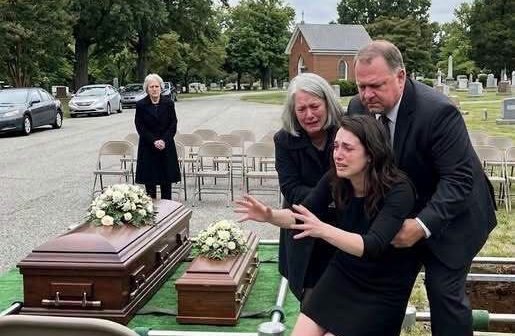
The sanctuary smelled of lemon polish and old hymnals. Ruth sat in the front pew on the left side, her black purse gripped tightly in both hands as she watched the altar.
The casket was smaller than the ones I had seen in movies. It sat on a low rolling frame, the dark wood catching the light from the stained-glass window above.
I looked back over my shoulder at the double doors at the back of the church. The brass latches were closed, and the long wooden pews on my family’s side were completely empty.
“The traffic on the bridge can be difficult at this hour,” Ruth said, her voice low and steady.
“It is eleven o’clock, Aunt Ruth,” I said.
“I know,” she said.
She reached out and took my hand, her fingers warm and dry. She did not offer another excuse for them, but her grip tightened until my knuckles turned white.
The minister stepped onto the altar, his black robes rustling in the quiet room. He looked at the empty pews, then back at me, his Bible held against his chest.
“We are ready when you are, Claire,” he said.
“We are waiting for my father,” I said.
Ruth did not release my hand. She kept her eyes on the small wooden casket in front of us.
“Arthur will not be coming, Claire,” she said.
“He said he would try,” I said.
“He did not try,” she said.
I turned my back on the doors and sat down next to my aunt. The service began with a single note from the organ that seemed to vibrate through the floorboards.
The minister spoke of peace and rest, but his words did not reach me. I kept my eyes on the brass latches of the double doors, waiting for them to click open. They did not move.
The Sunday afternoon light was flat and gray across the kitchen counter. Two unwashed mugs sat in the sink, the dark rings of coffee dried into the ceramic.
The phone on the counter vibrated, the screen lighting up with my mother’s name. I slid the bar to answer and placed it on speakerphone while I wiped down the laminate surface.
“Claire, sweetheart,” Beatrice said, her voice high and cheerful. “I wanted to see how you were holding up after Friday.”
“The service was quiet,” I said.
“We wanted to be there, we really did,” she said. “But Arthur had that late meeting with the accountant, and Melissa was just in tears.”
I stopped wiping the counter. The dishcloth was damp and cold in my hand.
“Melissa was crying?” I asked.
“Melissa felt hurt that you didn’t call her on her birthday,” Beatrice said.
I could hear the rustle of fabric over the line, the familiar sound of my mother smoothing her skirt while she spoke.
“I was burying my family, Mom,” I said.
“Well, yes, of course,” Beatrice said, her tone dropping into a quick, dismissive chirp. “But Melissa is thirty now, Claire. It was a milestone, and she felt completely cast aside.”
I looked down at the phone. The screen showed the call timer ticking past three minutes.
“Is Dad there?” I asked.
“He is out in the study,” Beatrice said. “He has been so distracted lately, always sorting through those old files.”
She paused, and I heard the faint clinking of a coffee cup on her end.
“We just need to focus on moving forward,” she said. “Melissa has her engagement party coming up, and we want to make sure she feels supported.”
I did not answer.
“Claire?” she asked.
I reached out and pressed the red button, ending the call. The kitchen went silent again, save for the hum of the refrigerator.
I set the phone face down on the counter.
The blank black screen of my phone sat on the counter as I chose not to reply.
The brass handle of the restaurant door was cold under my hand when I walked in the next day at noon. Melissa had chosen a quiet corner booth at the back of the Bistro on Market Street, a place with dark wood paneling, brass light fixtures, and the low, steady hum of lunchtime chatter. She and my mother were already leaning close over a glossy, tri-fold brochure, their heads nearly touching as they pointed at photos of manicured gardens.
“There she is,” my mother said, her voice instantly rising to that familiar, high-pitched register she used for social greetings. She smoothed her green knit skirt twice, her palms flat against the fabric. “We were beginning to think you wouldn’t make it, Claire. We already ordered some iced tea.”
“I said I would be here,” I said, sliding into the booth opposite them. The heavy paper menu in front of me was textured and clean, but I did not open it.
Melissa did not look up immediately. Her fingers were already busy, twirling a long lock of her blonde hair around her index finger while she pointed at a photo of a stone pavilion. “If we do the outdoor reception, we have to guarantee the tent rental by October. Dad says we shouldn’t skimp on the overhead coverage, especially with Richmond weather in the spring.”
“I came to talk about your text message, Mom,” I said. My voice sounded flat and thin compared to the lively clink of silverware around us.
My mother reached for her water glass, her fingers adjusting the lemon slice on the rim with meticulous care. “Let’s order some lunch first, sweetheart. They have that goat cheese salad with the warm vinaigrette you used to love when you worked at the school.”
“You texted me that Melissa was hurt because I didn’t call her on her birthday,” I said, keeping my hands resting flat on the table to stop them from rubbing my ring finger.
Melissa stopped twirling her hair and let the brochure drop onto the white tablecloth with a soft thud. “It was my thirtieth, Claire. It only happens once in a person’s life. You couldn’t even manage a simple text message to your own sister.”
“Her birthday was the day of the funeral,” I said.
My mother adjusted her silver bracelet, the metal clicking against the wooden edge of the table. “We all know how difficult that Friday was, Claire. Nobody is disputing that. But life does not stop moving forward just because of a tragedy.”
“A tragedy,” I repeated, the word tasting like copper in my mouth.
“Yes,” my mother said, her high voice dropping slightly but maintaining its cheerful, dismissive edge. “We have to keep our spirits up for Melissa. She has her whole life ahead of her, and this wedding is a fresh start for all of us. We need some light in the family.”
“You always find a way to make yourself the center of attention, Claire,” Melissa said, her voice cutting across our mother’s. She leaned over the table, her eyes bright with a sharp, defensive anger. “Ever since the accident, you look at me like my happiness is some kind of personal insult to you.”
My thumb began to rub the bare skin of my left ring finger, tracing the pale circle where the gold band had lived for seven years. “I buried my husband and my children on Friday, Melissa. I was not thinking about your birthday.”
“And we stayed home to give you space,” my mother lied, her hand smoothing her skirt again in a long, slow motion. “We thought it was best not to crowd you with our own grief. Your father was simply devastated, and we didn’t want to make the day harder for you by showing up.”
“Dad stayed home because he said it was Melissa’s birthday dinner,” I said, looking directly at my mother. “But Aunt Ruth told me you never even called her to tell her about the accident. She had to find out from Margaret.”
My mother’s hand froze on her skirt. She looked toward the bar, where a bartender was shaking a silver container.
“Ruth always was prone to exaggeration,” my mother said, her voice returning to its light, airy tone. “We had so much on our minds, Claire. Your father was dealing with so many complicated details that week.”
“What details?” I asked.
“The wedding, of course,” Melissa interrupted, her words coming fast, her fingers returning to her hair. “Dad wrote a five thousand dollar check for the country club deposit just yesterday. He didn’t hesitate for a second. He told me he wants me to have everything I’ve ever dreamed of, regardless of what else is going on.”
“He spent the entire evening in his study,” my mother added, nodding quickly. “He locked himself in there until nearly midnight to make sure the wire transfer went through properly. He was so focused on it he wouldn’t even let us bring him a cup of tea.”
“He wouldn’t let you in?” I asked.
“He had his desk covered in financial folders,” Melissa said, rolling her eyes. “You know how he is when he’s doing business. He gets so distracted he barely hears a word you say. He was sorting through columns of numbers and adjusting his watch every five minutes.”
The waiter approached our table with a small notepad, his pen hovering. “Are we ready to order, ladies?”
“No,” I said, sliding out of the vinyl booth before my mother could stop me. “We aren’t.”
“Claire, sit back down,” my mother hissed, her high-pitched cheer completely vanishing.
I did not answer. I grabbed my purse from the seat and walked quickly through the dining room, my eyes fixed on the glass double doors at the entrance.
Behind me, I heard the scrape of my mother’s chair against the wood floor, followed by the rapid click of her heels on the tile.
She caught up to me just as I stepped out into the humid August air of the parking lot. The heat from the asphalt rose up through the soles of my shoes, thick and heavy.
“You are being incredibly dramatic,” my mother said, catching my elbow and spinning me around to face her near the edge of the brick walkway. “You need to move on, Claire.”
“Move on,” I said, staring at her fingers on my arm until she let go.
“Yes,” she said, smoothing the side of her skirt with a quick, nervous gesture. “It has been weeks. We cannot live in this shadow forever. Your father and I have done everything we can to support you, but you are turning into a stranger.”
“You didn’t come to the funeral,” I said.
“We made a family decision to keep things quiet,” she said, her voice hardening. “And now you are punishing your sister for wanting a normal life. You are acting as if you are the only person who has ever suffered a loss.”
I looked at her, really looked at her, and realized there was no language we shared anymore. Every word I had for my grief was a language she refused to learn.
“I have to go home,” I said.
“Go then,” she said, stepping back toward the restaurant doors. “But don’t expect us to keep reaching out if you are going to treat us like enemies.”
I got into my car and locked the doors, the air conditioning blowing hot before finally turning cold.
The drive back to my neighborhood took twenty minutes, my hands gripping the steering wheel so tightly my knuckles turned white.
When I pulled into my driveway, I saw Margaret’s blue sedan parked near the side garden, its engine turned off.
Margaret was sitting on my front porch bench, holding a large stoneware baking dish wrapped in a faded blue kitchen towel. The scent of toasted butter and onions drifted off it in the heavy summer air. She stood up as soon as my car door opened, her face pale but her eyes steady.
“I brought the chicken casserole,” Margaret said, her voice raspy and soft. “The one with the buttery cracker crumbs Ethan always asked for on his birthday.”
She did not ask where I had been, and she did not ask why my eyes were red. She simply stepped off the porch and held out both of her hands, wrapping them around mine.
The physical contact was like a key turning in a lock. I pressed my face into the worn cotton of her shoulder, and the quietness of my empty house seemed to lift for just a second.
Margaret held me against her, her small frame unyielding, her hand stroking the back of my neck in slow, rhythmic circles.
“I’ve got you,” she whispered. “I’ve got you, Claire.”
We stood together in the driveway for several minutes, the hum of the distant highway the only sound in the quiet afternoon.
Inside, the kitchen was cool and dark, the blinds drawn against the harsh summer sun. We set the warm casserole on the counter next to the sink.
“Ruth is coming by at five,” I said, leaning against the counter.
“She called me,” Margaret said, wiping a stray tear from my cheek with the back of her thumb. “She wanted to make sure you weren’t alone after that lunch.”
“They think I’m trying to steal Melissa’s spotlight,” I said.
Margaret gave a small, sad smile that did not reach her eyes. “Some people only know how to look at the world through a very small window, sweetheart. You can’t make them see the whole sky.”
By five o’clock, Margaret had gone home, and Aunt Ruth was sitting in the small armchair in my study. Her plain black purse was held tightly in both hands, resting on her lap like a shield.
I sat at my desk, staring at my phone, which had been vibrating every few minutes with notifications from the family group chat.
“Melissa said Dad wrote a five thousand dollar check yesterday for her wedding venue,” I told Ruth. “And my mother said he was locked in his study all night, working on financial folders.”
Ruth’s eyes narrowed slightly, her grip on her purse tightening. “Arthur has always kept his study locked when he was trying to hide a deficit. He did it when your mother wanted that summer house in Nags Head, and he did it when the business started slowing down three years ago.”
“What is he hiding in there?” I asked.
“I don’t know,” Ruth said, her voice low and steady. “But your father has never been a man who handles pressure well. He wraps himself in paperwork so he doesn’t have to face the truth.”
The phone buzzed again on the desk, the screen illuminating the dark wood with another text from my mother.
Ruth rose from her chair, walked over to the desk, and picked up the phone. She did not read the message; she simply held the device out to me.
“You have spent your whole life trying to please them, Claire,” Ruth said gently. “You don’t have to listen to them anymore.”
“It’s my mother,” I said.
“A mother who stays home from a funeral is not a mother you owe your peace to,” Ruth said.
She tapped the screen, opening the group chat settings, then handed the phone back to me.
“Press it,” she said.
I looked at the options on the screen, my thumb hovering over the final line of text.
I tapped the screen, grateful for the quiet click of the mute button on my phone, silencing the family chat.
Margaret turned the page of the green velvet binder, her fingers lingering on the frayed gold corners of the cover where the thread had begun to unravel.
“He was seven here,” she said, her voice soft and raspy from the quiet hours we had spent sitting in the dimming afternoon light of the living room. “He tried to cut his own hair with the kitchen shears right before the school photographer arrived, and he was so proud of the result.”
I looked down at the photograph of Ethan, his crooked bangs revealing the tiny white scar near his temple where he had fallen off his tricycle during his first summer in the neighborhood.
Margaret reached across the narrow space between our chairs and took both of my hands in hers, squeezing them until the bones of my fingers pressed together under the pressure of her palms.
“I found his fifth-grade report card behind the wooden dresser last night,” she said, her knuckles pale against my skin. “He had hidden it because of a low mark in spelling, of all things, and he was so afraid I would be disappointed in him.”
“He always hated spelling,” I said, my voice barely reaching the unwashed coffee mugs sitting on the small side table between our chairs.
We sat in the living room, turning the thick black pages of the scrapbook while the distant hum of the highway traffic drifted through the window like a steady, low tide.
Margaret pointed to a dried yellow oak leaf taped next to a crayon drawing of a stick-figure dog with three legs and a long, curly tail.
“He told me he was going to build a treehouse out of those leaves,” she whispered, her thumb brushing the dry, brittle paper. “He was so certain it would hold his weight if he just found enough of them.”
“He was always building something,” I said.
“I keep thinking about the house being so quiet now,” Margaret said, her voice dropping even lower. “If I don’t talk about him, it feels like he’s slipping away, and I can’t bear the thought of being the only one left who remembers how his voice sounded when he was excited.”
I squeezed her fingers in return, the warmth of her hands the only real thing in the room.
A car door slammed in the driveway, the sound sharp enough to make my shoulder muscles tighten under my collar.
I stood up from the armchair and walked to the front window, letting the lace curtain drop back into place when I saw my father’s grey sedan parked near the mailbox at the edge of the lawn.
Arthur walked up the brick steps of my house, his hand rising to adjust his heavy gold watch before he reached the top of the porch.
I met him on the porch, closing the wooden front door firmly behind me so Margaret could have her privacy with the photographs inside the quiet house.
“Claire,” he said, looking past my shoulder at the closed door instead of looking at my face, his fingers already twisting the band of his watch. “Your mother said you weren’t answering your phone today when she tried to call you about the family dinner.”
“I have it on silent,” I said, my hand instinctively reaching to rub my bare ring finger where my wedding band used to sit before the accident.
He cleared his throat, a dry, deliberate sound that he always made before discussing anything that involved a bank, a contract, or a signature.
“We need to know what you’re doing about the estate, sweetheart,” he said, his eyes scanning the empty driveway before settling on his own polished leather shoes. “Have you hired someone to represent you yet, or are you still waiting?”
“I have an attorney,” I said, keeping my back to the door and my posture rigid.
“Who is it?” he asked, adjusting his watch again, the metal band clicking against his wrist in the quiet afternoon air. “Is it someone local? Your mother and I want to make sure you aren’t being taken advantage of during such a difficult time.”
“David,” I said, keeping my answers as short and vague as possible to avoid giving him any leverage. “He handles these matters.”
“Well, yes, but does he handle the corporate side of things?” Arthur asked, stepping closer until I could smell his peppermint cologne and the faint scent of the leather interior of his car. “A trucking company has deep pockets, Claire, and there are probate issues that require a very specific kind of expertise to protect your interests.”
“He is handling it,” I said, my voice flat.
“Because if there are documents to sign, you shouldn’t do it alone,” Arthur said, his voice rising slightly before he checked himself. “We need to make sure everything is coordinated properly, especially with the family’s future in mind.”
“The family’s future?” I asked.
“Your sister’s wedding, for one,” he said, clearing his throat again. “And the general stability of things. We just want to make sure you are taken care of, and that the family is kept in the loop on any major decisions.”
“I’m taking care of it,” I said.
Arthur opened his mouth to speak, but his eyes flicked to Margaret’s car parked at the curb, and he took a slow step back down the first brick stair.
“We just want to protect you,” he said, his voice dropping into a low, practiced tone that belonged in a boardroom or a bank manager’s office. “Keep us informed about the timeline.”
He walked back to his sedan without looking at the garden beds or the front windows, his keys jingling in his trousers pocket as he went.
At seven o’clock, the fluorescent lights of the community center basement hummed with a steady, low vibration that made my temples ache.
Ruth sat next to me on a green folding chair, her plain black purse clutched tightly in both hands against her knees as if it were the only anchor left in the room.
The support group leader was packing up some cardboard boxes at the far end of the room, leaving just the two of us in our corner by the coffee urn.
“Your father called me this afternoon,” Ruth said, her voice low and steady, never rushing through the words. “He wanted to know if I had the phone number for your lawyer’s office.”
I leaned my head against the cold cinder block wall behind us, looking at the water stain on the ceiling tile.
“I didn’t give him anything,” Ruth continued, her knuckles white where she gripped the leather strap of her purse. “But he is asking questions about the probate court that he has no business asking.”
“He wants to know about the settlement,” I said.
“He wants to know if there is a payout,” Ruth said. “And he wants to know if the trucking company is going to settle out of court.”
“There isn’t any money yet,” I said. “And if there is, I don’t want a single dollar of it in my personal bank account.”
“Arthur has always looked at other people’s money as a solution to his own problems,” Ruth said, her voice dropping even lower. “He’s been like that since he married my sister, always looking for the next big deal to bail him out.”
“I don’t care about his deals,” I said.
Ruth turned her head to look at me, her gray eyes clear and steady under the harsh fluorescent light.
“We can make sure their names are attached to something that saves other children,” she said.
The words seemed to hang in the empty basement air, larger than the steel girders supporting the ceiling above us.
“A foundation,” I whispered, the word tasting strange and heavy on my tongue.
“Something that checks the safety records of those heavy trucks,” Ruth said, her grip on her purse tightening. “Something that keeps another family from sitting in this basement.”
I looked down at my hands, my bare ring finger cold against my palm.
“My father would hate that,” I said.
“Your father has his own worries,” Ruth said.
David’s office smelled of old paper and furniture polish, the morning sun cutting through the heavy wood blinds in thin, bright strips across the carpet.
He laid a thick manila folder in the center of his mahogany desk, next to a silver pen that caught the light.
“The trucking company’s insurance representatives have made an initial assessment,” David said, his pen balanced between his fingers as he looked at me.
I sat straight in the leather chair, my hands folded in my lap to keep them from moving.
“They are prepared to discuss an eighteen million dollar settlement to avoid a jury trial,” he said.
The number did not sound like money; it sounded like a heavy, cold weight dropped onto the desk between us.
“Eighteen million,” I repeated, the syllables flat and empty.
“But you need to understand what this means, Claire,” David said, leaning forward and resting his forearms on the desk. “They will not simply write a check to resolve this.”
“What do they want?” I asked.
“They will demand complete discovery before the final probate hearing,” he said. “Your personal financial history, your medical records, your tax returns for the last ten years.”
“My life,” I said.
“Yes,” David said. “Every detail of your marriage, your employment history as an administrator, and your daily routine will be scrutinized by their legal team.”
“They want to find a reason to pay less,” I said.
“They want to find anything they can use to make you look like you are exaggerating your loss,” David said gently. “It will be very public, and it will be painful.”
“What kind of details?” I asked.
“They will look at how often you traveled, how you spent your weekends, and even your credit card statements,” David explained, his voice even and professional. “They will try to show that your life was already fractured before the accident occurred.”
“It wasn’t fractured,” I said.
“I know,” David said. “But their job is to make a jury believe otherwise to protect their assets.”
I looked at the yellow legal pad sitting next to his elbow, where several columns of numbers were written in blue ink.
“If we proceed, we can establish the trust parameters,” David said. “But once we sign this representation agreement, they will begin the disclosures.”
“The money wouldn’t be mine,” I said. “I want to use it for a safety foundation.”
David paused, his pen staying perfectly still above the paper.
“That is a significant commitment, Claire,” he said. “It means you would have no personal access to those funds.”
“I don’t want them,” I said.
I reached across the desk and pulled the black pen from his hand.
The paper of the contract felt thick and dry under my fingers as I turned to the signature page.
“If this protects other families,” I said, “they can look at whatever they want.”
I signed my name on the bottom line, the black ink soaking quickly into the fiber of the page.
David took the paper back, his face serious as he set it inside the blue folder and closed the cover with a soft click.
“I will file the initial response this afternoon,” he said.
I did not stand up immediately, my eyes drawing down to the yellow legal pad remaining on the mahogany wood.
I reached out with my bare index finger, slowly tracing the letters of Lily’s name on a legal notepad in David’s office.
The dining room table in my parents’ house was polished to a high shine, reflecting the warm glow of the brass chandelier. My mother, Beatrice, set down a heavy stoneware dish filled with chicken pot pie, the pastry crust crimped exactly the way she used to make it for my birthdays when I was a girl.
“I made sure to get the small pearl onions you always liked, Claire,” she said, her voice rising in that high-pitched, cheerful tone she used to dismiss bad news. She smoothed the front of her pleated green skirt with both hands as she sat down in her usual chair.
My father, Arthur, sat at the head of the table, his fingers tapping a slow rhythm against his water glass. He adjusted his gold watch, sliding the heavy metal band a fraction of an inch up his wrist, before lifting his silver serving fork.
“It is very good to have you here, Claire,” he said, clearing his throat before looking at my plate. “Your mother and I have been deeply concerned about how you are managing in that big house all by yourself.”
I rubbed my bare ring finger, the skin there still pale and slightly indented where my wedding band had lived for eight years. “I am managing fine, Dad. Aunt Ruth has been stopping by every other afternoon with groceries.”
Beatrice paused with her serving spoon in mid-air, a quick frown wrinkling her forehead before she replaced it with a bright, glassy smile. “Well, Ruth has always had plenty of free time on her hands, hasn’t she, Arthur?”
She spooned a large portion of the steaming pot pie onto my plate, the scent of rosemary and baked dough rising between us. I had not eaten a full meal in three days, but the sight of my childhood favorite did not make me hungry.
“Eat up, sweetheart,” Beatrice said, gesturing with her embroidered napkin. “You need to keep your strength up, especially now that the autumn chill is starting to settle in.”
Arthur took a slow bite of his dinner, his eyes darting toward the hallway where the front door stood closed. “Have you been keeping up with the yard work, Claire? The lawn looked a bit high when I drove past the property last Tuesday afternoon.”
“The neighbors have been helping with the mowing,” I said. “And Ruth brought a boy from down her street to trim the hedges yesterday.”
“We could have sent a professional service if you had just called us,” Beatrice said, her voice dropping into a gentle, patronizing register. “We don’t want you feeling like you are entirely on your own in this world.”
I looked at her, searching her eyes for any trace of the mother who had refused to stand beside me at the church cemetery. Her face remained smooth and carefully composed, as if the last five months had been nothing but a quiet winter.
“The house is quiet,” I said, my voice flat. “But I prefer it that way right now.”
Arthur cleared his throat again, a sharp, dry sound that drew my eyes back to his end of the table. “Of course. But a house like that requires constant maintenance, and maintenance requires a steady hand and a solid budget.”
I did not answer him, choosing instead to lift my fork and push a piece of carrot around the edge of my plate.
The silence stretched between us until Beatrice reached across the table to touch my forearm, her fingers warm and slightly dry. “We only want what is best for you, Claire, you know that.”
At half past seven, I carried my empty plate into the kitchen, the heavy swinging door clicking shut behind me. My sister, Melissa, was already standing by the sink, a cup of herbal tea in her hand and a stack of glossy papers spread across the granite island.
“Oh, Claire, perfect,” Melissa said, her words running together as she twirled a long strand of her blonde hair around her index finger. “I was hoping you would come out here so I could show you these.”
She pointed to a thick, cream-colored brochure with gold embossing that read The Grand Ballroom at the Jefferson Hotel. Beside it lay three sample wedding invitations printed on heavy vellum.
“We need to finalize the florist by next weekend too,” Melissa said, shifting her weight from side to side. “I told Mom that if we don’t secure the white hydrangeas now, we’ll have to settle for carnations, and I absolutely refuse to have carnations at my reception.”
“Hydrangeas are very nice,” I said, watching her fingers nervously tap the edge of the granite.
“They are essential, Claire,” she corrected quickly, her voice rising. “Every single detail has to be flawless because people from the gallery are coming, and I won’t be embarrassed in front of them.”
“I was thinking you could help me assemble the invitations next week,” Melissa said, leaning closer to me. “It would give you something to do, you know? Something to take your mind off things.”
I looked down at the brochure, noticing the pricing tier listed on the back page under the deposit schedule. The lowest package began at thirty-four thousand dollars, a sum that did not include the catering, the bar service, or the floral arrangements.
“The Jefferson is very beautiful, Melissa,” I said, keeping my voice low. “But isn’t the deposit due by the end of this month?”
“Dad is handling it,” she said quickly, dismissing my question with a wave of her hand. “He told me not to worry about the budget because everything is going to be taken care of very soon.”
I looked toward the dining room door, where the muffled sound of my father’s voice rose and fell in a quiet conversation with my mother.
“Are you sure he can manage that right now?” I asked.
Melissa laughed, a sharp, light sound that made me step back against the counter. “Of course he can. He is Arthur Vance. He always figures these things out.”
She gathered the brochures into a neat pile, her fingers tracing the gold foil lettering of her fiancé’s name. “Besides, a wedding only happens once. We have to do it right, or there is no point in doing it at all.”
“I should probably head home,” I said, turning toward the hallway.
“Don’t go yet,” Melissa said, blocking my path to the door. “Dad wanted to show you something in his study, and he said it was important.”
I walked down the narrow carpeted hallway to the back of the house, where the door to my father’s study stood cracked open, a sliver of yellow light spilling onto the floorboards.
Arthur was standing behind his mahogany desk, holding a silver pen between his fingers and staring down at a blank legal pad. He looked up as I entered, a quick smile appearing on his face before he gestured toward the leather chair opposite him.
“Come in, Claire. Close the door behind you, if you don’t mind.”
I shut the heavy wooden door, the sound of the latch clicking into place feeling loud in the small, book-lined room. I sat on the edge of the leather chair, my hands tucked into my lap.
I noticed a stack of unopened mail sitting on the corner of his desk, the return addresses bearing bold, blue logos of local banks. Arthur saw me looking and quickly moved his leather binder over them, his hand lingering on the leather surface for a moment before he adjusted his watch again.
“Your mother tells me you look tired,” Arthur said, adjusting the green glass lamp on his desk so the light did not shine directly into my eyes.
“I am just sleeping poorly,” I said.
He nodded slowly, his eyes dropping to the desk blotter where a yellow legal pad lay open. “Naturally. It is a terrible burden to carry alone. That is why we are here, Claire. We are your family.”
“We all have to look to the future, Claire,” he said, clearing his throat. “That is what Ethan would have wanted for you.”
The mention of Ethan’s name in this room, spoken in such a transactional tone, made my fingers tighten against my palms. “Ethan would have wanted me to focus on getting through the day, Dad.”
Arthur cleared his throat, the sound more pronounced this time, and tapped the silver pen against his palm. “I spoke with a colleague of mine who knows the regional director of the trucking company’s insurance pool.”
A cold chill settled in my chest, starting at the back of my neck and moving down my spine.
“Why would you speak to them, Dad?” I asked.
“Just a casual conversation, sweetheart,” he said, leaning forward and resting his forearms on the desk. “I wanted to understand the timeline. These large corporations like to drag their feet, hoping you will settle for pennies.”
He paused, his eyes searching mine for some sign of agreement. “Have they made an official offer yet?”
“David is handling the communication,” I said, keeping my voice steady. “I do not discuss the details with anyone else.”
Arthur’s smile remained fixed, but his fingers tightened around the silver pen. “Of course, David is a fine attorney. But he does not have your long-term interests at heart the way we do.”
He reached across the desk, placing his hand over mine. “We just want to make sure you’re taken care of financially, sweetheart.”
“I do not need the money to live, Dad,” I said, pulling my hand away to rub my ring finger. “I have my savings, and the school district’s pension.”
“Savings can disappear quickly in times of transition,” he said, his voice dropping to a confidential whisper. “And there are tax implications you might not be considering. A structured family trust would protect those assets from unnecessary exposure.”
I looked at the oil painting of the James River hanging behind his chair, a piece he had purchased three years ago at a gallery in Shockoe Slip.
“I will discuss it with David,” I said, standing up from the leather chair.
“We only want to help, Claire,” he said, rising with me. “Your mother and I have been sleepless thinking about your future.”
I did not wait for him to open the study door for me. I walked out into the hallway, past the kitchen where Melissa was still sorting her brochures, and straight to the front door.
Beatrice met me in the foyer with my light cardigan, her high-pitched laugh echoing slightly in the tiled space. “You must come back on Sunday, Claire. We are planning a small brunch.”
“I will let you know,” I said, slipping my arms into the sleeves.
I walked out onto the porch, the summer air feeling thick and humid against my skin. I got into my car, locked the doors, and drove two blocks before pulling over under a streetlamp.
My hands were cold as I reached for my phone and dialed Aunt Ruth’s number. She answered on the second ring, her voice low and steady.
“Claire? Are you home?”
“I am parked near the park,” I said, staring at the dashboard lights. “I just left my parents’ house.”
There was a long pause on the other end of the line, the quiet breathing of my aunt the only sound in the small cabin of my car. “How was the dinner?”
“They served chicken pot pie,” I said. “And then Melissa asked me to help with her wedding invitations at the Jefferson.”
“The Jefferson is very expensive,” Ruth said. “Did Arthur say how he was paying for it?”
“He didn’t,” I said. “But he asked me if the trucking company had made an offer yet. He told me they want to make sure I am taken care of.”
“Oh, Claire,” Ruth said, her voice dropping even lower. “I was afraid of that.”
“They didn’t ask how I was sleeping,” I said, my voice barely a whisper. “They didn’t ask about the children once.”
“I know, sweetheart,” Ruth said. “I am so sorry.”
“They just want the money, Ruth,” I said. “That is the only reason they called me.”
“Do you want me to come over?” Ruth asked. “I can be at your house in ten minutes.”
“No,” I said, putting the car in gear. “I need to go home.”
I ended the call and pulled back into the quiet street, turning the wheel toward the highway.
The road was nearly empty as I drove south, the hum of the tires against the asphalt the only thing breaking the silence.