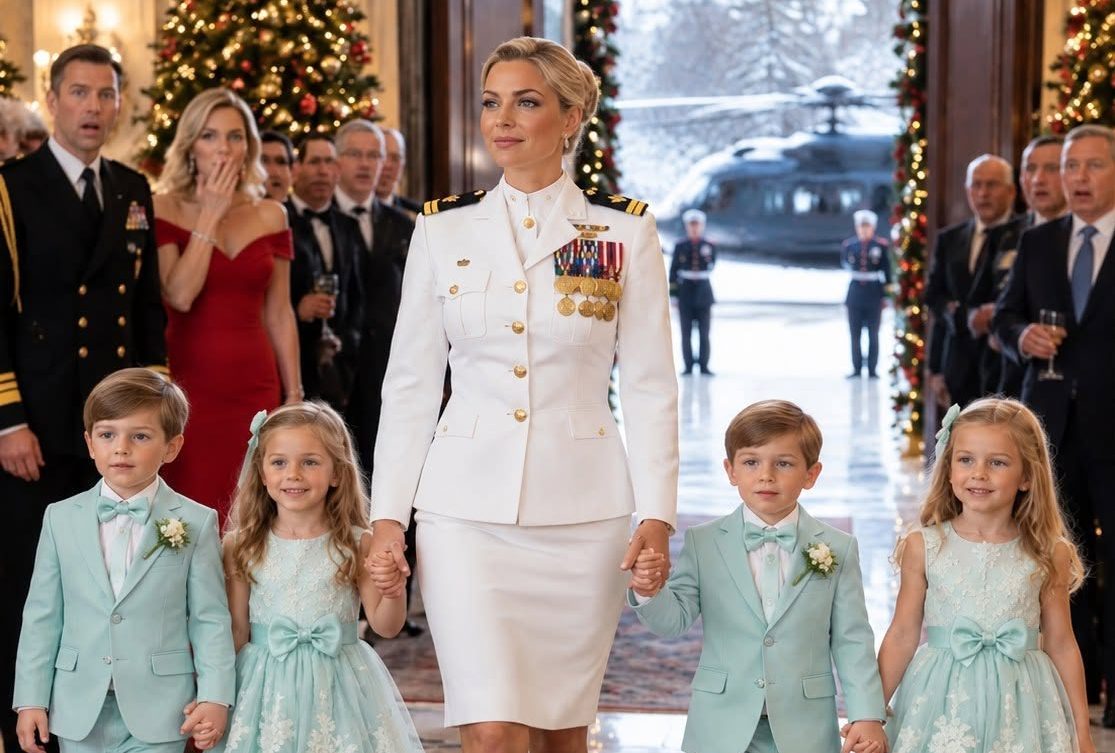
, but Noah found it before I finished packing the last snack bag. “Mom, why does Dad want you to come alone?” He stood beside the kitchen counter with the cream colored envelope in one hand and
a half addressed Christmas card in the other. The four of them had been sorting cards at the table while I packed apple slices and crackers for the school week. Four bags, four names, twenty four dollars saved by doing it myself.
“Where did you find that?” I asked.
“Your case was open.”
I took the invitation from him. Daniel’s name was printed across the front in dark blue letters, followed by the address of the Reynolds family estate. The gathering was scheduled for December 24 at 6:30 p.m. The last line asked me to attend alone.
Eight years had passed since Daniel and I separated. In all that time, he had never invited me anywhere, not even to discuss the children he had left behind.
Olivia slid a Christmas card across the table toward me. She had drawn a little green tree on the envelope and pressed a gold star above it.
“This one is for Grandma Reynolds,” she said. “Should I put her name on the inside too?”
I looked at the card, then at the invitation.
“Not yet, sweetheart.”
“Why not?” Sophia asked.
“Because I don’t know whether she wants to hear from us.”
Sophia held the card by its edges, careful not to bend the star. “But how will we find out if we never ask?”
I had no easy answer for her. I put the card beside the stack of envelopes and returned to the snack bags.
Noah had kept one card apart from the others. His handwriting was careful, each letter taking up more room than it needed. Daniel Reynolds was written across the front.
“You made this for him?” I asked.
Noah nodded. “I didn’t know what else to write.”
He had not written anything inside. He had told me two weeks earlier that he wanted to ask his father a question, but he had never decided which words to use.
“Are you going to mail it?” he asked.
I looked at the invitation again. Daniel had waited eight years to contact us, and now he wanted me to appear without my children.
“No,” I said. “Not today.”
Noah placed the card in front of me. “Does he know our names?”
The question was simple. My answer could not be.
“I will tell you what I can prove, sweetheart. I won’t guess about the rest.”
He nodded, though he did not look satisfied. Neither did I.
At 4:45 p.m., Noah and I moved to the dining nook with the invitation between us. The paper was thick, the kind that left a clean edge when folded. Inside was a formal portrait of Daniel in his military uniform, his expression steady and his collar perfectly arranged.
Noah leaned closer to the photograph.
“That’s really him?”
“Yes.”
“He looks like Ethan.”
I glanced toward the kitchen, where Ethan was trying to persuade Olivia that crackers counted as a proper dinner if you ate enough of them.
“He does,” I said.
Noah studied the portrait a little longer. “Does Dad know our names?”
“He knows what I told him.”
“That’s not what I asked.”
I set the invitation flat on the table. Noah was eight, but he had learned to recognize the difference between an answer and a way around one.
“I don’t know what he remembers, Noah. I know what I told him. I know what happened when we separated. I can show you the dates I have, and I can tell you what I saw myself.”
“Then why doesn’t he call?”
I reached for the paper, but Noah kept one finger on its corner.
“Mom, if he knows our names, why has he never said them?”
I let the question sit between us for a moment. I wanted to protect him from an answer that might hurt, but a soft lie would only leave him with more questions later.
“I don’t know why he has stayed away,” I said. “I won’t make up a reason just to make it easier.”
Noah lifted his finger. I turned the invitation over and checked the details printed beneath the address. The family gathering would begin at 6:30 p.m. on Christmas Eve. There was no explanation for the request that I come alone, no note saying the children were unwelcome, and no indication that Daniel intended to introduce us to anyone.
That last omission bothered me more than the formal wording.
“Could he want to apologize?” Noah asked.
“He could.”
“Could he want to tell us to go away?”
“He could.”
Noah looked down at his unfinished card. “Those are very different things.”
“Yes, they are.”
I took the invitation back to the kitchen and slipped it into the document case. I had kept that case for years because important papers needed a safe place. Now it held an invitation that offered no explanation at all.
At 5:20 p.m., Sophia helped me lay out four sets of clothes in the hallway. She had chosen a red sweater, then changed her mind and picked the blue one because Olivia had chosen red first. Ethan wanted his usual gray shirt. Noah asked if a tie would make him look too much like the man in the photograph.
“You don’t need to dress like anyone else,” I told him.
“Even if we’re going to see him?”
“Especially then.”
Sophia held the sleeve of my cardigan while I checked the children’s clothes. She had been listening to every word without asking another question, which usually meant she had several ready.
“Does Grandma Reynolds know about us?”
I stopped with Ethan’s shirt in my hands.
“I don’t know, sweetheart.”
“Not even that she has four grandchildren?”
“I don’t know what Daniel told her.”
Sophia lowered her eyes to the clothes. “If she didn’t know, she might be surprised.”
“She might.”
“And if she did know, she might not want us there.”
I put Ethan’s shirt on top of his trousers. “That is possible too.”
Sophia looked at me then. “Which one do you think it is?”
I pressed my thumb against the edge of the document case on the hall table. For years, I had told myself that Daniel’s family accepted his account because none of them cared enough to ask questions. It was easier to believe that than to wonder whether they had been told something different.
“I think we need to find out,” I said.
Sophia held on to my sleeve a little longer.
“Will you stay with us the whole time?”
“Yes.”
“Even if Dad asks you to leave?”
“I will not leave you alone with a question you didn’t ask for.”
She let go of my sleeve and carried her clothes toward the bedroom. Before she turned the corner, she looked back.
“Can Grandma still be our grandma if she doesn’t know us?”
“Yes,” I said. “But we will have to learn what kind of grandmother she wants to be.”
The answer was all I had.
At 6:05 p.m., the invitation lay beside Noah’s Christmas card again. The others were finishing dinner at the kitchen table while Ethan and I folded the two papers together, the card tucked inside the invitation so neither would get lost.
“Why does he want us there now?” Ethan asked.
He had been quiet through most of the evening. He sat with the invitation between his hands, rubbing the side of his index finger against his thumb.
“I wish I knew.”
“Did he ask for us?”
I paused.
“He asked me to come.”
Ethan looked at the folded papers. “But we’re coming too?”
I pulled out a chair and sat beside him. “Yes.”
“Will he be mad?”
“He might be surprised.”
“That’s not the same thing.”
“No, it isn’t.”
Ethan turned the invitation over. His eyes went to the portrait again, and he touched the edge of the photograph with one finger.
“I look like him.”
“You do.”
“Maybe that’s why he doesn’t want to see me.”
I took the invitation from his hands and laid it on the table.
“Your face is not a mistake, Ethan. You don’t have to change a single part of yourself to deserve an answer.”
He gave a small nod and returned to his dinner. He did not ask me to promise that Daniel would be kind. I was grateful he had not asked, because I could not make that promise.
Olivia carried her plate to the counter and came back for the Christmas card.
“Could we all go together and have dinner with Grandma, even if Dad doesn’t want to talk?”
“We can try to have dinner,” I said. “We cannot decide what he will do.”
“Then we should decide what we will do,” she replied.
She smoothed the folded card with both palms, working out a crease near the bottom. It was such an ordinary little movement that I almost smiled.
“That sounds fair,” I told her.
I looked at the four children around the table. I had spent eight years keeping Daniel’s absence from becoming the center of their lives. I had answered what I could, changed the subject when I had no answer, and learned to manage the questions that came back at bedtime. But the invitation had brought the questions into our kitchen, where I could no longer pretend that silence was enough.
If I refused to go, the children would keep wondering whether their father had ever wanted to see them. If I went alone, I would be accepting his terms before I even knew what he wanted.
I opened the document case and took out my copy of the invitation. On the back, I wrote Noah, Ethan, Sophia, and Olivia, one name beneath the other.
Ethan watched me.
“Are you telling him we’re coming?”
“Yes.”
“Even though he said alone?”
“Yes.”
Noah picked up his Christmas card. “Should I bring this?”
I looked at the blank space inside it, where he had left room for words he was not ready to write.
“You can bring it if you want to. You don’t have to give it to him.”
Noah slid the card into the pocket of his sweater.
I folded the invitation around my copy of the card and put both inside the document case. Then I closed the clasp.
“We will go on Christmas Eve,” I said. “All five of us.”
The children returned to their dinner. I gathered the empty snack bags and set them beside the packed lunches, then checked the invitation once more before putting it away.
Daniel had asked me to come alone.
I had decided not to.
found Vanessa Cole’s name before Noah finished reading the guest list.
“She’s Daniel’s fiancee,” he said, running his finger beneath the printed line. “Does that mean she’s going to be our stepmother?”
I set four snack bags beside the bread box. One had split along the folded top, and raisins had scattered across the counter.
“Not if she’s only engaged,” Noah said. “That’s not married.”
Ethan looked at the name again. “Does she know about us?”
I reached for the torn snack bag and poured its contents into a clean one. The children had learned to ask questions in different ways, but they were all asking me to explain the same absence.
“I don’t know, sweetheart.”
“Wouldn’t he tell the woman he’s going to marry?” Noah asked.
I sealed the bag and put it with the other three. Daniel had managed to keep his children out of his family story for eight years. I could not tell whether Vanessa was another person he had misled or someone who had agreed not to ask.
Olivia came in carrying the little paper star she had made at school. She wanted to know if the estate had a Christmas tree big enough for her star, though she had no intention of leaving it there.
“Maybe we can make one at home,” I told her.
“With the boxes from the basement?”
“The boxes are too small.”
“Then we need a bigger tree.”
Noah smiled at that, and Ethan returned to the guest list. For a few seconds, we were only a family discussing decorations, not four children trying to learn whether their father had ever spoken their names.
Noah tapped the bottom of the page.
“Mom, if Vanessa doesn’t know about us, will you tell her?”
I put the guest list inside my copy of the invitation. “First, I need to find out what I can prove.”
At nine, Sophia sat across from me in the dining nook with the old family calendar open between us. Its plastic cover had cracked at one corner, and several dates were marked in my handwriting from the year I learned I was carrying four babies.
“Which day was the ultrasound?” she asked.
I turned to March and found the square. The appointment date was written beside a reminder to call the insurance office.
“March sixth.”
Sophia leaned over to read it. “And when did Dad say he found out?”
“He told his family he learned about the pregnancy after we separated.”
“After you separated, or after he left?”
She had heard me practice answers when I thought the children were occupied. She had also noticed that I sometimes changed a sentence before finishing it.
“Those aren’t the same date,” I said.
She took the invitation from beside the calendar and studied the event details. Daniel’s military assignment had kept him away from home for stretches, but the dates on the calendar placed him in contact with me when he later claimed he knew nothing about the pregnancy.
“Could he have forgotten?” Sophia asked.
“People forget appointments. They don’t usually forget being told something that changes their lives.”
She traced the printed edge of the invitation without folding it. “Does Grandma know the dates?”
“I don’t know what Grandma was told.”
Sophia looked down at the calendar. “You always say you don’t know when you don’t know.”
“That is the only answer I can give you without making up the rest.”
She nodded, then pointed to a note written in the margin. I had recorded the next appointment and the name of the clinic. Beneath it was the reminder I had made to ask Daniel about the paperwork he had promised to complete.
“Did he do it?”
“I believe he did.”
“Then why are we still asking?”
I closed the calendar, but the question stayed between us. I had kept records because I wanted the children to have a truthful account when they were old enough to ask. Until that morning, I had not admitted how much I still hoped the dates might leave room for an innocent explanation.
At eleven thirty, Olivia followed me into the hallway while I reached for the leather document case on the high shelf. She held the small step stool steady as I brought it down.
“Is this where you keep the papers about Dad?”
“Some of them.”
“Are there papers about us?”
“There are papers that prove when you were born, and there are papers about what happened before you were born.”
“Which kind are we looking for?”
“The second kind.”
She watched while I placed the case on the bench and opened the clasp. The familiar folders were arranged by year, with school records and medical receipts tucked behind the divorce papers. I had kept the case because it was sturdy, because it locked, and because I did not want the children finding old documents while searching for crayons or batteries.
Olivia picked up a folded school notice that had slipped from one pocket.
“Can I put this with the school things?”
“Yes, sweetheart.”
She carried it to the kitchen, leaving me to sort through the folder marked March. There were copies of appointment slips, a hospital billing statement, and a sheet bearing the seal of Daniel’s military office.
I had not looked at that sheet in years.
The heading read Family Care Acknowledgment. Beneath it, Daniel’s full name appeared in typed letters, followed by a signature I recognized without needing to compare it with anything else.
I placed the page flat on the bench.
The date was March seventeenth.
Eleven days after the ultrasound.
For a while, I read the date as though one of the numbers might change if I looked away and returned to it. Then I checked the calendar again. March sixth. March seventeenth. There was no mistake in the order.
Olivia came back with the school notice.
“Did you find it?”
“Yes.”
“Is it a letter?”
“No. It’s a form your father signed.”
She moved closer but did not touch it. “What does it say?”
I turned the page over. The reverse side contained printed instructions and a blank space for additional comments. There were no handwritten notes explaining what Daniel had been told, what he had promised, or what he later said to his family.
“I need to read it carefully.”
Olivia returned the school notice to the proper folder, then stood beside me while I checked the signature once more.
“Can we show Grandma?”
“Not yet.”
“Why not?”
“Because I want to be sure I understand the paper before I ask anyone else to understand it.”
At one, Ethan sat beside me at the kitchen table while I slipped the acknowledgment into a clear plastic sleeve. He had brought his printed copy of the invitation, the one with Daniel’s formal portrait inside, and placed it face down.
I aligned the sleeve with the edge of the table. The paper fit without bending, and the signature remained visible through the plastic.
Ethan rubbed the side of his index finger against his thumb.
“Does the paper mean he knew?”
I looked at the form, then at him.
“It means he signed an acknowledgment eleven days after the ultrasound.”
“That’s not what I asked.”
“No,” I said. “It isn’t.”
He turned the invitation over. Daniel wore his uniform in the photograph, with his shoulders square and his expression set for the camera. Ethan had the same shape to his eyebrows and a similar straight line to his mouth when he was concentrating.
“Do I look like him because he knew about me?”
I sat beside him rather than across the table.
“You look like him because he’s your father. That was true before either of us saw this paper.”
“Would he know I look like him?”
“I can’t answer that.”
Ethan set the invitation down carefully. “Would he dislike me for it?”
“No, sweetheart. His choices are not your fault.”
He pressed one finger against the plastic sleeve, stopping just short of the signature.
“What did he acknowledge?”
I turned the page so we could read the printed section together. It recorded that the service member had been informed of a family circumstance requiring care planning and that the information supplied was to be used for official family support arrangements. Daniel had signed beneath the statement. The form did not say what he had told his mother, nor did it explain why he later claimed the pregnancy had been fabricated.
“This proves he signed something about a family care obligation,” I said. “It shows that he had been informed. It does not tell us what he admitted to everyone afterward.”
“Could he say he didn’t know what it meant?”
“He could say it. We would still have the date and his signature.”
Ethan rubbed his finger against his thumb again, then folded his invitation in half and opened it flat.
“Will you ask him?”
“I will ask questions when I have the right records in front of me.”
“Do we have enough records?”
I looked toward the hallway, where the document case remained open on the bench. The acknowledgment was one piece of paper, not a complete account. It could establish that Daniel had been informed, but it could not make another person believe what he had chosen to conceal.
“We have enough to start,” I said.
Ethan nodded and carried his invitation to the living room. He did not ask me to promise that Daniel would answer.
I returned to the case and placed the signed acknowledgment behind the Christmas invitation, keeping both in the same folder. The guest list remained visible through the open flap, Vanessa Cole’s name printed beneath Daniel’s.
A signature did not explain what he told everyone afterward.
I slid the form into place and closed the document case.
grocery receipts, then pulled it back out when he saw the word signature.
“Does this go with Dad’s paper?”
“Not that one, sweetheart.” I moved the notice to the left side of the table. “That belongs with your school records.”
He read the top line again before putting it in the proper pile. At eight, he had already learned that papers could change what adults were willing to say.
It was 7:30 on a Saturday morning, and four lunch bags sat open beside the bread box. I had packed the children’s snacks for the coming school week the night before, but Noah had found the receipts I needed to sort before our visit to the Reynolds estate.
“Why do you have to take so many papers?” he asked.
“Because I want the dates to be clear.”
“Clear to who?”
I looked at the leather document case beside my chair. “Anyone who asks us what happened.”
He set down the receipt he was holding.
“Will Grandma ask?”
“I don’t know yet.”
He accepted that answer, though he did not like it. He had stopped asking me to guess what other people would do.
I separated the military family care acknowledgment from the old insurance forms and household bills. Daniel’s signature sat beneath a date I had checked twice already. I placed the acknowledgment in a clear sleeve, then put the unrelated records into a different folder.
Noah watched me close the sleeve.
“Could he say he never saw that?”
“He could say it. The paper would still be here.”
“Would people believe him anyway?”
I had no answer that would not be a promise I might have to take back.
He reached for a Christmas card he had addressed to Daniel. The envelope was still unsealed, and the writing leaned slightly uphill across the front.
“Should I bring this?”
I turned it over in my hands. “You can bring it if you want to. You don’t have to give it to him.”
Noah slipped the card into his book bag, away from the school notices.
Then he asked the question I had been trying not to hear since the invitation arrived.
“Mom, why did Dad tell them he didn’t know about us if he signed this?”
I put the sleeve into the document case and left the clasp open.
At 10:15, Vanessa Cole met me in a small law office in a converted brick building near Alexandria. She had chosen a conference room with a narrow table and two chairs on either side. A stack of papers sat square with the table’s edge.
She stood when I entered, then offered me the chair nearest the door.
“Thank you for coming,” she said. “I know this isn’t a pleasant meeting.”
“I came because you asked about the dates.”
“That’s right. I would like to stay with the dates.”
She opened a thin folder. The first page was a copy of the account Daniel had given her about our marriage and its ending. She did not slide it toward me yet.
“Daniel told me he learned about the pregnancy after you had separated,” she said. “He also told me you had made claims about a child that never came to anything.”
“Four children,” I said.
Vanessa looked up.
“Four,” she repeated. “Yes. I’m sorry.”
I waited. I had spent years learning that an apology could be sincere and still leave the important question untouched.
She placed the page between us.
“I have asked him when he learned about the pregnancy. The date changes depending on how I phrase the question.”
“What dates has he given you?”
“First, he said it was after the marriage ended. Then he said he had heard you might be pregnant before the separation, but he had no reason to believe you. When I asked for the month, he said he couldn’t recall.”
She picked up a pen and wrote those answers in the margin.
“Did he tell you I had a medical appointment?”
“No. He said there was no confirmed pregnancy while you were together.”
I opened the document case, removed the sleeve, and placed it on the table without pushing it across to her.
“This is what I can prove,” I said. “I’m not going to accuse him of anything that the records cannot support.”
Vanessa read the heading through the clear plastic.
“May I see the original?”
I took the form out and handed it to her.
She read the first page, turned it over, and checked the signature. Then she looked at me.
“Do you have the date of the ultrasound?”
“Yes.”
“Do you have a record showing when he says the marriage ended?”
“I have the date he gave me in writing.”
She put the acknowledgment down carefully.
“Then we need all three.”
I had expected her to defend him, or to ask why I had waited eight years. Instead, she asked me for a calendar.
That did not make her my ally. It meant she was willing to check.
At 12:40, we were in the office reception room, where a low table held old magazines and a bowl of wrapped mints. Vanessa had brought the relevant copies out of the conference room, and I had my own records arranged in date order.
She set the ultrasound record on the left, Daniel’s acknowledgment in the middle, and his written account on the right.
“Tell me the date of the ultrasound,” she said.
I gave it to her.
She wrote it on a yellow note and placed the note beside the medical record.
“Now the acknowledgment.”
I read the date aloud. She checked it against the signature and wrote that down too.
Then she found the sentence in Daniel’s account where he claimed he first heard about the pregnancy.
She read it twice.
“This says he learned of it after the date on his own form.”
“Yes.”
“By eleven days?”
“Eleven days after the confirming ultrasound, he signed the acknowledgment.”
Vanessa put the three pages in a row again. She measured the dates with her finger, moving from one to the next.
“He told me he first heard about the pregnancy after the marriage ended,” she said. “But this signature is earlier than the date he gave me for hearing about it.”
“That’s what the records say.”
She looked at the acknowledgment once more.
“What exactly did he acknowledge here?”
I pointed to the printed language about family care responsibilities. I did not try to make the form say more than it did.
“It records that he had been informed of the pregnancy and acknowledged the related responsibilities. It doesn’t explain what he told his family afterward.”
Vanessa stopped writing.
“Did you ever send this to his mother?”
“No.”
“Why not?”
“Daniel told me his family believed I had invented the pregnancy. I had four babies to care for, and I could not spend every week trying to convince people who would not speak to me.”
She nodded once, then returned to the dates.
“I can live with an ugly fact, but I cannot build a marriage on a date that changes whenever I ask.”
The sentence was quiet. She did not look at me when she said it.
I watched her draw a line beneath the date in Daniel’s account.
“Will you show him these copies?” I asked.
“Not without telling him what I am checking. I won’t pretend this is a legal finding. I want to know why his account conflicts with a document he signed.”
“That is all I am asking.”
“No,” she said. “You are asking for your children to be acknowledged. That is more than a date, and I understand the difference.”
She gathered the pages and aligned their corners. Her pen stopped above the paper.
“One question, Kesha. Why are you bringing this forward now?”
I could have told her about the mortgage, the school lunches, and the eight years of explaining an absence to four children. None of those details would answer what she had asked.
“Because Daniel invited us to Christmas dinner, and my children deserve to know why.”
Vanessa closed the folder.
“Then I need to tell you something. He expects you to arrive alone.”
I looked at her.
“Did he say that?”
“Yes. He said he wanted to keep the evening simple.”
“Simple for whom?”
She did not answer.
Instead, she asked for a copy of the timeline. I made one, leaving the original acknowledgment in my possession.
At 2:20, Sophia sat beside me at the townhouse dining nook with four sheets of paper spread across the table. She had volunteered to help because she liked putting dates in order, but she kept checking the front door whenever a car passed.
“Is this the order?” she asked, placing the ultrasound record first.
“Yes. Then the acknowledgment, then the account Daniel gave Vanessa.”
She shifted the last page a little to the right.
“Why does this one come last if it talks about something that happened earlier?”
“Because we are putting the papers in the order they were made, not the order they talk about.”
She considered that, then wrote the dates in the corner of a spare sheet.
“Could we make a list of questions for Grandma?”
“We can.”
“First, did she know about us?”
I wrote it down.
“Second, why did Dad tell her we weren’t real?”
My pen stopped above the page.
“We don’t know yet what she was told, sweetheart.”
Sophia took hold of the cuff of my sleeve.
“But she might have believed him.”
“She might have.”
“Then how will we know if she is telling the truth now?”
I set the pen down and turned toward her.
“We listen to what she says, and we check what we can. We don’t have to decide everything at the first meeting.”
Sophia released my sleeve and returned to the papers.
At the bottom of the list, she wrote, “Does Grandma want us there?”
Her letters were small and careful. I left them as they were.
She picked up the acknowledgment and held it by the edges.
“This is older than the other paper, isn’t it?”
“Yes.”
“But Dad signed it.”
“Yes.”
“Then he knew about the babies before he told people he didn’t.”
“The date proves he had been informed. We still need to establish what he said afterward.”
Sophia set the form down.
“Why didn’t he write the truth on the paper?”
“It wasn’t a paper about what he told his family. It was a paper about the pregnancy and his responsibilities.”
She looked at the signature again.
“So the paper can’t answer the second question.”
“Not by itself.”
That was the part I could not soften for her. We had a record of Daniel’s knowledge, but no record yet of the words he used when his family asked him about us.
I added another question to the list: What did Daniel tell his family, and when?
Then I checked the clock. There were still several hours before the gathering, and I had to decide how much evidence to carry and how much to keep safely at home.
I placed the original acknowledgment in its sleeve, behind the other dated records. I put the copies in a separate folder and wrote the page numbers on a small index card.
Sophia watched me write.
“Will Vanessa come tonight?”
“I don’t know.”
“Do you trust her?”
“I trust her to check the dates. I don’t know what she will decide after that.”
Sophia seemed satisfied with the distinction. She gathered the question sheets and tapped them into a neat stack.
At the door, she turned back.
“Mom, if Grandma says she didn’t know, will you believe her?”
“I will ask her how she found out.”
I put the index card into the document case, then reached for the clasp.
My phone lit up before I could close it. Vanessa had sent a message.
I have the timeline. Daniel says the acknowledgment was only a precaution. He wants to know whether you intend to bring the original tonight.
I read it again, then typed my answer.
I will bring what the children need to have explained. I will not leave them outside the conversation.
A second message appeared before I put the phone down.
He says this is an attempt to interfere with our engagement.
I left the reply field empty.
From the dining nook, Sophia called to ask whether she should pack the question list with the school records or keep it separate. I told her to keep it separate, and she slid it into a plain blue folder.
The phone lit once more.
Vanessa had sent a photograph of a page from Daniel’s written account. Near the bottom, beside a paragraph about the end of our marriage, he had written a date that did not match the date he had given her that morning.
Under the photograph, she had typed one short question.
Kesha, why did he change this date too?
before I could take off his coat.
“Are you the father who told everyone we didn’t exist?”
Daniel had been reaching for a glass of water. His fingers stayed around it, and a woman near the Christmas tree lowered the plate she was carrying.
“Who told you that?” Daniel asked.
Noah looked at him without moving. “Mom told us you said there wasn’t going to be a baby.”
“That isn’t what I said.”
“Then what did you say?”
Daniel set the glass down. He looked past Noah toward the guests, several of whom had turned to listen. The Christmas music continued from a speaker on the mantel, soft enough that I could hear the scrape of a chair in the dining room.
I had rehearsed answers for my children in the townhouse, at the breakfast table, and in the dark after they went to bed. None of those answers had prepared me for Daniel having to answer Noah himself.
“Daniel,” Margaret called from beside the tree. “What is this boy talking about?”
Daniel looked at me. His expression asked for a private conversation, the kind where he could choose what to leave out.
“Can we discuss this somewhere else?” he asked.
“No,” I said. “Not if the children are expected to hear the truth afterward from me.”
His mouth tightened, but he did not answer. Ethan stood close to his brother, rubbing the side of his index finger against his thumb. Sophia held the cuff of my sleeve. Olivia had both hands wrapped around the small paper star she had brought from school, its edges softened from being carried in her pocket.
Margaret approached us, stopping a few feet away from the children.
“How old are you four?” she asked.
“Eight,” Sophia said. “We were born on March seventeenth.”
“All four of you?”
“Yes,” Olivia said. “We came together.”
Margaret looked at Daniel, then back at the children. “And you have never met your grandmother before tonight?”
Noah answered for them. “No, ma’am.”
Margaret pressed her lips together. A guest offered to take the children into the dining room, but Olivia moved closer to me, and I shook my head.
“We’re staying together,” I said.
Daniel drew me toward the reception table with a gesture that was meant to look courteous. Vanessa came with him, carrying the copy of the timeline she had kept from our meeting.
“Your mother deserves a chance to hear this without an audience,” Daniel said.
“Your mother has had eight years to hear your account. The children have had eight years without an answer.”
“This is not how I intended the evening to go.”
I looked at the guests who had returned to their conversations without quite leaving ours. A man near the tree was pretending to read the label on a box of chocolates.
“How did you intend it to go?” I asked.
Daniel glanced at Vanessa. She did not help him.
At the edge of the dining room, a waiter began setting out small plates. The ordinary business of the evening continued around us, but the children had stopped looking at the decorations.
Vanessa placed her copy of the timeline on the reception table.
“Daniel, you told me you learned about the pregnancy after the marriage had ended,” she said. “Is that still your account?”
“I told you there were complications around the separation.”
“That wasn’t my question.”
He rubbed his thumb along the rim of his glass.
“The dates were confused. We were both under pressure, and Kesha and I were no longer getting along.”
“I asked when you learned about the pregnancy.”
“I don’t remember every date from eight years ago.”
Vanessa glanced at the paper in front of her. “You gave me the date last week.”
“Then you have it.”
“Yes. I do.”
Margaret pulled a chair away from the wall but did not sit down.
“I need to understand how four children can be eight years old when my son says he never believed there was a pregnancy.”
Daniel turned toward her.
“Mother, you are hearing this in the middle of a family gathering. There is more to the story than Kesha has told you.”
“Then tell me the rest.”
He looked toward the children again. Ethan’s face had drawn his attention. The resemblance had been there in the printed portrait on the invitation, but standing beside Daniel, Ethan seemed to notice it too. He touched his own cheek, then lowered his hand.
“Did you know my name?” Ethan asked.
Daniel said nothing.
Ethan waited a moment longer. Then he looked down at the floor.
I reached into my leather document case. The clear sleeve containing the military family care acknowledgment was behind the invitation, where I had placed it that afternoon. I had kept the original through the divorce, through the years of unanswered questions, and through every time I had wondered whether I should throw it away.
I laid it on the table.
“What is that?” Margaret asked.
“The form Daniel signed after the ultrasound confirmed the pregnancy,” I said. “I brought it because I wanted the dates checked before anyone called me a liar.”
Daniel’s eyes settled on the signature.
Vanessa picked up the sleeve by its edges and drew the form out. She aligned it with her copy of the timeline, then turned the page so Margaret could read it.
Margaret leaned closer.
“Is this your signature, Daniel?”
“Yes.”
“And this date?”
“It’s the date on the form.”
“Eleven days after the ultrasound,” Vanessa said. “That is before the date you told me you first heard about the pregnancy.”
Daniel reached for the paper, but Vanessa kept her hand on its lower edge.
“I signed it because the military required family care information,” he said. “It did not mean I believed the pregnancy would continue.”
“You signed it after the ultrasound,” I said.
“I have already admitted that.”
“You knew I was pregnant.”
“I knew you had told me you were pregnant.”
The distinction was so narrow that for a second I wondered whether anyone else could hear how carefully he had placed each word. The form had seemed solid in my case that morning. Under the lights of the entrance hall, with four children standing nearby, it looked like a small piece of paper that could be talked around.
Margaret read the date again.
“Daniel, did you tell your father about this?”
His gaze shifted to her.
“That is a separate matter.”
“Did you tell him?”
“I don’t see how that is relevant to the signature.”
“Then answer the question.”
He took the form from Vanessa and examined it as if a missing line might appear at the bottom.
“I told Father that Kesha and I had problems. I told him the pregnancy was uncertain.”
“Uncertain in what way?” Vanessa asked.
“I thought the marriage was over. I thought there was a chance the pregnancy would not go forward. I made decisions based on what I believed at the time.”
Noah stepped nearer to the table.
“But you knew about us before we were born?”
Daniel looked at him. “I knew there was a possibility.”
“That’s not what Mom asked you,” Noah said.
I put my hand lightly on Noah’s shoulder. I wanted him to hear the answer, but I did not want him to have to fight for it in front of a roomful of adults.
“Daniel,” I said, “you had a signature when you needed one, and a different story when your family asked.”
“I never said the children weren’t real.”
“You told your mother there was no baby.”
“I told her the pregnancy had not resulted in a child.”
Margaret stepped back from the table. Her face had gone still, and she looked again at the four children. Olivia had taken the paper star from her pocket and was smoothing its center with both palms. Sophia’s fingers remained hooked around my sleeve.
“That is a very different statement from what you just made,” Vanessa said.
“It is a difference in wording, not a confession to what Kesha is suggesting.”
“Then explain the wording.”
Daniel opened his mouth, but no answer came. He placed the acknowledgment back in its sleeve and pushed it toward Margaret.
She did not take her eyes off him.
“I believed you when you told me there had been no child,” she said. “I believed you because you were my son, and because you told me the matter was settled.”
“Mother, you didn’t know what was happening between us.”
“No. I did not.”
Her answer left him without the argument he had prepared. She was not accusing him of every wrong I had described. She was admitting that she had accepted his version without asking for proof.
Margaret reached for the sleeve. Vanessa released it, and Margaret held the document in both hands, reading the date and signature once more.
“Did your father ever see this form?” she asked.
“I don’t know what Father saw.”
“Did you tell him the pregnancy was fabricated?”
Daniel’s face changed at the word. It was the first time that evening he had looked less concerned with the people watching us than with the question itself.
“Mother, this is not the place.”
Margaret looked at the children, then at the paper she was holding.
“I need to understand one thing.”
thumb moved over the edge of the document, stopping at Daniel’s signature.
“Did he tell you this was signed before he told us the pregnancy was impossible?”
Vanessa looked toward me, but I waited for Margaret to finish.
“I need to understand what I was told,” Margaret continued. “Daniel said the marriage was already over when you claimed you were expecting. He said there could not have been a child.”
“There were four,” I said. “And the date is on the form.”
Margaret turned the paper toward the light above the reception table. Around us, two guests had stopped pretending to arrange their coats.
“Can we speak somewhere private?” she asked.
“Not if private means the children have to wait outside while the adults decide what they are allowed to hear.”
She looked at Noah, Ethan, Sophia, and Olivia. Then she folded the document once, carefully, along an existing crease.
“No,” she said. “They can come.”
Daniel had not yet answered a single question that required more than a denial. Margaret carried the form toward the sitting room, and I followed with the children beside me.
At 7:15 the following morning, Sophia sat across from me at the kitchen table while my phone played Margaret’s voicemail a second time.
“Kesha, I would like to see you before Christmas dinner. Just the two of us, if possible. There are matters I need to ask you about.”
Sophia reached for the phone and stopped the recording.
“She said just the two of us.”
“I heard her, sweetheart.”
“Does that mean she wants us to stay home?”
I took the leather document case from the chair beside me and set it on the table. The invitation and the acknowledgment were inside, along with the birth records I had gathered over the past two days.
“I don’t know what she wants yet.”
“Then ask her.”
Sophia pulled the cuff of my sleeve between her fingers. She had learned to recognize the difference between an answer and a delay, even when I tried to make the two sound alike.
I called Margaret back.
She answered before the second ring finished.
“I can meet you,” I said. “But all four children will come with me.”
There was a pause long enough for me to hear paper moving at her end.
“I had hoped we might talk first.”
“We have spent eight years without talking. The children will not be left behind again.”
“All right,” Margaret said. “Bring them.”
When I ended the call, Sophia released my sleeve and carried the phone to the counter.
“Does Grandma know our names?” she asked.
“She will have to show us what she knows.”
At 9:30, Vanessa met me at the community legal aid office in the converted brick building. She had brought a yellow pad and a thin folder, and she aligned both with the edge of the table before opening them.
“I want to be careful about what I tell you,” she said. “The acknowledgment matters, but it does not settle the trust question.”
I took the signed form from my case and placed it between us.
“He signed it eleven days after the ultrasound confirmed the pregnancy.”
“That establishes a date and a signature. It may establish what he was told, depending on the form’s wording. It does not automatically prove that a trust condition has been met.”
“Then what would?”
“A properly executed trust provision, the children’s identities, and evidence that fits the condition in that provision. We need to see the actual language before drawing a conclusion.”
She turned the acknowledgment over and read the back, although neither of us expected to find an explanation there.
“Has Daniel said anything about his father’s estate?”
“Only that family matters are handled through his mother.”
Vanessa wrote that down.
“Did Margaret ever mention an attorney?”
“Not to me.”
Vanessa tapped her pen against the yellow pad once.
“His father used attorneys for the family assets. That is something Daniel told me himself, before we became engaged. He described the arrangements as settled.”
“Settled in whose favor?”
“He did not give me the documents.”
I waited.
“I’m not saying the trust protects the children,” she added. “I’m saying we cannot assume Daniel has the final word just because he has always acted as though he does.”
I slid the acknowledgment back into its sleeve.
“If we find something in those papers, I won’t make public claims until I can substantiate them.”
“That is wise,” Vanessa said. “Daniel will say you are trying to interfere with his engagement or get access to his money. I want you prepared for that.”
“He can say what he likes. I won’t put the children in front of a claim I cannot prove.”
Vanessa closed the folder, but she kept her copy of the dates on the table.
“One more question,” she said. “If Margaret offers you an explanation that does not match the records, will you tell her?”
“Yes.”
“Even if it costs you her cooperation?”
I placed the document case beside my chair.
“Especially then.”
At noon, Ethan sat with me in the dining nook, sorting the children’s birth certificates, school enrollment records, and old notices into four folders. He had put his own birth certificate in the wrong stack and was studying the names as if the paper might have changed while he was looking away.
“This one says March 17,” he said.
“That is your birthday.”
“I know.”
He moved the certificate to the folder marked Identity, then pressed its corner flat.
“Do we have to prove we belong to our own family?”
I stopped writing the folder labels.
“No, sweetheart. You do not have to earn a place with us.”
“But the lawyer needs the papers.”
“The lawyer needs to establish who you are. That is different from deciding whether you deserve to be loved.”
Ethan rubbed his index finger against his thumb.
“Will Grandma need proof too?”
“She may need to see the dates. She may need to hear answers she has not heard before.”
He placed his school record on top of the certificate.
“What if she doesn’t believe us?”
“Then we will keep showing the facts. We will not ask you to convince her by being good children.”
He considered that, then opened Olivia’s folder and found her school photograph tucked between two notices.
“She looks like she is about to tell the principal something.”
“She usually is.”
Ethan gave a small smile and returned the photograph to its place.
For several minutes, we worked without speaking. I labeled each folder, checked the names, and made a separate list of what still needed to be copied. The birth certificates were ordinary documents. I had never expected to need them to explain a family to itself.
Before Ethan left the table, he pointed at the document case.
“Is Dad’s paper going in there too?”
“Yes.”
“Then don’t lose it.”
“I won’t.”
He took the four folders to the counter, one at a time, and stacked them in the order I had written on their covers.
At 3:10, Margaret received me in her guest room at the estate. Four place cards lay beside the Christmas dinner menu. She had written the children’s names in dark blue ink, but she had not yet placed them at the table.
“I asked the staff to set four extra places,” she said. “I hope that was all right.”
“It was thoughtful.”
She picked up Noah’s card and checked the spelling before putting it back.
“I want to get this right. I have been wrong about enough already.”
I sat across from her and kept my document case beside my chair.
“Did Daniel tell you I was pregnant before the children were born?”
Margaret lowered the place card.
“He told me there had been no real pregnancy. He said you had made claims after the marriage ended.”
“That isn’t what I asked.”
“No.” She set the card down. “He did not tell me he had signed a family care acknowledgment.”
The admission came without a defense, but it did not answer the question I had carried into the room.
“Did you ever ask him to show you proof?”
Margaret looked toward the menu.
“I accepted what he told me. He was my son, and I thought he would not lie about something so serious.”
“Did you ever contact me?”
“No. Daniel told me not to. He said any contact would encourage you to continue the dispute.”
I pressed my thumb against the edge of my case.
“You had my name. You could have called.”
“Yes,” she said. “I could have.”
She did not ask me to understand her choice, and I did not offer to excuse it.
Instead, she moved the four place cards into a straight row.
“William handled the family assets through attorneys. He never trusted informal promises when property or inheritances were involved.”
“Did he know about the children?”
Margaret’s fingers stopped on Olivia’s card.
“I don’t know what William knew about your pregnancy. He kept his legal papers separate from the household accounts, and there are documents I have never read.”
“Where are those papers?”
“His study. Some are with the estate attorney. I have not examined the whole file since he passed away.”
She rose and opened the top drawer of a small writing desk. Inside lay a list of folders, each labeled in William’s handwriting. She ran a finger down the page, then stopped at a heading that read Family Trust.
“Daniel told me the trust arrangements were settled,” she said. “I believed him about that, too.”
“Did he tell you what the arrangements said?”
“No.”
She returned the list to the drawer, leaving it partly open.
I watched her hand rest on the wooden edge.
“Margaret, I am not asking you to choose us over your son. I am asking you to stop choosing his version without checking it.”
She looked at me for a long moment, then picked up the Christmas dinner menu.
“I will look at the papers before tonight. I cannot promise what they will say, and I will not pretend I understand their legal effect.”
“That is all I am asking.”
She placed the four cards beside the menu again.
“Come back this evening,” she said. “Bring the children. I want them at the table.”
I stood and lifted the document case. Margaret followed me to the doorway, then turned back toward the desk.
“There is one file I have not been able to open easily,” she said. “Your father in law kept it in the study cabinet. The lower drawer sticks, and the key is still in my desk.”
She glanced at the list she had left inside.
“I will find it before you return.”
I reached the hallway before she called after me.
“Kesha, the file is marked with William’s name, not Daniel’s.”
I turned around.
Margaret was still holding the key.
the stack of napkins, then reached past her for the blue pitcher.
“Water for Sophia, lemonade for Olivia, and milk for the boys,” she said. “Did I get that right?”
Olivia nodded. “You remembered.”
“I wrote it down after our telephone call,” Margaret said. “I did not want to get it wrong.”
Sophia touched the cuff of my sleeve while Margaret moved around the dining room. I had expected polite questions and careful smiles. Instead, Margaret asked Noah about his spelling test and whether Ethan still liked building things from cardboard boxes.
“He built a whole airport,” Noah said. “But the planes could not land because he forgot the runway.”
“I was going to add it,” Ethan said.
“When?”
“After you stopped talking about it.”
Margaret laughed, and even Ethan smiled. I passed him a plate before he could defend the airport any further.
For a few minutes, the evening resembled an ordinary family dinner. Four extra napkins lay beside four small glasses. Margaret asked whether the children had finished their Christmas shopping at school, and Olivia explained that her class had made paper stars.
“Mine is silver,” she said. “I saved it.”
“For somebody special?” Margaret asked.
Olivia glanced at me before answering. “Maybe.”
Margaret did not press her. She simply put the pitcher down and asked if Olivia wanted another roll.
I watched the children begin to settle into their chairs. This was the sort of welcome I had imagined for them years ago, before I learned how easily a kind word could be offered without an honest answer behind it.
“Margaret,” I said, “may I ask you something before dinner?”
She turned from the sideboard. “Of course.”
“Did Daniel tell you anything about the pregnancy before today?”
Her hand stayed on the back of the empty chair.
“Not here,” she said. “Let us get everyone settled first.”
It was not an answer, and I did not ask again while the children were listening.
At 6:10, I carried a bowl of green beans toward the dining room and heard Vanessa speaking from the side sitting room. Daniel’s voice followed hers, low and clipped, as if they were discussing a schedule that had gone slightly wrong.
“The proposal is supposed to happen before dessert,” Vanessa said. “You told me the family would be comfortable with it.”
“They will be.”
“Then explain the dates one more time.”
I stopped outside the doorway with the bowl in my hands.
Daniel answered, “The marriage was over. Kesha told me about the pregnancy later.”
Vanessa did not respond at once. I heard paper slide across a table.
“The acknowledgment is dated eleven days after the ultrasound,” she said. “You signed it before the date you gave me.”
“I signed a form. That does not mean the circumstances stayed the same.”
“Which circumstances changed?”
“This is not the place to examine every detail of an old marriage.”
“Then tell me where the right place is, Daniel.”
I stepped away before either of them could see me standing there. The green beans were getting cold, and the children were waiting for dinner. I carried the bowl into the dining room and set it between the rolls and the butter.
Noah looked toward the sitting room.
“Are they arguing?”
“They are having a difficult conversation,” I said.
“About us?”
I moved his glass away from the edge of the table. “About what the adults have told each other.”
“That means us,” he said.
I had no good answer, so I asked him to pass the butter.
At 6:25, Margaret met us in the kitchen doorway with four small parcels wrapped in red paper. Each had a name written on a white tag.
“I wanted to give these to the children before we sit down,” she said. “Nothing grand. Just a little welcome.”
She handed Noah a silver compass, Ethan a military challenge coin that had belonged to William, Sophia a small bracelet, and Olivia a star shaped ornament.
Ethan turned the coin over in his palm. “Was this Grandpa’s?”
“Yes,” Margaret said. “He kept it in his desk.”
“Did he use it?”
“He carried it for years. I think he liked having something familiar with him.”
Ethan nodded and slipped the coin into his pocket. He did not ask another question, but his thumb moved along the