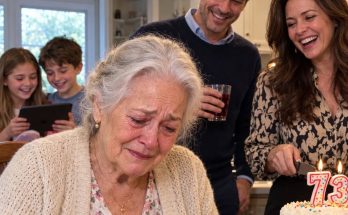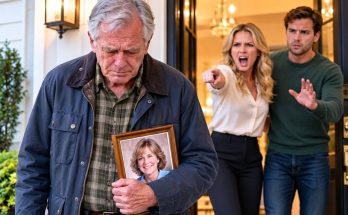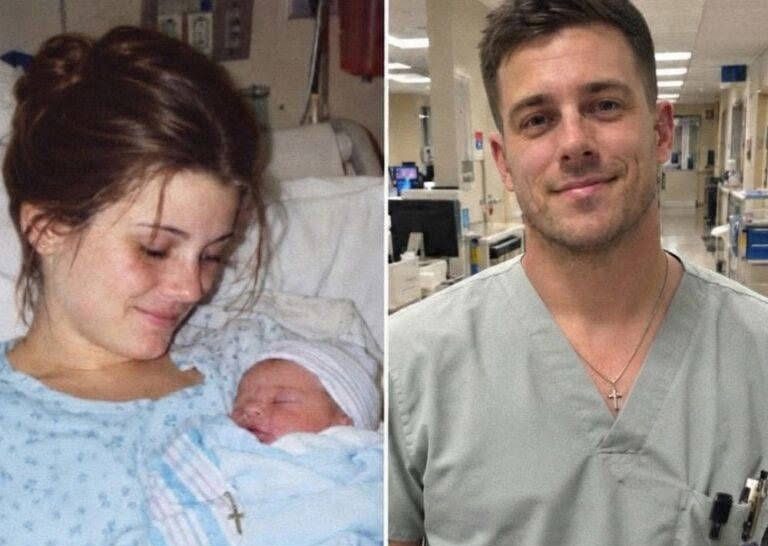
Part 1: The Necklace That Changed Everything “Doctor, that necklace belonged to my son.” My voice was so faint that I barely recognized it as my own.
The surgeon standing beside my hospital bed stopped moving. His fingers tightened around the small silver cross hanging from his neck. For a moment, he looked as though he had forgotten where he was.
Then he slowly closed my medical chart.
“Ma’am,” he said, pulling a chair toward me, “I need you to listen carefully to what I’m about to tell you.”
My heart began pounding.
“What does that mean? Where did you get that cross?”
He glanced toward the closed hospital-room door before looking back at me.
“My name is Dr. Fabian Bennett,” he said quietly. “I’m thirty-one years old.”
The room seemed to tilt.
Fabian.
That was the name I had given my baby before my parents took him away.
I stared at the doctor, searching his face for something familiar. His dark hair, the shape of his eyes, the small crease beside his mouth when he was worried—every detail suddenly seemed impossibly important.
“Why are you telling me your age?” I whispered.
He swallowed.
“Because I think you may be the woman I’ve been searching for.”
For thirty-one years, I had imagined this moment a thousand different ways.
Sometimes, I pictured my son running toward me with tears in his eyes. Other times, I imagined him refusing to speak to me because he believed I had abandoned him.
I had prepared myself for anger, rejection, and disappointment.
But I had never imagined that I would discover the truth while lying in a hospital bed, recovering from emergency surgery, with the man who had saved my life standing beside me.
And I certainly had never imagined that the truth would begin with a little silver cross.
To understand how it came to rest around Dr. Bennett’s neck, I must take you back thirty-one years, to the day my entire life was changed by two people who claimed they were protecting me.
I was eighteen years old.
I had just graduated from high school, worked occasional shifts at a grocery store, and lived in a small house with my parents in a quiet American town.
I was young, frightened, and completely unprepared for motherhood.
But when I discovered I was pregnant, I knew one thing with absolute certainty.
I wanted my baby.
The father was someone I had loved deeply, but our relationship had ended before I discovered I was expecting. I was too ashamed and confused to explain the circumstances to my parents, and I refused to reveal his identity when my father demanded answers.
“Who is responsible for this?” he shouted across the kitchen.
I stood with both hands wrapped around a glass of water.
“I don’t want to talk about him.”
“You don’t get to bring a child into this family and refuse to tell us who the father is!”
“It’s my baby, Dad.”
His face darkened.
“Your baby? You don’t even have enough money to pay your own bills.”
My mother sat at the table, crying into a dish towel.
She had always been the person I ran to when life hurt me. She had comforted me after childhood disappointments, helped me through school examinations, and held me when my grandmother died.
I expected her to defend me.
Instead, she said, “Sweetheart, sometimes loving a child means making a difficult decision.”
I knew what she meant.
Adoption.
“No,” I answered immediately. “I’m keeping my baby.”
For weeks, our house became a battlefield.
My father reminded me that I had no savings, no apartment, and no way to support an infant. My mother showed me brochures from adoption agencies and told me about loving couples who desperately wanted children.
I listened, but I never changed my mind.
Then, unexpectedly, everything changed.
My mother began accompanying me to prenatal appointments. My father stopped arguing with me about adoption. They even helped me clear out a small bedroom at the back of the house.
One evening, my mother placed a bowl of soup in front of me and gently squeezed my hand.
“Your father and I have talked,” she said. “We don’t want you to be afraid anymore.”
My father sat across from us.
“We’ll help you raise the baby,” he said. “You can stay here until you’re able to support yourself.”
I stared at him, hardly daring to believe it.
“Really?”
He nodded.
“You’re our daughter. We won’t let you struggle alone.”
I burst into tears and hugged my mother.
For the first time in months, I believed I might have a future with my child.
I found a steadier part-time job, saved whatever money I could, and began collecting baby clothes from thrift stores. I bought tiny socks, soft blankets, and a little blue outfit with embroidered stars.
I even chose his name.
Fabian.
Every night, I rested my hands on my growing belly and whispered to him.
“Goodnight, Fabian. Mommy can’t wait to meet you.”
I imagined taking him to the park, teaching him to read, and watching him grow into a man who would never doubt that he was loved.
I had no idea that the people promising to help me would soon become the reason I spent three decades searching for him.
When my labor began, my mother drove me to the hospital.
After hours of pain and exhaustion, I heard a tiny cry.
A nurse placed my newborn son against my chest.
He was warm and impossibly small. His fingers curled around mine, and his dark eyes fluttered open for a brief moment.
I began to cry.
“Hello, Fabian,” I whispered. “I’m your mommy.”
He made a soft sound and settled against me.
I had never loved anyone so completely.
Before the nurse carried him away for a routine examination, I remembered the little silver cross I had brought from home.
It had belonged to my grandmother, the one person in my family who had always made me feel safe.
The cross was delicate, with a tiny scratch on one arm. My grandmother had worn it for decades, and after she died, I kept it in a small wooden jewelry box.
I carefully tucked it into the fold of my son’s blanket, away from his skin.
“This is from your great-grandmother,” I whispered. “One day, I’ll tell you all about her.”
It was a small promise.
I thought I would have a lifetime to keep it.
A few hours later, my parents entered my hospital room.
My father carried a folder.
My mother wouldn’t look at me.
“What’s that?” I asked.
“Some paperwork,” my father replied.
He placed the folder on my bed and opened it.
Adoption documents.
For several seconds, I couldn’t understand what I was seeing.
“No,” I whispered.
My father pulled a chair closer.
“We’ve reconsidered the arrangement. This is the right decision.”
“What arrangement?”
My voice rose.
“You promised I could bring him home!”
My mother finally looked at me. Her eyes were red, but her expression was strangely distant.
“We know you’re emotional right now. You’re exhausted, and you don’t understand how difficult this will be.”
“I understand perfectly! He’s my son!”
My father placed a pen beside the documents.
“Sign them.”
I pushed the folder away.
“No!”
He leaned forward.
“If you refuse, don’t expect to return to our house. You’re an adult now. You’ll have to find somewhere else to live.”
I stared at him in disbelief.
“You wouldn’t do that to me.”
“Try me.”
My mother reached for my hand.
“Please don’t make this harder than it has to be.”
I pulled away.
“You said you’d help me. You looked me in the eyes and promised!”
She began crying again.
But she didn’t defend me.
I asked for another day. I begged them to let me recover, take my son home, and find a way to support him.
My father refused.
I was eighteen, weak from childbirth, terrified of being homeless, and convinced that I had no one else to turn to.
Eventually, with tears running down my face, I signed the papers.
My hand shook so badly that my signature barely resembled my name.
The moment I finished, my father gathered the documents.
“There,” he said. “It’s settled.”
I looked at my mother.
“Please. Just tell me where he’s going.”
She turned away.
“Somewhere he’ll have a better chance.”
“Who is taking him?”
Neither of them answered.
That evening, a nurse told me my baby had been taken to the nursery.
When I asked to hold him again, she hesitated.
Then she said she would check.
She never returned.
The next morning, my parents told me the adoption had been completed and that my son was already with another family.
They refused to give me a name, an address, or even the name of the agency handling the placement.
“It’s better if you move on,” my father said.
Move on.
As if my son were a mistake I could erase.
As if the little person who had wrapped his fingers around mine had never existed.
I went home without him.
His blue outfit remained folded inside a drawer. The crib my mother had helped me assemble stood empty. Every night, I woke from dreams in which I heard him crying from another room.
And every morning, I remembered that I had signed the papers.
For years, I blamed myself.
I told myself I should have been stronger. I should have run away. I should have found someone willing to help me.
But I was eighteen, and the people who had raised me had used my fear to take away the one thing I wanted most.
Eventually, I found work, rented a small apartment, and built a life of my own.
Yet I never stopped searching.
I contacted adoption agencies. I wrote letters. I hired investigators whenever I could afford them. I requested every record I was legally allowed to see.
Most of my efforts ended with the same response.
Confidential adoption.
No information available.
My parents insisted they knew nothing more.
Whenever I asked, my father grew angry.
“Your obsession won’t change anything,” he said.
My mother simply left the room.
Years became decades.
I turned thirty, then forty.
I celebrated birthdays, changed jobs, and watched friends raise their children. I smiled at family gatherings when people asked why I had never married or had more children.
But privately, I carried the same question.
Was Fabian happy?
Did he know his birth mother had wanted him?
Did he ever wonder why I had given him away?
I never stopped hoping that someday I would find him.
Then, at forty-nine, my life nearly ended before I could discover the truth.
The pain began on an ordinary morning at work.
At first, I thought it was indigestion. Then the pain sharpened until I could barely stand.
A colleague called an ambulance.
I remember the flashing lights, the paramedic asking me questions, and the hospital ceiling passing above me as I was rushed through double doors.
Doctors discovered a dangerous internal condition that required emergency surgery.
I signed the consent form with trembling hands.
Then everything went dark.
When I woke up, my throat was dry, my abdomen ached, and a monitor beeped steadily beside my bed.
A nurse told me the operation had gone well.
I closed my eyes and silently thanked whatever force had allowed me to survive.
I had spent thirty-one years searching for my son.
I wasn’t ready to leave this world without knowing what had happened to him.
The next afternoon, my surgeon entered the room.
He was tall, with dark hair, thoughtful eyes, and a calm voice. He introduced himself as Dr. Fabian Bennett and explained that the surgery had been successful.
I barely noticed his name.
I was still groggy from medication.
He leaned over to review my chart.
That was when a silver chain slipped from beneath his shirt.
A small cross rested against his chest.
I recognized the scratch immediately.
My grandmother’s cross.
The same one I had hidden in my newborn son’s blanket thirty-one years earlier.
My breath caught.
“Doctor,” I whispered.
He looked up.
“Are you in pain?”
I shook my head, tears already filling my eyes.
“Where did you get that necklace?”
He touched the cross.
“This? I’ve had it since I was a baby.”
The room fell silent.
I gripped the blanket.
“Your entire life?”
He nodded slowly.
“My adoptive parents told me it came with my baby blanket.”
My heart hammered against my ribs.
I stared at him, at the necklace, and then at the name printed on his identification badge.
Fabian Bennett.
“Doctor,” I whispered, “I think you may be my son.”
He went completely still.
For a long moment, he simply looked at me.
Then he pulled a chair beside my bed.
His next question changed everything.
“Did your family ever tell you what really happened after you signed those papers?”
Part 2: The Truth Hidden for Thirty-One Years
I couldn’t answer him.
My mouth opened, but no words came out.
Finally, I whispered, “They told me you were adopted by a family who could give you a better life. They said they couldn’t tell me anything else because the records were confidential.”
Fabian lowered his eyes.
“That is what my adoptive parents told me, too.”
I reached toward him, then stopped.
I wanted to touch his face. I wanted to hold his hand. I wanted to pull him into my arms and make up for every birthday I had missed.
But he was a grown man now.
A respected surgeon.
He had lived an entire lifetime without me.
I didn’t know whether I had the right to reach for him.
“What’s your birthday?” I asked.
He told me the date.
It was the same day I had given birth.
I covered my mouth with my trembling hand.
“Do you know the name your birth mother gave you?”
Fabian shook his head.
“My adoption papers said my original name was unknown. My parents named me Fabian because they said they liked the name.”
I began to sob.
“I named you Fabian, too.”
He stared at me.
For the first time, I saw his professional composure begin to crumble.
“You’re serious?”
I nodded.
“Your grandmother and I used to talk about that name. She said it sounded like the name of someone who would grow up brave and kind.”
I laughed through my tears.
“I used to whisper it to you before you were born. I used to tell you that I couldn’t wait to meet you.”
Fabian stood up and walked toward the window.
He remained there for several seconds, looking down at the hospital parking lot.
Then he turned around.
“I need to tell you something about my childhood.”
I wiped my cheeks.
“Please.”
“My adoptive parents, Robert and Helen Bennett, loved me. They never treated me like I was unwanted. They gave me a good home, helped me through medical school, and supported every decision I made.”
His voice softened.
“But I always felt that something was missing.”
He explained that he had grown up knowing he was adopted. His parents had never hidden that fact from him, and they had told him that his birth mother had been young when she gave birth.
They said she had made a difficult decision because she wanted him to have a better future.
For years, he had accepted that explanation.
But when he turned eighteen, he began wondering about her.
Did she think about him?
Had she ever wanted to meet him?
Was she still alive?
He asked his parents for the adoption records, but they had very little information. The agency had closed years earlier, and the original paperwork was incomplete.
Still, he searched whenever he had time.
“I became a doctor partly because I wanted to help people,” he admitted. “But there was another reason. I kept imagining that perhaps my birth mother was somewhere in the world, and I wanted to believe that if I ever found her, she’d be proud of me.”
My tears fell faster.
“Fabian, I’ve always been proud of you.”
He looked at me for a long time.
Then he asked the question I had dreaded for thirty-one years.
“Why did you give me away?”
The words struck me like a physical blow.
I took a shaky breath.
“I didn’t want to.”
He didn’t move.
“I never wanted to give you away. My parents promised they would help me raise you. Then, after you were born, they forced adoption papers in front of me and threatened to throw me out of the house if I refused to sign.”
His face changed.
“They forced you?”
“I was eighteen. I had nowhere to go, no savings, and no one who could help me. I was still recovering from childbirth. I begged them to let me keep you.”
I reached for a tissue and pressed it against my face.
“I signed because I was frightened. But I never stopped looking for you. Not for one day.”
Fabian slowly sat down.
“My parents told me that my birth mother had chosen adoption because she wanted a different life.”
“I wanted a life with you.”
My voice broke.
“I wanted to watch you take your first steps. I wanted to hear your first words. I wanted to help you with your homework and teach you how to ride a bicycle. I wanted to be there when you graduated.”
I looked into his eyes.
“I didn’t miss those things because I didn’t love you. I missed them because I was made to believe I had no choice.”
Fabian lowered his head.
For several minutes, neither of us spoke.
Then he reached beneath his collar and lifted the silver cross.
“There’s something else,” he said.
I looked at the necklace.
“When I was little, I used to ask my mother why this cross had a scratch on it. She said it had probably been damaged before I was adopted.”
He turned it gently between his fingers.
“When I was twelve, I asked whether I could have it repaired. My father told me not to. He said the scratch was part of its history.”
I nodded through my tears.
“My grandmother always said the same thing about old things. She believed the marks they carried were proof that they had survived.”
Fabian smiled faintly.
“I’ve worn it almost every day since I was a teenager.”
Then he asked, “Did you ever try to find me through the courts?”
“Several times. I hired investigators, contacted agencies, and requested records. Every time I hit a wall. I was told the adoption was confidential, and I had no identifying information.”
I hesitated.
“There was one other thing. My parents told me that the adoption had been handled through a private agency. But whenever I asked for the name, they changed the subject.”
Fabian leaned forward.
“What were your parents’ names?”
I told him.
He took out his phone and wrote them down.
“Do you still have contact with them?”
“Yes.”
“Have they ever admitted they know more than they’ve told you?”
I thought about my father’s angry silences. My mother’s tearful excuses. The way both of them had reacted whenever I mentioned adoption.
“No,” I whispered. “But I’ve never believed they told me everything.”
Fabian looked at me with a seriousness that made my stomach tighten.
“Then I think we need to find out why.”
That evening, after he finished his hospital rounds, Fabian returned to my room.
He had spoken to his adoptive parents.
“They’re alive,” he said. “They live about two hours from here. I told them what happened today.”
“What did they say?”
He pulled a chair beside my bed.
“My mother cried. She said she had prayed for this day for years.”
I pressed my hand to my heart.
“They knew?”
“They always knew I might want to find my birth mother someday. They never wanted to keep me from you. They simply didn’t know who you were.”
He paused.
“But my father remembered something unusual about the adoption.”
I leaned forward as far as my healing body allowed.
“What?”
“When they first brought me home, the adoption coordinator gave them a sealed envelope with the necklace and my baby blanket. She told them to keep everything safe.”
“An envelope?”
Fabian nodded.
“My father said it contained a note from the hospital, but he never read it because he believed it was part of my confidential records.”
My heart raced.
“Do they still have it?”
“Yes.”
For the first time in thirty-one years, hope felt like something I could actually touch.
We agreed that Fabian would bring his adoptive parents to visit once I was well enough to receive them.
But before he left, I asked him one final question.
“Fabian, do you hate me?”
He looked genuinely shocked.
“Hate you?”
“For not finding you sooner. For not being there when you needed someone.”
He moved his chair closer.
“I don’t know how to feel yet,” he admitted. “I need time to understand everything.”
I nodded, fighting the urge to apologize again.
“But I don’t hate you,” he continued. “And I don’t think you should have to spend the rest of your life punishing yourself for something you were pressured into doing.”
He stood and gently squeezed my hand.
“Get some rest, Mom.”
Mom.
One word.
One small word that made thirty-one years of grief rise inside me like a wave.
After he left, I pressed my face into my pillow and cried until I fell asleep.
The next morning, I called my parents.
My father answered.
“What do you want?”
His voice was as cold as ever.
“I found Fabian.”
There was silence.
Then he laughed.
“That’s impossible.”
“No, Dad. He’s real. He’s thirty-one years old, and he’s a surgeon. He saved my life.”
My father stopped laughing.
I heard something scrape against the floor.
Then he said, very quietly, “You need to stop this nonsense.”
“Why? What are you afraid of?”
“Your surgery has clearly affected your judgment.”
I gripped the phone.
“He has the silver cross I placed in his blanket. He has the same birthday. And I gave him the name Fabian.”
For several seconds, he said nothing.
Then he muttered, “You don’t know what you’re talking about.”
“Tell me the truth.”
“There is no truth to tell.”
“Then you’ll have no problem meeting him.”
His breathing grew louder.
“I will not discuss this with you.”
He hung up.
I stared at the phone.
For thirty-one years, I had wondered whether my parents had simply been cruel, selfish people who believed they were making the right decision.
Now I wondered whether they had done something much worse.
And I was determined to find out.
Three days later, Fabian returned to my hospital room with a woman in her late sixties and a silver-haired man walking beside her.
“This is my mother, Helen,” he said, placing a hand on the woman’s shoulder. “And my father, Robert.”
Helen approached my bed with tears streaming down her cheeks.
“I have imagined meeting you for so many years,” she whispered.
I took her hand.
“Thank you for loving my son.”
She shook her head.
“Please don’t thank me for something I was blessed to do.”
Robert placed a small, worn envelope on the bedside table.
“We brought the papers we told Fabian about.”
My fingers trembled as I opened it.
Inside was a yellowed sheet of paper and a faded hospital identification tag.
The note was brief.
Baby boy. Born at 2:14 a.m. Birth mother requested the name Fabian. Silver cross enclosed with blanket.
Below it was the signature of a hospital nurse.
But at the bottom of the page was another name.
The adoption coordinator.
Margaret Collins.
I recognized it immediately.
My mother had a sister named Margaret.
They had stopped speaking years before I became pregnant.
I looked up at Fabian.
“My aunt was involved?”
Robert nodded slowly.
“That’s what we discovered when we tried to obtain the original adoption records. Margaret worked with a private placement service at the time. She was the person who arranged our adoption.”
Helen reached into her purse and took out another document.
“This was tucked inside the envelope. We never understood why it had been included.”
It was a receipt from the private placement service.
The date matched the day I had signed the adoption papers.
But the line marked birth mother’s consent contained a note that made my blood run cold.
Consent obtained under family guardianship arrangement.
I was eighteen.
I had been legally an adult.
Why would anyone have written that?
Fabian studied the document.
“Mom,” he said, looking at me, “I think your parents may have misrepresented what happened.”
Before I could answer, Robert placed another paper on the table.
It was a letter, dated two weeks after Fabian’s adoption.
The handwriting was unmistakably my father’s.
And the first line read:
Margaret, as agreed, the matter must remain between us.
My hands began to shake.
I looked at Fabian.
“Whatever happened,” I whispered, “my parents knew about it.”
He nodded.
“And now we’re going to find out what they did.”
Part 3: The Secret My Parents Could No Longer Hide
I was discharged from the hospital several days later.
Fabian insisted that I recover at his home while we investigated the documents.
I initially refused.
I didn’t want to intrude on his life or place a burden on the family that had raised him.
But Helen took both my hands and looked directly into my eyes.
“You have spent thirty-one years wondering whether your son was safe,” she said. “Please allow yourself a little time to be cared for, too.”
I accepted.
For the first time since giving birth, I entered a home where my son lived.
There were framed photographs on the walls: Fabian as a toddler, Fabian on his first day of school, Fabian in his graduation gown, and Fabian standing beside Helen and Robert at his medical school graduation.
I stopped in front of the last photograph.
He looked so proud.
I had missed every milestone.
But I was grateful that someone had been there to celebrate them.
That evening, Fabian made tea and sat with me in the living room.
“I want to show you something,” he said.
He brought out an old box containing his childhood belongings.
Inside were school certificates, photographs, birthday cards, and a small blue blanket.
I recognized it immediately.
It was the blanket I had chosen before he was born.
My hands shook as I touched the fabric.
“I remember buying this,” I whispered.
Fabian sat beside me.
“My mother kept everything. She said I might want to know about my beginnings someday.”
Tucked beneath the blanket was a small envelope.
Robert had found it while searching through the box.
Inside was a photograph of a young woman holding a newborn baby.
The woman was me.
I was pale and exhausted, my hair messy, my eyes swollen from crying.
But I was smiling at the baby in my arms.
On the back, someone had written:
Mother and child, morning after delivery.
I pressed the photograph to my chest.
For thirty-one years, I had feared that my son might believe I had never wanted him.
Now he could see the truth with his own eyes.
Fabian sat quietly beside me.
“I wish I had known about this picture when I was a child,” he said.
“I wish you had known everything.”
He took the photograph and studied it.
“You look so young.”
“I was.”
“Were you frightened?”
“Terrified.”
He looked at me.
“But you loved me.”
“With every part of me.”
He nodded slowly, as though he were finally allowing himself to believe something he had always wanted to hear.
The next morning, Fabian contacted an attorney who specialized in adoption records and family matters.
After reviewing the documents, the attorney explained that the wording on the receipt was unusual. It did not prove wrongdoing by itself, but it justified further investigation into how the adoption had been arranged.
She helped us locate archived records from the private placement service.
Some documents had been lost. Others were incomplete.
But one file contained a copy of a letter written by Margaret Collins, my aunt.
The letter was addressed to my father.
It revealed that Margaret had warned him against pressuring me into signing the adoption papers.
She had written that I was legally an adult and that any placement had to reflect my own informed decision.
My father had responded with a single sentence.
She will agree when she understands she has no other option.
I read the sentence three times.
Then I put the paper down.
For years, I had wondered whether I had been weak.
Whether another eighteen-year-old girl would have found a way to keep her baby.
Whether I had somehow failed my son.
But the letter showed me something I had never allowed myself to believe fully.
My father had planned to make me surrender my child before I even entered the hospital.
My mother had known.
And my aunt had tried to stop them.
Fabian sat across from me.
“I think we need to speak to Margaret.”
We found her living in a small retirement community several states away.
When Fabian called, she initially refused to discuss the matter.
But after he explained who he was, she became silent.
Then she began to cry.
“I’ve wondered about you for thirty-one years,” she said.
She agreed to meet us.
Three days later, Fabian drove me to Margaret’s home.
She was seventy-two years old, with silver hair and tired eyes. When she saw me, she stood slowly.
For a moment, we simply stared at each other.
Then she whispered, “I’m so sorry.”
I felt anger rise inside me.
“You knew what happened to my baby?”
She lowered her head.
“Yes.”
“Did you know my parents forced me to sign those papers?”
“Yes.”
“Then why didn’t you help me?”
Margaret covered her face.
“Because I was a coward.”
She told us that my father had approached her during my pregnancy, asking her to arrange an adoption through the private service where she worked.
At first, she refused.
She explained that I was an adult and that I had the right to make my own decision.
But my father insisted that I would eventually agree.
He claimed I had no money, no stable future, and no ability to raise a child.
Margaret later learned that my parents had threatened to disown me and leave me without financial support.
She tried to persuade them to let me keep Fabian.
They refused.
“I should have come to you,” Margaret said, crying. “I should have told you that you had options. I should have helped you find a lawyer or a safe place to stay.”
“Why didn’t you?”
She looked at me with unbearable sadness.
“Your father told me that if I interfered, he would make sure I lost my job. I was afraid of him. I told myself that at least the baby would go to a good family.”
I shook my head.
“You knew I wanted him.”
“Yes.”
“You knew I was crying for him.”
“Yes.”
“And you let me believe I had no choice.”
She began to sob.
“I will regret that for the rest of my life.”
Fabian sat silently beside me.
Then Margaret revealed the part of the story that hurt most.
My parents had known exactly who adopted Fabian.
They had approved the Bennett family because Robert and Helen were financially secure, respected in their community, and willing to provide a stable home.
They had received updates during the first few years.
They knew Fabian was healthy.
They knew he was growing well.
They even received a photograph of him as a toddler.
But they never shared any of it with me.
“Why?” I whispered.
Margaret hesitated.
“Your father believed that if you knew your son was doing well, you might try to contact the adoptive family. He was afraid you would challenge the adoption.”
“Did they pay my parents?”
Margaret shook her head.
“Not for the child. The Bennetts paid the legitimate adoption and legal expenses. But your father demanded that the arrangement remain private and that no identifying information be shared with you.”
She explained that the adoption agency had followed the confidentiality procedures in place at the time, but my parents had also used intimidation and secrecy to prevent me from pursuing the matter.
The documents did not establish every detail of what had happened, and Margaret admitted she had never seen evidence of an illegal payment.
But one thing was undeniable.
My parents had known more than they ever told me.
And they had deliberately kept Fabian’s identity from me.
I left Margaret’s home feeling as though a heavy door had finally opened.
The truth was painful.
But it was no longer a mystery.
Fabian drove me home in silence.
Halfway through the journey, he reached over and gently squeezed my hand.
“You don’t have to carry this alone anymore,” he said.
I looked at him.
For thirty-one years, I had dreamed of hearing my son say something like that.
I had imagined him as a little boy, a teenager, or a young man.
But I had never imagined how comforting it would feel to have him beside me as an adult.
When we arrived home, I asked Fabian to help me call my parents.
I wanted them to hear the truth from both of us.
My father answered after the third ring.
“What now?”
I took a deep breath.
“Fabian is here with me.”
There was a pause.
Then I heard my mother’s voice in the background.
“What did she say?”
My father covered the phone, but not before I heard him mutter something angrily.
Finally, he returned to the call.
“Put him on.”
Fabian took the phone.
“My name is Dr. Fabian Bennett. I’m the son you arranged to have adopted thirty-one years ago.”
Silence.
Then my father said, “We did what was best for you.”
Fabian’s voice remained calm.
“You did what you thought was best for yourselves. You took a young woman’s choice away from her and then concealed the truth for three decades.”
My father began to argue.
“You had a good life. You were raised by people who could afford to give you everything.”
“I know,” Fabian replied. “And I love my parents. Helen and Robert are my parents in every way that matters. But their love does not excuse what you did to my birth mother.”
My father said nothing.
Fabian continued.
“You could have told her I was safe. You could have given her the opportunity to contact me when I became an adult. Instead, you allowed her to spend thirty-one years believing she had lost me forever.”
Then he asked the question that had haunted me since I was eighteen.
“Did you ever think about what that did to her?”
My mother began crying.
My father finally spoke.
“We believed she would eventually move on.”
I took the phone from Fabian.
“Move on?”
My voice shook.
“I spent every birthday wondering whether you knew where my son was. I searched for him while you knew he was alive. I cried myself to sleep because I thought I had failed him.”
I paused, struggling to breathe.
“You watched me suffer, and you said nothing.”
My father tried to interrupt.
“We were protecting you.”
“No,” I said. “You were protecting your decision.”
For the first time in my life, I did not feel afraid of him.
“You made me believe that losing my son was my fault. You let me carry that guilt for thirty-one years.”
My mother sobbed into the phone.
“I am sorry.”
I closed my eyes.
I had imagined hearing those words for decades.
But when they finally came, they did not repair the damage.
“I’m glad you’re sorry,” I said. “But I can’t give you back the years I lost.”
My father remained silent.
I ended the call.
For a long time, I sat beside Fabian in the quiet living room.
Then I began to cry.
Not because I had lost my son.
But because I had finally found him.
And because I could finally stop blaming myself for the circumstances that had separated us.
Over the following weeks, Fabian and I began getting to know each other.
We started with small things.
He told me about his childhood, his favorite books, and the first time he realized he wanted to become a surgeon.
I told him about my grandmother, the woman who had given me the silver cross, and the years I had spent searching for him.
Sometimes, we laughed.
Sometimes, we cried.
Sometimes, we sat quietly because there were simply no words for everything we had missed.
Fabian introduced me to his wife, Claire, and their eight-year-old daughter, Sophie.
When Sophie learned that I was her father’s birth mother, she studied me with enormous eyes.
“Does that mean you’re my grandma?”
I smiled through my tears.
“If you’d like me to be.”
She immediately climbed onto the couch beside me.
“Can you come to my school play next month?”
My heart nearly broke.
“I would love to.”
That night, after they had gone home, I stood alone in the guest room where I was staying.
On the bedside table lay the silver cross.
Fabian had removed it from his neck and placed it in my hands earlier that evening.
“It’s been with me my whole life,” he had said. “But I think you should hold it for a while.”
I closed my fingers around the familiar metal.
For thirty-one years, I had believed that the cross was the only piece of my son I had left.
Now I understood that it had never been a symbol of losing him.
It had been a thread connecting two lives that had been separated by fear, secrecy, and the decisions of others.
The next morning, Fabian came downstairs and found me holding it.
“Mom,” he said gently, “I’d like you to keep it.”
I looked up.
“Are you sure?”
He nodded.
“I wore it for thirty-one years. It reminded me that somewhere, I had a beginning. Now I know where that beginning was.”
He paused.
“And I know that I was wanted.”
I stood and hugged him.
This time, I did not hesitate.
He wrapped his arms around me and held me tightly.
I could feel the little boy I had once cradled in the hospital, the teenager who had wondered about his birth mother, and the man who had become a doctor.
All of them seemed to exist in that single embrace.
“I love you, Fabian,” I whispered.
He rested his chin against my head.
“I love you, Mom.”
I knew we could never recover the years we had lost.
I could never attend his first day of school or watch him learn to ride a bicycle. I could never help him through his teenage heartbreaks or sit in the audience at his medical school graduation.
But we had something precious.
We had the truth.
We had the chance to begin again.
And we had time.
Months later, Fabian invited me to a small family gathering at his home.
Helen and Robert were there, along with Claire, Sophie, and several friends.
Before dinner, Fabian stood and raised a glass.
“I want to thank the two people who made me who I am,” he said.
He looked at Helen and Robert.
“You gave me a childhood filled with love. You taught me kindness, courage, and the importance of helping others.”
They smiled through their tears.
Then Fabian turned toward me.
“And I want to thank the woman who loved me before she ever had the chance to know me.”
I covered my mouth.
“She spent thirty-one years believing she had failed me. But she never stopped searching. And today, I want her to know something.”
He walked toward me and placed the silver cross in my palm.
“You didn’t lose me because you didn’t love me enough. You lost me because other people took your choice away. And I will never blame you for that.”
The room fell silent.
I couldn’t speak.
Sophie ran over and hugged my waist.
Then Helen joined us, followed by Robert and Claire.
For the first time, I was surrounded by a family that understood that love was not a competition.
I did not have to replace Helen.
She did not have to defend the years she had spent raising Fabian.
We could all love him in different ways.
And that was enough.
Later that evening, Fabian and I sat together on the back porch.
The sun was setting, painting the sky in shades of gold and rose.
He looked at the cross in my hand.
“Do you ever wonder what would have happened if things had been different?”
I thought about the eighteen-year-old girl who had held her newborn son and promised to protect him.
I thought about the years of searching, the unanswered letters, and the birthdays spent wondering whether he was happy.
“Yes,” I admitted. “Sometimes.”
He nodded.
“Me too.”
I reached for his hand.
“But I don’t want to spend the rest of my life looking backward.”
He smiled.
“Neither do I.”
We sat together until the sky grew dark.
For thirty-one years, I had carried the pain of losing my son.
Now, at forty-nine, I finally understood that my story did not have to end with the day I signed those papers.
It could begin again with the day he walked into my hospital room wearing the silver cross.
My parents had believed that silence would bury the past.
They had believed that time would make me forget.
But love had survived every lie, every unanswered question, and every year we had spent apart.
And when the truth finally emerged, it brought us back to each other.
I never got to raise my son.
But I was given the chance to know the man he had become.
And every time I saw that little silver cross, I remembered the promise I had whispered to him on the day he was born.
You’ll always carry a little piece of me.
He had.
For thirty-one years, he had carried it close to his heart.
And now, at last, we could carry the truth together.
THE END.
If this story touched your heart, follow our page for more powerful stories about family, secrets, betrayal, and the love that never truly disappears. ❤️