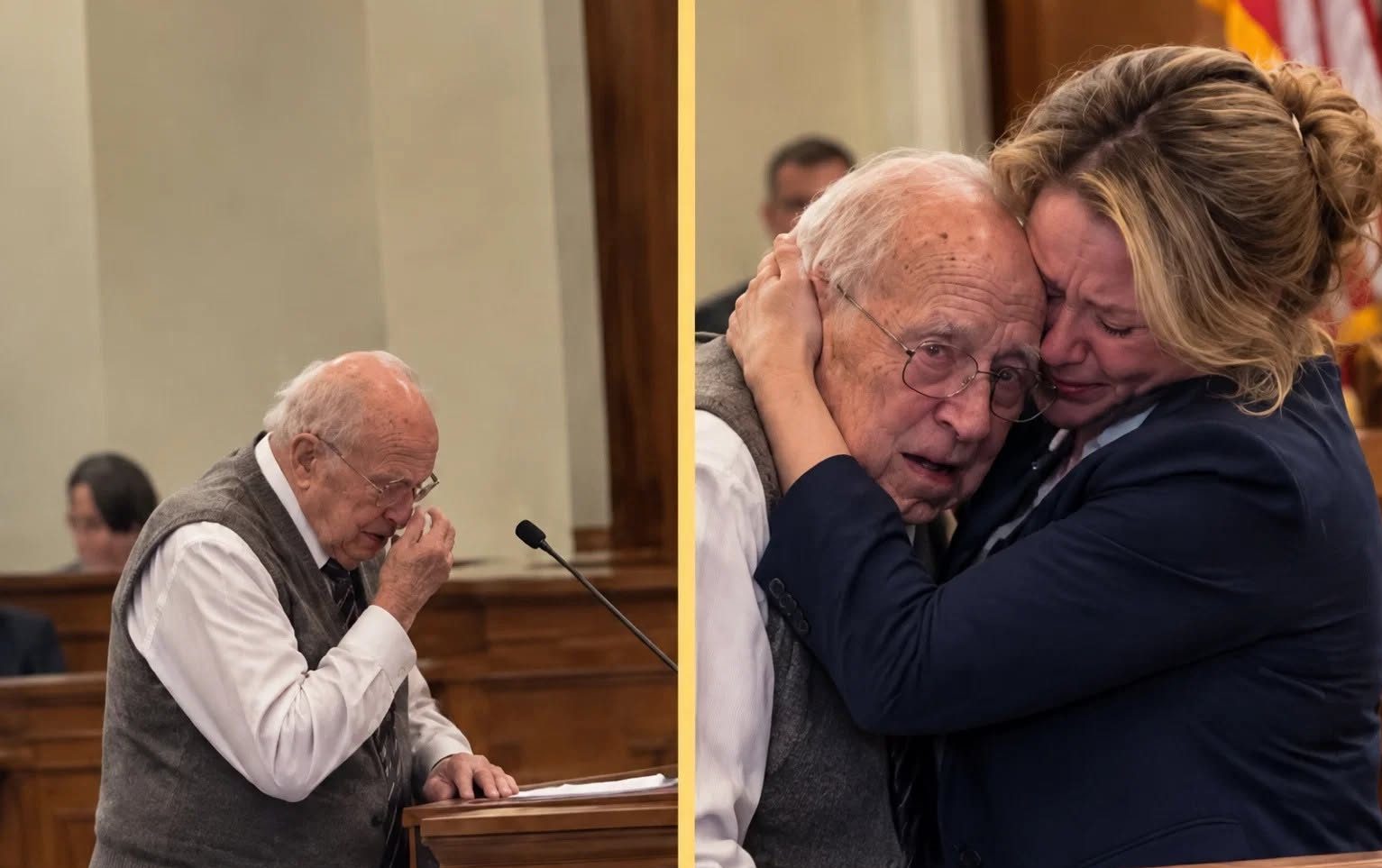
PART 1: THE OLD MAN IN THE COURTROOM The courtroom was unusually quiet that morning. At the front stood a 101-year-old man named Walter Miller, leaning heavily on a wooden cane.
His silver hair was neatly combed, his old brown jacket hung loosely from his shoulders, and his hands trembled slightly as he held the edge of the table.
He looked like someone who should have been celebrating another birthday with his family, sitting in a comfortable chair beside a warm fireplace.
Instead, he was facing criminal charges for stealing more than $2,000 worth of merchandise from a local department store.
The prosecutor stood and arranged several photographs on the table.
“Your Honor, the defendant has repeatedly entered the same store and removed merchandise without paying. The incidents occurred over several months. Despite multiple warnings from employees, the behavior continued.”
The judge, a serious-looking man in his early sixties named Harold Bennett, adjusted his glasses.
He studied the photographs.
There were cans of soup, bags of rice, children’s winter coats, school notebooks, shoes, blankets, laundry detergent, and several packages of diapers.
The judge looked confused.
“Mr. Miller, I’ve reviewed the security footage. You weren’t taking expensive electronics, jewelry, or luxury items. You were taking ordinary household necessities.”
Walter lowered his eyes.
“Yes, Your Honor.”
“Can you explain why?”
Walter swallowed.
“No, sir.”
The judge leaned forward.
“You’re 101 years old. Surely you understand the seriousness of these charges. The total value of the merchandise exceeds $2,000. The store initially showed you compassion, but the incidents continued.”
Walter nodded.
“I understand.”
“Did you steal these items?”
“Yes, sir.”
“Do you deny any of the accusations?”
“No, sir.”
“Do you have anything to say in your defense?”
Walter’s fingers tightened around his cane.
“I know what I did was wrong. I won’t make excuses. Whatever punishment you believe is appropriate, I’ll accept.”
The judge looked at him for several seconds.
“Mr. Miller, you have lived for more than a century. You’ve witnessed wars, economic hardship, and generations of change. I find it difficult to understand why someone your age would repeatedly put himself in this position.”
Walter stared at the floor.
“I wish I could explain, Your Honor.”
“Then explain.”
The old man shook his head.
“I gave someone my word.”
The judge frowned.
“Your word to whom?”
Walter didn’t answer.
The prosecutor shifted impatiently.
“Your Honor, the defendant has admitted to the offenses. The court should proceed.”
But before the judge could respond, a woman’s voice suddenly came from the back of the courtroom.
“Please! Your Honor, you cannot sentence him without hearing the truth!”
Everyone turned.
A woman in her late seventies was standing beside the last row of benches. She wore a simple gray coat and held a handbag against her chest.
Her name was Margaret Ellis.
She had lived next door to Walter for thirty years.
“Ma’am,” the judge said, “you cannot interrupt these proceedings.”
“I understand, Your Honor. But I know why he did it.”
Walter turned sharply.
“Margaret, sit down.”
His voice was weak, but there was panic in it.
“Please don’t.”
Margaret’s eyes filled with tears.
“I’m sorry, Walter. I can’t keep this secret anymore.”
“You promised me.”
“I know.”
“You gave me your word.”
Margaret pressed her lips together.
“And I’ve spent every night wishing I hadn’t.”
The judge raised his hand.
“Bring her forward. Let’s hear what she has to say.”
Margaret slowly walked toward the front.
She stopped beside Walter and looked at him.
For a moment, neither spoke.
Then she reached into her handbag and removed a folded letter.
“Your Honor, this is why Walter kept returning to that store. These things weren’t for him. He wasn’t stealing because he wanted something for himself.”
The judge looked at the letter.
“Then who were they for?”
Margaret glanced toward the back of the courtroom.
A young woman sat there with a little boy asleep against her shoulder. She looked exhausted, perhaps in her early thirties. Her coat was worn, and her shoes appeared several years old.
The boy wore a small blue sweater.
Margaret pointed toward them.
“That young woman is named Emily Carter. Walter has been helping her and her son for months.”
The judge looked toward Emily.
“Does she know about these thefts?”
Margaret shook her head.
“No, Your Honor. She has absolutely no idea.”
Walter closed his eyes.
Margaret unfolded the letter.
“There’s something else. This young woman once saved Walter’s life. And he has been trying to repay her ever since.”
The courtroom became completely silent.
The judge extended his hand.
“May I see that letter?”
Margaret handed it to him.
As he began reading, his expression slowly changed.
And when he reached the final paragraph, he looked directly at Walter.
“Mr. Miller,” he said quietly, “is this true?”
Walter’s eyes filled with tears.
“Yes, Your Honor.”
The judge looked back at the young woman.
“Ms. Carter, I believe you need to hear this.”
Emily woke her son and slowly approached the front.
She had no idea that the old man she barely knew had been carrying a secret that would change her life forever.
PART 2: THE PROMISE THAT COST HIM EVERYTHING
To understand what happened in that courtroom, everyone needed to know the story that began eight months earlier.
Walter Miller had lived alone for nearly twelve years.
His wife, Eleanor, had passed away when he was eighty-nine. They had been married for sixty-seven years.
They never had children.
For decades, their little house on Maple Street had been filled with laughter, Sunday dinners, birthday celebrations, and the smell of Eleanor’s homemade apple pie.
After she died, Walter stopped baking.
He stopped inviting people over.
He stopped attending the neighborhood gatherings Eleanor had loved.
He still kept her photograph beside his bed, and every morning he greeted it as if she were sitting across from him.
“Good morning, sweetheart,” he would whisper.
Then he would make one cup of coffee and sit alone.
Margaret, his neighbor, checked on him regularly.
She brought groceries, helped him with appointments, and sometimes stayed for tea.
Walter always thanked her.
“I’m an old man, Margaret. I don’t want to become a burden.”
“You’re not a burden,” she would reply. “You’re my neighbor.”
But Walter had become increasingly frail.
Walking to the grocery store was difficult, and his pension barely covered his medication, utilities, and basic expenses.
Still, he managed.
He had lived through the Great Depression as a young boy. He knew how to stretch a dollar.
He believed that if he had made it through a hundred years, he could manage a few more.
Then one rainy afternoon, something happened that changed his remaining years.
Walter was walking home from the pharmacy when he suddenly felt dizzy.
His vision blurred.
His cane slipped from his hand, and he collapsed near the sidewalk.
He remembered hearing a car horn.
Then someone shouting.
“Sir! Can you hear me?”
A young woman ran toward him.
She was carrying two grocery bags and holding the hand of a little boy.
She dropped everything and knelt beside Walter.
“Please, stay with me. Can you hear me?”
Walter tried to speak, but his words came out weakly.
The woman immediately called emergency services.
She covered him with her own coat because the rain was soaking through his clothes.
Her little boy stood beside her, frightened.
“Mommy, is the old man going to die?”
The woman looked at her son.
“No, sweetheart. We’re going to help him.”
She stayed with Walter until the ambulance arrived.
At the hospital, doctors discovered that Walter had suffered a serious cardiac episode. They told him that arriving when he did had made a significant difference.
When he finally woke up, Margaret was sitting beside his bed.
“You scared me half to death,” she said.
Walter managed a small smile.
“Apparently, I’m not finished yet.”
Margaret laughed through her tears.
A few minutes later, the young woman entered.
She was carrying a small paper bag.
“Hello, Mr. Miller. I’m Emily. I was the one who called the ambulance.”
Walter looked at her carefully.
Then he recognized her.
“You stayed with me?”
Emily smiled.
“Of course. I couldn’t just leave you there.”
Walter reached for her hand.
“Thank you.”
She shook her head.
“You don’t have to thank me. Anyone would have done the same.”
Walter looked at the little boy standing beside her.
“And who’s this?”
“My son, Noah. He’s five.”
Noah stepped forward.
“Are you feeling better, sir?”
Walter smiled.
“Much better, young man.”
Noah looked relieved.
Emily explained that she had been on her way home from work when she saw Walter collapse.
She worked part-time at a small bakery and cleaned houses on weekends.
She was raising Noah alone after her husband had died in a construction accident two years earlier.
Walter listened quietly.
He didn’t ask many questions.
But he noticed how tired she looked.
Her hands were rough from work, and her coat had a torn sleeve.
When Emily left, Walter turned to Margaret.
“That young woman has a good heart.”
“She certainly does.”
“She didn’t even know me.”
“Sometimes the kindest people don’t need a reason.”
Walter stared at the ceiling.
Then he whispered something Margaret never forgot.
“She gave me another chance to see tomorrow.”
Over the next few weeks, Walter recovered slowly.
He began walking again, although he still needed his cane.
One afternoon, he saw Emily struggling to carry groceries from her car.
He walked over.
“Let me help you.”
Emily smiled.
“Oh, Mr. Miller. You shouldn’t be carrying anything.”
“I’ve carried heavier things than groceries in my life.”
She laughed.
He helped her take the bags inside.
As he entered the small house, he noticed that the kitchen was almost empty.
There was a nearly empty loaf of bread on the counter, a jar of peanut butter, and two cans of soup.
Noah was sitting at the table doing homework.
Walter noticed the boy’s shoes.
They were too small.
The toes were pressing against the fabric.
“Are those new shoes?” Walter asked.
Noah looked down.
“Mommy says I can get new ones next month.”
Emily quickly interrupted.
“He’s growing so fast. Children need new shoes every five minutes.”
She smiled, trying to make the situation sound funny.
But Walter understood.
He had seen that kind of pride before.
The kind that hides hardship because asking for help feels worse than going without.
Before leaving, Walter slipped a twenty-dollar bill beneath a bowl on the counter.
Emily discovered it later.
She immediately came next door.
“Mr. Miller, you forgot this.”
Walter looked at the money.
“No, I didn’t.”
“I can’t accept it.”
“Then consider it repayment for the ambulance.”
Emily shook her head.
“You don’t owe me anything.”
Walter looked at her.
“Neither do you. Yet you helped me.”
She stood silently.
Finally, she accepted the money.
But she made him promise not to do it again.
And Walter agreed.
For a while, he kept his promise.
Then winter arrived.
And everything became worse.
Emily lost her bakery job when the business closed unexpectedly.
She applied for other positions, but finding work that fit around Noah’s school schedule proved difficult.
Her savings disappeared.
The electricity bill went unpaid.
The landlord began leaving notices on her door.
One evening, Walter heard Noah crying through the thin walls of their adjoining houses.
He couldn’t sleep.
The next morning, he knocked on Emily’s door.
She answered with red eyes.
“Is everything all right?”
She smiled weakly.
“Yes, Mr. Miller. Just a difficult night.”
Walter looked past her.
He noticed the dark kitchen, the empty refrigerator, and Noah sitting on the floor wearing his coat.
“Has the heat stopped working?”
Emily looked embarrassed.
“Just temporarily.”
Walter knew that wasn’t true.
He also knew she would never ask him for help.
That afternoon, he visited the local department store.
He bought a bag of groceries with the money he had saved from his pension.
He also purchased a warm winter coat for Noah and a pair of shoes.
When he brought them to Emily’s house, she nearly cried.
“Mr. Miller, I told you I couldn’t keep accepting things.”
He smiled.
“Then don’t think of them as gifts. Think of them as things that were going to waste in my imaginary grandchildren’s bedroom.”
Emily laughed despite herself.
Walter continued helping whenever he could.
He bought food.
He purchased school supplies.
He paid for Noah’s winter boots.
But his pension was limited, and the money was disappearing faster than he expected.
Then came the day that changed everything.
Walter went to the store with only a few dollars in his pocket.
He saw children’s socks, canned vegetables, and a small box of notebooks.
He thought of Noah.
He thought of Emily working long hours and trying to keep her little boy warm.
He looked at the items.
Then he made a terrible decision.
He slipped them into his shopping bag and walked out without paying.
He knew exactly what he was doing.
He wasn’t confused.
He wasn’t suffering from memory loss.
He simply couldn’t bring himself to watch that child go without necessities.
An employee stopped him outside.
“Sir, you forgot to pay for these.”
Walter looked at the ground.
“I’m sorry.”
The employee recognized him.
He had seen Walter before.
“Please don’t do this again.”
“I won’t.”
But he returned two days later.
And then again.
Each time, he took something different.
He told himself he would find a way to repay the store.
He planned to use the small savings he had left.
But the incidents continued.
The store eventually contacted the authorities.
Walter never blamed anyone.
He never accused the employees of being cruel.
He never tried to escape responsibility.
He believed that if he had made a wrong decision, he had to accept the consequences.
But he had made one request to Margaret.
“Please don’t tell Emily.”
Margaret was horrified.
“Walter, you’re putting yourself in danger. Why don’t you tell her what’s happening?”
“Because she’s already carrying enough.”
“She deserves to know.”
“No,” he said firmly. “She saved my life. I won’t make her feel responsible for mine.”
Margaret promised.
And she kept that promise until the day she walked into the courtroom.
Now, as the judge finished reading her letter, the truth was finally coming out.
PART 3: THE LETTER THAT CHANGED THE COURTROOM
Emily stood beside Margaret, confused and frightened.
“Mr. Miller?” she whispered.
Walter couldn’t look at her.
“Emily, I’m sorry.”
She looked at the photographs spread across the judge’s desk.
Children’s clothes.
Groceries.
School supplies.
Her face slowly changed.
“Those things…”
Walter nodded.
“I wanted Noah to have what he needed.”
Emily covered her mouth.
“Why didn’t you tell me?”
“Because I knew you’d refuse.”
“Of course I would have refused! You are 101 years old!”
Walter’s eyes filled with tears.
“I know.”
“You’re supposed to be resting. You’re supposed to be taking care of yourself!”
He lowered his head.
“I couldn’t forget what you did for me.”
Emily began crying.
“Mr. Miller, I didn’t save you because I expected something in return.”
“I know.”
“I helped because you were lying on the sidewalk and needed help. That’s all.”
Walter looked at her.
“And I helped because you and Noah needed help. That’s all.”
For several seconds, neither spoke.
Then the judge gently tapped the letter.
“Ms. Ellis, may I read the contents aloud?”
Margaret nodded.
The judge unfolded the final page.
It was written in Walter’s shaky handwriting.
He began reading.
“To whoever finds this letter,”
“My name is Walter Miller. I am 101 years old, and I have lived a long life. I have been fortunate enough to know love, kindness, and the comfort of having someone beside me.”
“Eight months ago, I collapsed on the sidewalk. I believed my time had come. But a young woman named Emily Carter stopped her own day to help a stranger.”
“She called an ambulance. She stayed in the rain. She gave me her coat. She waited until help arrived.”
“She didn’t know my name. She didn’t know whether I had money. She didn’t ask for anything.”
“She simply refused to leave an old man alone.”
“After I recovered, I learned that she was raising a little boy by herself. I also learned that she was struggling to provide even the simplest necessities.”
“I wanted to help her.”
“I tried to do it quietly because I knew she would refuse if she understood how much I was giving.”
“I made mistakes. I took things from a store without paying. I know that was wrong, and I will accept responsibility.”
“But I want the court to understand one thing.”
“Those things were never for me.”
“I have lived for 101 years. I have clothes, memories, and more belongings than I need. I don’t need another blanket or another can of soup.”
“But a five-year-old boy needs warm shoes. A child needs notebooks for school. A mother needs groceries so she can feed her son.”
“I could not make myself walk away when I knew they were struggling.”
“I am not asking anyone to excuse what I did.”
“I am only asking that Emily never be blamed for it.”
“She saved my life once. Please don’t let my mistakes become another burden on hers.”
“If I have one regret, it is that I didn’t find a better way to help.”
“Signed, Walter Miller.”
By the time the judge finished reading, several people in the courtroom were wiping their eyes.
Emily was sobbing.
Walter stood motionless.
The judge removed his glasses.
“Mr. Miller, I have one question.”
Walter looked up.
“Yes, Your Honor?”
“Did you ever tell Emily that you were taking these things for her?”
“No, sir.”
“Why?”
Walter glanced toward her.
“Because I didn’t want her to feel that she owed me anything.”
The judge nodded slowly.
Then he turned toward Emily.
“Ms. Carter, did you know that Mr. Miller had been helping you?”
Emily wiped her cheeks.
“I knew he’d occasionally brought us groceries. I thought he was simply being kind. I had no idea he was doing this.”
“Did you ever ask him to steal anything?”
“Never, Your Honor. I didn’t even know he was taking these things.”
The judge turned back toward the prosecutor.
“Does the store have a representative present?”
A man in a dark suit stood.
“Yes, Your Honor. I’m the regional manager.”
The judge looked at him.
“Has your company considered the circumstances surrounding these incidents?”
The manager shifted in his chair.
“We were aware of Mr. Miller’s age, Your Honor. Our employees had shown him considerable patience. But we also have policies regarding repeated theft.”
“I understand. Was the merchandise recovered?”
“Some of it was, but not all.”
The judge nodded.
“Would your company be willing to consider restitution through an appropriate arrangement?”
The manager glanced at Walter.
After a long pause, he said, “We would be willing to discuss it.”
The judge looked at Walter again.
“Mr. Miller, I want you to understand something. Your actions were wrong. The fact that you intended to help someone does not make stealing acceptable.”
Walter nodded.
“I understand.”
“But I also want this court to recognize the extraordinary circumstances surrounding this case.”
He paused.
“I am not interested in sending a 101-year-old man to prison simply to make an example of him when there are other ways to address the harm.”
Walter’s shoulders began to shake.
The judge continued.
“I will consider the appropriate legal outcome, including your age, health, lack of previous criminal history, your admission of responsibility, and the possibility of restitution.”
Then he looked toward Emily.
“And I believe there is something else this courtroom needs to understand.”
Emily raised her eyes.
“Your kindness toward Mr. Miller was not a transaction. You did not save him expecting repayment. He should not have felt that he needed to risk his freedom to thank you.”
He turned to Walter.
“You owe the store an honest effort to make things right. You do not owe anyone your remaining years.”
Walter began crying.
For the first time that morning, he reached for a handkerchief.
The judge announced a short recess before issuing his decision.
During the break, Emily approached Walter.
She knelt carefully beside his chair.
“Why didn’t you tell me?” she asked again.
Walter looked at her.
“I didn’t want you to worry.”
She laughed through her tears.
“You really are the most stubborn old man I’ve ever met.”
He smiled.
“At 101, I’ve had plenty of practice.”
Emily took his hand.
“Listen to me. You don’t have to repay me for helping you. Not with money, not with groceries, and certainly not by risking prison.”
Walter nodded.
“I know that now.”
Then Noah, who had been sitting with Margaret, walked toward them.
He held a small drawing.
It showed a little boy holding hands with an old man.
Above them, in crooked letters, were the words:
MY FRIEND WALTER.
Noah handed it to him.
“I made this for you.”
Walter stared at the picture.
His lips trembled.
“That’s the finest painting I’ve ever seen.”
Noah smiled.
“You’re my favorite old person.”
Walter laughed.
“Well, that’s a very important position.”
Then Noah asked something that made everyone smile.
“Can you come to my birthday party?”
Walter looked at Emily.
She nodded.
“Of course he can.”
Walter carefully folded the drawing and placed it inside his jacket pocket.
He had never received anything so valuable.
A few minutes later, the courtroom reconvened.
The judge returned to his seat.
Everyone stood.
Walter gripped his cane.
The judge announced that he would not impose imprisonment. Instead, considering the circumstances and the applicable law, he ordered a non-custodial resolution, with restitution addressed through an arrangement that would not place an unreasonable burden on the elderly defendant.
The judge also made clear that Walter must not return to taking merchandise without paying.
Walter nodded.
“Thank you, Your Honor. I will do my best to make things right.”
The store representative then stood.
“Your Honor, after hearing everything, our company would like to withdraw its request for further financial recovery beyond the merchandise already documented. We would also like to offer Mr. Miller a grocery delivery arrangement.”
The judge looked surprised.
“Are you certain?”
“Yes, Your Honor. Our employees have known him for months. We didn’t understand what was happening, but we would like to help resolve this properly.”
Walter began crying again.
“I don’t know what to say.”
The manager smiled.
“You don’t have to say anything, Mr. Miller. Just promise us you’ll let people help you before you make another mistake.”
Walter nodded.
“I promise.”
But the biggest surprise was still waiting outside the courtroom.
PART 4: THE GIFT WALTER NEVER EXPECTED
Three days after the hearing, Margaret knocked on Walter’s front door.
He was sitting in his favorite chair, reading an old newspaper.
“Come in,” he called.
Margaret entered carrying a large envelope.
“What is that?” Walter asked.
“Something you need to see.”
He put down his newspaper.
Margaret placed the envelope on his lap.
Inside were several documents.
The first was a letter from the department store.
They were offering him free grocery deliveries for the remainder of his life, with assistance from a local community program.
The second was a letter from a neighborhood charity.
After hearing about the case, several residents had organized a small fund to support Emily and Noah.
There was enough money to cover their overdue rent, replace Noah’s worn-out clothes, and provide groceries for several months.
Walter stared at the papers.
“Who arranged all this?”
“People who heard what happened,” Margaret replied.
Walter shook his head.
“I didn’t want anyone making a big deal out of it.”
Margaret sat beside him.
“Sometimes, Walter, people need to hear a story about kindness. Not because they want to judge someone, but because it reminds them that they can make a difference.”
Walter looked at the envelope again.
“Does Emily know?”
“She does.”
He smiled.
“Good.”
Then Margaret handed him one more envelope.
“This one is from Emily.”
Walter carefully opened it.
Inside was a handwritten letter.
“Dear Mr. Miller,
I don’t know how to thank you for everything you’ve done.
When my husband died, I thought my life had ended too. I had to learn how to be a mother, work, pay bills, and be strong even when I was terrified.
Some days, I felt like I was failing Noah.
Then you appeared.
You never made me feel ashamed. You never asked questions that made me uncomfortable. You simply showed up with groceries, a coat, or a kind word.
But I need you to understand something.
You were never supposed to pay me back for saving your life.
I didn’t save you because I wanted something in return.
I saved you because you mattered.
And you still matter.
Noah talks about you every day. He tells everyone that he has a special friend who knows stories about the old days.
He wants to visit you this Sunday.
I hope you’ll let us come.
Love,
Emily and Noah.”
Walter read the letter twice.
Then he pressed it against his chest.
“Margaret?”
“Yes?”
“Do you think Eleanor would have liked them?”
Margaret smiled.
“I think she would have loved them.”
Walter looked toward the photograph on his fireplace.
For the first time in many years, he felt something other than loneliness.
He felt needed.
And he felt loved.
On Sunday afternoon, Emily and Noah arrived carrying a homemade apple pie.
Walter opened the door.
Noah ran straight toward him.
“Walter!”
The old man laughed as the boy wrapped his arms around his legs.
“Careful, young man. These old bones aren’t built for running anymore.”
Emily smiled.
“I brought lunch. And I was hoping you might tell Noah one of your stories.”
Walter looked at the pie.
“Apple?”
“Your favorite, according to Margaret.”
He looked toward Margaret, who was standing behind them.
She winked.
“Don’t look at me. I didn’t bake it.”
Walter laughed.
They spent the afternoon together.
Emily prepared sandwiches.
Noah colored pictures at the kitchen table.
Walter told stories about his childhood, the first car he ever owned, and the time he met Eleanor at a county fair in 1943.
Noah listened as if every word were an adventure.
At one point, the boy climbed onto the chair beside Walter.
“Are you going to be here next Sunday?”
Walter looked at him.
“I certainly hope so.”
“Good. Because I have another picture to make for you.”
Walter smiled.
“I’ll be waiting.”
That evening, after Emily and Noah left, Walter sat alone in his living room.
But it wasn’t the same kind of loneliness he had known before.
On the table was a plate with a slice of apple pie.
Beside it was Noah’s drawing.
And tucked into his jacket pocket was Emily’s letter.
Walter looked at Eleanor’s photograph.
“You were right, sweetheart,” he whispered.
“Kindness always comes back. Sometimes it just takes a little longer than we expect.”
He smiled.
Then he added something he hadn’t said in years.
“I think I’m going to be all right.”
Over the following months, Walter became a familiar face in the neighborhood again.
He no longer tried to hide his struggles.
He accepted grocery deliveries.
He allowed Margaret to help with his appointments.
And every Sunday, Emily and Noah visited.
Sometimes they brought food.
Sometimes they simply sat with him.
Noah eventually started calling him Grandpa Walter.
The first time he said it, Walter pretended not to hear.
But later that evening, Margaret found him crying quietly in his kitchen.
“What’s wrong?” she asked.
Walter wiped his eyes.
“Nothing.”
“Then why are you crying?”
He smiled.
“Because I thought I’d already had everything life could give me.”
He looked at the little drawing Noah had made.
“Turns out, at 101, I still had room for another family.”
And that was the greatest gift of all.
Walter had entered the courtroom believing he was about to lose his freedom. Instead, he discovered that he had gained something he thought he would never have again: a family that loved him.
He had spent months trying to repay one act of kindness.
But in the end, Emily and Noah taught him something far more important.
Real kindness is never a debt. It is a gift that grows when people pass it along.
And sometimes, the person you help ends up saving you in ways you never imagined.
THE END.
If Walter’s story touched your heart, please follow our page for more emotional stories about kindness, family, second chances, and the people who remind us that it’s never too late to find love again.