Part 1: The Woman He Thought He Could Humiliate The first handcuff locked around my wrist before I even managed to put down my fork.
“Put your hands behind your back!”
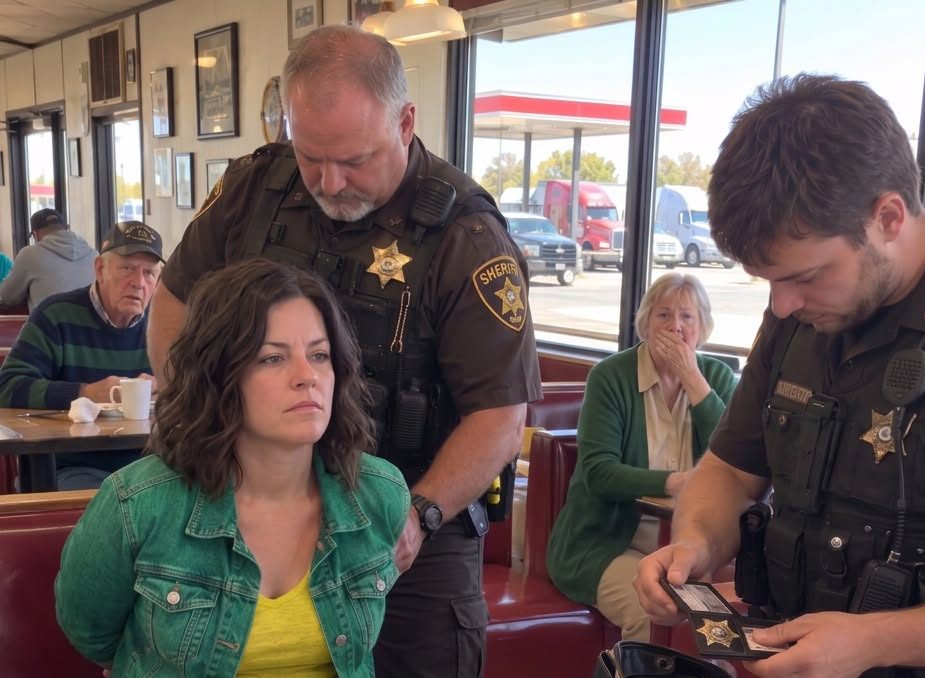
Sheriff Dalton Voss’s voice thundered across the little roadside diner.
Every conversation stopped.
A waitress froze beside the coffee machine. A truck driver lowered his newspaper. An elderly couple sitting near the window exchanged frightened glances.
I looked up slowly.
The sheriff stood beside my booth, his face red, his jaw clenched, and one hand resting on his belt. Two deputies stood behind him.
“Ma’am, you’re under arrest,” he announced.
I glanced at the half-eaten sandwich on my plate.
“For what?” I asked.
“Don’t play games with me.”
“I asked what I’m being arrested for.”
He grabbed my arm.
“Hands behind your back!”
I could have resisted. I could have demanded that he identify the legal basis for his actions. I could have reached into my handbag and produced identification that would have changed the entire atmosphere of that diner.
But I didn’t.
I calmly placed my fork beside my plate and turned around.
The second handcuff clicked.
My name is Amara Whitlock. I was forty-four years old, originally from Georgia, and had served as an appointed United States District Judge for six years.
My courtroom was in Atlanta.
I had presided over complex federal criminal cases, reviewed civil rights violations, sentenced convicted criminals, and listened to hundreds of people explain why they believed the law should not apply to them.
I had also learned something important.
Power rarely reveals itself when someone is being watched by people who can challenge it.
It reveals itself when the person holding that power believes nobody can stop them.
That was precisely why I was sitting in that diner.
Three weeks earlier, my chambers had received a collection of anonymous complaints concerning the sheriff’s department in a small Georgia county called Bellweather.
The complaints were disturbing.
Residents described traffic stops without explanations, questionable searches, missing evidence, intimidation, and arrests that seemed to happen whenever someone publicly criticized Sheriff Voss.
One woman claimed her teenage son had been detained for eleven hours after recording a deputy striking a handcuffed man.
A retired mechanic alleged that officers had repeatedly stopped his business deliveries after he complained about missing money from an impounded vehicle.
Another complaint came from a local journalist who said the sheriff had threatened to destroy his career.
The allegations were serious, but anonymous accusations were not proof.
I wanted reliable information.
I wanted witnesses who felt safe enough to speak.
And I wanted to understand whether the department had a culture problem or whether the problem came from one individual.
I had therefore arranged an official judicial oversight visit through the appropriate federal channels, but I arrived in the county ahead of the scheduled meetings.
I wasn’t there to secretly conduct an investigation or exercise judicial authority over local officers.
I was there to observe the community, speak with residents, and understand the circumstances surrounding the complaints.
I deliberately dressed casually.
No expensive jewelry.
No formal clothing.
No judicial identification hanging around my neck.
Just jeans, a denim jacket, comfortable shoes, and a small handbag.
To Sheriff Voss, I apparently looked like someone he could push around.
He tightened his grip on my arm.
“You’re coming with us.”
“May I ask what crime you believe I’ve committed?”
He leaned closer.
“You match the description of a woman involved in an armed robbery.”
I blinked.
“An armed robbery?”
“That’s what I said.”
“Where did this robbery occur?”
“That’s none of your business right now.”
“Then how am I supposed to understand why you’re arresting me?”
His expression darkened.
“Listen carefully. I don’t explain myself to people like you.”
The words landed heavily in the room.
Nobody moved.
I noticed the waitress looking down at the floor. The elderly man near the window slowly removed his glasses.
The sheriff appeared to enjoy the silence.
He pulled me out of the booth so abruptly that the table shook. My water glass tipped over, spilling across the table and onto the floor.
“You’re resisting!” he shouted.
I hadn’t resisted.
I hadn’t even pulled away.
I looked directly at him.
“Sheriff, I strongly recommend that you reconsider what you’re doing.”
He laughed.
“Is that a threat?”
“No. It’s advice.”
He moved his face closer to mine.
“People around here don’t give me advice.”
Then he turned toward his deputies.
“Get her purse.”
One of the deputies picked it up from the seat.
My encrypted phone began vibrating inside.
Once.
Twice.
Then continuously.
The screen had received several urgent notifications.
One was from the Chief Judge of the federal district court.
Another came from my chambers.
I could see the deputy glance at the illuminated screen.
“Sir, her phone keeps—”
“Turn it off,” Voss interrupted.
“But—”
“I said turn it off!”
The deputy obeyed.
I said nothing.
The sheriff marched me toward the entrance.
As we passed the counter, the waitress finally found her voice.
“Excuse me, Sheriff?”
Voss stopped.
“What?”
“She didn’t do anything. She was just eating lunch.”
He turned toward her.
“Do you want to be involved in this?”
The woman’s face went pale.
“No, sir.”
“Then keep serving your customers.”
I looked at her.
She looked back at me.
There was fear in her eyes, but also something else.
Shame.
The kind of shame people feel when they witness injustice and have learned that speaking up can cost them everything.
I understood.
Outside, a black patrol SUV waited beside the diner.
The sheriff pushed me toward the rear door.
“Get in.”
I lowered myself into the seat without resistance.
He shut the door hard enough to make the vehicle shake.
Through the tinted window, I watched the diners return to their meals.
Nobody had eaten anything.
They were simply pretending.
During the short drive to the station, Sheriff Voss spoke into his radio.
“Dispatch, this is Voss. I’ve got a robbery suspect in custody. Female, approximately forty, refusing to cooperate.”
I looked at the back of his head.
“That’s not what happened,” I said.
He glanced at me through the rearview mirror.
“You want to add obstruction to your charges?”
“You’re welcome to record whatever you believe is accurate.”
He smiled.
“You’ll learn how things work here.”
I had a feeling he was about to learn something too.
But I wasn’t interested in frightening him with my title.
I wanted to know what he would do when he believed there was nobody important in the room.
The police station was a low brick building with a faded American flag outside.
Inside, the air smelled of burnt coffee, old paper, and disinfectant.
A young receptionist looked up as the sheriff entered.
“What do we have?”
“Robbery suspect. Book her.”
“What’s her name?”
“Didn’t ask.”
The receptionist hesitated.
“Sir, we need her name.”
Voss turned sharply.
“Then ask her.”
I answered before the receptionist could speak.
“Amara Whitlock.”
The young woman typed it into the computer.
“Date of birth?”
I provided it.
“Address?”
I gave my home address.
The receptionist entered the information, then paused.
Something about the name had caught her attention.
She looked at me again.
Then at the computer.
Then back at me.
“Ma’am, are you related to Judge Amara Whitlock?”
The sheriff laughed.
“Everybody’s related to somebody important when they’re in trouble.”
I remained silent.
The receptionist frowned.
“I think I’ve heard that name before.”
“Get the booking paperwork,” Voss ordered.
She reluctantly continued typing.
A few seconds later, the sheriff’s radio crackled.
“Unit Twelve, dispatch requesting confirmation on the armed robbery suspect.”
Voss grabbed the radio.
“Confirmed. She’s in custody.”
“Sir, the reporting officer is requesting a description verification.”
“I’ll handle it.”
He switched off the radio.
I watched him.
There was no robbery report number in the paperwork.
No officer had identified me as a suspect.
Nobody had even asked whether I owned a weapon.
And yet he had already announced that I was guilty.
The sheriff pushed a chair toward the booking desk.
“Sit.”
I sat.
He leaned against the counter.
“Let’s see how cooperative you are now.”
I looked at him calmly.
“Do you intend to notify me of the specific charge?”
“Eventually.”
“Do I have access to a telephone?”
“After booking.”
“Will my property be inventoried?”
He smiled.
“You’re asking a lot of questions for somebody wearing handcuffs.”
I didn’t answer.
A young deputy entered carrying my handbag.
His name tag read EVAN MILLER.
He looked to be in his late twenties, with tired eyes and a nervous expression.
“Sheriff, I need to inventory the property.”
“Go ahead.”
Deputy Miller opened the bag.
He removed a wallet, a set of keys, a small notebook, and my phone.
Then he noticed a slim black leather credential holder tucked inside the wallet.
“Ma’am, what is this?”
I looked at him.
“Please examine it carefully.”
He opened the holder.
Inside was my official federal judicial identification.
A photograph.
My full name.
My title.
The seal of the United States District Court.
And a credential number.
Deputy Miller’s expression changed.
He read it once.
Then again.
His face lost its color.
“Sir?”
Sheriff Voss was still looking at his computer.
“What now?”
The deputy swallowed.
“Sir, I think you need to come look at this.”
Voss sighed.
“What?”
Deputy Miller held up the credential.
The sheriff turned.
For a moment, he appeared irritated.
Then he read the identification.
His mouth opened slightly.
He stepped closer.
“What is that?”
Deputy Miller answered in a voice barely above a whisper.
“Federal judicial credentials.”
The room became completely silent.
Voss snatched the holder from his hand.
He examined the photograph.
Then he looked at me.
Then at the photograph again.
“You’re a judge?”
I met his eyes.
“Yes.”
“Federal?”
“Yes.”
He stared at the identification as if it had suddenly become dangerous.
I remained seated.
The handcuffs were still locked around my wrists.
And that was when I asked the question that changed everything.
“Sheriff, would you like me to explain why I came to Bellweather County?”
His face tightened.
Before he could answer, the station telephone began ringing.
The receptionist picked it up.
She listened for three seconds.
Then she looked directly at Sheriff Voss.
“Sir, it’s the Chief Judge’s office.”
Voss didn’t move.
The receptionist covered the receiver.
“They’re asking to speak to Judge Whitlock.”
For the first time since the diner, Sheriff Dalton Voss looked genuinely afraid.
And he still hadn’t heard the most important part.
Part 2: The Call That Changed the Entire Station
Sheriff Voss stared at the telephone as though it might explode.
“Give me that,” he said.
The receptionist slowly handed him the receiver.
He cleared his throat.
“This is Sheriff Dalton Voss.”
A woman’s voice came through the speaker.
“Where is Judge Whitlock?”
Voss straightened.
“She’s here, ma’am. We’re processing an arrest.”
“Processing an arrest?”
“Yes. We had reason to believe she matched the description of a robbery suspect.”
There was a pause.
Then the woman spoke again.
“Sheriff, this is Margaret Ellis, Chief Judge of the United States District Court. I need you to listen very carefully. Put Judge Whitlock on the telephone immediately.”
Voss glanced at me.
“Of course, Your Honor.”
He extended the receiver.
I took it as comfortably as the handcuffs allowed.
“Good afternoon, Margaret.”
“Amara, are you all right?”
“I’m physically fine.”
“What happened?”
I looked at the sheriff.
“I was having lunch when Sheriff Voss arrested me without explaining the legal basis. He accused me of an armed robbery, claimed I resisted, and brought me here. I have not been given a case number or a clear statement of the alleged offense.”
Margaret became quiet.
Then she asked, “Are you still restrained?”
“Yes.”
“Has anyone verified your identity?”
“Deputy Miller has examined my judicial credentials.”
“All right. I’m contacting the appropriate federal authorities and your security detail. Do not discuss any official judicial business with the sheriff. Have the department preserve every recording, dispatch communication, report, and property record relating to your detention.”
“I understand.”
“Amara, I want you to know that we’re taking this seriously.”
“Thank you.”
I handed the telephone back.
Sheriff Voss looked as if he had swallowed something unpleasant.
“Judge, there seems to have been a misunderstanding.”
I studied him.
“Which part?”
He blinked.
“What?”
“Which part was the misunderstanding? The accusation of armed robbery? The claim that I resisted? Or the statement that you don’t explain yourself to people like me?”
Nobody spoke.
Deputy Miller lowered his eyes.
The receptionist slowly stopped typing.
Voss forced a smile.
“Let’s not make this bigger than it needs to be.”
I looked down at my handcuffs.
“Then perhaps you should start by explaining why they are still on my wrists.”
He turned toward Deputy Miller.
“Get those off.”
The young deputy approached with the key.
But before he could unlock them, I raised my hand slightly.
“One moment.”
Voss frowned.
“What now?”
“I want the original arrest documentation preserved exactly as it currently exists. I also want the time of my detention recorded accurately.”
“We can handle all that.”
“And I want the names of every officer involved.”
His expression hardened again.
“You’re not in charge of this department, Judge.”
“I know.”
I looked directly at him.
“That’s why I’m asking you to follow the procedures that apply to everyone.”
Deputy Miller unlocked the cuffs.
The metal fell away from my wrists.
I rubbed the red marks around my skin.
The sheriff stepped backward.
“Judge, I apologize if the situation became uncomfortable.”
I almost smiled.
Uncomfortable.
That was the word he had chosen.
Not unlawful.
Not unjustified.
Not wrong.
Uncomfortable.
“Thank you,” I said. “I would also like my belongings returned.”
Deputy Miller began placing everything on the counter.
When he reached my phone, it lit up again.
This time the screen displayed a message from my chief judicial assistant.
URGENT: FEDERAL INSPECTOR GENERAL’S OFFICE HAS BEEN NOTIFIED. PLEASE CONFIRM YOUR SAFETY.
Voss saw it.
His eyes moved from the phone to me.
“Inspector General?”
“Yes.”
“Why would they be involved?”
I picked up my handbag.
“That is a question you may want to consider.”
At that moment, the station doors opened.
A tall woman wearing a dark suit entered, followed by two men carrying briefcases.
The first woman introduced herself as Special Agent Rebecca Lawson from the Department of Justice’s appropriate investigative office.
She showed her credentials.
“Who is Sheriff Voss?”
He raised his hand.
“That’s me.”
She looked around the room.
“Where is Judge Whitlock?”
I stepped forward.
“Right here.”
Agent Lawson approached me.
“Judge, are you injured?”
“Only minor marks from the handcuffs.”
She examined my wrists without touching them.
“Do you require medical attention?”
“No, thank you.”
She turned toward Voss.
“We need the incident report, the dispatch records, the arrest basis, and the names of every officer who participated.”
Voss folded his arms.
“With all due respect, this is a local law enforcement matter.”
“Whether it is a federal matter will be determined through the appropriate process,” Lawson replied. “Right now, we’re preserving evidence and documenting what happened.”
The sheriff looked toward the other officers, apparently hoping somebody would support him.
Nobody did.
Agent Lawson turned to Deputy Miller.
“Deputy, were you present during the arrest?”
“Yes, ma’am.”
“Did you observe the suspect resisting?”
Miller hesitated.
Voss immediately interrupted.
“Deputy Miller, I’ll handle the official statement.”
Agent Lawson looked at him.
“I asked the deputy a question.”
Miller swallowed.
“No, ma’am.”
Voss’s head snapped toward him.
“What did you say?”
Miller’s voice trembled, but he repeated himself.
“She didn’t resist. She was sitting in the booth when you handcuffed her.”
The sheriff’s face turned crimson.
“Watch yourself, Miller.”
Agent Lawson wrote something in her notebook.
“Thank you. Please provide your account independently.”
For the first time, someone inside that building had openly contradicted Sheriff Voss.
And I could see how difficult it was for him to accept.
But there was more.
I turned toward Agent Lawson.
“There’s something else you should know.”
She waited.
“I came to Bellweather County because several complaints described a pattern of questionable arrests and intimidation within this department.”
Voss stared at me.
“What complaints?”
I didn’t answer him.
Agent Lawson did.
“Those matters will be handled through the appropriate channels.”
The sheriff suddenly became defensive.
“Are you saying this arrest was planned?”
“No,” I replied. “I am saying that I wanted to understand the conditions described by residents. Your decision to arrest me was entirely yours.”
He opened his mouth.
Then closed it.
Agent Lawson requested the booking paperwork.
The receptionist retrieved the file.
She placed it on the counter.
The first page contained the arrest description.
The second page contained a preliminary incident narrative.
The third page was particularly interesting.
It stated that I had attempted to flee.
It also claimed that I had physically resisted being placed in handcuffs.
Deputy Miller looked at the document.
“Sir, that’s not accurate.”
Voss turned slowly.
“Excuse me?”
“You wrote that she attempted to flee. She never left the booth.”
The sheriff stepped toward him.
“You’re going to regret questioning me.”
Agent Lawson immediately intervened.
“Step away from the deputy, Sheriff.”
Voss stopped.
I watched Deputy Miller.
He looked frightened, but he did not take back what he had said.
That small act of courage mattered.
I had spent years watching witnesses struggle to speak in federal courtrooms.
Sometimes the truth did not emerge because people lacked evidence.
Sometimes it remained hidden because people were afraid of what would happen after they told it.
I turned to Miller.
“Deputy, thank you for telling the truth.”
He looked at me.
“Ma’am, I should have spoken sooner.”
“Perhaps. But you are speaking now.”
Agent Lawson requested that the relevant electronic records be preserved.
Then she asked whether the station had surveillance cameras.
The receptionist nodded.
“Front desk, booking room, hallway, and interview area.”
“Are the recordings automatically overwritten?”
“Some of them after seven days.”
“Then we need immediate preservation.”
Voss rubbed his forehead.
“This is becoming ridiculous.”
Agent Lawson looked at him.
“Then it should be easy to explain everything.”
He didn’t respond.
A few minutes later, the station doors opened again.
This time, an older man in a gray suit entered carrying a leather folder.
He introduced himself as Thomas Reed, the federal court’s administrative security officer.
He walked directly toward me.
“Judge Whitlock, we’ve been trying to reach you.”
“I’m sorry for the concern.”
He glanced at my wrists.
His expression changed.
“Are those marks from the restraints?”
“Yes.”
He looked toward Voss.
“Who authorized this?”
The sheriff straightened.
“I did.”
Reed nodded slowly.
“Then I suggest you preserve every record connected with that decision.”
Voss looked around.
For the first time, his own station seemed unfamiliar to him.
But I knew we had not reached the most important moment.
Because when Agent Lawson examined the original dispatch log, she discovered something that changed the nature of the entire incident.
The alleged armed robbery had never been reported.
There was no victim.
No suspect description.
No case number.
And no active warrant.
Instead, the dispatch system showed something else.
A private communication had been sent to the sheriff’s vehicle approximately four minutes before he entered the diner.
It came from a number registered to someone inside his own department.
Agent Lawson slowly turned the monitor toward herself.
“Who sent this message?”
Voss stared at the screen.
His expression changed.
“That’s department business.”
Agent Lawson looked up.
“Not anymore.”
And then Deputy Miller said something none of us expected.
“Ma’am, I know who sent it.”
Everyone turned toward him.
He took a breath.
“Because I’ve seen that same message before. It was used in another arrest.”
“Whose arrest?” I asked.
Miller looked at the sheriff.
“Mine.”
The room fell silent again.
And what Deputy Miller revealed next would expose a much larger problem than one sheriff making one unlawful arrest.
Part 3: The Evidence That Brought Down a Sheriff’s Empire
Deputy Evan Miller stood beside the booking counter, his hands shaking.
Sheriff Voss looked furious.
“That’s enough, Miller.”
But the young deputy didn’t stop.
“Two months ago, I questioned a traffic stop involving a man named James Porter. He was arrested after complaining that officers had taken money from his vehicle.”
Agent Lawson listened carefully.
Miller continued.
“I checked the dispatch record because something didn’t make sense. There was no original complaint. The message had come from an internal department number.”
“Whose number?” Agent Lawson asked.
Miller looked at the computer.
Then at the sheriff.
“Captain Russell Kane.”
Voss immediately interrupted.
“You’re making accusations you can’t support.”
Miller reached into his uniform pocket.
“I kept a copy.”
He removed a small folded piece of paper.
It was a printed dispatch record.
Agent Lawson accepted it.
“Why did you keep this?”
“Because I was told to delete my notes. I didn’t think that was right.”
Voss took a step forward.
“Give me that.”
Agent Lawson moved between them.
“Don’t touch the evidence.”
The sheriff stopped.
I watched him carefully.
The confidence that had filled his voice at the diner was gone.
Miller explained that he had been assigned to review the Porter arrest. When he questioned inconsistencies in the paperwork, Captain Kane told him to stop asking questions.
A week later, Miller was transferred to night patrol.
His overtime disappeared.
His supervisor began documenting minor mistakes.
Then came a warning.
If he wanted to keep his job, he needed to learn that the sheriff’s office had its own way of doing things.
“Why didn’t you report it?” I asked.
Miller looked embarrassed.
“My father was a deputy here for twenty-seven years. I grew up believing this department protected people. I didn’t want to destroy what he spent his life building.”
I nodded.
“Protecting an institution and protecting misconduct are not the same thing.”
He lowered his head.
“I understand that now.”
Agent Lawson asked him to provide a complete statement.
He agreed.
Meanwhile, the sheriff was pacing near his office.
He repeatedly insisted that the incident was a misunderstanding and that the arrest had been based on information available at the time.
But the evidence was becoming increasingly difficult to explain.
The diner had security cameras.
Several customers had recorded the arrest on their phones.
The station cameras showed me arriving in handcuffs.
The booking footage showed that I had not been informed of any specific robbery report.
And the original dispatch system contained no record of the alleged armed robbery.
Most importantly, the sheriff’s own radio recording contradicted his written report.
On the recording, he could be heard saying that he had identified a suspicious woman.
There was no mention of a weapon.
No mention of a victim.
No mention of a robbery.
Then came the statement that made Agent Lawson pause the recording.
“She’ll learn how things work around here.”
Voss stared at the speaker.
He had forgotten that his radio transmissions were recorded.
Or perhaps he had never cared.
The investigation continued over the following hours.
I was eventually allowed to leave the station after my identity and circumstances were formally documented.
Before departing, I asked Agent Lawson whether the department would preserve the original records.
She assured me that appropriate preservation measures were underway.
Then I turned toward Deputy Miller.
“Deputy, you did something important today.”
He shook his head.
“I should have done it months ago.”
“That may be true. But courage isn’t measured only by how early someone finds it. Sometimes it is measured by whether they finally choose to use it.”
He looked at me for a long moment.
“Thank you, Judge.”
I left the station with Thomas Reed.
Outside, a small crowd had gathered.
Word had spread through Bellweather County.
The waitress from the diner stood near the entrance.
When she saw me, she walked forward.
“Judge Whitlock?”
“Yes.”
“I’m sorry.”
I looked at her.
“For what?”
“For not saying more when he arrested you.”
Her eyes filled with tears.
“My husband lost his business after he complained about the sheriff’s department. We learned to stay quiet.”
I gently touched her shoulder.
“You should never have had to choose between speaking honestly and protecting your family.”
She began crying.
Then she told me something important.
She knew of several residents who had experienced similar treatment.
Some had been arrested after criticizing the sheriff.
Others had lost property through questionable impoundments.
One man had even moved away because he feared another traffic stop.
I asked whether she would be willing to speak with investigators.
She nodded.
“Yes. If someone finally listens.”
And that was how the investigation began to grow.
Over the next several weeks, federal investigators reviewed complaints, recordings, dispatch logs, arrest reports, and financial records.
They interviewed residents.
They examined department policies.
They compared original reports with later amended versions.
Several witnesses independently described similar incidents.
One former deputy reported that he had been instructed to alter an arrest narrative.
A local business owner produced receipts showing repeated towing charges that he believed were unjustified.
A retired schoolteacher provided letters documenting threats made after she complained about the treatment of her grandson.
Then investigators discovered something even more serious.
Captain Russell Kane had been maintaining a separate spreadsheet containing names of residents who had filed complaints against the department.
Beside several names were notes.
Troublemaker.
Watch closely.
Family business—pressure point.
Repeat stop recommended.
The spreadsheet was not proof by itself of every allegation, but it provided investigators with a disturbing lead.
They began examining whether department resources had been used to intimidate people who exercised their legal rights.
Sheriff Voss was placed on administrative leave pending the investigation.
Captain Kane was also removed from operational duties.
The county commission announced that an independent review would examine department practices.
For the first time in years, residents began speaking publicly.
At a community meeting, an elderly man stood before the audience.
His name was James Porter.
He had been the mechanic Miller mentioned.
He explained that his son had been detained after recording a roadside encounter.
“I spent thirty years paying taxes in this county,” he said. “I never thought I’d be afraid of the people I helped pay to protect us.”
Several people began applauding.
Then the waitress stood.
She described the afternoon of my arrest.
She explained that the sheriff had entered the diner, accused me of a robbery, and handcuffed me while I was still sitting at the table.
She also described how he had threatened her when she tried to speak.
By the time she finished, the room was silent.
Not the frightened silence I had witnessed in the diner.
This was different.
It was the silence of people finally understanding that they were not alone.
Months later, the findings of the investigation were made public through the appropriate legal proceedings.
Sheriff Voss faced serious consequences.
The investigation resulted in criminal charges against him and Captain Kane relating to their alleged misconduct, including falsification of official records and deprivation of civil rights.
Both were required to answer those allegations in court.
The county also agreed to implement major reforms, including independent review of complaints, improved evidence preservation, additional training, and stronger protections for employees who reported misconduct.
Deputy Miller became one of the principal witnesses.
His testimony was difficult.
He described the pressure he had faced, the warnings he had received, and the records he had preserved.
He also admitted that he had remained silent for too long.
Nobody pretended he had been perfect.
But he had eventually chosen to tell the truth.
And that mattered.
I did not preside over any criminal case arising from the investigation. To avoid any conflict of interest, I was kept entirely separate from those proceedings.
My role had been to observe, document what happened to me, and ensure that appropriate authorities received the information.
One afternoon, several months after the incident, I returned to Bellweather County.
This time, I wore my judicial robes because I had been invited to attend a public community discussion about protecting civil rights.
The diner owner recognized me immediately.
He came out from behind the counter.
“Judge Whitlock! Your usual table is waiting.”
I smiled.
“I hope the coffee is better this time.”
He laughed.
“It always was. You just had a difficult lunch.”
The waitress approached with a fresh cup.
She placed it in front of me.
Then she leaned forward.
“Can I ask you something?”
“Of course.”
“Why didn’t you tell him who you were?”
I considered the question.
“I could have.”
“Then why didn’t you?”
I looked around the diner.
At the same counter.
The same booths.
The same customers.
“I wanted to understand what happened when someone believed the person in front of them had no power to challenge them.”
She nodded slowly.
“Well, he found out.”
I smiled faintly.
“Yes. But that’s not the most important lesson.”
“What is?”
I looked toward the window.
“That nobody should need federal credentials, a powerful position, or an important telephone number to be treated with dignity.”
The waitress became quiet.
I continued.
“The woman sitting in this booth deserved respect before anyone knew my name. The man who was arrested for recording an officer deserved respect. Your husband deserved respect. Deputy Miller deserved the freedom to tell the truth without fearing retaliation.”
She wiped her eyes.
“I hope things really change.”
“So do I.”
Before leaving, I noticed a young man entering the diner.
He wore a police uniform.
It was Deputy Miller.
He approached our table.
“Judge Whitlock.”
“Deputy.”
He smiled nervously.
“I wanted to tell you something. I was promoted to training officer last week.”
“Congratulations.”
“Thank you. I’m trying to teach the new recruits something my father taught me when I was young.”
“What is that?”
He paused.
“That a badge gives you responsibility. It doesn’t make you better than the people you serve.”
I smiled.
“Your father taught you something worth remembering.”
Miller nodded.
Then he said something I never forgot.
“That day at the diner, I thought finding your credentials was what saved you.”
I looked at him.
“And now?”
“Now I realize it shouldn’t have mattered who you were.”
For a moment, neither of us spoke.
Then I extended my hand.
He shook it.
And I left Bellweather County with a feeling I hadn’t experienced when I first arrived.
Hope.
Because the real victory wasn’t that a sheriff had discovered he had arrested a federal judge.
The real victory was that people who had lived in fear finally believed they could speak.
Sheriff Dalton Voss had thought the handcuffs gave him power.
He had believed that a uniform made him untouchable.
He had assumed that an ordinary woman sitting alone in a diner had nobody important behind her.
But he had misunderstood something fundamental.
Justice doesn’t become important because the person suffering an injustice has a powerful title.
Justice matters because every person deserves it.
And the next time a frightened citizen stood before an officer, they deserved to be heard, not humiliated.
I never forgot that afternoon.
Not because I had been handcuffed.
But because, for a few minutes, I had experienced the fear that so many ordinary people in Bellweather County had been living with for years.
And I understood why some of them had stopped believing anyone would listen.
Sometimes the most powerful thing a person can do is refuse to be intimidated. And sometimes the bravest person in the room is not the one wearing the badge, but the one who finally tells the truth.
THE END.