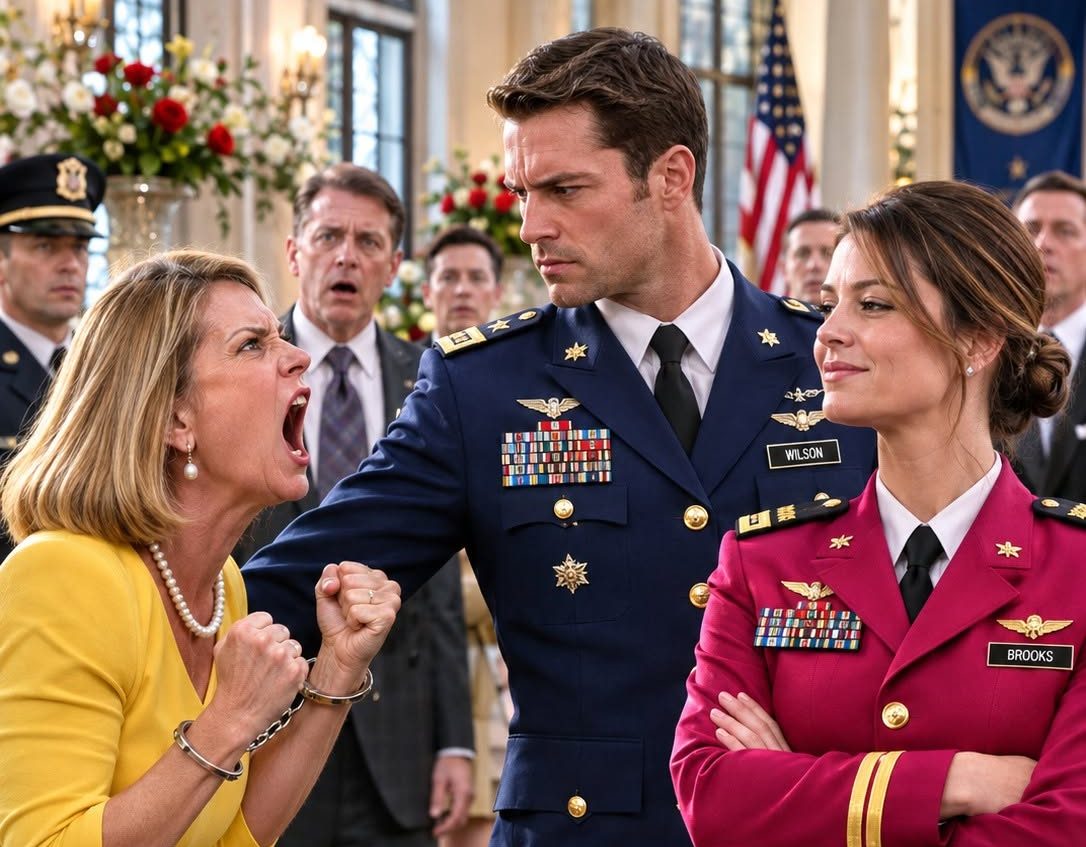
The day before my brother’s wedding, my mother grabbed a pair of scissors and cut my Army dress uniform to pieces. She destroyed every civilian outfit I’d brought, too, then threw
the scraps at my feet. She said she wanted me to “look like a proper woman.” She thought I’d have no choice but to arrive at the wedding embarrassed and defeated. Four hours later, a three-star general appeared at her front door and told her he was my husband.
My name is Major Emily Carter.
I stood in the guest bedroom of my parents’ house in Virginia, looking down at twelve years of my life lying in pieces across the floor.
Someone had slashed straight through the chest of my dress jacket. Two dresses dangled from their hangers in strips. The garment bag holding the outfit I’d planned to wear to the rehearsal had been sliced open as well.
“Don’t tell me you’re going to cry over that hideous uniform.”
I turned around.
My mother stood in the doorway with Aunt Marlene beside her, casually drinking wine as though the two of them had just finished some ordinary household chore.
“Why would you do this?” I asked.
Mom gave a dismissive shrug. “This weekend is supposed to be about Lucas. Just once, I wanted you to quit showing off like everybody’s supposed to admire you.”
Marlene gave me a smug smile. “Who knows? If you started dressing like a regular woman, maybe you’d finally get yourself a husband.”
I nearly laughed.
For twelve years, my family had acted as though my Army career was something I would eventually grow out of. When I enlisted instead of going to work at Dad’s company, Mom told the rest of the family I’d ruined my future.
After I became an Army physician, she dismissed me as nothing more than an overpaid nurse.
They knew nothing about the soldiers whose hands I’d held in operating rooms.
They had no idea I’d recently been promoted to Major.
And they definitely didn’t know I’d been married for the past eighteen months.
Without saying another word, I took pictures of the damaged clothing and sent them to one person.
My husband.
Lieutenant General Alexander Hale.
He responded almost at once.
“Text me the address.”
Four hours afterward, the doorbell sounded.
From downstairs, Mom yelled, “Emily! Answer the door!”
I went to the entrance and opened it.
Alexander was standing on the front porch in his full service uniform.
Three stars marked his shoulders.
The moment he looked at me, his face softened.
“Are you okay, Major?”
“I am now.”
He leaned forward and kissed my forehead.
Behind me, glass broke against the floor.
Aunt Marlene had let her wineglass slip from her hand.
My father rose slowly from the couch. Lucas stopped speaking. Mom looked at Alexander as though she couldn’t remember how to take a breath.
“General Hale?” Dad murmured.
Alexander walked into the house with a garment bag in his hand.
At last, my mother managed to speak. “What are you doing here?”
“Someone destroyed my wife’s uniform. That’s why I’m here.”
Everyone went still.
“Your wife?”
Alexander opened the garment bag.
Hanging inside was a new dress uniform, fitted precisely to my measurements, with every ribbon, award, and insignia I had earned in its proper place.
He turned toward me.
“No one has the right to take away what you’ve earned.”
Then he faced my mother.
“You aren’t required to understand your daughter’s military service. But you are going to respect it.”
We were heading for the door when Lucas spoke behind us.
“Emily… you are coming to the wedding tomorrow, aren’t you?”
I gave him a smile.
“Oh, I wouldn’t miss it.”
Because revealing my marriage wasn’t the biggest surprise waiting for my family.
The following morning, several vehicles transporting senior military officers would pull up at Lucas’s wedding.
And one of those officers would have a sealed document involving my father.
A document my family had worked for twelve years to keep out of my hands.
I knew about the document because Alexander had shown me a copy six weeks earlier.
What I didn’t know was whether my father would finally admit what he’d done when the original was placed in front of him.
That night, after leaving my parents’ house, Alexander drove us to a small hotel outside Richmond. He hadn’t said much during the drive. He’d simply reached across the center console and taken my hand.
I was grateful for the silence.
At the hotel, he carried the replacement uniform upstairs, hung it carefully in the closet, and turned toward me.
“How long have they been treating you like that?”
I sat on the edge of the bed.
“Since I was seventeen.”
He waited.
I looked down at my hands.
“Maybe earlier. I just didn’t recognize it until then.”
Alexander loosened his tie and sat beside me.
“Emily, your mother destroyed a military uniform. She destroyed personal property. And she did it because she knew it would hurt you.”
“I know.”
“Then why are you trying to convince yourself it wasn’t serious?”
I opened my mouth to answer.
Nothing came out.
That was the problem with spending your entire childhood learning to survive your family. Eventually, you stopped asking whether their behavior was acceptable. You started measuring how much of it you could tolerate.
Alexander had never understood that part of me.
He came from a family where disagreements ended with apologies, not months of punishment. His parents had welcomed me into their home before they even knew what I did for a living.
My mother had spent twelve years making me feel that becoming a physician in the Army was something shameful.
Alexander’s mother had cried when she learned I’d operated on wounded soldiers during a deployment.
Not because she pitied me.
Because she was proud.
“There’s something I need to ask you,” Alexander said.
I looked at him.
“Are you going tomorrow because you want to celebrate Lucas, or because you want your parents to see what happens when they underestimate you?”
“Both.”
He nodded.
“Fair enough.”
I turned toward the window.
“But mostly because Lucas asked me.”
Alexander studied me for a moment.
“Do you think he knows?”
“About the document?”
“Yes.”
I shook my head.
“I don’t think so.”
“Then tomorrow may be harder for him than anyone.”
That possibility had been bothering me since the moment Lucas asked whether I’d attend.
My brother and I had never been particularly close, but we’d never been enemies either.
He’d accepted our parents’ favoritism without questioning it. I’d learned to live around it.
Still, Lucas had never personally tried to destroy my career.
I didn’t want his wedding day turned into a spectacle simply because our father had spent years hiding a crime.
Alexander seemed to read my thoughts.
“Everything has already been arranged through the proper channels,” he said. “Nobody is coming to arrest your father in the middle of a wedding ceremony.”
“Then why are Colonel Bennett and the others attending?”
“Because your father has avoided every private opportunity to resolve this. And because he insisted the matter wouldn’t proceed without witnesses when the investigators contacted him.”
I gave a bitter laugh.
“He always did like an audience.”
Alexander didn’t smile.
“There’s another reason.”
I looked at him.
“The company isn’t the only thing involved anymore.”
My stomach tightened.
“What does that mean?”
He hesitated.
“Emily, I need you to hear the official findings from the investigators, not from me. I’m your husband. I can’t be the person handling a matter involving your father.”
“I know.”
“And whatever happens tomorrow, I want you to remember something.”
“What?”
“Your father’s decisions aren’t your responsibility.”
I nodded.
But somewhere deep inside, I was still the seventeen-year-old girl standing in our kitchen while Dad told me I would regret refusing the future he’d planned.
And for the first time in twelve years, I was beginning to understand exactly what he’d meant.
The next morning, I woke before sunrise.
My new dress uniform hung beside the window. Alexander had arranged for a tailor to make the final adjustments the previous evening, and it fit perfectly.
I stood in front of the mirror, fastening each button.
The familiar movements steadied me.
I’d worn that uniform at ceremonies honoring fallen soldiers. I’d worn it while accepting an award for battlefield medical service. I’d worn it beside families who had lost people I couldn’t save.
But somehow, wearing it to my brother’s wedding frightened me more than any of those occasions.
Alexander appeared behind me.
He was already dressed.
Three stars gleamed on his shoulders.
“You look beautiful,” he said.
I smiled faintly.
“You look intimidating.”
“Occupational hazard.”
He adjusted the collar of my jacket, then kissed my cheek.
“You ready?”
“No.”
He nodded.
“Me neither.”
That made me laugh.
And just like that, some of the fear loosened.
We arrived at the wedding venue shortly before eleven.
My brother had chosen a historic Virginia estate surrounded by gardens, with a white-columned mansion overlooking a wide lawn.
Hundreds of guests were already gathering.
Luxury vehicles lined the circular driveway.
A string quartet played near the entrance.
And standing beneath a canopy of white roses was my mother.
She wore a pale champagne dress and an expression of complete satisfaction.
Until she saw us.
Her smile disappeared.
Aunt Marlene stood beside her, holding a glass of sparkling wine.
She followed Mom’s gaze.
Then she nearly dropped her drink again.
Alexander stepped out of the car first.
He came around to my side and opened the door.
I emerged in my dress uniform.
For a moment, neither woman spoke.
My mother looked from my face to my ribbons, then to Alexander.
“Emily,” she said quietly. “I thought we agreed you wouldn’t wear that.”
I stared at her.
“We didn’t agree on anything.”
She glanced nervously at nearby guests.
“This is Lucas’s wedding.”
“I know. That’s why I’m here.”
Aunt Marlene leaned closer to Mom.
“People are staring.”
Alexander offered me his arm.
“Then perhaps we should stop blocking the entrance.”
We walked past them.
I could feel my mother’s anger following us.
But I didn’t turn around.
Inside the mansion, Lucas was standing with his best man near the grand staircase.
He saw me.
For a moment, his expression was unreadable.
Then he stepped forward.
“Emily.”
“Hey, little brother.”
He looked at my uniform.
Then at Alexander.
Then back at me.
“You really married a general?”
“Eighteen months ago.”
“Wow.”
It was such a Lucas response that I nearly laughed.
He rubbed the back of his neck.
“Why didn’t you tell me?”
I considered giving him the easy answer.
That we’d wanted privacy.
That our schedules had been complicated.
That we hadn’t found the right moment.
All of those things were partly true.
But none was the real reason.
“Because every time I tried to share something important with this family, it became an argument about why I should’ve chosen a different life.”
Lucas looked away.
I saw the answer settle over him.
“Yeah,” he admitted. “That sounds like us.”
Alexander extended his hand.
“Congratulations, Lucas.”
My brother shook it.
“Thank you, sir.”
“Alexander is fine today.”
Lucas smiled nervously.
“I’ll work on that.”
Then his expression changed.
“Emily, did Mom really destroy your clothes?”
I nodded.
He closed his eyes.
“She told me you were exaggerating.”
“She usually does.”
He looked at the uniform.
“Is that a replacement?”
“Yes.”
He exhaled.
“I’m sorry.”
It wasn’t a grand apology.
It didn’t erase twelve years of silence.
But it was the first time my brother had acknowledged that what happened to me mattered.
I appreciated it more than he knew.
“Go get married,” I told him. “We’ll talk afterward.”
He reached for my hand.
“I’m glad you’re here.”
I squeezed his fingers.
“Me too.”
For a little while, the day almost felt normal.
Guests moved between the gardens and reception hall.
The bride, Natalie, arrived with her family.
I helped straighten Lucas’s boutonniere before he went outside.
And when the ceremony began, I sat beside Alexander beneath a white pavilion, watching my younger brother promise to love someone through good days and bad.
Natalie cried.
Lucas cried.
Even I felt tears gathering in my eyes.
For twenty beautiful minutes, none of the ugliness mattered.
My brother was happy.
That was enough.
Then the reception began.
And my father saw the black vehicles.
Three government sedans pulled into the estate’s side driveway shortly after one.
The first carried Colonel Rebecca Bennett, a senior Army legal officer who had been coordinating with federal investigators.
The second carried two civilian investigators.
The third carried an Army colonel and a retired brigadier general named Thomas Whitaker.
I knew Whitaker.
He had served on a military medical advisory board years earlier.
More importantly, he had known my grandfather.
My father’s father.
The man who’d died when I was sixteen.
The man whose final wishes had apparently never been honored.
Alexander noticed the vehicles before I did.
He touched my elbow.
“They’re here.”
My chest tightened.
Across the reception hall, my father was speaking with three business associates.
He wore an expensive charcoal suit and held a glass of whiskey.
He had been smiling.
But when Colonel Bennett entered, the color drained from his face.
I watched him set down his drink.
Then he walked toward us with the stiff, controlled expression he used whenever he believed someone was challenging his authority.
“Emily.”
“Dad.”
“What is this?”
I glanced toward the arriving guests.
“People you’ve been expecting, apparently.”
His jaw tightened.
“Not here.”
“That wasn’t my decision.”
He turned toward Alexander.
“General, with all due respect, this is a private family event.”
Alexander remained calm.
“Mr. Carter, I’m here as Emily’s husband.”
“Then tell these people to leave.”
“I don’t command civilian investigators, and Colonel Bennett isn’t here under my direction.”
Dad’s expression hardened.
“This is harassment.”
A woman’s voice answered from behind him.
“No, Mr. Carter. This is an opportunity to acknowledge receipt of documents you’ve repeatedly declined to accept.”
Colonel Bennett stood a few feet away.
She was in her early fifties, with silver threaded through her dark hair and a manner that reminded me of the best surgeons I’d ever worked with.
Efficient.
Controlled.
Uninterested in intimidation.
Beside her stood a civilian investigator carrying a leather folder.
My father’s gaze dropped to it.
And for the first time in my life, I saw genuine fear in his eyes.
“Not now,” he hissed.
Bennett glanced toward the wedding guests.
“We requested a private meeting off-site, Mr. Carter. Your attorney’s office insisted you would only accept personal service at this location today. We can step into a private room.”
Dad said nothing.
“That would be my preference,” she added.
Alexander leaned toward me.
“You don’t have to be part of this.”
I looked at my father.
Twelve years.
Twelve years of insults, missed holidays, unanswered letters, and quiet humiliation.
Twelve years of believing he hated me because I refused to work at his company.
Now I was about to find out what else he’d been hiding.
“I’m staying,” I said.
My father gave a sharp shake of his head.
“Absolutely not.”
Colonel Bennett looked at him.
“Major Carter is an interested party, Mr. Carter. She has the right to hear the findings being disclosed to her.”
He stared at her.
Then he looked at Alexander’s uniform.
At the three stars.
At the investigators.
And finally at me.
“You planned this.”
I met his eyes.
“No, Dad. You did.”
We moved into a small library near the rear of the mansion.
The room smelled of polished wood and old books.
Tall windows overlooked the gardens where guests were taking photographs.
My father stood near the fireplace.
Mom had followed us, along with Aunt Marlene, who apparently couldn’t resist the possibility of another family confrontation.
Lucas arrived moments later.
His new wife was beside him.
“What’s going on?” he asked.
I turned.
“Lucas, you should be with your guests.”
“Dad just told me you’re trying to ruin the wedding.”
Natalie looked between us.
“Is that true?”
“No,” I said. “But there are things your family needs to hear.”
My father pointed toward the door.
“Lucas, get out.”
My brother didn’t move.
For once, he looked directly at Dad.
“No. I want to know.”
Colonel Bennett placed the folder on a table.
“Before we begin, I want to make one thing clear. This is not a military disciplinary proceeding against Mr. Carter. He’s a civilian. The matters under review involve corporate records, federal contracting disclosures, and potential financial misconduct. Any criminal determination would be made through the appropriate civilian authorities.”
Dad folded his arms.
“My attorneys have already addressed this nonsense.”
“Your attorneys responded to two preliminary requests,” Bennett said. “They haven’t addressed the newly recovered records.”
She opened the folder.
And slid the first document toward me.
Across the top was my grandfather’s name.
Charles Edwin Carter.
Below it was a date.
Thirteen years earlier.
I recognized his signature immediately.
My grandfather had beautiful handwriting.
Even as a teenager, I used to watch him sign birthday cards with a fountain pen.
The document was an amendment to a family trust.
I read the first paragraph.
Then the second.
And suddenly, I understood.
My grandfather had established an educational and professional development trust for both Lucas and me.
Equal amounts.
Equal rights.
The trust provided funding for higher education, professional training, and certain approved business ventures.
But it contained one unusual condition.
Neither beneficiary’s eligibility could be limited by parental preference regarding career choice.
I looked up.
“Grandpa knew.”
My father said nothing.
“He knew you wanted me at the company.”
Still nothing.
Colonel Bennett spoke gently.
“Your grandfather amended the trust shortly before his death. He wanted to make sure you could pursue medicine, military service, or any other lawful profession without losing financial support.”
My throat tightened.
I remembered Grandpa sitting beside me on our back porch when I was sixteen.
I’d told him I wanted to become a doctor.
He’d listened carefully.
Then he’d asked whether I was afraid of disappointing my parents.
I’d said yes.
He’d squeezed my hand.
“Emily, don’t spend your life becoming someone else’s idea of successful.”
I’d thought those were simply the words of a loving grandfather.
I hadn’t known he’d taken legal steps to protect my future.
“How much?” I whispered.
The investigator slid another document toward me.
“The original allocation was approximately two million dollars per beneficiary.”
Mom made a small sound.
Lucas stared at Dad.
“Two million?”
I continued reading.
The money had been invested.
Over the years, it had grown substantially.
My portion should have been worth several million dollars.
Instead, the account had been drained.
Through a series of transfers.
Into companies controlled by my father.
I looked up slowly.
“Dad?”
He shifted his weight.
“That’s not what it looks like.”
I almost smiled.
Because I’d heard those words before.
When he missed my commissioning ceremony.
When he’d promised to attend my medical school graduation and then disappeared.
When Mom told relatives I had abandoned the family.
Every betrayal came with an explanation.
Every explanation required me to doubt what I could see.
“Then tell me what it is,” I said.
Dad looked toward Lucas.
“Everything I did was for this family.”
Colonel Bennett placed another sheet on the table.
“Mr. Carter, these records indicate that transfers were made using signatures purportedly belonging to Major Carter.”
I stared at the page.
There was my name.
Emily Carter.
A signature beneath it.
But it wasn’t mine.
It looked enough like mine to fool someone who’d never seen me sign a document.
I knew immediately who had written it.
My father.
He’d been signing school permission slips and financial paperwork for me since I was a child.
He knew exactly how to imitate my handwriting.
“That’s forged,” I said.
The investigator nodded.
“That’s the preliminary conclusion of the document examiner.”
My mother suddenly stepped forward.
“Robert, tell them.”
Dad stared at her.
“Stay out of this.”
“Tell them you had permission.”
“I said stay out of it.”
Her face changed.
And I saw something that frightened me more than his anger.
Recognition.
She already knew.
“Mom?” I asked.
She wouldn’t look at me.
I felt something inside me go cold.
“You knew?”
She pressed her lips together.
“Emily, you need to understand what was happening at the time.”
I shook my head.
“No. Answer me.”
Her voice trembled.
“Your father had a business to protect.”
Lucas stepped closer.
“What business?”
Dad snapped, “Lucas, enough.”
But my brother wasn’t listening anymore.
“Was this money used for Carter Development?”
Silence.
Lucas looked at me.
Then at the documents.
Then back at Dad.
“Oh my God.”
I watched the realization spread across his face.
He had worked at the company since graduating from college.
He knew the financial history.
He knew the expansions.
The acquisitions.
The sudden recovery from a recession that had nearly destroyed the business.
“You used Emily’s trust,” he whispered.
Dad looked exhausted.
“Those funds were never meant to sit untouched while the company collapsed.”
“Grandpa left them to her.”
“I was the trustee.”
“That didn’t make the money yours!”
Lucas’s voice echoed through the library.
Natalie reached for his arm.
He stepped back, stunned by his own anger.
Dad looked toward me.
“You weren’t going to use it.”
I stared at him.
“What?”
“You joined the Army. Your education was being paid for. You didn’t need millions of dollars sitting in an account.”
I could barely believe what I was hearing.
“So you took it?”
“I invested it.”
“In your own company.”
“To protect your brother’s future.”
There it was.
The truth I’d spent years trying not to see.
Lucas’s future mattered.
Mine was negotiable.
My father continued, apparently believing that if he spoke long enough, the situation would become reasonable.
“You have to understand, Emily. Lucas was supposed to inherit the company. He needed a stable foundation.”
“And I didn’t?”
“You had the military.”
I felt Alexander move beside me.
But he didn’t speak.
He knew this was mine to answer.
“Do you know how many nights I worked while I was training?” I asked.
Dad frowned.
“That’s irrelevant.”
“Do you know how many birthdays I spent overseas? How many holidays? How many times I called home and nobody answered?”
“Emily—”
“You told everyone I was a failure because I chose service over the family business. All that time, you were using money Grandpa left me to keep that business alive.”
My father looked away.
I waited.
For an apology.
For shame.
For anything that suggested he understood what he’d done.
Instead, he said, “I made difficult decisions. That’s what leadership requires.”
Alexander’s face hardened.
I turned toward him.
He remained silent.
But I knew what he was thinking.
Real leadership required accountability.
My father had confused control with authority for so long that he no longer recognized the difference.
Colonel Bennett opened another section of the folder.
“There’s an additional issue.”
Dad’s shoulders stiffened.
The civilian investigator took over.
“During the period when these transfers occurred, Carter Development was applying for federal construction contracts. Certain financial disclosures listed funds from Major Carter’s trust as unrestricted corporate assets.”
Dad said nothing.
“Those disclosures may have materially misrepresented the company’s financial position.”
Lucas looked sick.
“Which contracts?”
The investigator named three projects.
I recognized one.
A medical facility renovation near a military installation.
My father had bragged about winning that contract for years.
I looked at him.
“Did you use my name on those applications?”
He shook his head.
“Not directly.”
The investigator slid forward another record.
A document bearing my forged signature.
This one authorized the use of trust assets as collateral.
A document submitted through a lender in connection with the federal contract.
My stomach turned.
For years, my father had told relatives that my military career was an embarrassment.
Meanwhile, he had been using my identity to strengthen his business dealings.
“How long have you known?” I asked him.
He didn’t answer.
“Dad.”
His eyes finally met mine.
“Since the beginning.”
The room went quiet.
Even Aunt Marlene had stopped pretending she wasn’t listening.
I turned toward Colonel Bennett.
“Why did this surface now?”
She looked at the investigator.
He nodded.
“An internal audit at one of the lending institutions flagged irregularities in the collateral records. The review led to records from the trust and eventually to signatures attributed to you.”
“Why wasn’t I contacted earlier?”
“We attempted to locate the relevant beneficiary using the information on file. The trust records contained an outdated civilian address and an email account we later determined wasn’t controlled by you.”
I looked at my father.
His face told me everything.
“Who controlled the email account?”
The investigator answered.
“It was registered using information connected to your father’s company.”
I closed my eyes.
My father hadn’t simply stolen money.
He’d built an entire system to keep me from finding out.
And he’d maintained it for twelve years.
I thought about all the times he’d accused me of abandoning the family.
All the times he’d said I was selfish.
All the times Mom had told me I was ungrateful.
They’d been afraid.
Not of losing me.
Of what I might discover.
Lucas sank into a chair.
Natalie knelt beside him.
He looked up at Dad.
“Did you know I was working with money that belonged to Emily?”
Dad shook his head.
“Lucas, the company is your legacy.”
“No.”
My brother’s voice was quiet.
“No, it isn’t.”
Dad stared at him.
Lucas stood.
“Grandpa built the company. You were supposed to protect it. You used Emily’s inheritance, and you let me believe everything was legitimate.”
“Because it was legitimate!”
The investigator calmly closed the folder.
“Mr. Carter, that’s a determination for the legal process. You and your counsel will receive the underlying records and an opportunity to respond.”
My father looked at the closed folder.
Then at the door.
For a terrible moment, I thought he might try to walk out.
Instead, he turned toward me.
“You brought these people to your brother’s wedding.”
I looked at him for a long time.
“No, Dad. Your actions brought us here.”
His face reddened.
“You’re enjoying this.”
That accusation hurt more than I expected.
Because I wasn’t enjoying anything.
I had wanted a father who was proud of me.
A mother who didn’t mock my choices.
A brother who noticed when I was hurting.
I had wanted Christmas dinners that didn’t end in arguments and phone calls that didn’t leave me feeling ashamed.
I hadn’t wanted federal investigators standing in a wedding venue with documents proving my own father had stolen from me.
“Do you really think this is what I wanted?” I asked.
He didn’t answer.
I stepped closer.
“I wanted you at my graduation.”
His expression flickered.
“I invited you.”
“Emily—”
“I wanted you to call me when I got promoted. I wanted you to ask whether I was safe when I deployed. I wanted you to care about my life even though it wasn’t the one you chose.”
My voice cracked.
I hated that.
But I didn’t stop.
“Instead, you spent twelve years making me feel like I had failed you. And all that time, you were hiding what you did.”
My father’s eyes moved toward my uniform.
For once, he had nothing to say.
I looked at my mother.
“And you.”
She began shaking her head.
“Emily, please.”
“You cut up my clothes yesterday.”
“I was upset.”
“You destroyed the one thing you knew represented everything I’d worked for.”
Her eyes filled with tears.
“I didn’t know Alexander was your husband.”
The words hung between us.
Then I understood.
She wasn’t apologizing because she’d hurt me.
She was frightened because she’d discovered I had someone powerful standing beside me.
I felt a strange calm settle over me.
“Would you have done it if I’d married an ordinary man?” I asked.
She opened her mouth.
Closed it.
“Would you have done it if I’d come alone?”
She looked away.
There was my answer.
I stepped back.
“I won’t keep giving you opportunities to hurt me.”
Mom began crying.
For most of my life, that would’ve been enough to make me apologize.
Not this time.
Colonel Bennett spoke.
“Major Carter, we have sufficient information for today. The remaining interviews can be scheduled through counsel.”
I nodded.
The investigator handed me copies of the documents.
“There may be additional records requiring your review. Your civilian attorney can coordinate with the relevant agencies.”
“Thank you.”
Dad suddenly stepped forward.
“Emily, don’t do this.”
I looked at him.
“Don’t do what?”
“Turn your own father into a criminal.”
My hands tightened around the folder.
Alexander moved closer, but I raised a finger slightly.
I could handle this.
“Dad, I didn’t forge those signatures.”
He stared at me.
“I didn’t transfer that money.”
His jaw worked.
“I didn’t submit false financial records.”
“Emily—”
“You made those choices.”
He looked around the room, searching for someone to support him.
My mother was crying.
Aunt Marlene was staring at the carpet.
Lucas stood beside Natalie, his face pale.
And Alexander remained quietly at my side.
My father had always been the loudest person in any room.
For the first time, nobody was listening to him.
I turned toward the door.
Then Lucas spoke.
“Emily.”
I stopped.
He looked at the folder in my hand.
“Are you going to sue us?”
The word us made my chest tighten.
“Lucas, I don’t want anything that belongs to you.”
He nodded slowly.
“But what if the company owes you money?”
“Then the company needs to address that.”
He swallowed.
“Even if it means losing everything?”
I looked at him.
“Would you want me to ignore it if someone had done this to Natalie?”
He glanced at his wife.
She was holding his hand.
“No,” he whispered.
“Then don’t ask me to ignore it because we’re family.”
He nodded again.
This time, there was understanding in his face.
“I’m not asking you to.”
He looked toward Dad.
“I’m asking because I need to know how much damage he’s done.”
My father made a strangled sound.
“Lucas, you can’t possibly believe—”
“I believe the documents.”
Those four words changed something.
Not just between Lucas and Dad.
Between Lucas and me.
For the first time, my brother had chosen the truth over the comfort of remaining uninvolved.
I looked at Natalie.
“I’m sorry this happened today.”
She shook her head.
“You didn’t cause it.”
Then she surprised me.
She stepped forward and hugged me.
I’d only met her a handful of times.
But she held me like family.
And in that moment, I realized how badly I’d needed someone to do that.
When we returned to the reception hall, the music was still playing.
Guests were laughing.
Servers carried trays of champagne.
Someone had begun cutting the wedding cake.
The ordinary happiness of the day felt almost unreal after what had happened in the library.
Lucas took Natalie’s hand.
He looked exhausted.
But when the photographer called for the newlyweds, he straightened his shoulders and went to stand beside her.
I watched them smile for the camera.
Then Alexander leaned toward me.
“Do you want to leave?”
I considered it.
Part of me wanted to disappear.
To return to our hotel, take off my uniform, and spend the rest of the day pretending none of this had happened.
But I looked across the room.
Lucas caught my eye.
He gave me a small nod.
I understood.
He wanted me to stay.
Not because the family expected it.
Because he did.
“Not yet,” I said.
Alexander smiled.
“Then we’re staying.”
We returned to our table.
A few minutes later, a server approached with two glasses of sparkling water.
Alexander took one and handed me the other.
“To your brother,” he said.
I lifted my glass.
“To Lucas.”
He touched his glass to mine.
“And to you.”
I looked at him.
“For what?”
“For standing your ground.”
I smiled faintly.
“I almost ran.”
“But you didn’t.”
He squeezed my hand.
“You know, people think courage means never being afraid.”
I raised an eyebrow.
“Are you giving me a military lecture at a wedding?”
“Possibly.”
I laughed.
He smiled.
“Courage is doing the right thing when you’re afraid of what it might cost.”
I looked toward the dance floor.
My brother was holding his new wife.
She had her head against his shoulder.
For a moment, I allowed myself to feel happy for them.
Then I felt a presence beside my chair.
It was my mother.
Her makeup had been repaired.
Her posture was perfect.
She looked like the woman who’d hosted countless charity dinners and company events.
Only her hands betrayed her.
They were trembling.
“Emily,” she said.
I turned.
Alexander remained seated.
Mom glanced at him.
Then back at me.
“Could we talk privately?”
I looked at her.
“About what?”
Her lips tightened.
“Please don’t make a scene.”
I almost laughed.
After everything that had happened, she was still worried about appearances.
“We can talk here.”
She glanced around.
People were enjoying the reception.
Nobody was paying attention.
Still, she lowered her voice.
“Your father is in terrible trouble.”
“I know.”
“He’s worked his entire life for that company.”
“I know.”
“Surely there’s a way to handle this without destroying everything.”
I set down my glass.
“Mom, do you understand what happened?”
She looked offended.
“Of course I do.”
“Then tell me.”
Her expression changed.
“What?”
“Tell me what Dad did.”
She hesitated.
“He borrowed money.”
“No.”
“Emily—”
“He forged my signature. He transferred assets that weren’t his. He concealed the records from me. And he used those assets to support business transactions.”
She looked down.
“I never approved any of that.”
“Did you know?”
She didn’t answer.
I felt a familiar ache spreading through my chest.
“Mom.”
Her eyes filled again.
“I knew he was using part of the money.”
“How much?”
“I don’t know.”
“When?”
“Years ago.”
I stared at her.
“Before I became an Army doctor?”
She nodded.
“Before I was promoted?”
Another nod.
“Before you told everyone I was a failure?”
Her face crumpled.
“Emily, I was trying to keep the family together.”
“No.”
I spoke more sharply than I’d intended.
She flinched.
“You were trying to keep the family the way you wanted it.”
Her eyes widened.
I continued quietly.
“You wanted Lucas at the company. You wanted me married to someone you approved of, living near home, pretending my ambitions were a phase. When I refused, you punished me.”
“That’s not fair.”
“Neither was destroying my uniform.”
She looked at Alexander.
“General, surely you understand that families sometimes say things they don’t mean.”
He set down his glass.
“Mrs. Carter, I’m not going to negotiate your relationship with your daughter.”
Mom blinked.
He continued.
“Emily can decide what she wants from you. My job is to support her decision.”
For a moment, my mother looked genuinely confused.
She’d spent her entire marriage watching my father make decisions for everyone.
The idea that a man with three stars on his shoulders might refuse to control his wife seemed beyond her understanding.
She turned back to me.
“What do you want, Emily?”
It was the first time she’d asked that question without immediately supplying her own answer.
I took a breath.
“I want you to stop defending what Dad did.”
She looked down.
“I want you to acknowledge what you did yesterday.”
Tears slipped down her cheeks.
“And I want you to understand that you don’t get to hurt me and then demand forgiveness because you’re my mother.”
She was silent for a long time.
Finally, she whispered, “I don’t know how to fix this.”
I looked at her.
“Neither do I.”
For once, I didn’t rush to make her feel better.
She stood there another moment.
Then she quietly walked away.
Alexander reached beneath the table and took my hand.
I held on.
We stayed until the first dance ended.
Then Lucas came over.
“Can I borrow my sister?”
Alexander smiled.
“Absolutely.”
Lucas offered me his hand.
I stood.
The band had just begun playing a slower song.
He led me onto the dance floor.
For a few seconds, we moved awkwardly.
Then he laughed.
“You’re still terrible at dancing.”
“You’re still worse.”
He smiled.
It reminded me of the boy he’d been before our parents taught us that love was something you earned by meeting expectations.
We danced quietly.
Then he said, “I found something last night.”
I looked at him.
“What?”
“After you left the house.”
He swallowed.
“Mom and Dad were arguing. I went into Dad’s office because I wanted to know what was happening. He’d left one of his desk drawers open.”
My pulse quickened.
“Lucas.”
“I didn’t go looking for company secrets. I was trying to figure out why he was so angry about Alexander.”
He looked toward the ceiling.
“There was a folder with your name on it.”
I felt my stomach tighten.
“What was inside?”
“Letters.”
I stared at him.
“What letters?”
“From you.”
For a moment, the music seemed to fade.
“Letters I sent home?”
He nodded.
“From overseas. From medical school. Even some from when you first enlisted.”
My throat closed.
I’d written dozens of letters.
Especially during my first deployment.
I’d sent photographs, holiday cards, notes about training, and stories I thought might make my parents proud.
Most had gone unanswered.
Eventually, I stopped writing.
“What was Dad doing with them?”
Lucas shook his head.
“I don’t know.”
He reached inside his jacket and withdrew a small envelope.
“I brought a few.”
My hands trembled as I took it.
The first envelope bore a military postal marking.
My handwriting.
My mother’s name.
Unopened.
The second was from my medical school.
Also unopened.
The third made my knees feel weak.
It was a letter I’d written after my first major surgical case overseas.
I’d told my parents about a young soldier who’d survived injuries we initially feared were fatal.
I’d written that the experience had confirmed everything I believed about becoming a physician.
I remembered ending the letter with six words.
I hope you’re proud of me.
The envelope was still sealed.
I looked at Lucas.
“Why?”
His expression twisted.
“I asked Dad the same thing.”
“What did he say?”
“He said there was no point encouraging you.”
I stared at him.
Lucas’s eyes were wet.
“Emily, I didn’t know.”
I couldn’t speak.
He tightened his grip on my hand.
“I thought you stopped writing because you didn’t want anything to do with us.”
I looked at the envelopes.
Twelve years of silence.
And now I knew that at least some of it hadn’t been mine.
Lucas swallowed.
“I used to ask Mom why you never came home.”
“What did she say?”
“That you thought you were better than us.”
I closed my eyes.
He stepped closer.
“I’m sorry I believed her.”
That was when I began to cry.
Not loudly.
Not dramatically.
Just a few tears I couldn’t stop.
Lucas pulled me into his arms.
I held on.
For the first time in years, my little brother felt like my little brother again.
“I missed you,” he whispered.
I pressed my forehead against his shoulder.
“I missed you too.”
When the song ended, neither of us moved immediately.
Then Lucas stepped back.
“There’s more in the folder. I’ll get everything to you.”
I nodded.
“Thank you.”
He glanced toward our parents.
“They don’t get to decide whether we’re family anymore.”
I looked at him.
And for the first time all day, I felt something that wasn’t anger or grief.
Hope.
The following weeks were difficult.
The investigation expanded.
Civilian authorities reviewed the trust records, the corporate transfers, and the documents submitted to lenders.
My attorney filed a civil action seeking a full accounting and recovery of the diverted trust assets.
A court appointed an independent professional to oversee the disputed trust matters while the financial records were examined.
My father’s attorneys challenged nearly everything.
They questioned the authenticity of the recovered documents.
They argued that the transfers had benefited the family.
They insisted that I had implicitly approved the arrangements by failing to object years earlier.
But every argument returned to the same problem.
I hadn’t known the trust existed.
And the signatures weren’t mine.
Meanwhile, the company’s board began its own review.
Lucas, who had been working as a vice president in operations, voluntarily stepped back from financial decisions connected to the disputed transactions.
He cooperated with investigators.
And when Dad demanded that he defend the company publicly, Lucas refused.
“I’m not lying for you,” he told him.
Dad threatened to remove him from the business.
Lucas said he understood.
It was the first major decision he’d ever made that went directly against our father’s wishes.
And it cost him.
Within two months, my brother was no longer working at Carter Development.
He called me the day it happened.
“I think Dad expected me to beg.”
I sat at my kitchen table, listening.
“Did you?”
“No.”
He gave a weary laugh.
“I just packed my office.”
“How are you doing?”
He was quiet.
“Honestly? I don’t know who I am without that company.”
I understood that feeling better than he realized.
For years, my father had defined our value by our usefulness to his plans.
I’d rejected the role.
Lucas had accepted it.
Now we were both trying to learn who we were without his approval.
“You’re Natalie’s husband,” I said. “You’re my brother. You’re someone who knows how to work hard and run projects. The company didn’t create those things.”
He was silent.
Then he said, “You sound like Grandpa.”
My eyes stung.
“Good.”
We began talking regularly.
Sometimes about the investigation.
More often about ordinary things.
Natalie’s new job.
His attempts to learn cooking.
My hospital schedule.
Alexander’s terrible habit of leaving half-finished crossword puzzles around the house.
Slowly, we built the relationship we should’ve had all along.
My mother tried calling several times.
At first, every conversation became another attempt to convince me to protect Dad.
Then I stopped answering.
Eventually, she sent a letter.
It was six pages long.
The first four pages explained why she’d behaved as she had.
The pressure of raising a family.
The expectations of the community.
Her fear that I would be hurt or abandoned in a career she didn’t understand.
I nearly stopped reading.
Then I reached the fifth page.
There, for the first time, she wrote something different.
I destroyed your uniform because I wanted to hurt you.
I read the sentence twice.
She continued.
I was angry that you had built a life I couldn’t control. I told myself I was helping you, but I knew what I was doing. I was wrong.
I sat quietly for a long time.
Alexander found me at the kitchen table.
He saw the letter.
“From your mother?”
I nodded.
“Is it another excuse?”
“Not entirely.”
He sat beside me.
“How do you feel?”
I considered the question.
“Sad.”
He nodded.
“That makes sense.”
“And relieved.”
“That makes sense too.”
I looked at him.
“Do you think I should forgive her?”
He shook his head.
“I think you should decide what forgiveness means to you. And whether you’re ready for it.”
I rested my head against his shoulder.
For once, I didn’t feel pressured to reach an answer.
Three months after the wedding, the investigators discovered another document.
This one changed the direction of the case.
It was a memorandum from my grandfather’s former attorney.
Dated shortly before Grandpa’s death.
The attorney had recorded a meeting with my father concerning the trust amendment.
According to the memorandum, Dad had objected to the provision protecting my right to pursue an independent career.
He’d argued that the money should be used to preserve Carter Development.
Grandpa had refused.
Then he’d instructed the attorney to distribute copies of the trust documents to both beneficiaries when they reached the appropriate age.
The attorney had complied with the trust’s administrative requirements.
But the address listed for me had been changed through correspondence submitted by my father in his capacity as trustee.
The investigators recovered the paperwork.
My father had directed correspondence intended for me to an address controlled by his business.
It wasn’t a misunderstanding.
It wasn’t a clerical error.
It was deliberate.
When my attorney showed me the documents, I felt strangely numb.
I’d already accepted that Dad had stolen from me.
What I hadn’t fully understood was how carefully he’d planned to keep me ignorant.
He’d spent years telling me that my grandfather would have been disappointed in my choices.
Now I knew the opposite was true.
Grandpa had tried to protect them.
I drove to the cemetery that weekend.
Alexander offered to come.
I told him I needed to go alone.
My grandfather was buried beneath a large oak tree in a quiet section of a cemetery outside Richmond.
I’d visited only a few times since joining the Army.
Standing there, I felt sixteen again.
I placed a small bouquet of white roses beside the headstone.
Then I sat on the grass.
“Hey, Grandpa.”
The wind moved through the branches overhead.
“I finally found out.”
My voice cracked.
“You tried to make sure I could become whoever I wanted.”
I looked at his name carved into the stone.
“I wish I’d known.”
For a long time, I sat without speaking.
Then I took a folded piece of paper from my pocket.
It was a copy of the trust amendment.
I’d highlighted one sentence.
No beneficiary shall suffer reduction or forfeiture of benefit on account of selecting a lawful vocation inconsistent with the preference of a parent or guardian.
I read it aloud.
Then I smiled through my tears.
“Still looking out for me.”
I stayed until the afternoon sunlight began slipping through the trees.
When I left, I felt lighter than I had in years.
Not because everything was resolved.
But because one painful question finally had an answer.
My grandfather had believed in me.
And my father had lied about it.
Six months after Lucas’s wedding, the financial investigation reached a turning point.
Independent auditors confirmed that substantial trust assets had been transferred without authorization.
Some had been used to cover operating losses.
Others had supported expansion projects and financial obligations unrelated to the trust.
The investigators also identified inaccurate financial representations connected to several lending arrangements.
Federal prosecutors reviewed the evidence.
Eventually, my father was charged with offenses arising from the fraudulent financial records and transfers.
The criminal case did not proceed quickly.
There were hearings.
Motions.
Arguments over documents.
Months of legal work that felt both exhausting and strangely impersonal.
For years, Dad had controlled our family through emotion.
Now his decisions were being examined through evidence.
Bank records.
Signatures.
Emails.
Financial statements.
And evidence didn’t care how loudly he spoke.
The civil action moved forward separately.
Carter Development’s board agreed to cooperate with the accounting process and negotiate a resolution concerning the misappropriated trust assets.
Some money could be recovered.
Some couldn’t.
Certain properties were sold.
Insurance issues and competing creditor claims complicated the process.
It was messy.
Slow.
Far less satisfying than the dramatic justice people imagine when they hear stories like mine.
But it was real.
And it mattered.
During that period, my father sent me a message.
Only one.
I hope you’re happy. You’ve destroyed everything your grandfather built.
I read it standing in my hospital office.
For a moment, the old guilt returned.
Then I looked around.
At the photographs on my desk.
At the certificates hanging on the wall.
At a picture of Alexander and me laughing during a hike.
And at a small framed photograph of Grandpa holding my hand when I was eight.
I typed a reply.
Grandpa built something that was supposed to protect both of us. You chose to destroy that trust.
Then I blocked the number.
It was one of the hardest things I’d ever done.
Not because I thought I was wrong.
But because part of me still wanted him to say he loved me.
I finally understood that wanting something didn’t mean I had to keep allowing myself to be hurt while I waited for it.
My mother and I met for coffee several weeks later.
It was the first time we’d been alone together since the wedding.
She looked older.
Not dramatically.
Just tired in a way I’d never noticed before.
Her hair was still perfectly styled.
Her clothes were expensive.
But she held her coffee cup with both hands as though she needed something steady.
“Thank you for coming,” she said.
I nodded.
She looked at the table.
“I’ve been seeing a counselor.”
That surprised me.
Mom had spent most of my childhood dismissing therapy as something for people who couldn’t manage their emotions.
“How’s that going?”
She gave a small, embarrassed laugh.
“Uncomfortable.”
I almost smiled.
“That sounds about right.”
She looked up.
“I’ve been thinking about what you said at the wedding.”
I waited.
“About wanting us at your graduation. And your promotions.”
Her eyes filled.
“I didn’t understand how much I’d missed.”
I looked down at my coffee.
“You missed a lot.”
She nodded.
“I know.”
Then she reached into her purse.
She pulled out a photograph.
It showed me at seventeen, standing in front of my first military training facility.
I was smiling so hard my cheeks looked painful.
I remembered sending that picture home.
Mom placed it on the table.
“I found this in the drawer with your letters.”
I stared at it.
“Did you ever look at it?”
She nodded.
“Once.”
“What did you think?”
She took a shaky breath.
“That you looked happy.”
The answer surprised me.
She wiped at her eyes.
“And I hated it.”
I looked up.
She began crying.
“Because you were happy somewhere I couldn’t control. And I convinced myself that meant you didn’t love us anymore.”
For a moment, neither of us spoke.
Then she whispered, “I was jealous of your independence.”
It was the most honest thing I’d ever heard her say.
I felt tears gathering.
But I didn’t reach across the table.
Not yet.
“I’m glad you’re getting help,” I said.
She nodded.
“I know I can’t ask you to pretend none of this happened.”
“No.”
“And I know one apology doesn’t fix twelve years.”
“No.”
She looked at me.
“But could we try to know each other again?”
I considered the question carefully.
Then I answered.
“Slowly.”
Her face crumpled.
She nodded.
“Slowly.”
It wasn’t forgiveness.
Not yet.
But it was a beginning.
A year after the wedding, the criminal case against my father reached its conclusion.
Faced with the documentary evidence and the financial findings, he entered a guilty plea to multiple fraud-related charges under an agreement with prosecutors.
He was ordered to pay restitution, subject to the court’s determination and his ability to satisfy the judgment, and received a custodial sentence followed by supervised release.
The civil settlement addressed the remaining trust claims through a combination of recovered funds, property proceeds, and structured payments.
I did not recover everything Grandpa had intended for me.
Some of the money was gone.
Some of the harm couldn’t be measured in dollars.
No settlement could return the years when I’d believed my family was ashamed of me.
No court could give me back the letters my parents never opened.
But the truth was finally part of the record.
And nobody could take that away.
Lucas attended the sentencing.
So did my mother.
Alexander came with me, but sat quietly beside me.
My father looked smaller than I’d remembered.
He wore a plain suit.
His hair had gone almost completely gray.
When the judge invited him to speak, he stood and read from a prepared statement.
He acknowledged violating the trust and falsifying records.
He expressed regret for the financial consequences.
He apologized to the employees and business partners affected by the investigation.
Then he looked at me.
For one second, I thought he might finally say what I’d been waiting to hear.
Instead, he said, “I hope my daughter understands that I was trying to protect our family.”
My chest tightened.
Alexander’s hand closed gently around mine.
I looked at my father.
And I realized something.
He still believed protecting the family meant controlling it.
He still couldn’t separate his intentions from the damage he’d caused.
Maybe one day he would.
Maybe he wouldn’t.
But I no longer needed him to understand before I could move forward.
After the hearing, Lucas found me in the courthouse hallway.
He was carrying a small box.
“Emily.”
I turned.
“Hey.”
He looked at Alexander.
“Mind if I steal her for a minute?”
Alexander smiled.
“She’s all yours.”
Lucas and I walked toward a quiet seating area.
He placed the box on a bench.
“I found the rest.”
I stared at it.
“The letters?”
He nodded.
“All of them.”
I slowly opened the lid.
Inside were dozens of envelopes.
Some yellowed with age.
Some still sealed.
Others had been opened and carefully folded again.
There were photographs.
Holiday cards.
Postcards from military bases.
A birthday card I’d sent Mom during my first deployment.
And near the bottom, a small envelope with Grandpa’s handwriting.
My breath caught.
I lifted it carefully.
My name was written across the front.
For Emily.
I looked at Lucas.
“Where did you find this?”
“In Dad’s old filing cabinet. The company was clearing out storage.”
My hands trembled.
I opened the envelope.
Inside was a letter dated two weeks before Grandpa died.
I recognized his handwriting immediately.
My dear Emily,
Your father tells me you still want to become a doctor and that you’re considering the Army. He worries you’re making a mistake.
I don’t.
I’ve watched you grow from a stubborn little girl into a young woman with a good heart and a mind of her own. You ask questions other people are afraid to ask. You care about people who have nothing to offer you in return. And when you decide something matters, you work harder than anyone I know.
Those qualities will take you farther than any company I could leave behind.
I stopped reading.
Tears blurred the words.
Lucas sat beside me.
I continued.
I’ve arranged things so you and your brother will both have the chance to choose your own futures. Money cannot guarantee happiness, but it should never be used to purchase obedience.
If you become a doctor, I’ll be proud.
If you become a soldier, I’ll be proud.
If you change your mind and choose something entirely different, I’ll still be proud.
Your life belongs to you.
Love, Grandpa.
I pressed the letter against my chest.
For twelve years, I’d carried the weight of believing I’d disappointed him.
And all along, he’d left me these words.
Lucas put his arm around my shoulders.
I leaned against him and cried.
Not because I’d lost something.
Because, after all those years, something precious had finally been returned.
That evening, Alexander and I went home.
I changed out of my uniform and hung it carefully in the closet.
The replacement he’d brought to my parents’ house was still in perfect condition.
I’d worn it several times since the wedding.
Every time, I thought about the woman I’d been when my mother destroyed the original.
The woman who’d stood in a guest bedroom surrounded by scraps of fabric, trying not to cry.
I wished I could go back and tell her that the humiliation wasn’t the end of the story.
It was the moment she stopped accepting the way she’d been treated.
Alexander came into the bedroom carrying two mugs of tea.
He handed me one.
“How are you doing?”
I looked at the uniform.
“Better than I expected.”
He followed my gaze.
“That uniform’s been through a lot.”
I smiled.
“Technically, this one’s only been through one wedding and a courthouse.”
He laughed.
“Fair point.”
I sat on the edge of the bed.
He sat beside me.
For a while, we drank our tea in silence.
Then I took Grandpa’s letter from my pocket.
I handed it to Alexander.
He read it slowly.
When he finished, he looked at me.
“He knew exactly who you were.”
I nodded.
“He did.”
Alexander folded the letter carefully and returned it.
I leaned against him.
“Can I tell you something?”
“Anything.”
“For years, I thought being strong meant not needing anybody.”
He kissed the top of my head.
“And now?”
I smiled.
“Now I think it means knowing who deserves to stand beside you.”
He didn’t answer.
He simply wrapped his arm around me.
And that was enough.
Over the next year, my life changed in ways I hadn’t expected.
I continued serving as an Army physician.
I took on greater responsibilities.
I mentored younger medical officers.
And I began volunteering with an organization that helped military families navigate medical care during deployments.
The work reminded me why I’d chosen this life.
Not for the uniform.
Not for the rank.
Not for the recognition.
But because I wanted to help people during the hardest moments of their lives.
Lucas found a new position with a regional construction firm.
He started below the executive level.
No family name on the building.
No guaranteed promotions.
No father making calls on his behalf.
He loved it.
Natalie told me he’d never been happier.
They began visiting us on weekends.
Sometimes we cooked dinner together.
Sometimes Lucas and Alexander argued good-naturedly about football.
Sometimes Natalie and I sat on the porch and laughed about how stubborn the men could be.
Gradually, the distance between us disappeared.
My mother continued counseling.
We spoke occasionally.
Then more regularly.
She stopped asking me to excuse my father’s behavior.
She started asking about my work.
At first, her questions were awkward.
“Do you actually perform surgery?”
“Yes, Mom.”
“On soldiers?”
“Sometimes. On other patients too.”
“Isn’t that frightening?”
“Sometimes.”
She listened.
Really listened.
It wasn’t perfect.
There were still moments when old habits surfaced.
But now, when I told her she’d crossed a line, she didn’t immediately attack me.
Sometimes she apologized.
Sometimes she needed time.
And sometimes I ended the conversation.
We were learning.
Not how to return to the family we’d been.
But how to build something healthier from what remained.
One afternoon, nearly two years after Lucas’s wedding, my mother visited our home.
She brought a small wrapped package.
“I found something,” she said.
I opened it.
Inside was a silver picture frame.
It held the photograph of me at seventeen, smiling outside my first military training facility.
Beneath the photograph, she’d added a small engraved plate.
Major Emily Carter.
With pride.
I stared at it.
Mom stood nervously beside me.
“I know it’s late.”
I looked up.
She swallowed.
“I should’ve been proud of you from the beginning.”
My eyes filled.
For a moment, I couldn’t speak.
Then I stepped forward and hugged her.
She began crying.
So did I.
It didn’t erase what she’d done.
It didn’t make everything right.
But it was the first time she’d given me something without trying to make me into someone else.
And I chose to accept it.
That evening, after she left, I carried the photograph into my study.
I placed it beside Grandpa’s picture.
Then I stepped back.
Two photographs.
One of the girl I’d been.
One of the man who’d believed in her.
Between them, I placed his letter in a simple wooden frame.
Alexander appeared in the doorway.
“Looks good.”
I smiled.
“It does.”
He walked over and stood beside me.
For a moment, we looked at the photographs together.
Then he reached for my hand.
“You know what I remember about that day at your parents’ house?”
I glanced at him.
“What?”
“You opened the door wearing jeans and an old sweater.”
I laughed.
“I didn’t exactly have many wardrobe options.”
He smiled.
“And you looked like you were trying very hard not to cry.”
I nodded.
“Because I was.”
He turned toward me.
“But when your mother started making excuses, you didn’t back down.”
I looked at him.
“I was terrified.”
“I know.”
He squeezed my hand.
“That’s what made it courageous.”
I rested my forehead against his chest.
For years, I’d believed the people who loved me were supposed to tell me who I should become.
My father wanted an obedient daughter.
My mother wanted a woman who fit her expectations.
They’d mistaken my independence for rejection and my silence for weakness.
But my grandfather had understood something they hadn’t.
Love wasn’t supposed to come with conditions about the life I chose.
And my husband had never asked me to become smaller so he could feel important.
He’d simply stood beside me until I remembered that I didn’t need anyone’s permission to be proud of myself.
I looked once more at the photograph of seventeen-year-old Emily.
The girl who had no idea how difficult the next twelve years would be.
The girl who would lose friends, miss holidays, endure deployments, and spend too many nights wondering whether she’d made the right choices.
The girl who would eventually become a physician, a major, a wife, and a woman capable of standing up to the people she’d spent her childhood trying to please.
I smiled at her.
Then I turned off the study light.
Because the most important thing my family had tried to take from me was never a uniform, an inheritance, or even their approval.
It was the right to decide who I was.
And in the end, that was the one thing they had never truly owned.
THE END.