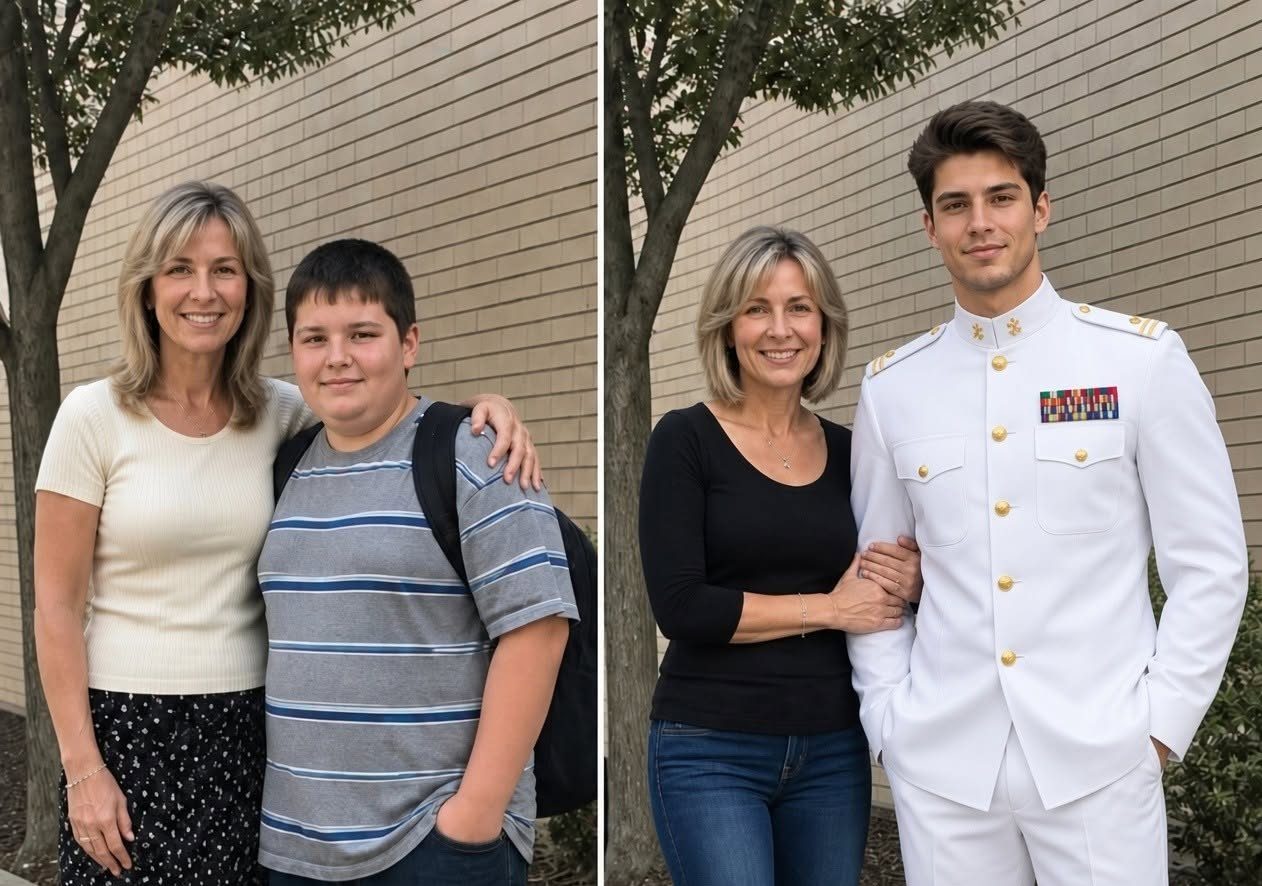
It was his expression. For the first time in years, he looked completely sure of himself. “Are you certain you want to do this?” I asked. He turned toward me. “Mom, I’ve spent ten years avoiding places where
I might run into those people. Tonight, I’m tired of running.” I walked closer and straightened his collar. “You don’t owe those people anything.”
“I know.”
“Then why go?”
He smiled.
“Because sometimes, Mom, people need to see that the person they tried to destroy didn’t disappear.”
I wanted to hug him, but I could see that he needed to go alone.
Before leaving, he kissed my forehead.
“Don’t wait up. I might be a little late.”
Then he walked out.
I stood at the window and watched his car disappear down the street.
I had no idea what he was planning.
All I knew was that the little boy who once cried silently in his bedroom was about to walk into a room full of people who had made his childhood miserable.
And I prayed he wouldn’t let them hurt him again.
Meanwhile, across town, the reunion was already underway.
The event was being held in a beautiful hotel ballroom.
There were flowers on the tables, expensive decorations, soft music, and a large banner that read:
WELCOME BACK, CLASS OF 2016!
Former classmates were laughing, taking pictures, exchanging business cards, and talking about their careers.
Some had become doctors.
Others were lawyers, business owners, teachers, and managers.
They were enjoying themselves, remembering old stories, and pretending that their school years had been wonderful for everyone.
At one table sat Daniel Carter, the former class president.
He had always been popular.
In school, he was the kind of person everyone wanted to impress.
He had been particularly cruel to my son, Ethan.
Daniel had once hidden Ethan’s backpack in a trash can and convinced the entire class to laugh when he had to search for it.
Another time, he had organized a group photograph and deliberately told everyone to move closer together, leaving Ethan standing alone outside the frame.
Now Daniel was wearing an expensive suit and holding a glass of champagne.
“Can you believe it’s been ten years?” he said to his friends.
“I still remember graduation like it was yesterday.”
His friend Michael laughed.
“Remember Ethan? That quiet guy who never talked to anybody?”
Another man chuckled.
“Whatever happened to him?”
Daniel shrugged.
“Probably doing something ordinary. He was never exactly the ambitious type.”
They laughed.
Then someone mentioned the reunion invitations.
“Did we get everybody?” a woman asked.
Daniel took a sip of his drink.
“Pretty much.”
“Everybody?”
He smiled.
“Well, almost everybody.”
The woman understood immediately.
“Ethan?”
Daniel shrugged.
“Let’s be honest. He probably wouldn’t have come anyway.”
They laughed again.
Then the ballroom doors opened.
At first, nobody paid much attention.
A man in a dark blue suit entered.
He was tall, well-dressed, and carried himself with quiet confidence.
His shoes were polished.
His watch was elegant.
He didn’t look around nervously or search for someone to welcome him.
He simply walked inside.
Then one former student stopped talking.
Another turned around.
Someone whispered.
“Wait a minute…”
Daniel looked toward the entrance.
His smile disappeared.
It was Ethan.
The same Ethan they had ignored for years.
Except he wasn’t the nervous, awkward boy they remembered.
He looked like a completely different person.
He walked toward the registration table.
The woman behind it glanced at her guest list.
“Good evening. May I have your name?”
“Ethan Carter.”
She searched the list.
Her expression changed.
“I’m sorry. I don’t see your name here.”
“I know,” he replied calmly.
She looked uncomfortable.
“Did you receive an invitation?”
“No.”
“Then I’m afraid…”
Before she could finish, Ethan smiled.
“That’s all right. I came to see everyone, not to cause trouble.”
Several people nearby were watching.
Daniel stood up.
He walked toward Ethan with a smile that looked more nervous than friendly.
“Well, well. Look who finally decided to show up.”
Ethan turned.
“Hello, Daniel.”
Daniel looked him up and down.
“Wow. Look at you. Didn’t expect to see you here.”
“I imagine you didn’t.”
A few people exchanged uncomfortable glances.
Daniel laughed awkwardly.
“So, what have you been doing with yourself?”
“Working.”
“Doing what?”
Ethan looked directly at him.
“Building something.”
Daniel grinned.
“Sounds mysterious.”
Before Ethan could answer, the lights in the ballroom dimmed slightly.
A woman holding a microphone stepped onto the small stage.
“Good evening, everyone! Thank you for joining us tonight. We have a very special guest who has agreed to say a few words.”
Ethan glanced toward the stage.
The woman continued.
“But before we introduce him, I’d like to thank everyone who helped make this evening possible.”
She paused and looked toward the entrance.
“Especially the person who generously sponsored this entire reunion.”
People began whispering.
Daniel looked confused.
“Who sponsored it?”
The woman smiled.
“Someone who wanted this evening to be unforgettable.”
Then she announced a name.
“Ethan Carter.”
The room went completely silent.
Daniel’s glass stopped halfway to his mouth.
Ethan calmly adjusted his jacket.
Then he walked toward the stage.
And for the first time in ten years, every person in that room was looking at him.
But what happened next was something none of them expected.
PART 3: THE SECRET THEY NEVER SAW COMING
Ethan stepped onto the stage.
The woman handed him the microphone.
He looked around the ballroom.
For a few seconds, he said nothing.
He recognized almost every face.
The same faces that had laughed when he stumbled in the hallway.
The same faces that had ignored him when he sat alone at lunch.
The same faces that had watched while others made cruel jokes about him.
Some looked embarrassed.
Others looked confused.
Daniel was standing near the front, his expression somewhere between disbelief and irritation.
Ethan finally spoke.
“Good evening, everyone.”
His voice was calm.
“I know some of you are probably wondering why I’m here.”
A few nervous laughs came from the audience.
“Some of you might also be wondering why I wasn’t on the invitation list.”
Nobody answered.
Ethan smiled faintly.
“I wondered the same thing.”
He paused.
“Ten years ago, I was a very different person. I was quiet. I was insecure. I wanted friends more than anything in the world.”
He looked toward the tables.
“I remember sitting alone during lunch. I remember hoping someone would ask me to join their group. I remember pretending I didn’t care when people laughed at me.”
His voice became softer.
“And I remember going home and telling my mother that school was fine.”
Several people lowered their eyes.
“My mother knew it wasn’t fine. She always knew.”
He took a breath.
“For a long time, I believed something was wrong with me. I thought maybe I wasn’t interesting enough, funny enough, handsome enough, or successful enough to deserve friendship.”
A woman near the back wiped her eyes.
“But eventually, I learned something important.”
He looked around the room.
“Being rejected by people doesn’t mean you’re worthless. Sometimes it simply means you’re surrounded by people who don’t know how to recognize your worth.”
The room remained silent.
Ethan continued.
“After graduation, I decided to stop trying to convince people to like me. Instead, I started working on the person I wanted to become.”
He explained that he had attended university while working part-time.
His first job had been at a small technology company.
He had spent nights studying, learning new skills, and saving every dollar he could.
There were difficult years.
There were failed business ideas.
There were moments when he wanted to quit.
But he kept going.
Eventually, he started his own technology company with two friends.
At first, they worked from a tiny rented office.
Sometimes they couldn’t afford proper meals.
Sometimes they went months without making a profit.
But slowly, their company grew.
They developed software that helped small businesses manage their operations.
One client recommended them to another.
Then another.
Within five years, they had dozens of employees.
Within seven years, their company was operating internationally.
And now, ten years after graduation, Ethan was the founder and chief executive of a successful company.
The room was stunned.
Daniel finally spoke.
“Wait. You’re the Ethan who founded Carter Technologies?”
Ethan looked at him.
“Yes.”
Daniel shook his head.
“I read about that company last month.”
Ethan nodded.
“That’s us.”
A few people began whispering excitedly.
One former classmate pulled out her phone.
Another leaned toward her husband.
Daniel forced a smile.
“That’s incredible, man. Seriously. We should catch up sometime.”
Ethan looked at him for a moment.
Then he said something that made the room uncomfortable again.
“Funny how that works, isn’t it?”
Daniel’s smile faded.
“What do you mean?”
“Ten years ago, you couldn’t find a reason to sit beside me. Tonight, you suddenly want to catch up.”
Nobody laughed.
Ethan placed the microphone closer to his mouth.
“But that’s not why I came here.”
He turned toward the woman who had introduced him.
“May I show them something?”
She nodded.
A large screen behind him came alive.
The first image showed a small classroom.
Then another photograph appeared.
It was a picture of a group of children sitting around a table.
A few people recognized the school.
Ethan explained that after building his company, he had started visiting schools and speaking with students who struggled socially.
He had met children who were bullied, excluded, and made to feel invisible.
Some had stopped attending school regularly.
Others had convinced themselves that they would never have friends.
He knew exactly how they felt.
“Two years ago,” Ethan said, “I met a boy named Lucas.”
The screen showed a photograph of a young boy standing beside a teacher.
“Lucas was being bullied because he was shy and had difficulty making friends. He used to eat lunch in the library because he didn’t want anyone to see him sitting alone.”
Ethan paused.
“When I heard his story, I saw a little version of myself.”
He looked around.
“I couldn’t change what happened to me. But I could help make sure another child didn’t have to face the same thing alone.”
He announced that he had established a foundation dedicated to helping children who experienced bullying, social exclusion, and isolation.
The foundation funded school counseling programs, mentorship opportunities, educational scholarships, and safe after-school spaces.
Then came the announcement that made the entire room fall silent.
“Tonight’s reunion,” Ethan said, “has been sponsored by that foundation.”
He explained that the money spent on the venue, catering, decorations, and entertainment was part of a larger charitable initiative.
The event was also being used to launch a new scholarship program for students who had experienced bullying.
A large number appeared on the screen.
$500,000.
It was the initial funding commitment for the program.
People stared at the screen.
Daniel slowly sat down.
Ethan continued.
“I could have spent tonight talking about how successful I’ve become. I could have told you about the company, the awards, and the opportunities I’ve been given.”
He smiled.
“But none of those things would have mattered as much as what I learned when I was a lonely teenager.”
He looked toward the back of the room.
“Nobody should have to become successful just to prove they deserved kindness.”
That sentence seemed to hit everyone.
And then Ethan did something unexpected.
He asked the reunion organizer to bring up another slide.
It showed a list of names.
Not the names of former classmates.
The names of students who had received support from his foundation.
Beside each name was a short message about their progress.
One had returned to school.
Another had joined a music club.
Another had received a scholarship.
And one had become a student mentor.
Ethan smiled.
“These are the people I wanted to celebrate tonight.”
The audience began applauding.
But Ethan wasn’t finished.
He had one final announcement.
And this one was personal.
PART 4: THE ENDING — THE BOY THEY REJECTED BECAME THE MAN WHO CHANGED LIVES
Ethan stepped away from the screen.
“I have one more thing to say.”
The applause gradually faded.
He looked toward the front table.
Daniel was sitting with his hands folded.
Several former classmates looked uncomfortable.
Ethan continued.
“I know some people here might feel that I’m trying to embarrass anyone tonight. That’s not my intention.”
He paused.
“I didn’t come here to punish anyone.”
Then he looked directly at Daniel.
“And I certainly didn’t come here to ask anyone for an apology.”
Daniel shifted in his chair.
Ethan spoke again.
“Because the truth is, I don’t need one anymore.”
For a moment, nobody moved.
“Some of you probably remember the things that happened in school. Some of you might not. But I remember.”
He didn’t raise his voice.
He didn’t point fingers.
He simply told the truth.
“I remember being left out of birthday parties. I remember hearing people laugh when I walked past. I remember being the last person chosen for everything. I remember the feeling of walking into a classroom and hoping that, just for one day, nobody would make me feel unwanted.”
He paused.
“And I remember my mother waiting for me at home.”
His eyes became emotional.
“She never forced me to talk. She never told me to fight back. She never told me that I needed to become popular.”
He smiled.
“She simply reminded me every single day that I mattered.”
Several people turned toward the back of the room, where a woman was standing quietly near the entrance.
It was me.
I had arrived shortly before the speech began.
I hadn’t wanted to interrupt him.
But when I heard him mention me, I couldn’t stop the tears.
Ethan saw me.
For a moment, he looked like the little boy who used to come home with his head down.
Then he smiled.
“Mom, would you come up here?”
I froze.
I wasn’t expecting that.
But everyone was looking at me now.
I walked slowly toward the stage.
When I reached him, he put his arm around my shoulders.
“This woman,” he said, “was the first person who believed in me when I couldn’t believe in myself.”
My eyes filled with tears.
“She listened when I was hurting. She encouraged me when I wanted to give up. And she never allowed the way other people treated me to become the way I saw myself.”
He kissed my forehead.
“Everything I have today started with her.”
I couldn’t speak.
I just held his hand.
The audience stood and applauded.
Some people were crying.
Others looked down at the floor.
Daniel was among them.
After the speech, people began approaching Ethan.
Some congratulated him.
Others asked about his company.
A few wanted photographs.
One woman who had been in his class approached us.
“Ethan,” she said quietly, “I wanted to apologize.”
He turned toward her.
“For what?”
“For not standing up for you. I remember what happened. I knew it was wrong, but I was afraid of becoming the next person they laughed at.”
She looked genuinely upset.
“I should have done something.”
Ethan listened.
Then he nodded.
“Thank you for saying that.”
She wiped her eyes.
“I hope you know you didn’t deserve any of it.”
“I know that now.”
She smiled sadly.
“I’m glad you’re doing well.”
“Thank you.”
A little later, Daniel approached.
He was no longer smiling.
He stood in front of Ethan with his hands in his pockets.
“Can we talk?”
Ethan nodded.
Daniel glanced toward me, then back at my son.
“I owe you an apology.”
Ethan said nothing.
Daniel continued.
“I was cruel to you in school. I thought it was funny. I thought being popular meant I could treat people however I wanted.”
He swallowed.
“I’ve thought about some of those things over the years. I just never imagined I’d see you again.”
Ethan looked at him.
“Why didn’t you invite me?”
Daniel looked down.
“Honestly? I thought you wouldn’t want to come. And maybe I didn’t want to remember how badly I treated you.”
For the first time that evening, Ethan’s expression changed.
Not anger.
Not satisfaction.
Just disappointment.
“Daniel, do you know what I remember most about school?”
Daniel shook his head.
“I remember how many people saw what was happening and did nothing.”
Daniel’s eyes filled with tears.
“I know.”
Ethan continued.
“Some people were bullies. Others were just standing nearby. But when you’re the person being laughed at, silence feels exactly like rejection.”
Daniel nodded.
“I’m sorry.”
Ethan took a breath.
“I appreciate your apology. But I hope you understand something. You don’t get to decide when someone else has healed.”
Daniel nodded again.
“I understand.”
They shook hands.
It wasn’t a dramatic reconciliation.
They didn’t suddenly become friends.
There was no magical moment when ten years of painful memories disappeared.
But there was honesty.
And sometimes, honesty is where change begins.
As the evening continued, something surprising happened.
Several former classmates approached Ethan to ask about the foundation.
One woman offered to volunteer as a school counselor.
Another said she worked in education and wanted to help develop the scholarship program.
A former classmate who now owned a printing business offered to provide materials for the foundation at no cost.
Ethan listened to each person.
He didn’t judge them by their past.
He judged them by what they were willing to do now.
Later that night, as the reunion began winding down, I found Ethan standing alone near the ballroom windows.
He was looking out at the city lights.
I walked over and touched his arm.
“Are you all right?”
He smiled.
“Yeah, Mom.”
I looked at him.
“Did it feel good?”
He thought for a moment.
“Not exactly.”
I was surprised.
“Why not?”
He looked down at his hands.
“Because standing in that room reminded me of how lonely I used to feel.”
I nodded.
He continued.
“But it also reminded me of something else.”
“What?”
“That I survived it.”
I felt tears forming again.
He put his arm around me.
“Do you remember the night I came home after my classmates threw my lunch in the trash?”
I remembered.
Of course I remembered.
He had been fourteen.
He had sat at the kitchen table and refused to eat.
I had asked him what happened.
He had shrugged and said it was nothing.
But later that night, I found him crying in his bedroom.
I nodded.
“I remember.”
“You told me something that night.”
“What did I say?”
He smiled.
“You told me that one day, I would find people who would be happy to have me around. You said that the people who made me feel small didn’t get to decide how big my future could become.”
I covered my mouth.
He squeezed my hand.
“I didn’t believe you then.”
I laughed through my tears.
“I know.”
“But you were right.”
We stood there together for a long time.
Then Ethan reached into his jacket and handed me a small envelope.
“What’s this?”
“Open it.”
Inside was a photograph.
It showed a building with a large sign above the entrance.
THE ELLEN CARTER CENTER FOR KINDNESS AND STUDENT SUPPORT.
I stared at the photograph.
“What is this?”
He smiled.
“It’s the new headquarters for the foundation.”
I looked at him.
“Why does it have my name?”
“Because I want every child who walks through those doors to know that someone believed in them before the world did.”
I began crying.
“Ethan, you didn’t have to do that.”
“I know.”
He hugged me.
“But I wanted to.”
Then he told me that the center would offer free counseling, mentorship, tutoring, and activities for children who felt isolated at school.
There would also be a quiet room for students who needed somewhere safe to spend lunchtime.
I looked at the photograph again.
A quiet room.
A place where nobody would have to pretend they were fine.
A place where no child would have to sit alone because nobody wanted them at their table.
And suddenly, I understood.
My son hadn’t gone to the reunion to show everyone how much money he had made.
He hadn’t gone to make Daniel jealous.
He hadn’t gone to prove that he was better than the people who had hurt him.
He had gone because he finally understood what he wanted to do with the pain he had carried for so many years.
He wanted to make sure other children had someone in their corner.
Someone who would notice.
Someone who would listen.
Someone who would say, “You belong here.”
Three months later, the center officially opened.
The building wasn’t enormous, but it was beautiful.
There were bright classrooms, comfortable chairs, bookshelves, computers, and a large garden where children could spend time together.
On opening day, dozens of families arrived.
Some children were excited.
Others were shy.
A few stayed close to their parents, afraid to speak to anyone.
Ethan greeted every child personally.
He didn’t rush them.
He didn’t force them to socialize.
He simply made them feel welcome.
At one point, a small boy approached him.
He couldn’t have been older than eleven.
He was holding a backpack with both hands.
“Are you the person who started this place?” he asked.
Ethan knelt slightly so they were at eye level.
“I am. What’s your name?”
“Lucas.”
Ethan smiled.
“Nice to meet you, Lucas.”
The boy looked around.
“Do you think I can come here even if I don’t have any friends?”
Ethan’s expression softened.
“Especially if you don’t have any friends.”
The boy looked uncertain.
“What if nobody likes me?”
Ethan paused.
Then he said something I will never forget.
“Lucas, you don’t have to earn the right to be treated kindly. You deserve kindness simply because you’re a person.”
The boy stared at him.
Then he smiled.
It was a small smile.
But it was real.
And for a moment, I saw the little boy my son used to be.
I watched Ethan walk with Lucas toward the other children.
He introduced him to a mentor.
He showed him the library.
Then he helped him find a place at a table where several children were drawing pictures.
Nobody laughed.
Nobody told him to leave.
Nobody made him feel like he didn’t belong.
He simply sat down.
And someone handed him a colored pencil.
I stood near the entrance, crying quietly.
Not because I was sad.
Because I finally understood that the painful years had not taken my son’s kindness away.
They had taught him how important kindness could be.
A few weeks after the opening, Ethan received a message from Daniel.
It was a short email.
Daniel wrote that the reunion had made him reconsider the way he had treated people throughout his life.
He had started volunteering with a local youth organization.
He wasn’t asking Ethan to become his friend.
He wasn’t asking him to forget the past.
He simply wanted to say that seeing the foundation had made him realize how much damage a person could cause by treating cruelty as entertainment.
Ethan read the message and put his phone down.
I asked him whether he was going to respond.
He thought about it.
Then he wrote:
“Thank you for acknowledging what happened. I hope the work you’re doing helps someone who needs it. That’s what matters now.”
He sent it.
Then he went back to work.
There was no dramatic celebration.
No revenge.
No attempt to reopen old wounds.
Just a quiet decision to move forward.
And that, I think, was the greatest victory of all.
Months passed.
The foundation continued growing.
More schools joined the program.
More children received scholarships.
Teachers began attending workshops about recognizing bullying and social exclusion.
Parents started reaching out for help.
And every time Ethan spoke to a group of students, he told them the same thing.
“Don’t let someone else’s cruelty become the story you tell yourself about who you are.”
One afternoon, I visited his office.
He was sitting at his desk, reading letters from children who had benefited from the program.
One letter caught my attention.
It was written in uneven handwriting.
It said:
“Dear Mr. Carter,
Thank you for making a place where people like me can feel normal. Before I came here, I thought nobody wanted to be my friend. Now I have three friends. I like coming to school again.
Thank you for understanding.
From, Lucas.”
I looked at my son.
He was smiling, but his eyes were wet.
“That’s a good letter,” I whispered.
He nodded.
“It’s the best kind of success.”
I sat beside him.
“Better than all your business awards?”
He laughed.
“Much better.”
Then he folded the letter carefully and placed it in a drawer.
I noticed that the drawer was already full of letters.
Hundreds of them.
Some were drawings.
Some were thank-you notes.
Some were stories about children who had found their confidence again.
My son had kept every single one.
And I realized that, in a strange way, the boy who once sat alone at lunch had finally found his place.
Not at the popular table.
Not among the classmates who had rejected him.
But somewhere much more meaningful.
Among people whose lives he was helping change.
One evening, almost a year after the reunion, Ethan and I were having dinner.
I asked him whether he ever thought about that night.
He smiled.
“Sometimes.”
“Do you regret going?”
He put down his fork.
“No.”
“Even though those memories came back?”
He nodded.
“Especially because those memories came back.”
I looked at him.
He continued.
“Mom, for years I thought the happiest moment of my life would be the day those people finally realized they were wrong about me.”
“And wasn’t it?”
He shook his head.
“No.”
He reached across the table and took my hand.
“The happiest moment was when I realized I didn’t need them to be wrong for me to be happy.”
I squeezed his hand.
He smiled.
“I spent so much of my childhood wanting those people to choose me. But now I get to help children who think nobody will ever choose them.”
He paused.
“And that’s enough.”
I looked at my son and thought about all the nights I had watched him come home pretending not to be hurt.
I remembered the birthday parties he was never invited to.
The school events where he stood alone.
The lunches he ate in silence.
The tears he tried to hide.
If I could have gone back and changed those years, I would have done it without hesitation.
But I couldn’t.
What I could do was love him.
And what he could do was turn his painful memories into something that helped others.
That night, before he left, he hugged me.
“Thank you for never giving up on me.”
I kissed his cheek.
“Never, sweetheart.”
He smiled.
“Then I guess we both did something right.”
And he walked out into the evening.
I stood at the window, just as I had done the night of the reunion.
But this time, I wasn’t worried.
I wasn’t wondering whether someone would hurt him.
I wasn’t afraid he would come home feeling unwanted.
Because I finally understood something I wish every parent could understand:
You cannot always protect your child from people who choose to be cruel. But you can make sure they never mistake that cruelty for their worth.
My son was not invited to his ten-year reunion.
But he showed up anyway.
And he didn’t leave with a trophy, an apology, or a room full of new friends.
He left with something much more valuable.
He left knowing that the people who once made him feel invisible no longer had any power over his life.
And somewhere, in a bright little center filled with laughter, books, and children who were learning to believe in themselves, the lonely boy he once was finally found the place he had always deserved.
He didn’t go to the reunion to prove that he had become somebody.
He went there having already discovered that he always was somebody.
And that was the ending nobody in that ballroom had expected.
THE END.