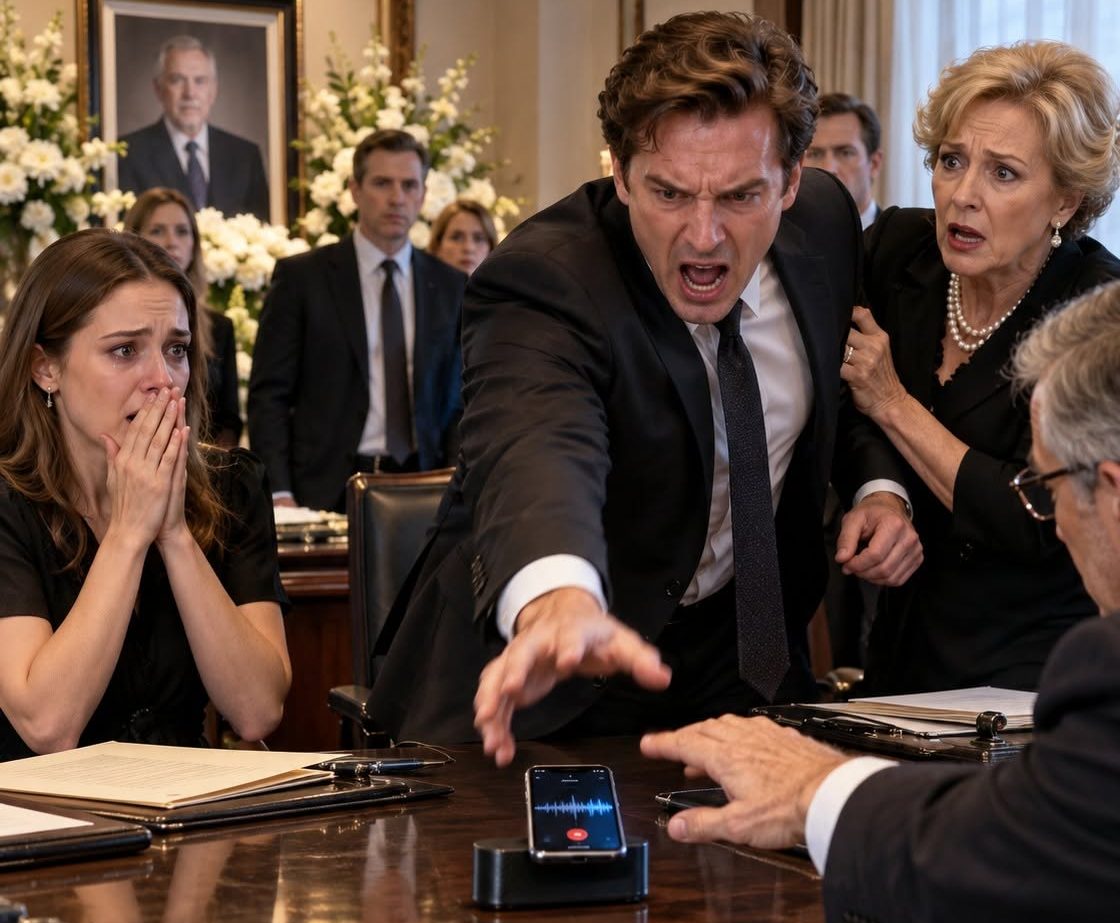
My father’s funeral was underway when my husband told everyone, “Her inheritance will finally pay off my family’s debts.” My MIL had already picked a $600,000 house. I said nothing. At the will reading,
the lawyer placed Dad’s old phone on the table and pressed play. Six seconds later, my husband sprang up, yelling, “Turn that off!”
My husband stood up in the middle of my father’s funeral reception and announced that my inheritance would finally erase his family’s debts.
For three seconds, nobody moved.
Then his mother, Patricia, squeezed his arm and said, almost proudly, “And once probate clears, we can finally close on the house.”

The house.
The $600,000 four-bedroom place she had toured two days after my father died.
I stared at Ethan across the crowded church hall. My father’s coworkers, neighbors, cousins, and old friends were still holding paper cups of coffee. His photograph, surrounded by white lilies, was ten feet behind my husband.
“You told them?” I asked.
Ethan smiled as if I were being difficult. “Claire, everyone knows your dad left you everything. There’s no reason to pretend we’re struggling anymore.”
I felt something inside me turn cold.
Ethan had spent the last year telling me his consulting firm was “temporarily tight.” He had borrowed from our joint savings twice. He had insisted that his mother’s debts were not our responsibility. Now, before my father was even buried, he was speaking as though my inheritance belonged to him.
I said nothing.
That frightened him more than anger would have.
Three days later, we sat in my father’s attorney’s conference room for the will reading. Patricia came too, wearing pearls and carrying a folder from a luxury real-estate agency. Ethan kept checking his phone. His knee bounced beneath the table.
My father’s attorney, Martin Hale, did not open the will immediately.
Instead, he locked the conference-room door.
Ethan stopped bouncing his knee.
Martin placed a sealed evidence bag on the table. Inside was my father’s old black phone, the one I had seen beside his hospital bed during his final week.
“What is that?” Ethan asked.
Martin looked at me, not him.
“Your father left specific instructions,” he said. “Before I discuss the estate, Claire needs to hear something.”
Patricia leaned forward. “This is highly inappropriate.”
Martin removed the phone, connected it to a small speaker, and tapped a recording dated eleven days before my father died.
There was static.
A chair scraped.
Then my father’s voice.
“You understand that money is Claire’s, Ethan. Not yours.”
My husband’s face drained of color.
A second voice answered.
His.
“She’s my wife. What belongs to her belongs to me.”
I looked at Ethan.
He would not look back.
The recording continued.
My father said, “Not if she knows what you did.”
Six seconds later, Ethan shot to his feet so violently that his chair crashed backward.
“Turn that off!”
Martin did not move.
Patricia grabbed Ethan’s sleeve.
I heard my own voice come out thin and unfamiliar.
“What did you do?”
Ethan reached across the table for the phone.
Martin pulled it away.
Patricia whispered, “Ethan, don’t.” Her voice was no longer smug. It was terrified. That was when I realized she already knew.
And from the speaker, my father said one final sentence that made Ethan freeze with his hand still in the air.
“I have the documents proving you forged Claire’s signature.”
Part 2
Ethan’s hand dropped.
For the first time in twelve years of marriage, I saw fear on his face that had nothing to do with losing money. It was the fear of being caught.
“That recording proves nothing,” he said.
Martin calmly turned the volume higher.
My father’s voice returned. “I compared the signature on the home-equity application with Claire’s passport records. You copied it.”
I turned toward Ethan. “Home-equity application?”
He said nothing.
Martin opened a second folder and slid three pages toward me. The first carried my name. The second showed a $185,000 credit line secured against our house. The third showed a transfer to a company I had never heard of: Mercer Ridge Consulting LLC.
Ethan owned Mercer Ridge.
I had never signed any of it.
My stomach tightened.
Patricia suddenly stood. “This is a family misunderstanding. Richard hated Ethan. Everyone knows that.”
“No,” Martin said. “Richard hired a forensic accountant.”
That silenced her.
The accountant had traced more than $260,000 in hidden business losses, personal loans, and credit-card debt connected to Ethan. Worse, several accounts had been opened using my information. According to Martin, my father discovered everything after a bank verification letter was accidentally mailed to his house, where I had lived before marriage.
Ethan finally spoke.
“I was fixing it.”
“With my inheritance?” I asked.
“With our future.”
Martin pushed another document across the table.
It was a purchase agreement for Patricia’s $600,000 house.
The buyer was not Patricia.
It was me. My name appeared on the contract.
So did a signature that looked almost perfect.
I had never seen the document before.
Patricia’s face changed.
“I thought Claire agreed,” she said quickly.
Ethan stared at her with such fury that I knew she had just betrayed him.
Then Martin revealed the first twist.
My father had known about the house before he died.
The real-estate agent had called him because Ethan listed my father as the source of funds and claimed a large inheritance distribution was “imminent.” My father became suspicious and arranged the recorded meeting with Ethan.
But Martin still had not played the most important part.
He tapped the phone again.
My father asked, “What happens if Claire refuses to sign after I’m gone?”
Ethan laughed softly on the recording.
“She won’t refuse. If she does, I have enough to make her look unstable.”
My skin went cold.
Ethan lunged for the speaker.
Martin stood and blocked him.
Patricia shouted for Ethan to stop, but he shoved the chair aside and knocked a glass of water onto the floor.
I backed toward the wall.
“What does that mean?” I asked.
Martin reached into his briefcase and removed a sealed envelope with my name on it.
“Your father believed Ethan was preparing more than forged financial documents,” he said.
Ethan stopped moving.
Martin looked directly at me.
“He believed your husband had been building a file to convince a court that you were mentally incapable of controlling your own money.”
I remembered the therapist Ethan had insisted I see after my father’s diagnosis. The sleeping pills he kept asking whether I had taken. The nights he photographed me crying.
Then Patricia whispered something I was not supposed to hear.
“You said those records were already enough.”
The room went silent.
Martin slowly turned toward her.
Ethan’s face hardened.
And I realized the conspiracy had never been only about stealing my inheritance after my father died.
They had been preparing to take control of me while he was still alive.
Martin did not open the envelope. He placed it beside the phone and told me my father had required two witnesses before its contents could be disclosed. One was already in the room. The other, he said, was waiting outside.
Ethan looked toward the locked door.
Then someone knocked three times.
Patricia went pale.
“Claire,” Martin said, “whatever happens next, do not leave with your husband.”
What do you think will happen next? I’d love to hear your honest guess or reaction.
Part 3 What do you think will happen next? I’d love to hear your honest guess or reaction.
The knocking came again.
Martin walked to the door, unlocked it, and let in a woman I recognized from my father’s funeral. Her name was Sophia Grant. I had assumed she was one of his former business clients. She introduced herself now as the forensic accountant my father had hired six weeks before his death.
Behind her stood Detective Lena Morales.
Ethan stepped backward.
“This is insane,” he said. “Claire, tell them this is a family matter.”
I looked at the forged purchase agreement with my name on it.
“No,” I said. “It stopped being a family matter when you signed my name.”
Detective Morales explained that Martin had already given police copies of the suspected forged credit application, the house contract, and the accountant’s preliminary report. She was not there because of whatever Ethan might say in that room. She was there because investigators had obtained a warrant to seize specific financial records and electronic devices connected to Mercer Ridge.
Ethan immediately reached for his phone.
Morales told him to put it on the table.
He did not.
Instead, he turned toward the door.
Sophia moved out of the way. Martin did too. Morales blocked the exit and repeated the instruction. For several seconds Ethan stared at her, breathing hard, then slammed his phone onto the table so violently that the screen cracked.
Patricia began crying.
“Ethan handled the paperwork,” she said. “I never signed Claire’s name.”
Ethan spun toward her.
“You knew exactly what we were doing.”
That sentence destroyed the last possibility that I had misunderstood anything.
He Announced My Inheritance Would Erase His Family’s Debts, Then Screamed When My Father’s Voice Filled The Room, But The Envelope Waiting On The Table Changed My Entire Life Forever
Part 4
Detective Morales did not raise her voice, and that was the first thing I noticed.
In the movies, a moment like this always came with shouting. Instead, the conference room went so quiet that I could hear the air conditioner humming in the ceiling and the slow drip of spilled water running off the edge of the table onto the carpet.
“Mr. Hale,” she said calmly, “you mentioned an envelope.”
“I did.” Martin straightened his jacket, and for the first time since I had known him, he looked less like my father’s lawyer and more like my father’s friend. “Richard’s instructions were very specific. The envelope may be opened only in the presence of two witnesses, and only after the recording has been played, and only with Claire’s permission. Ms. Grant and I are the two witnesses.”
He turned to me.
“Claire, this is your decision. You can walk out of this room right now and never hear what is inside. Nobody here would think less of you.”
I looked at Ethan.
He was standing with his back against the window, one hand pressed flat against the glass as though the building might tip over. His cracked phone lay face-up on the table between us, a spider web of lines spreading across the screen. He looked smaller than he had at the funeral. Smaller than he had that morning over breakfast, when he had kissed my forehead and said, “Today’s going to be a good day for us.”
Twelve years. I had married him when I was twenty-eight. He had cried during his own vows. He had driven four hours through a snowstorm once because I had a fever and my car would not start. I had believed, all the way down to the bottom of my bones, that I knew what kind of man he was.
“Open it,” I said.
Ethan took one step toward the table. “Claire, wait. Before you do this, think about what you’re—”
“Mr. Whitaker’s daughter has given her consent,” Detective Morales said. “Please stay where you are, sir.”
Ethan stayed where he was.
Martin picked up a silver letter opener and slit the top of the envelope with one slow, careful stroke. He tipped it, and four items slid onto the table. A folded letter in my father’s handwriting, three pages thick. A small silver flash drive. A stapled document with a notary seal pressed into the corner. And a thin blue folder with a label I recognized because it was written in my father’s blocky engineer’s print: WHITAKER FAMILY TRUST.
Ethan’s eyes went straight to the blue folder.
“That trust is not valid,” he said quickly. “Richard was sick. He was on medication. Any court would—”
“The trust was signed eighteen months ago,” Martin said, “and reaffirmed three weeks before his death. Two attorneys reviewed it. Two independent witnesses signed it. And on the day he reaffirmed it, Richard also completed a cognitive evaluation with his physician, because he suspected someone might eventually question his judgment.”
Martin’s voice did not change, but something in his face sharpened.
“He was right about that, wasn’t he?”
Ethan said nothing.
Martin opened the blue folder and turned it toward me. “Claire, I want you to hear this part clearly, because I suspect you have been told otherwise. Your father’s estate passes to you, and only to you, through this trust. Every dollar, every account, the house on Alder Street, the retirement funds. Under the law, and under the specific language your father wrote, it is your separate property. It cannot be pledged, borrowed against, or redirected by any spouse, any relative, or any business partner. Not one cent can be released to anyone but you.”
I heard a small, strangled sound from across the table.
Patricia had pressed her hand over her mouth.
“There is no probate delay to wait out,” Martin continued, looking at her now. “There is no distribution that will ‘clear’ on any schedule you have been promised. Mrs. Reyes, I understand a deposit of forty thousand dollars was wired to the real-estate agency for a house on Marlowe Court.”
Patricia’s voice came out cracked. “Ethan said it was a temporary hold. He said the funds would be replaced the moment the estate—”
“The deposit came from the Mercer Ridge account,” Sophia Grant said quietly. “Which means it came from a home-equity line that Claire never authorized.”
Patricia sank into her chair like someone had cut a string.
I could not stop staring at the letter. I picked it up. The paper felt thin and warm, as if my father had only just set it down. My hands were shaking so badly that the pages rattled.
“Would you like me to read it?” Martin asked gently.
“No,” I said. “I’ll do it.”
I unfolded the first page. My father’s handwriting slanted hard to the right, the way it always had, as though every word were leaning into a strong wind.
I began to read out loud.
Claire-bear,
If Martin is handing you this letter, then two things have happened. First, I am gone, and I am so sorry to have left you before I was ready. Second, I was right about something I very much hoped I was wrong about. I have never hated being right as much as I hate it now.
My voice caught. I swallowed and kept going.
I spent thirty-one years working on the water systems for this county. Do you know what I learned? A pipe does not break all at once. It weeps. A small dark patch in the soil, a faint dampness in the wall, and most people walk right past it. By the time the flood arrives, the leak has been there for years.
I noticed the leak in your marriage a long time ago, and I said nothing, because you were happy, and because you loved him, and because a father who criticizes his daughter’s husband usually loses his daughter. That was my mistake. I will carry it to the end.
I stopped. I pressed my lips together until I could breathe again.
Nobody in the room moved.
Here is what I need you to know, and I want you to read this next part twice.
What Ethan did is not a measure of your intelligence. Being deceived says something about the deceiver, never about the person who trusted him. You did not fail. You were generous with someone who was not, and that is not a flaw. Please do not let anyone, including yourself, convince you otherwise.
In March, I asked you to see Dr. Okafor for a checkup. I told you it was for my peace of mind while I was sick. You rolled your eyes and went anyway. I am sorry I could not explain why. Her sworn letter is in this envelope. It says you are healthy, sharp, and entirely capable of running your own life, which I could have told any judge in one sentence. But some people only believe paper.
I laughed, and it came out as a sob. I remembered that appointment. I had complained the entire drive home. Dad had called that evening just to ask, “Did she say you were okay?” and I had said, “Dad, I’m fine,” and he had said, “Good,” in a voice so relieved that I had thought it was strange.
The money in this trust is the least important thing I am leaving you. Do not let it become the biggest thing in your life. Do not let it make you afraid, and do not let anyone teach you to hide. If you decide to spend it, spend it on something that makes you free.
One more thing. Patricia will be frightened when this comes out. Frightened people follow strong voices, and she has been following Ethan’s for years. I do not think she is a wicked woman. I think she is a scared one. If she does the right thing at the end, Claire, let her. Whatever you decide about the rest, decide it with your eyes open and your heart intact.
Call Dana. She has been worried about you longer than you know.
I love you, kiddo. I was so proud to be your father. I would do all of it again.
Dad.
The last page slipped from my fingers and drifted onto the table.
For a while, no one said anything. I heard Sophia sniff quietly behind me. Detective Morales looked at the floor with the stillness of someone who had learned to let people have their moment. Even Martin took off his glasses and pressed the bridge of his nose.
Then Ethan spoke, and the sound of his voice was like a stone dropped into a pool.
“That’s a beautiful letter,” he said, and there was something almost pleading in it. “It really is. But nothing in it proves I did anything. Your father was sick. He was suspicious of me from the day we met. You’re going to let his paranoia destroy our marriage?”
I looked up at him.
“You forged my name on a credit application,” I said.
“I helped with the paperwork—”
“You put my name on a house contract.”
“I was going to tell you—”
“You told a room full of my father’s friends that my inheritance would pay your family’s debts while his photograph was ten feet away from you.”
Ethan opened his mouth. Nothing came out.
Sophia Grant stepped forward. She was small and quiet and carried herself with the calm of someone who had read a thousand records more carefully than anyone else ever would. She opened a slim laptop on the table.
“Mr. Reyes, let me save everyone some time,” she said. “The online application for the home-equity line was submitted from the IP address at your office. The signature was traced from Claire’s passport application. We compared them side by side. The tremor pattern in the capital C is identical, which is how we know it was traced instead of signed. A real signature never lands exactly the same way twice.”
She tapped a key.
“The house contract was notarized by a mobile notary named Dale Purcell. Mr. Purcell keeps a careful journal. The identification number he logged does not belong to Claire. He told us a man brought the documents to him already signed and said his wife was too overcome with grief to attend. He remembers the man wore a gray suit and looked nervous.”
She looked at Ethan.
“He also remembers that the man tipped him twenty dollars for being quick.”
Ethan’s face went pale in patches, the way skin goes when the blood runs out of it.
“And this,” Sophia said, tapping a second key, “was recovered from a cloud backup connected to your business email.”
A document filled the screen. The heading read: Petition for Temporary Conservatorship. My name was typed beneath it, followed by a date three weeks in the future. A blank line waited at the bottom for a signature and a court seal.
The room seemed to tilt.
I read the first paragraph, though I could barely make the words hold still. It described me as “increasingly forgetful, emotionally unstable, and unable to responsibly manage complex financial matters following the loss of a parent.”
“That’s not finished,” Ethan said hoarsely. “That was only a draft. It was a contingency.”
“A contingency,” I repeated.
“In case you fell apart, Claire! You were crying every night. I was scared for you.”
“You photographed me crying,” I said. “You told me it was to remember how much I’d been through.”
“I—”
“You asked me every single evening whether I had taken the sleeping aids. You kept the bottle in your nightstand. You asked Dr. Bell to write that I was forgetful. I remember now. You asked her twice.”
That was when Patricia finally broke.
“I told you it would only be temporary,” she cried, looking at her son with a face I had never seen on her. She had always been so composed, so polished. Now her mascara was running and her voice was raw. “You said she would rest. You said she would be looked after. You said it was for her own good and we would just be managing things until she was feeling better!”
“Mom.” Ethan’s voice was a warning. “Stop talking.”
“She was going to be—” Patricia turned to me. “Claire, I swear I did not understand what he meant. I thought—”
“Mrs. Reyes,” Detective Morales said, not unkindly. “You are not under arrest right now. But I need you to understand that anything you say may be used later, and you may want an attorney before you say any more.”
Patricia stopped. She stared at her folded hands. Then in a small, cracked voice she said, “I only wanted to keep my home. That’s all I wanted. We owed so much. He said this was the only way.”
“How much did you owe?” I asked her, and I was surprised by how steady my voice was.
She glanced at Sophia.
“One hundred and forty thousand dollars,” Sophia said quietly. “Between a refinance, a failed condo investment, and a private lender who had been calling. Ethan promised to fix it. He took out the credit line, opened cards in Claire’s name, and drained the joint savings account of seventy-one thousand dollars over eleven months. Some of that went to his mother’s creditors. Most of it went to hide losses at Mercer Ridge, which had been failing for two years.”
Two years.
I thought of every dinner where he had said, “Business is good, just slow this quarter.” Every evening he had come home late. Every time he had squeezed my hand and told me not to worry.
Detective Morales stepped forward and pulled a folded paper from inside her jacket.
“Ethan Reyes,” she said, “a judge signed this arrest warrant at nine o’clock this morning. It charges you with forgery, identity theft, and financial fraud in connection with the home-equity application and the purchase agreement. Please put your hands where I can see them.”
Ethan did not move.
“This is a mistake,” he whispered. Then louder, turning to me, his whole body suddenly softening with a desperate tenderness that I had once mistaken for love: “Claire. Claire, please. We can fix this. Tell them you signed. Tell them you forgot. You were grieving. Nobody would blame you. We can clear everything up, and we’ll go home, and I promise I will make this right.”
I stared at him. I truly stared at him, the way you stare at a house you have lived in for years after you have learned the foundation is cracked.
“You told my father that if I refused to sign, you’d make me look unstable,” I said.
His mouth trembled.
“You don’t have to do that anymore,” I said. “I’m standing right here. And I have never been clearer in my life.”
The handcuffs clicked with a small, ordinary sound, like a car door closing. Ethan flinched at it. Detective Morales spoke his rights in a low, even voice, and he did not fight her. He simply looked at me, hollow and stunned, as she guided him toward the door.
“Twelve years, Claire,” he said.
“I remember every one of them,” I told him. “That is exactly why this hurts. But remembering someone is not the same as staying.”
The door closed behind him.
I did not cry until we reached the hallway. My knees gave out as if someone had cut my strings, and Sophia’s hand was suddenly under my elbow, small and strong and steady. Martin appeared at my other side. I had not asked him to, but he stood there like a wall, and that was what I needed.
“Do not leave with your husband,” he had said, hours earlier.
I hadn’t. I walked out of that building with my father’s lawyer on one side and his forensic accountant on the other, into a parking lot flooded with plain afternoon sunlight. A little boy was riding a scooter along the far sidewalk. Somewhere a dog barked. The world was ridiculous in its ordinariness.
And I stood there in the light and finally let myself weep, out loud, for my father, and for the marriage I thought I’d had, and for the woman who had walked into that room that morning believing she only had one loss to grieve.
Part 5
My father’s house smelled like coffee and pine cleaner.
I had not been back since the funeral. Everything was exactly where he had left it: his reading glasses folded on the arm of the recliner, the crossword still open on the side table with three squares left blank, the old wool cardigan hanging on the hook by the kitchen door. It looked like a house waiting for someone to come home.
I stood in the doorway for a long time. Then I sat down in his chair, pulled the cardigan over my shoulders, and sat there until the sun went down.
That was where Dana found me.
She did not knock. She had a key, because my father had given her one years ago, back when we were in college and she practically lived at our kitchen table. She came in with a grocery bag on each arm, took one look at me, dropped both bags on the floor, and wrapped me in a hug so fierce that it knocked the breath out of me.
“Martin called me,” she said into my hair. “He said you shouldn’t be alone.”
“Dana.” My voice cracked. “I’m so sorry.”
“Don’t you dare.”
“I stopped calling you. I let it just—”
“Claire.” She pulled back and held my face in both hands. Her eyes were red. “I know exactly why you stopped calling me. And it was not your fault. It was never your fault.”
That was the sentence that undid me. I had been holding it together all day, and I lost it completely. She sat on the arm of the recliner and held on to me while I shook.
Later, we sat at the kitchen table with tomato soup she had made from her mother’s recipe. I told her everything, and she listened without interrupting, without flinching, without telling me what I should have seen.
When I finished, she was quiet for a while.
“You know what I remember?” she said finally. “The year you and Ethan got engaged, he told you that I was ‘a little jealous.’ He said it kindly, like he was protecting you.”
I stared at her. “He did say that.”
“And then it was that your father was ‘too critical.’ And then that your work friends ‘talked too much.’ And then that your cousin Marie ‘stirred up drama.'” Dana shook her head slowly. “It was never one big thing. It was a hundred little ones. Every time someone who loved you got close, there was a reason to step back. That’s how it works. The walls go up quietly, one brick at a time.”
I thought about my father’s letter. A pipe does not break all at once. It weeps.
“Why didn’t I see it?” I asked.
“Because you weren’t looking for it. You were trusting someone. That’s not a flaw, Claire.” She said it firmly, just the way my father would have. “Someone who wants to be trusted and someone who deserves to be trusted can look exactly the same from the outside. Right up until the day they don’t.”
I didn’t say anything. I reached across the table and held her hand, and we sat there in my father’s kitchen, and it was the first time in two years I had felt like I could breathe all the way to the bottom of my lungs.
Sophia Grant arrived at nine the next morning with a laptop, a box of pastries, and a stack of neatly labeled folders. She set everything on the kitchen table like a general arranging a map.
“I’m going to walk you through all of it,” she said. “Every account, every debt, every transfer. Some of it will be hard to hear. But I’ve found that people cope better with the whole picture than with a hundred rumors.”
“Show me everything,” I said.
She did. It took four hours.
The credit line was the largest piece: $185,000 secured against our house. But the bank’s fraud unit had already opened a review, and after the police report was filed, they froze the account and confirmed in writing that I would not be held responsible for any of it. “The signature was forged,” Sophia said. “The application was fraudulent. The debt belongs to the person who created it, and that person is not you.”
There were three credit cards opened in my name. Those would be closed and cleared. There was a personal loan Ethan had taken out using my Social Security number, which would take a few months of paperwork to remove. There was the joint savings account, drained down to eleven dollars.
“Some of that may be recoverable,” Sophia said. “Detective Morales’s team has frozen the Mercer Ridge accounts. Everything traceable will be seized and applied toward restitution.”
“Everything traceable,” I repeated.
“Everything,” she said, and gave me a small smile. “I’m very good at tracing.”
I looked at the columns of numbers, dates, and account names, and I felt something I could not quite name. It wasn’t anger anymore. It was something quieter and steadier. It felt like standing on the floor of a house that had finally been swept clean, even though the furniture was gone.