“Listen to me carefully. Don’t let him touch them.” I frowned. “What?” “Don’t let Ethan move the forks. Don’t throw them away. And whatever you do, don’t tell anyone about this.”
I almost laughed because I couldn’t believe what I was hearing.
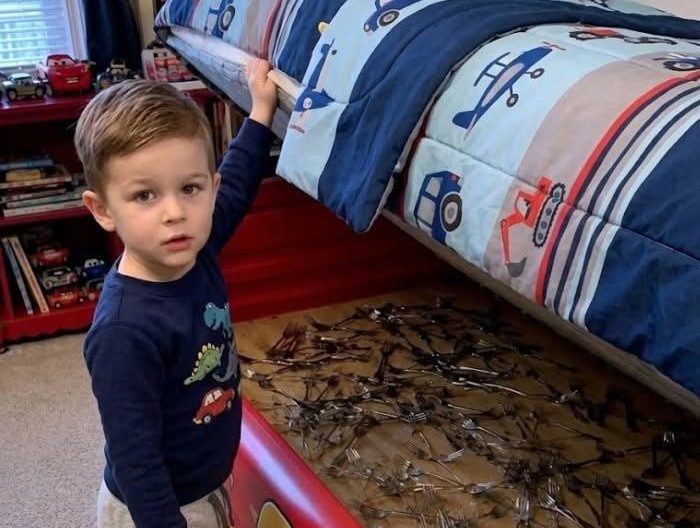
“You’ve got to be kidding me. Your five-year-old son is hiding dozens of forks under his mattress, and you’re telling me to keep quiet?”
“Please, Sarah. I’m serious.”
“Then explain!”
His voice suddenly became softer.
“Sarah, I never wanted you to find out this way.”
My stomach tightened.
“Find out what?”
He exhaled shakily.
“I’ll explain when I get home.”
“No. You’re explaining right now.”
“Not over the phone.”
“Daniel, you have ten seconds before I call the police and ask them what I should do.”
That finally made him react.
“Don’t call the police!”
His voice was so loud that I instinctively pulled the phone away from my ear.
Then he lowered his voice.
“Please. I know how this looks, but Ethan hasn’t done anything wrong.”
“Then why is he terrified of telling me?”
I heard something move on his end.
A chair, perhaps.
Then Daniel whispered:
“Because I made him promise.”
I closed my eyes.
“You made our five-year-old promise to hide something from his own mother?”
“I know.”
“What kind of father does that?”
“The kind who was trying to protect his family.”
I felt my heart pounding.
“Protect us from what?”
He didn’t answer immediately.
Then he said:
“Sarah, do you remember the night I told you I was working late at the office three months ago?”
I searched my memory.
“Which night?”
“The Thursday when I came home after midnight.”
I remembered it.
I’d been upset because Ethan had a fever, and I’d spent the entire evening alone with him. Daniel had called once to say he was stuck at work.
“Yes. What about it?”
“I wasn’t at the office.”
My entire body went still.
“What?”
“I was at a storage facility.”
I stared at the wall.
“Why?”
“Because someone had been coming into our house.”
I couldn’t breathe for a moment.
“What are you talking about?”
“Someone was entering the house when we were asleep.”
I looked toward the front door.
The hallway suddenly seemed darker than it had a few minutes earlier.
“Who?”
“I don’t know.”
“How can someone enter our house without us knowing?”
“That’s what I’ve been trying to figure out.”
I swallowed.
“Daniel, stop talking in riddles. What does this have to do with the forks?”
He hesitated.
Then he said:
“The forks weren’t originally mine.”
I looked toward Ethan’s bedroom.
“What?”
“They belonged to someone who used to live in our house.”
I felt a chill travel down my back.
Our house had been purchased four years earlier. The previous owners were an elderly couple who had moved into a retirement community.
I remembered the inspection, the paperwork, and the small repairs we’d made before moving in.
There was nothing unusual about the property.
“What are you saying?”
Daniel’s voice cracked.
“Sarah, there’s something I haven’t told you about the house.”
Before I could respond, I heard a small sound behind me.
“Mommy?”
I turned.
Ethan was standing in his bedroom doorway.
His little hands were trembling.
“Mommy, please don’t be angry with Daddy.”
I covered the phone.
“Sweetheart, go back to bed.”
He shook his head.
“Are you going to throw them away?”
I looked at him.
His eyes were filled with tears.
“No, baby. I just want to understand.”
He looked down at his feet.
Then he whispered something that made me forget about the phone in my hand.
“Daddy said the lady gets sad when the forks aren’t there.”
I slowly turned back toward the phone.
“Daniel?”
“I’m here.”
“What lady?”
Silence.
Then, almost too quietly to hear, he said:
“That’s why I need to come home.”
And the call ended.
I stared at the screen.
My husband had hung up.
I wanted to call him back, but something about Ethan’s expression stopped me.
He was watching me as if he expected me to become angry.
I crouched in front of him.
“Sweetheart, look at Mommy.”
He slowly lifted his face.
“Who is the lady?”
His lower lip trembled.
“The lady in the kitchen.”
I felt my stomach twist.
“What lady in the kitchen?”
“The one Daddy talks to.”
I glanced toward the kitchen.
It was empty.
The lights were still on.
The dishwasher hummed quietly.
“Does Daddy talk to a lady in our kitchen?”
Ethan nodded.
“Sometimes.”
“When?”
“At night.”
“Does she come inside?”
He shook his head.
“No. She’s already there.”
I swallowed.
“Where does she sit?”
He pointed toward the dining room.
“At the table.”
I looked.
There was nothing there except four chairs and the small vase of artificial flowers I’d bought last spring.
“What’s her name?”
Ethan hesitated.
Then he said:
“Grandma Margaret.”
I froze.
Margaret.
That was the name of Daniel’s mother.
His mother had died six years earlier.
Before Ethan was even born.
I had only met her twice, during the early days of our relationship, but Daniel had kept several photographs of her.
I slowly looked at my son.
“Baby, have you seen Grandma Margaret?”
He nodded.
“She sits with Daddy.”
My throat tightened.
“Does she talk to you?”
“Sometimes.”
“What does she say?”
Ethan rubbed his eyes.
“She says Daddy shouldn’t forget her.”
I didn’t know what to say.
Then Ethan added:
“She doesn’t like the spoons.”
I stared at him.
“What?”
“She only wants forks.”
For a moment, the house seemed to become completely silent.
And then I remembered something.
A small detail I had never thought important.
Three months earlier, Daniel had brought home an old silver photograph frame from a box of his mother’s belongings.
He’d placed it on the kitchen shelf.
I remembered the photograph.
A smiling woman with short gray hair, sitting at a dining table.
Margaret.
And beside her, arranged neatly on a white cloth, were dozens of silver forks.
I’d assumed they were part of some family collection.
I had never asked.
Now I wished I had.
Because suddenly, I understood that the missing forks were not just a strange childhood habit.
They were connected to something my husband had been hiding from me.
And I was beginning to suspect that the secret was much bigger than I had imagined.
PART 3: THE WOMAN IN THE PHOTOGRAPH
I didn’t sleep that night.
After Ethan finally settled down, I went into the kitchen and examined the photograph of Margaret.
It was an ordinary family picture.
She was smiling warmly.
Her hands rested on the table.
But something caught my attention.
The silverware.
There were at least twenty forks arranged in front of her.
Not spoons.
Not knives.
Only forks.
I took the photograph down and examined the back.
There was a handwritten note.
Christmas dinner, 1998. Margaret’s favorite table.
I turned it over again.
The woman in the photograph looked kind.
Nothing about her suggested the strange story Ethan had just told me.
I put the photograph back.
Then I opened the cupboard where we kept our silverware.
There were plenty of spoons.
Plenty of knives.
But only three forks remained.
I counted them twice.
Three.
I felt a strange mixture of anger and fear.
If Daniel had been taking the forks, why hadn’t he simply told me?
Why involve Ethan?
Why make a five-year-old believe he had to keep a secret from his mother?
At 2:17 a.m., I heard the front door.
I nearly dropped my glass.
Daniel had returned.
He walked into the kitchen carrying a small black bag.
His face looked exhausted.
His eyes immediately went to the photograph.
“You found it,” he said.
I folded my arms.
“I found more than a photograph.”
He placed the bag on the table.
“Is Ethan asleep?”
“Yes.”
“Good.”
“Don’t say good as if we’re discussing the weather. Sit down.”
He obeyed.
For a moment, neither of us spoke.
Then I asked the question that had been eating at me.
“Why did you make our son hide forks?”
Daniel rubbed his forehead.
“I didn’t want him to be frightened.”
“Well, congratulations. He’s terrified.”
“I know.”
“He thinks he’s protecting you from me.”
Daniel closed his eyes.
“I know, Sarah.”
“Then explain.”
He looked toward the staircase.
“When my mother was alive, she had a strange habit.”
I said nothing.
“She collected forks.”
I glanced at the photograph.
“That much is obvious.”
“She believed every family needed a place at the table for someone who wasn’t there anymore.”
I frowned.
“What does that mean?”
“She lost her younger brother when she was twelve. He died in an accident. After that, she always kept one extra place at the dinner table.”
I listened.
“She said nobody should ever feel forgotten. Even people who weren’t sitting with us.”
It sounded sentimental.
Sad, perhaps.
But it didn’t explain anything.
Daniel continued.
“When I was a child, she had a particular set of silver forks. She kept them in a wooden box. She only brought them out on special occasions.”
“What happened to them?”
“She gave them away.”
“To whom?”
He looked down.
“That’s the part I never understood.”
He opened the black bag.
Inside was a small, faded notebook.
He pushed it toward me.
“I found this in the storage unit.”
I opened it.
The first few pages contained handwritten recipes.
Then I noticed a list.
Names.
Dates.
And numbers.
Each name had a number beside it.
Some had one.
Some had two.
Some had five.
I turned another page.
There was a sentence written in Margaret’s handwriting.
Never let the table become empty.
I looked at Daniel.
“What is this?”
“My mother’s notebook.”
“Why was it in storage?”
“Because I didn’t want to deal with it.”
He turned several pages.
Then he pointed to a name.
Thomas Bell — 12 forks.
I frowned.
“Who is Thomas Bell?”
“My uncle.”
“Your mother’s brother?”
He nodded.
“The one who died when she was young?”
“Yes.”
I turned another page.
There was another name.
Eleanor Price — 8 forks.
Then another.
Michael Reed — 6 forks.
I looked at Daniel.
“What do these numbers mean?”
He hesitated.
“People.”
I stared at him.
“What?”
“My mother used to give away forks whenever someone in the family was going through a difficult time.”
I blinked.
“That doesn’t make sense.”
“She believed that sharing a meal could bring people back together. She gave forks to people who had lost someone, people who were lonely, people who had nowhere to go.”
He paused.
“Sometimes she gave them to strangers.”
I looked at the notebook again.
“Then why were they hidden under Ethan’s mattress?”
Daniel’s face changed.
“Because I found the notebook three months ago.”
“And?”
“I started receiving letters.”
“What letters?”
He reached into the bag and pulled out an envelope.
It was yellowed and slightly torn.
My name was written on the front.
I stared at it.
“Why is my name on this?”
“I don’t know.”
I opened it.
Inside was a single handwritten note.
Daniel,
If you are reading this, you have finally found the things your mother left behind.
Do not throw them away.
The forks belong to the people she helped. Some were never returned. Some were left behind after she died.
If you still have a family, remember that the table is meant to be shared.
And please, do not let the little boy carry a burden that belongs to the adults.
There was no signature.
I read it twice.
Then I looked at my husband.
“Who sent this?”
“I don’t know.”
“Daniel, this is ridiculous. Why didn’t you tell me?”
He lowered his head.
“Because I was embarrassed.”
“Embarrassed?”
He nodded.
“I thought my mother had been involved in something strange. I thought someone was using her old stories to manipulate me.”
“Who?”
“I started receiving messages from people who knew her.”
He pulled out his phone.
He showed me several messages.
One came from an unknown number.
The forks are still missing.
Another said:
Your mother promised the table would never be empty.
A third read:
You have forgotten what she asked you to remember.
I felt a cold shiver.
“Who are these people?”
“I don’t know. I tried calling the numbers. Some were disconnected. Others didn’t answer.”
“Then why didn’t you go to the police?”
“I didn’t think there was anything criminal happening.”
I looked at the notebook.
“And the person entering our house?”
Daniel went quiet.
Then he stood up.
“Come with me.”
“Where?”
“To the basement.”
I hesitated.
We rarely used the basement except for storing holiday decorations.
Daniel walked ahead.
He switched on the light.
At the far end stood an old wooden cabinet.
He opened it.
Inside were several boxes.
One contained old photographs.
Another held letters.
The third contained a collection of silver forks.
I counted them.
Twenty-three.
“Where did these come from?”
“Some were in my mother’s belongings. Others were left by people who used to visit her.”
I picked up one fork.
It was old, heavy, and slightly tarnished.
On the handle was a small engraved letter.
M.
“Why would someone come into our house for these?”
Daniel shook his head.
“I don’t know.”
Then he opened a folder.
Inside were copies of old property documents.
I recognized our house’s address.
But the name on the first page wasn’t the previous owner.
It was Margaret.
My heart skipped.
“Your mother owned this house?”
“Not exactly.”
He turned another page.
There was a document showing that Margaret had once rented a small room here, decades before we purchased the property.
A handwritten note had been attached.
The dining room was where Margaret hosted the Sunday table.
I looked around the basement.
“Your mother used to live here?”
“For a short time, yes.”
“And you never told me?”
“I was a child. I barely remember it.”
I stared at the document.
Then I noticed something else.
A photograph tucked between two pages.
It showed Margaret standing outside our house.
But she wasn’t alone.
Beside her was a young woman holding a little girl.
I turned it over.
The date was written on the back.
June 2001.
And beneath it was a name.
Helen.
I looked at Daniel.
“Who is Helen?”
His face went pale.
“That’s the woman who sent me the letters.”
“How do you know?”
“Because I’ve seen her handwriting.”
He took the photograph from me.
“She was one of the people my mother helped.”
“Where is she now?”
Daniel stared at the picture.
Then he said:
“I think she’s been trying to contact us for years.”
PART 4: THE SECRET BEHIND THE FORKS
The following morning, I did something I should have done much earlier.
I asked Daniel to tell me everything.
Not half-truths.
Not explanations designed to protect my feelings.
Everything.
He made coffee, sat across from me, and began.
His mother, Margaret, had been a difficult woman to understand.
She had grown up poor.
Her father had abandoned the family, and her mother had worked long hours to support the children.
Margaret had spent much of her childhood looking after her younger brother, Thomas.
When Thomas died in an accident, Margaret changed.
She became obsessed with the idea that nobody should ever eat alone.
She started inviting neighbors to Sunday dinners.
At first, it was just a few people.
An elderly man whose wife had died.
A young mother struggling to raise two children.
A teenager who had nowhere to go after school.
A widower who spent every holiday by himself.
Margaret made room for everyone.
She didn’t ask questions.
She didn’t expect payment.
She simply cooked, set the table, and made sure there was enough food.
Over time, the gatherings became known as the Sunday Table.
And the forks?
They became a symbol.
Margaret gave each regular guest a fork to keep.
Not because the silverware was valuable, but because she wanted everyone to remember that they had a place somewhere.
“If you ever feel alone,” she used to say, “bring your fork back and there will always be a chair for you.”
I listened carefully.
It was the first explanation that made sense.
But one question remained.
“Why did Ethan think he had to hide them?”
Daniel looked miserable.
“Because I found some of the old forks in the storage unit, and I brought them home. I wanted to return them to the people whose names were in the notebook.”
“Then what?”
“One night, Ethan saw me placing them under his bed.”
I frowned.
“Why under his bed?”
Daniel looked embarrassed.
“I was trying to keep them away from the boxes in the basement. I didn’t want you asking questions before I understood everything.”
“So you hid them under our son’s mattress?”
“I know how stupid that sounds.”
“It sounds worse than stupid, Daniel.”
He nodded.
“Ethan found the forks. He thought they were important. I told him Grandma Margaret had left them for people who needed them. I said we had to keep them safe until we knew who they belonged to.”
I stared at him.
“And the secret?”
“I told him not to tell anyone because I was afraid someone might take them.”
“Anyone? Including me?”
Daniel covered his face.
“I didn’t think he’d understand.”
“He’s five years old. Of course he didn’t understand!”
My voice rose.
“He thought he was doing something wrong. He thought he had to lie to his mother to protect you.”
Daniel didn’t argue.
Then he said something that made me even angrier.
“I was going to tell you.”
“When?”
“When I found Helen.”
I stood up.
“Well, you should have found your conscience first.”
I left him sitting at the table.
But the story wasn’t over.
That afternoon, I received a message from an unknown number.
My name is Helen. I believe you have something that belonged to Margaret. Please don’t throw the forks away. I would like to speak with you.
My heart started beating faster.
I showed Daniel.
He read it twice.
Then he said:
“That’s her.”
I replied.
Who are you, and why are you contacting my family?
A few minutes later, my phone rang.
An older woman introduced herself as Helen.
Her voice was gentle but nervous.
She told me that she had known Margaret for almost twenty-five years.
When Helen was twenty-two, she had been left alone with a little girl after her husband disappeared.
She had no money.
No family nearby.
And nowhere to go.
One rainy evening, she had sat outside a grocery store crying while her daughter slept in a stroller.
Margaret had approached her.
She hadn’t asked what happened.
She simply said:
“Come and have dinner.”
That dinner became a friendship.
For several years, Helen and her daughter attended the Sunday Table.
Margaret had given Helen a silver fork.
She told her to keep it.
“If life becomes difficult again,” she said, “remember that somebody once made room for you.”
Helen began crying as she told me this.
“Margaret saved my life,” she whispered.
I felt my anger soften.
“What happened to the fork?”
“I gave it to my daughter when she moved away. She took it with her. Years later, after Margaret died, I discovered she had left a notebook with several names. I wanted to help return the remaining forks.”
“Why didn’t you contact Daniel directly?”
“I did. Many times. He never answered.”
I looked at my husband.
He lowered his eyes.
Helen continued.
“I heard that Margaret’s house had been sold. I didn’t know Daniel had moved back into it. I only recently found his address.”
“Why are you looking for the forks now?”
There was a pause.
Then Helen said:
“Because Margaret made me promise something.”
“What?”
“That one day, if I was able, I would help keep the Sunday Table alive.”
I looked toward the kitchen.
The dining room.
The table.
The photograph.
Suddenly, the story felt less frightening.
But there was still one mystery.
I asked Helen about the messages Daniel had received.
She went quiet.
Then she said:
“Those weren’t all from me.”
My stomach tightened.
“What do you mean?”
“Another person has been looking for the forks.”
“Who?”
Helen hesitated.
“Margaret’s daughter.”
I looked at Daniel.
He had gone completely still.
“Margaret had a daughter?” I asked.
Daniel shook his head.
“No.”
Helen sighed.
“Daniel, I think it’s time you knew the truth about your mother.”
And then she told us something neither of us expected.
Margaret had given birth to a daughter before Daniel was born.
The child had been placed with another family when Margaret was very young.
She had never stopped thinking about her.
She had spent years trying to find her.
And according to Helen, she had finally succeeded.
Her name was Claire.
She was alive.
And she wanted the forks because they were the last things her mother had left behind.
PART 5: THE DAUGHTER NOBODY KNEW ABOUT
Daniel didn’t speak for almost a minute.
Then he stood up.
“That’s impossible.”
Helen remained calm.
“I know this is difficult.”
“My mother never had another child.”
“She did.”
“No. She would have told me.”
“Perhaps she wanted to. Perhaps she was afraid.”
Daniel shook his head.
I reached for his hand.
“Let her finish.”
Helen explained that Margaret had been seventeen when she became pregnant.
Her family had been strict.
They believed an unmarried teenage girl having a baby would bring shame upon them.
Margaret had been pressured to give the child up.
She had spent years regretting that decision.
When Daniel was born, she tried to build a new life.
But she never forgot her daughter.
Helen had met Claire several times during the last years of Margaret’s life.
Margaret had eventually found her through an adoption agency.
They had met privately.
They had spoken.
They had exchanged letters.
But Margaret had never told Daniel.
“Why?” Daniel asked.
Helen’s voice softened.
“She was afraid you would think she had hidden something important from you.”
Daniel laughed bitterly.
“She hid an entire sister from me.”
“She was trying to find the right moment.”
“And she never found it.”
“No.”
The room became quiet.
I looked at the old notebook.
“Does Claire know about the forks?”
“Yes,” Helen said. “She has been searching for them because her mother told her that they represented the people she loved.”
Daniel sat down again.
“Where is she?”
“She lives about two hours away.”
“Why hasn’t she contacted me?”
“She tried. But she didn’t want to force herself into your life.”
I watched my husband struggle with the information.
He looked angry.
Then confused.
Then deeply sad.
I understood why.
Everything he thought he knew about his mother had suddenly become incomplete.
But I also knew that none of this justified what he’d done to Ethan.
I leaned forward.
“Daniel, whatever happened between your mother and your family, we cannot put that weight on our son.”
He nodded.
“I know.”
“Do you?”
He looked at me.
“I do.”
That evening, we sat with Ethan.
Daniel apologized.
He explained that the forks were not dangerous and that Ethan had never done anything wrong.
Then he told him the truth.
“Grandma Margaret wanted people to feel welcome,” Daniel said. “She believed everyone deserved a place at the table.”
Ethan listened carefully.
“Even people who are sad?”
“Especially people who are sad.”
Ethan thought about that.
Then he asked:
“Does Grandma Margaret have a fork?”
Daniel smiled sadly.
“She did.”
“Where is it?”
Daniel looked at me.
I suddenly understood.
The fork in the photograph.
The one Margaret had held in her hand.
It was probably the most important one of all.
“We’ll find it,” I said.
Ethan nodded.
Then he looked at his father.
“Can I stop hiding them now?”
Daniel’s eyes filled with tears.
“Yes, buddy. You never have to hide anything from Mommy.”
Ethan threw his arms around him.
I watched them embrace.
I wanted to forgive my husband.
But forgiveness wasn’t something I could simply switch on.
He had frightened our child.
He had taught him that secrets were more important than honesty.
And he had allowed me to believe something was wrong with Ethan when he knew exactly what was happening.
We had a long way to go.
The next morning, Helen came to our house.
She arrived carrying a small cardboard box.
Inside was an old photograph of Margaret and a handwritten letter.
She sat at our dining table.
The same table where Margaret had once hosted her Sunday dinners.
She looked around the room.
Then she smiled.
“She would have loved seeing this place full of people again.”
Daniel opened the letter.
It was addressed to Claire.
He read it silently.
Then his eyes filled with tears.
“What does it say?” I asked.
He handed it to me.
The letter was simple.
Margaret wrote about being young and afraid.
She wrote about the daughter she had lost.
She wrote about the son she had raised.
And she wrote about how much she wished she could bring both of them together.
The final paragraph read:
If you ever meet Daniel, please tell him that he was never the replacement for anyone. He was my second chance to become the mother I wished I had been. I loved both of my children, even when I did not know how to bring their lives together.
I couldn’t stop the tears.
Daniel covered his face.
For the first time since I had found the forks, I saw my husband as something other than a man who had lied to me.
I saw a son who had just discovered that his mother had carried a painful secret for decades.
And I understood that he had been trying to make sense of it alone.
But he didn’t have to be alone.
None of us did.
PART 6: THE DAY THE FORKS FINALLY RETURNED TO THE TABLE
Two weeks later, we met Claire.
I was nervous.
Daniel was even more nervous.
Ethan, however, seemed completely comfortable.
He had spent the entire morning asking whether his new aunt liked pancakes.
When Claire arrived, she stood on our doorstep holding a small handbag.
She looked remarkably like Margaret.
The same eyes.
The same smile.
Even the same way of tilting her head when she was uncertain.
Daniel stared at her.
For a moment, neither of them knew what to say.
Then Claire spoke.
“Hello, Daniel.”
He swallowed.
“Hello.”
She looked at him.
“I’ve wanted to meet you for a long time.”
He nodded.
“Me too, apparently.”
It was an awkward attempt at humor.
Claire smiled.
Then she began crying.
Daniel stepped forward and hugged her.
I watched them embrace.
It wasn’t a perfect reunion.
There were too many unanswered questions.
Too many years.
Too many things that could never be changed.
But it was a beginning.
We sat at the dining table.
I had prepared a simple lunch.
Roast chicken.
Potatoes.
Salad.
And, of course, enough forks for everyone.
Ethan proudly placed one beside Claire’s plate.
“This one is yours.”
She smiled.
“Thank you.”
He looked serious.
“You have to keep it safe.”
Claire glanced at Daniel.
He nodded gently.
“He’s right. Those forks are special.”
Ethan leaned toward her.
“Mommy found them under my bed.”
Claire laughed softly.
“I heard.”
“Do you know why?”
She nodded.
“My grandmother wanted people to remember they always had a place at the table.”
Ethan thought about that.
Then he asked:
“Does that mean nobody has to eat alone?”
Claire’s eyes filled with tears.
“That’s exactly what it means.”
After lunch, Claire showed us another photograph.
It was Margaret standing outside the old house.
She was younger than in the photograph we had.
Beside her stood a little girl.
Claire.
And in Margaret’s hand was a silver fork.
The same fork we had found in the basement.
Claire gently touched the photograph.
“My mother used to tell me that this fork was the first thing she bought after she started the Sunday Table.”
Daniel frowned.
“Why?”
“Because she wanted everyone to have something of their own. She couldn’t afford expensive gifts, but she could give someone a place to belong.”
I looked around our dining room.
It suddenly felt different.
Not haunted.
Not mysterious.
Just full of memories.
Claire explained that she had been trying to locate the remaining forks because Margaret had made a promise.
Before she died, she had told Claire that the collection should never become something locked away in a box.
It should be used.
Shared.
Passed on.
And that was what we decided to do.
We didn’t keep the forks under the mattress.
We didn’t put them in storage.
We cleaned them carefully and placed them in a wooden display box beside the dining room.
Each fork had a small card.
A name.
Sometimes a date.
Sometimes a short note about the person who had once received it.
There were stories of people who had lost loved ones.
People who had struggled financially.
People who had been abandoned.
People who had simply needed someone to sit beside them.
Some of the names were familiar to Helen.
Others were not.
But every single fork represented a moment when somebody had been welcomed.
And that was something worth preserving.
Daniel also made another decision.
He apologized to me properly.
Not with flowers.
Not with expensive gifts.
With honesty.
He admitted that he had been afraid of discovering more about his mother’s past.
He admitted that he had been embarrassed by the secrecy.
And he admitted that he had made a terrible mistake involving Ethan.
I told him that I loved him.
But I also told him that love didn’t excuse dishonesty.
We agreed that our son would never again be asked to carry an adult secret.
If something needed to be hidden from him because he was too young to understand, we would simply explain that it was a grown-up matter and that he had done nothing wrong.
No promises of secrecy.
No frightening stories.
No making him responsible for protecting us.
Daniel agreed.
And slowly, our home began to feel peaceful again.
But the biggest change happened one Sunday afternoon.
Claire suggested that we bring back the Sunday Table.
Not as a formal event.
Just as a meal.
We invited Helen.
Then an elderly neighbor who lived alone.
Then a young couple from down the street who had recently moved into town.
We even invited a man named Robert, whose wife had died the previous winter.
He had barely spoken to anyone since.
When he arrived, he stood awkwardly at the doorway.
“I don’t want to impose,” he said.
I smiled.
“You’re not imposing. We have plenty of food.”
He looked at the table.
Then at the empty chair.
And something changed in his expression.
He sat down.
Ethan proudly walked over and placed a fork beside his plate.
Robert looked at it.
Then at Ethan.
“Is this for me?”
Ethan nodded.
“Everybody gets a fork.”
Robert laughed.
A small, surprised laugh.
Then he looked down and wiped his eyes.
“Thank you, little man.”
I watched from the kitchen.
Daniel came up behind me and wrapped his arms around my waist.
“What are you thinking?” he whispered.
I looked at the table.
At the people talking.
At Claire smiling.
At Helen telling a story about Margaret.
And at Ethan, who was carefully arranging the forks.
“That your mother knew something we had forgotten.”
Daniel rested his chin on my shoulder.
“What’s that?”
I smiled.
“That a home isn’t made special by the things inside it.”
He looked at me.
“It’s made special by who feels welcome inside it.”
He kissed my forehead.
And for the first time in weeks, I felt like we were going to be okay.
PART 7: THE LAST FORK
Three months passed.
The Sunday Table became a regular tradition.
Every week, someone new joined us.
Sometimes it was a neighbor.
Sometimes it was a friend of Helen’s.
Sometimes it was someone who had heard about Margaret’s old tradition and wanted to know more.
The dining room was no longer just a place where our family ate dinner.
It had become a place where people shared stories.
Some were happy.
Some were painful.
Some were so ordinary that they made everyone laugh.
But everyone had a chair.
And everyone had a fork.
One Saturday morning, while cleaning the basement, Ethan discovered a small wooden box behind an old cabinet.
He carried it upstairs.
“Mommy!”
I turned from the kitchen.
“What is it, sweetheart?”
“Look what I found!”
He placed the box on the table.
It was smaller than the one we had discovered earlier.
The wood was dark and worn.
There was a tiny brass latch.
Daniel came into the room.
“Where did you find that?”
“Downstairs.”
He examined it.
Then slowly opened it.
Inside was a single silver fork.
It was different from the others.
Its handle was decorated with a tiny flower.
There was also a folded piece of paper.
Daniel opened it.
His expression changed immediately.
“What does it say?” I asked.
He handed it to me.
It was another letter from Margaret.
This one was addressed to anyone who might find the box.
To whoever finds this last fork,
Please don’t think it is the most valuable because it is the last one.
It is valuable because it reminds us that there is always room for one more person.
If you have found this, I hope you are surrounded by people who love you.
And if you are not, please remember that you are worthy of being invited.
Set another place.
Make another plate.
Find another chair.
There is always room.
I read the letter twice.
Then I looked at Daniel.
He was crying.
I had never seen him cry like that before.
He took the fork gently.
“This was my mother’s favorite.”
“How do you know?”
He pointed to the flower on the handle.
“She had a ring with the same flower. She wore it every day.”
Claire came over and looked at the fork.
Then she smiled through her tears.
“She saved this one.”
We placed the last fork in the display box.
But not before Ethan asked if he could use it.
Daniel looked surprised.
“You want to use Grandma’s special fork?”
Ethan nodded.
“For Sunday dinner.”
I smiled.
“Of course.”
That evening, we prepared the table.
There were seven people coming.
We set eight places.
“Why eight?” Daniel asked.
Ethan looked up from his chair.
“Because somebody might come.”
Nobody laughed.
Nobody corrected him.
Daniel simply nodded.
“You’re right, buddy.”
We left the extra chair empty.
At first, nobody sat there.
But halfway through dinner, someone knocked.
It was an elderly woman from two streets away.
Her name was Mrs. Collins.
She apologized for arriving unexpectedly.
“I heard you sometimes have dinner together,” she said. “I was wondering whether…”
I opened the door wider.
“Would you like to join us?”
She looked surprised.
“Are you sure?”
I smiled.
“We have a chair.”
She followed me inside.
Ethan immediately stood up.
He picked up the last fork and carried it carefully to her place.
“This one is special,” he explained.
Mrs. Collins smiled.
“Why?”
“Because there’s always room for one more.”
The woman stared at him.
Then she began to cry.
Not loudly.
Just quiet tears that rolled down her cheeks.
She sat down.
And for the first time in a long while, she didn’t eat dinner alone.
I looked across the table at Daniel.
He smiled at me.
I smiled back.
The missing forks had nearly destroyed our peace.
They had frightened our son.
They had exposed a secret in my husband’s family.
They had forced us to confront the things we were afraid to discuss.
But somehow, those same forks had brought strangers together.
They had helped a brother find a sister.
They had brought an old promise back to life.
And they had taught our little boy something that I hoped he would remember forever.
A secret can make a person feel alone.
But kindness can give someone a place to belong.
That night, after everyone had gone home, I tucked Ethan into bed.
I kissed his forehead.
“Goodnight, sweetheart.”
He smiled sleepily.
“Mommy?”
“Yes, baby?”
“Can I ask you something?”
“Of course.”
“Are you happy we found the forks?”
I looked at him.
Then I brushed his hair away from his forehead.
“Yes. But I’m happier that you don’t have to hide anything anymore.”
He smiled.
“Daddy said secrets are bad.”
I paused.
“Some things are private, sweetheart. But nobody should ever make you feel scared to tell Mommy or Daddy the truth.”
He nodded.
Then he whispered:
“Grandma Margaret would like our table.”
I smiled.
“I think she would love it.”
He closed his eyes.
And as I stood in the doorway, I looked toward the hallway.
For a moment, I remembered the night I had lifted his mattress and found dozens of forks arranged in perfectly straight rows.
I remembered the fear in his little face.
I remembered my husband’s silence.
And I remembered how close we had come to misunderstanding something that was never really about silverware.
It had been about grief.
About family.
About promises.
And about the terrible mistakes adults sometimes make when they think protecting someone means keeping them in the dark.
I turned off the bedroom light.
Then I went downstairs.
On the dining table, beneath the warm glow of the kitchen light, the wooden box sat quietly.
Inside were dozens of silver forks.
Each one had a story.
Each one had belonged to someone.
And now, finally, they were no longer hidden.
They were waiting for the next person who needed a place at the table.
Because sometimes the strangest things we find in our homes aren’t signs that something terrible has happened. Sometimes they’re reminders of something beautiful that someone was afraid we would forget.
And my five-year-old son had taught me the simplest lesson of all:
There is always room for one more.
THE END.