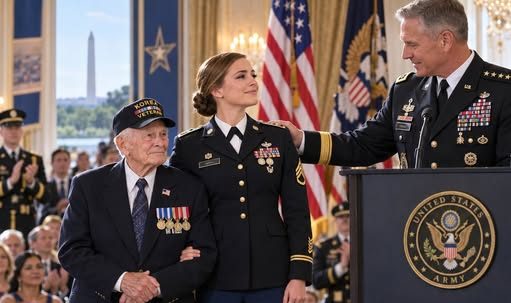
My family begged me not to wear my Army uniform to my grandfather’s military honor ceremony because they said it would “embarrass” them in front of important guests.
My brother mocked my medals. My father told me real success happened in boardrooms, not in uniform.
I said nothing and took my seat near the back of the ballroom.
What none of them knew was that a Pentagon delegation had arrived for a second ceremony no one in my family had been told about.
Then a four-star general stepped to the microphone and said:
“Ladies and gentlemen, today we are honoring not one hero—but two.”
My name is Staff Sergeant Maya Parker.
My grandfather, Thomas Parker, was turning ninety.
Our family had organized an enormous tribute for him at a military heritage center overlooking the Potomac outside Washington, D.C.
Grandpa had served in the Army when he was young and spent the rest of his life supporting veterans.
He rarely talked about the details of his service.
When I was a child, I thought the old photographs in his study were simply pictures of men standing beside muddy vehicles.
When I grew older, I understood that every photograph represented someone Grandpa remembered.
That was partly why I joined the Army.
My father never understood that.
Richard Parker had built a successful commercial real-estate company.
My older brother Daniel joined him straight out of business school.
Together, they expanded Parker Development into several states.
Their names appeared in business magazines.
They attended charity galas.
They knew senators, executives, attorneys, and donors.
My younger sister, Claire, became an attorney and married another attorney.
Then there was me.
The enlisted soldier.
In my father’s version of our family, Daniel had ambition.
Claire had professionalism.
I had made an unusual life choice that everyone politely tolerated.
The moment I stepped out of the Army SUV at the heritage center, Daniel stared at me.
“You actually came dressed like that?”
I looked down at my Army service uniform.
“Yes.”
He adjusted the cuffs of his expensive suit.
“You know this is a major event, right?”
“I’m aware.”
“There are members of Congress here.”
“Okay.”
“CEOs.”
“Good for them.”
“Senior military leadership.”
I looked at him.
“That makes the uniform seem even more appropriate.”
Daniel smiled the way he always did when he thought I was being difficult.
His wife Ashley walked up beside him.
She looked at my ribbons.
Then at the badge above my pocket.
“Honestly, Maya, don’t you think all of that is a little dramatic?”
“All of what?”
She gestured toward my uniform.
“The medals.”
“Those are not costume jewelry.”
Her smile tightened.
“I didn’t say they were.”
“You didn’t need to.”
Daniel shook his head.
“Here we go.”
I let it go.
That had become my specialty around my family.
Let it go.
Ignore the comment.
Change the subject.
Keep dinner peaceful.
Pretend it didn’t hurt.
Inside, the ballroom was already filling.
White tablecloths.
Military flags.
Large screens displaying photographs from Grandpa’s life.
Corporate executives mingled beside veterans in old unit caps.
Several retired generals stood near the stage.
My father found me before I reached my table.
“Maya.”
I stopped.
He lowered his voice.
“Could we speak privately?”
“Sure.”
He led me toward a quieter hallway.
“What?”
His expression became serious.
“Today is about your grandfather.”
“I know.”
“I don’t want unnecessary attention.”
I waited.
Dad looked at my uniform.
There it was.
“You think I’m going to take attention from Grandpa by wearing the uniform he asked me to wear?”
“He didn’t specifically ask you.”
Actually, he had.
Grandpa had called two weeks earlier.
Wear your uniform, kid.
That was what he said.
I didn’t bother telling Dad.
He continued.
“There are important people here.”
“You already mentioned that.”
“Daniel has several investors attending.”
I stared at him.
“What does Daniel’s business have to do with Grandpa’s military tribute?”
Dad sighed.
“You always make things harder than they need to be.”
“How?”
“By turning everything into a challenge.”
I laughed once.
“I walked into a building wearing my work uniform.”
“You know what I mean.”
“No. I genuinely don’t.”
Then Dad said the sentence I would remember for years.
“Compared to what Daniel has accomplished, being a career soldier simply isn’t particularly impressive anymore.”
For a moment, neither of us spoke.
My mother stood only several feet away.
She had heard him.
I looked at her.
She looked down.
That hurt worse.
Daniel had a company title.
A corner office.
A seven-figure house.
I had spent years responsible for soldiers.
Training them.
Bringing them home.
Making decisions when mistakes could injure people rather than reduce quarterly earnings.
But arguing would not change my father’s definition of success.
So I nodded.
“Understood.”
“Maya—”
“I said I understand.”
I walked outside.
Cold air came off the river.
I stood near the terrace, staring across the water until my hands stopped tightening.
I had been under mortar alarms without losing control.
Had coordinated evacuations in weather bad enough to ground aircraft.
Had sat beside wounded soldiers who asked me whether they were going to live.
And somehow, one sentence from my father could still make me feel seventeen years old.
Then my phone rang.
I looked at the screen.
Restricted number.
I answered immediately.
“Staff Sergeant Parker.”
A professional voice replied.
“Ma’am, this is Lieutenant Colonel Reeves. The Pentagon delegation has arrived.”
My posture changed automatically.
“Understood.”
“The Chief’s vehicle is entering the security area now.”
“Thank you.”
“Are you in position?”
I looked through the ballroom windows.
Daniel was laughing beside several executives.
Ashley was speaking with my mother.
Dad was shaking hands with a donor.
None of them had any idea.
“Yes, sir.”
“We’ll proceed as briefed.”
“Roger.”
I ended the call.
Months earlier, I had been notified that the Army intended to recognize me for my actions during an overseas multinational disaster-response mission.
The exact circumstances had remained restricted while partner governments completed reviews.
Once enough details were cleared, the Army arranged the presentation.
I asked that it happen during Grandpa’s ceremony.
Not because I wanted a larger audience.
Because if anyone deserved to stand beside me that day, it was him.
Only Grandpa knew.
Military leadership knew.
The event coordinator knew.
My immediate chain of command knew.
My family did not.
I returned to the ballroom.
Daniel barely looked at me.
Dad acted as though our conversation had never happened.
I took my assigned seat.
An hour later, the lights dimmed.
A four-star general stepped onto the stage.
Every conversation stopped.
General Andrew Halstead, the Army Chief of Staff, began by speaking about my grandfather’s service.
Duty.
Courage.
The generations that served before us.
Grandpa sat near the stage in a dark suit, his old unit pin on his lapel.
Then General Halstead paused.
His tone changed.
“Sergeant Major, bring the case forward.”
A senior enlisted leader stepped onto the stage carrying a presentation case.
My heart began pounding.
Dad slowly turned his head toward me.
Daniel stopped smiling.
General Halstead looked across the ballroom.
“Today, we honor not one hero—but two.”
Then he said:
“Staff Sergeant Maya Parker, United States Army, please join me on stage.”
For several seconds, nobody at my table moved.
Then I stood.
Daniel whispered:
“What is this?”
I looked at him.
“Apparently something unimpressive.”
And walked toward the stage.
PART 2 — THE MEDAL THEY THOUGHT WAS DECORATION
The walk to the stage felt longer than it was.
Hundreds of people were watching.
Some stood as I passed.
Others whispered.
I kept my eyes forward.
General Halstead waited until I reached him.
Then he extended his hand.
“Staff Sergeant Parker.”
“Sir.”
“About time.”
That surprised a small laugh out of me.
He smiled.
Then turned toward the audience.
“Please remain standing.”
The room rose.
My family rose with everyone else.
The Sergeant Major opened the case.
Inside was a Soldier’s Medal.
For people outside the military, ribbons and decorations can blur together.
To many of my relatives, they were colored fabric arranged over a pocket.
But the Soldier’s Medal is awarded for heroism not involving direct conflict with an enemy.
It requires personal risk.
The kind of situation where nobody is shooting at you, but you can still die if you make the wrong choice.
General Halstead began reading the citation.
Months earlier, I had been assigned to a multinational logistics team supporting a humanitarian mission after a major earthquake and subsequent flooding overseas.
A landslide severed the safest road out of a mountain district.
Communication failed.
A temporary medical site held civilians and several injured service members.
Weather deteriorated.
Another slope was becoming unstable.
The planned evacuation route was no longer usable.
I was the senior noncommissioned leader on the ground for the movement team.
The citation did not tell every detail.
It did not mention the screaming.
The smell of diesel.
The child who would not let go of my sleeve.
The medic with a fractured wrist who kept treating other people anyway.
It did say enough.
General Halstead read:
“Staff Sergeant Parker demonstrated extraordinary courage and leadership while coordinating the evacuation of thirty-seven civilians and six injured service members from an area threatened by secondary ground collapse.”
My father’s face changed.
Daniel no longer looked at me.
The citation continued.
When the primary route became unusable, I identified an alternative passage using an older maintenance corridor and personally moved ahead to confirm that the route remained passable.
That was the sanitized version.
The reality was uglier.
The corridor crossed a damaged section of road where part of the embankment had already fallen away.
We had one heavy vehicle.
Several smaller vehicles.
Not enough time.
We moved people in stages.
I returned to the medical site twice because two civilian families initially refused to leave without elderly relatives.
The last vehicle cleared the zone minutes before another section of hillside collapsed across the original evacuation area.
Nobody died.
That was what mattered.
General Halstead finished:
“Her decisive leadership, personal courage, and unwavering commitment to the safety of others reflect great credit upon herself, her unit, and the United States Army.”
The room was completely silent.
Then the Sergeant Major stepped forward.
General Halstead placed the medal on my uniform.
He leaned closer.
“Your grandfather is proud of you.”
My throat tightened.
“Yes, sir.”
Then applause erupted.
Not polite applause.
The kind that rolls through a room.
I looked toward Grandpa.
He was standing.
Ninety years old.
One hand gripping his cane.
The other saluting me.
That almost broke my composure.
I returned the salute.
When the applause finally settled, General Halstead raised one hand.
“Please remain standing. We are not finished.”
My father looked confused.
Daniel looked worse.
I hadn’t known about this part either.
General Halstead turned toward Grandpa.
“Mr. Parker, with your permission?”
Grandpa smiled.
“You’ve got the floor, General.”
A staff officer handed General Halstead a folded letter.
He looked at me.
Then at my family.
“Several months ago, Mr. Parker was contacted regarding today’s presentation.”
My heart began beating harder.
“He was asked whether he objected to Staff Sergeant Parker receiving her medal during the ceremony planned in his honor.”
Grandpa shook his head.
General Halstead smiled.
“His response was longer than necessary.”
Laughter moved through the ballroom.
Grandpa called:
“I had things to say.”
More laughter.
General Halstead unfolded the letter.
“I asked Mr. Parker for permission to read a portion of his response today.”
He looked toward Grandpa.
“He agreed.”
Then he began.
My granddaughter Maya has spent much of her life being the quietest accomplished person in a family that often mistakes volume for value.
My chest tightened.
Daniel’s face changed.
Dad slowly sat down.
The General continued.
When she enlisted, members of our family called it a phase.
When she reenlisted, they called it stubbornness.
When she earned responsibility, they asked when she was going to find a real career.
I allowed too many of those comments to pass without correcting them.
That was my mistake.
I looked at Grandpa.
His eyes never left me.
Then came the sentence that changed the entire room.
If my family has spent years measuring success by salary, office size, and social access, then somewhere along the way we forgot who taught us what service meant.
No one at my table moved.
General Halstead continued.
I am not writing this because Maya needs public praise.
She does not.
I am writing it because the rest of us apparently do need public correction.
A few people laughed softly.
Daniel did not.
Then the General paused.
His eyes moved to another paragraph.
“There is one final section Mr. Parker specifically asked me to read.”
Grandpa leaned back in his chair.
Dad turned toward him.
For more than twenty years, the Parker Service Foundation has supported veterans, military families, and emergency responders.
My father’s face went pale.
I knew the foundation well.
Grandpa created it after selling part of his first business.
Its endowment had grown to more than twenty million dollars.
Dad served as vice chair.
Daniel had spent years telling everyone he would eventually take over.
Grandpa’s letter continued.
My family has assumed that Daniel will succeed me as chairman.
That assumption is incorrect.
Daniel stared at Grandpa.
Ashley’s mouth fell open.
My father whispered:
“What?”
General Halstead read:
Three months ago, in the presence of independent counsel and the foundation’s board, I signed the succession documents naming Staff Sergeant Maya Parker as the next chair of the Parker Service Foundation when my tenure ends.
The room erupted in whispers.
I stood frozen.
This part was news to me too.
I turned toward Grandpa.
He smiled.
I mouthed:
You did what?
He only winked.
General Halstead continued.
I did not choose Maya because she wears a uniform.
I chose her because, when responsibility becomes inconvenient, she does not hand it to somebody else.
I chose her because service to her has never been a branding strategy.
And I chose her because the people this foundation exists to help deserve someone who understands that dignity matters as much as a check.
Daniel sat down.
Dad stared straight ahead.
Then the General read Grandpa’s final line.
If anyone in my family is embarrassed by Maya’s uniform today, I suggest they ask themselves whether the problem is the uniform—or the mirror standing in front of them.
Silence.
Absolute silence.
Then Grandpa started clapping.
The room followed.
And standing beneath the lights with a medal I had never asked my family to admire, I realized the biggest surprise of the day was not the Army award.
It was that my grandfather had spent months quietly preparing to force our family to confront something they had avoided for years.
What they valued.
And why.
PART 3 — THE CONVERSATION BEHIND THE CLOSED DOOR
The ceremony continued.
That surprised my family more than anything.
Grandpa still received his tribute.
Veterans spoke.
Photographs appeared on the screens.
A retired colonel told a story about Grandpa getting lost during a training exercise in Germany and refusing to admit it for six hours.
People laughed.
Grandpa laughed hardest.
My medal did not replace his moment.
It became part of it.
That had been the point.
Afterward, guests crowded around me.
Veterans shook my hand.
A congresswoman thanked me.
Two young soldiers asked about my unit.
People from Daniel’s business circle suddenly wanted to know everything about my career.
I hated that part.
Not because I was ungrateful.
Because I knew many of them had seen me at family events for years.
They could have asked before a four-star general told them I was worth noticing.
Eventually, Dad appeared.
“Maya.”
“Dad.”
“We need to talk.”
I almost smiled.
My family loved private conversations after public surprises.
Daniel joined us.
So did Mom.
Grandpa’s aide quietly told us he was waiting in a private sitting room.
When we entered, Grandpa was sitting beside the window, cane across his knees.
He looked exhausted.
Happy.
And completely unapologetic.
Dad closed the door.
“What was that?”
Grandpa raised an eyebrow.
“A ceremony.”
“You know what I mean.”
“Then ask a better question.”
Daniel stepped forward.
“You replaced me as foundation successor without even telling me?”
Grandpa looked at him.
“I did not replace you.”
Daniel laughed bitterly.
“Really?”
“You were never formally selected.”
Everyone went quiet.
Daniel looked toward Dad.
Dad looked away.
That told me something.
Grandpa continued.
“Your father assumed.”
Daniel stared at him.
“For years you let me believe—”
“No.”
Grandpa’s voice sharpened.
“For years, you told people what you intended to become. I never confirmed it.”
Daniel flushed.
Mom stepped in.
“Dad, today was supposed to bring the family together.”
Grandpa looked at her.
“Then maybe the family should stop requiring one person to become smaller so everyone else can feel larger.”
Mom fell silent.
Dad turned toward me.
“You knew about this.”
“No.”
“The medal?”
“Yes.”
“The foundation?”
“No.”
He looked at Grandpa.
“You expect me to believe she had no idea?”
Grandpa tapped his cane once against the floor.
“Richard.”
Dad stopped.
“You are doing exactly what I wrote about.”
“What?”
“You cannot imagine Maya receiving something unless she maneuvered for it.”
Dad’s face tightened.
“That’s unfair.”
Grandpa leaned forward.
“You told her this morning that her career was unimpressive.”
Dad froze.
So did I.
“How did you know?”
Grandpa looked toward the door.
“My hearing may be bad. The event staff’s is excellent.”
I almost laughed.
Dad looked embarrassed.
Grandpa continued.
“You said that at my military honor ceremony.”
“I was trying to keep attention on you.”
“By insulting the only grandchild who followed me into service?”
Dad looked away.
Grandpa shook his head.
“No, Richard. You were protecting the story you tell about your children.”
Dad frowned.
“What story?”
“That Daniel succeeded because he built wealth.”
Grandpa pointed toward Claire, who had quietly entered behind us.
“That Claire succeeded because she became a lawyer.”
Then he pointed toward me.
“And that Maya chose something respectable but lesser.”
Nobody answered.
Grandpa said:
“I have listened to that story for fifteen years.”
Mom whispered:
“Why didn’t you say something?”
“I should have.”
He looked at me.
“That is one of the reasons for the letter.”
I swallowed.
“Grandpa, you didn’t owe me a public defense.”
“No.”
He nodded.
“I owed you a private one years ago.”
That sentence landed harder than the applause.
Daniel paced toward the wall.
“Fine. Maya’s a hero. Everyone understands.”
I turned toward him.
“Stop.”
He looked at me.
“I am not asking you to call me a hero.”
“The General just did.”
“No.”
I shook my head.
“He described one thing I did.”
Daniel laughed.
“Same difference.”
“It isn’t.”
That silenced him.
I continued.
“I worked with people on that mission who did things nobody in this room will ever hear about.”
Daniel crossed his arms.
“So now you’re humble too.”
“Daniel.”
Grandpa’s voice warned him.
But I raised a hand.
“No. Let him finish.”
Daniel looked at me.
“You want the truth?”
“Yes.”
“I’m tired of this family acting like my career doesn’t count because I didn’t wear a uniform.”
I stared.
Then something unexpected happened.
I understood.
Not agreed.
Understood.
“This isn’t supposed to erase your career.”
“Sure feels like it.”
“Then you learned the wrong lesson.”
His expression changed.
I continued.
“I have never said your work means nothing.”
“You mock corporate people constantly.”
“I mock you constantly.”
Claire snorted.
Daniel glared at her.
I almost smiled.
Then I said:
“You built something real.”
He looked surprised.
“You employ hundreds of people.”
Silence.
“You made Grandpa’s foundation financially stronger through your investment committee work.”
More silence.
“I know exactly what you’ve accomplished.”
Daniel looked away.
I finished:
“The problem is you never thought you needed to know what I accomplished.”
That landed.
He had no response.
Grandpa nodded slowly.
“Now we’re getting somewhere.”
Dad sat down.
He looked suddenly older.
Then he asked Grandpa:
“Why Maya?”
Not angry this time.
Just confused.
Grandpa answered simply.
“Because the foundation is not a reward.”
Daniel looked at him.
“It’s work.”
“Exactly.”
Grandpa leaned back.
“Daniel thinks leadership is the prize you receive after succeeding.”
He looked toward me.
“Maya understands leadership is what you owe after people trust you.”
That was the difference.
Not better person.
Different fit.
And for the first time, I realized Grandpa’s decision was not his way of punishing Daniel.
It was his way of protecting a mission.
PART 4 — WHAT REALLY HAPPENED OVERSEAS
My family had heard the citation.
They still did not understand the mission.
That was partly my fault.
I rarely told them anything about work.
For years, every conversation became strange.
Dad would ask:
“Still doing logistics?”
As if I worked in a warehouse.
Daniel once asked whether my job was “basically moving trucks around.”
I stopped explaining.
After the ceremony, Dad asked me something he had never asked before.
“What actually happened over there?”
We were at Grandpa’s house the following morning.
Just Dad and me.
I almost said:
It’s complicated.
Instead:
“Coffee?”
He nodded.
We sat at the kitchen table.
I told him what I could.
Our team had been supporting a humanitarian response after an earthquake in a partner nation.
Roads were damaged.
Communications unreliable.
Thousands displaced.
A multinational relief force established several temporary medical and supply sites.
Our team’s job was movement.
People.
Fuel.
Medical material.
Vehicles.
Routes.
The glamorous stuff nobody photographs.
Dad listened.
Then I told him about the night behind the medal.
Rain had been falling for hours.
A secondary landslide blocked our primary road.
Engineering personnel warned another slope was unstable.
We had thirty-seven civilians at a temporary aid station.
Several children.
Two elderly people who could barely walk.
Six injured service members.
One needed urgent surgery.
Air evacuation was impossible in the weather.
We needed ground movement.
Fast.
A local driver mentioned an old service road through a quarry.
Our maps showed it as partially abandoned.
I went with an engineer and local liaison to assess it.
Part of the route was narrow.
One section had water moving across it.
Not ideal.
But possible.
Dad asked:
“Were you ordered to go?”
“No.”
“Why did you?”
“Someone had to verify the route.”
“You were the senior person.”
“I was the senior NCO at that site.”
“So you could have sent someone.”
“Yes.”
He stared at me.
“Why didn’t you?”
“Because if I was going to order vehicles full of injured people onto that road, I wanted to see it myself.”
Dad looked down.
I continued.
We moved the most vulnerable first.
Then medical personnel.
Then equipment.
A civilian family refused to leave because an elderly grandfather was missing.
We found him in a damaged building nearby.
Dad frowned.
“You went back?”
“Yes.”
“How many times?”
“Twice.”
He looked frustrated.
“That sounds reckless.”
“Some of it was.”
I smiled slightly.
“The Army did not give me a medal for flawless risk avoidance.”
He almost smiled back.
Then I told him the part no citation mentioned.
On the final trip, one of my soldiers—Specialist Aaron Lewis—was exhausted and scared.
Twenty-one years old.
His first overseas mission.
He told me he did not think he could go back through the damaged section again.
I could have ordered him.
Instead, I removed him from the vehicle crew and drove the last vehicle myself with another qualified operator.
Dad said:
“Why?”
“Because he had reached his limit.”
“He could have obeyed.”
“Yes.”
“But?”
“Leadership isn’t proving somebody can endure one more thing.”
Dad became very quiet.
That sentence seemed to reach somewhere the citation had not.
Then he asked:
“Did you ever tell us any of this?”
“No.”
“Why?”
I looked at him.
“When?”
He frowned.
“What do you mean?”
“When would I have told you?”
He started to answer.
Stopped.
I continued.
“At Christmas, Daniel talked about an acquisition for forty minutes.”
Dad said nothing.
“At Mom’s birthday, Claire discussed her promotion.”
Silence.
“You asked me whether I planned to stay in the Army much longer.”
His face changed.
I wasn’t angry.
That made it worse.
“You didn’t ask what I did.”
Dad looked toward the window.
“I thought you didn’t like talking about it.”
“Sometimes I don’t.”
“That’s what your mother said.”
“Did you ever ask me?”
No answer.
I took a sip of coffee.
Dad whispered:
“No.”
That was the truth.
My family had convinced themselves I was private because it relieved them of curiosity.
Then Dad asked:
“What did Lewis say afterward?”
“What?”
“The young soldier.”
I smiled.
“He apologized for freezing.”
“What did you tell him?”
“That fear wasn’t misconduct.”
Dad looked at me.
“And?”
“I told him to eat something and sleep.”
Dad laughed softly.
Then he rubbed his eyes.
“I’ve been an ass.”
That was the first apology.
Not complete.
But real.
I said:
“Yes.”
He stared at me.
“You could soften it.”
“You raised me to be honest.”
He laughed again.
And somehow, for the first time in years, we were talking like a father and daughter instead of two people defending different definitions of success.
PART 5 — WHY GRANDPA CHANGED THE FOUNDATION
Three days after the ceremony, Grandpa asked me to come to his study.
The same room I had loved as a child.
Old photographs.
Military books.
A flag folded inside a wooden case.
A photograph of Grandma before she died.
And beside it, a thick binder.
Grandpa pointed toward the chair.
“Sit.”
I sat.
He pushed the binder toward me.
PARKER SERVICE FOUNDATION.
“Read.”
I opened it.
Board structure.
Endowment reports.
Grant programs.
Veterans housing support.
Scholarships.
Emergency aid.
Military spouse employment programs.
I knew broadly what the foundation did.
I had never seen the internal structure.
Grandpa said:
“Daniel has done good work there.”
That surprised me.
“I know.”
“You do?”
“Yes.”
“He improved the investment process.”
“He did.”
“He negotiated lower management fees.”
“I know that too.”
Grandpa smiled.
“You pay more attention than they think.”
“I always have.”
Then I asked:
“Why not Daniel?”
Grandpa leaned back.
“Because two years ago, the board reviewed a request to expand emergency grants for junior enlisted families.”
I waited.
“Daniel opposed it.”
“That doesn’t automatically make him wrong.”
Grandpa raised an eyebrow.
“Good answer.”
“What was his reason?”
“He said emergency grants produced no measurable long-term return.”
I frowned.
“What kind of return?”
“Programmatic efficiency.”
“That still might be a legitimate concern.”
“It was.”
Grandpa nodded.
“So we changed the proposal.”
“What happened?”
“He opposed it again.”
“Why?”
“Too small to matter to donors.”
There it was.
Grandpa continued.
“Daniel is excellent at growing money.”
“Yes.”
“He is less interested in what money is for.”
I said nothing.
“Then last year we had a Gold Star spouse apply for temporary housing assistance.”
I looked up.
“She had three children.”
“Yes.”
“I know the case.”
Grandpa smiled.
Of course I knew it.
A military family support group had circulated it.
“The foundation denied her.”
“Initially.”
“Yes.”
“Why?”
“Technical residency rule.”
Grandpa nodded.
“Daniel wanted to keep the denial.”
“What happened?”
“You called me.”
I remembered.
I had called Grandpa furious.
I did not know his foundation was the organization involved.
I simply knew a veteran-support nonprofit had refused emergency housing over an address technicality.
I had said:
If a program designed to help families can’t survive one reasonable exception, then it isn’t serving families. It’s serving its own paperwork.
Grandpa had asked a lot of questions.
I had forgotten the conversation.
He had not.
“We changed the policy.”
I stared at him.
“You chose me because I complained on the phone?”
“No.”
He laughed.
“I chose you because you had no idea the foundation was mine.”
I blinked.
“What?”
“The case materials you saw used the program subsidiary name.”
He smiled.
“You thought you were criticizing some random nonprofit.”
“I was.”
“Exactly.”
He leaned forward.
“You weren’t performing.”
That mattered to him.
I looked down at the binder.
“Grandpa, I’m still active duty.”
“I know.”
“I can’t simply run a private foundation however I want.”
“I know.”
“There are ethics rules.”
“Yes.”
“I would need counsel.”
“Already consulted.”
Of course he had.
I laughed.
“You planned this thoroughly.”
“I’m ninety, not dead.”
Then he became serious.
“You will not manage investments.”
“Good.”
“Professional staff will.”
“Good.”
“You will chair the board when you are legally able to accept the role under whatever restrictions apply to your service status.”
“Okay.”
“You will not be paid while rules prohibit it.”
“Also good.”
“You will have independent directors.”
“Very good.”
He smiled.
“See why I picked you?”
“No.”
“You keep trying to reduce your own authority.”
“That’s called governance.”
“Exactly.”
Then his expression softened.
“I am not giving you a trophy.”
“I know.”
“Daniel thinks I am.”
“I know.”
“He will understand eventually.”
“You sound confident.”
“I raised him too.”
Then Grandpa reached into the desk.
He removed another letter.
Not the one read at the ceremony.
This one was addressed to Daniel.
“I want you to give him this.”
“Why me?”
“Because if I give it to him, he’ll hear criticism from an old man.”
“And if I do?”
“He might hear his sister.”
I stared.
“You’re using me.”
“Leadership.”
I laughed.
He smiled.
Then coughed.
Longer than usual.
For the first time, I noticed how frail he looked.
Ninety.
The ceremony had made him seem larger.
In his study, he looked mortal.
I asked:
“You okay?”
“Old.”
“That isn’t a diagnosis.”
“It becomes one eventually.”
I hated that answer.
He reached across the desk.
“Kid.”
I looked at him.
“Do not spend your life trying to prove your choices were worthy.”
My eyes burned.
“They were yours.”
He tapped the binder.
“This is work.”
He touched the medal ribbon on my uniform photograph sitting nearby.
“That was work.”
Then he pointed toward my chest.
“You are not either one.”
I swallowed.
“Then what am I?”
“My granddaughter.”
His voice softened.
“That should have been enough for all of us.”
PART 6 — DANIEL’S LETTER
I gave Daniel the letter two days later.
He looked at the envelope like it might explode.
“What is it?”
“Grandpa asked me to give it to you.”
“He couldn’t mail it?”
“He could.”
“Then why didn’t he?”
“Because apparently I’m now a courier.”
Daniel did not laugh.
We were sitting in his office overlooking downtown.
The room looked exactly like him.
Perfect lines.
Expensive furniture.
Awards arranged strategically.
Photographs with important people.
He opened the letter.
I watched his face while he read.
Eventually, he put it down.
“What did he tell you?”
“Nothing about your letter.”
“You expect me to believe that?”
“Yes.”
He laughed bitterly.
“You’re enjoying this.”
“No.”
“Come on, Maya.”
He stood.
“For fifteen years, everyone talked about me being the future of the foundation.”
“You talked about it.”
“So did Dad.”
“Grandpa didn’t.”
He glared at me.
“You always do that.”
“Do what?”
“Act like you don’t care about status because you secretly think that makes you morally superior.”
That landed.
Because there might have been some truth in it.
I stood too.
“You want honesty?”
“Yes.”
“Sometimes I do judge you.”
His face hardened.
“Good.”
“I think you care too much about appearances.”
“Sure.”
“I think Ashley’s comment about my medals was insulting.”
“It was.”
That surprised me.
He continued.
“I told her that.”
“When?”
“After the ceremony.”
I paused.
Daniel sat again.
Then said:
“You think I’m shallow.”
“Sometimes.”
“And I think you hide behind service.”
My eyes narrowed.
“What does that mean?”
“You never have to talk about what you want.”
I said nothing.
“You can always say the mission matters.”
Silence.
“The soldiers matter.”
Silence.
“The unit matters.”
He leaned forward.
“When does Maya matter?”
That annoyed me because it sounded like something Grandpa would say.
I sat.
“Keep going.”
Daniel seemed surprised.
“You stay in a career that asks everything from you.”
“Yes.”
“And when anyone asks whether you’re happy, you call the question selfish.”
“I do not.”
“You do.”
He paused.
“Maybe not out loud.”
I looked away.
This conversation was not going where I expected.
Daniel continued.
“You know why Dad bragged about me?”
“Because you’re his favorite.”
“No.”
I raised an eyebrow.
“Okay, partly.”
He almost smiled.
Then:
“Because I needed it.”
That surprised me.
“What?”
“You never did.”
I stared.
“Maya, you joined the Army at nineteen.”
“Twenty.”
“Whatever.”
“It matters.”
“Fine. Twenty.”
He shook his head.
“You left home. Built your own life. Never asked anyone for money. Never asked Dad for a job.”
“You did.”
“Yes.”
He said it without defensiveness.
“I needed help.”
Silence.
“And Dad liked being needed.”
That connected something.
Daniel looked at Grandpa’s letter again.
“Grandpa says I confuse being useful to an institution with being useful to people.”
That sounded like Grandpa.
“What else?”
“That I am not being punished.”
I nodded.
“He told me that too.”
Daniel laughed.
“Of course.”
Then he read one line aloud.
Maya is not replacing you. She is doing a job I believe fits her better. Your choice is whether you are mature enough to continue doing the work that fits you.
He looked at me.
“What does that mean?”
“I think he wants you to stay on the investment committee.”
“He does.”
“You’re good at it.”
Daniel frowned.
“You really believe that?”
“Yes.”
“Even after everything?”
“What everything?”
“Years of being an ass to you.”
I considered it.
“Yes.”
“That’s annoying.”
“I’m very mature now.”
He laughed.
Finally.
Then he said:
“I was jealous of you.”
I stared.
“What?”
“You had a thing.”
“What thing?”
“The Army.”
“That clears it up.”
He rolled his eyes.
“You knew who you were.”
I laughed.
“Daniel, I spent most of my twenties confused and sleep-deprived.”
“But you had something you believed in.”
His expression became serious.
“I had Dad’s company.”
“That’s not nothing.”
“No.”
“But sometimes I didn’t know if I wanted it or if I just wanted him to be impressed.”
For the first time, I saw my brother without the suit.
Not literally.
Unfortunately.
But the man underneath it.
He had spent years trying to win Dad’s approval.
I had spent years pretending I did not need it.
Different strategies.
Same wound.
Daniel tapped Grandpa’s letter.
“I’ll stay on the committee.”
“Good.”
“But if you destroy the endowment with emotional decisions, I’ll tell you.”
“Please do.”
“And if you start giving money to every sad story—”
“I’ll throw you out a window.”
He smiled.
“There she is.”
Then he grew quiet.
“Maya.”
“Yeah?”
“I’m sorry about the medals.”
I looked at him.
“I knew they meant something.”
“Okay.”
“I just didn’t know what.”
That was enough for that day.