I arrived at my ex-husband’s extravagant family Christmas gathering expecting an uncomfortable reunion. Instead, he was the one who couldn’t speak. He had invited the woman he’d
abandoned because he believed she couldn’t have children, certain his influential military family would feel sorry for me. But when I stepped out of a helicopter with the four children he had insisted didn’t exist, everything changed. And when my oldest son asked one innocent question, a room filled with decorated military officers went completely silent.
My name is Commander Kesha Reynolds. Eight years ago, Colonel Daniel Reynolds left me while I was pregnant with our children.
I was at Texas Department of Public Safety headquarters, going over a criminal investigation spanning several states, when a familiar name appeared on my secure phone.
Daniel Reynolds.
I hadn’t heard from him in eight years.
Eight years since he’d claimed I was lying about being pregnant, hurried through our divorce, taken an overseas assignment, and disappeared without ever hearing one of our children’s heartbeats.
There was no apology in his message.
Not even a hello.
Mother wants to see you before it’s too late. Christmas Day. Reynolds residence. Fort Carson. Don’t be late.
After eight years, Daniel apparently still believed he could order me around.
He likely pictured the same devastated young woman he’d walked away from.
He knew nothing about the life I’d built or the fact that I now led one of the most respected investigative units within Texas DPS.
And he certainly didn’t know I was bringing company.
My deputy, Officer Lena Brooks, appeared in my office doorway, looking concerned.
“Commander… are you really going?”
I glanced toward the helicopters parked outside and smiled.
“Oh, I’m going.”
On Christmas morning, beneath a freezing gray sky, our department helicopter took off from Austin.
Seated across from me were the four greatest blessings I’d ever received: Noah, Ethan, Sophia, and Olivia.
My eight-year-old quadruplets were dressed in matching navy coats, each with a small honorary unit badge pinned proudly near the collar.
“Mama,” Noah said, straightening his little cap, “is this when we finally get to meet Grandpa?”
“And Grandma?” Sophia asked.
“Maybe,” I told them softly.
All four children looked remarkably like Daniel. They had his steel-gray eyes, his slightly crooked smile, and the distinctive Reynolds family dimple.
A DNA test wouldn’t be necessary.
The resemblance was right there on every one of their faces.
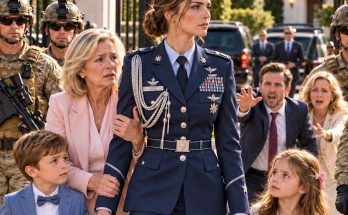
Our helicopter touched down on the snow-covered grounds of Fort Carson, its powerful rotor wash scattering snow in every direction.
I was the first to step outside, wearing my formal command uniform.
My children followed, climbing down one after another.
We joined hands and made our way toward the family’s enormous estate.
Daniel’s mother was standing at the front entrance with a crystal wineglass in her hand.
As soon as she noticed the children, the glass fell from her fingers and shattered against the stone steps.
“Mom,” Noah murmured, gazing up at me. “Is that Grandma?”
I hadn’t had a chance to answer when relatives began pouring into the entrance.
Retired generals.
Highly decorated officers.
Longtime friends of the family.
Conversations stopped as soon as everyone saw us.
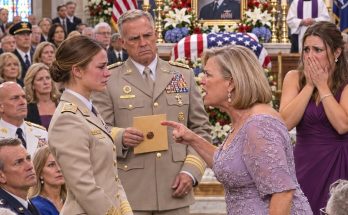
Inside the house, Daniel was standing near the fireplace, dressed in his full military dress uniform.
Beside him stood an attractive blonde woman, and in his hand was an open jewelry box containing a ring.
We had arrived in the middle of his proposal.
The self-assured smile on his face vanished.
He stared at the first child.
Then the second.
Then the third.
And finally, the fourth.
His face went pale.
The blonde woman cautiously moved away from him.
“Daniel…” she said quietly. “Who are those children?”
He opened his mouth to respond.
But no words came.
I placed a hand on Olivia’s shoulder and met his stare without looking away.
“Merry Christmas, Colonel.”
The ring box dropped from his hand, striking the hardwood floor with a sharp click.
His mother reached for the doorframe to keep herself upright.
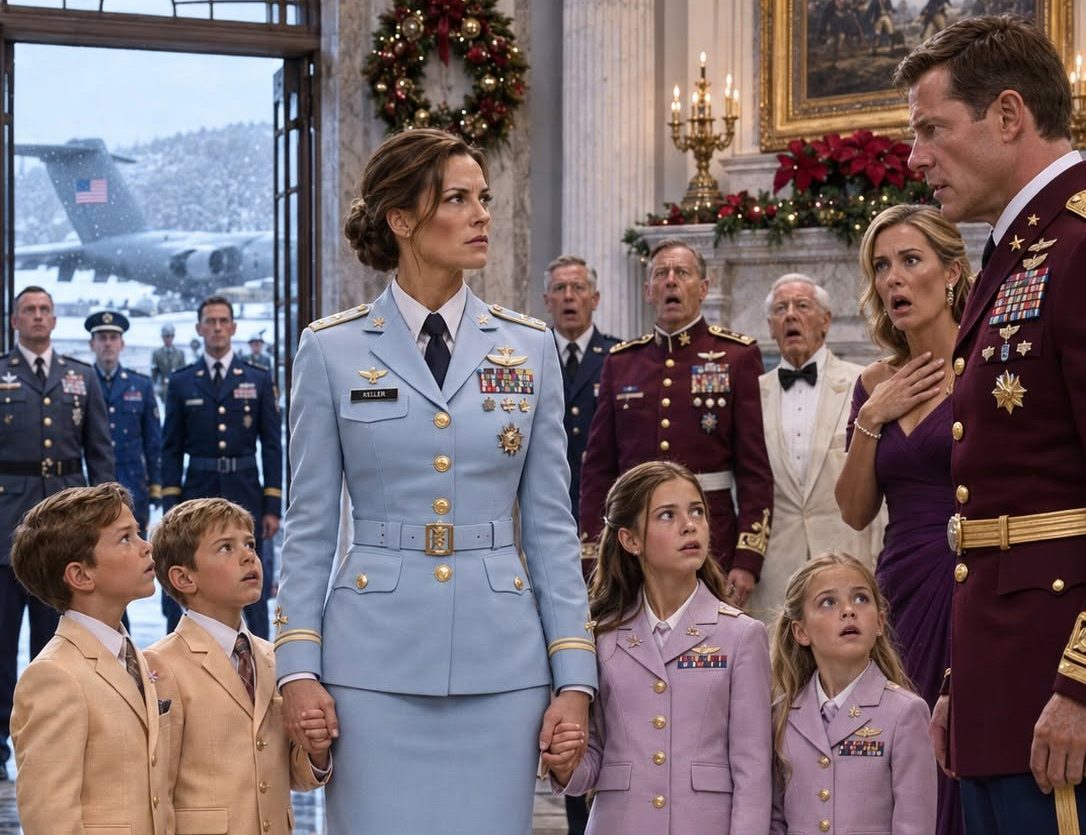
I turned toward the speechless people gathered around us.
“I figured it was about time the Reynolds family met the four grandchildren they’d been told didn’t exist.”
Shocked murmurs spread across the room.
Then Noah stepped toward Daniel. He lifted his eyes to the man who’d left him before he’d even entered the world and asked with heartbreaking innocence,
“Are you really my daddy?”
At that very instant, the front door swung open behind us, and two military investigators walked into the house.
The two investigators stopped just inside the doorway, bringing a gust of cold Colorado air with them.
Neither reached for a weapon.
Neither raised his voice.
But the atmosphere changed immediately.
The older investigator, a broad-shouldered man with silver at his temples, surveyed the crowded room before identifying himself.
“Major Thomas Mercer, Army Criminal Investigation Division. This is Special Agent Rachel Donovan.”
Daniel’s expression changed from shock to alarm.
“What the hell is this?”
Major Mercer ignored the question for a moment. His attention settled on the four children standing beside me.
“Commander Reynolds,” he said respectfully. “I apologize for the timing.”
I tightened my hold on Olivia’s hand.
“Major, my children are present.”
“I understand, ma’am. We won’t discuss sensitive matters in front of them.”
Daniel looked from Mercer to me.
Then back again.
“Kesha, what have you done?”
Eight years ago, that question might have frightened me. Daniel had always known how to make an accusation sound like a verdict.
This time, I simply looked at him.
“I brought our children to meet their family. Everything else is the result of decisions you made without me.”
Noah was still standing a few feet away from his father.
His little face had gone serious.
“Sir,” he said again, “are you my daddy?”
The question was so quiet that several people leaned forward to hear it.
Daniel stared at him.
For one terrible second, I thought he might deny him again.
Instead, his eyes moved across Noah’s face, lingering on the crooked smile that had been passed down through generations of Reynolds men.
“I…”
His voice broke.
Noah waited.
Daniel swallowed.
“I think I am.”
Ethan, who had remained beside me, frowned.
“You think?”
The room went painfully still.
Ethan had always been the practical one. He liked answers that made sense. He liked numbers, maps, and building things that didn’t fall apart.
He had no patience for adults who couldn’t answer simple questions.
“We have the same eyes,” he continued. “Mom showed us pictures.”
Daniel’s mother made a sound somewhere between a sob and a gasp.
Daniel looked at me with something approaching desperation.
“Kesha, can we talk privately?”
“You can answer your son first.”
His eyes returned to Noah.
“Yes,” he whispered. “I’m your father.”
Noah didn’t smile.
He didn’t run forward.
He simply nodded, as though he’d finally received a piece of information he’d been waiting eight years to understand.
“Then why didn’t you come to our birthdays?”
I felt Sophia’s fingers tighten around mine.
Daniel looked away.
And that hurt Noah more than any answer could have.
“Sweetheart,” I said gently, kneeling beside him, “you don’t have to ask everything today.”
“But Mama, I just want to know.”
“I know.”
He looked back at Daniel.
“Did you know about us?”
Daniel’s mouth opened.
Before he could speak, his mother stepped forward.
“Of course he didn’t know! This is obviously some terrible misunderstanding.”
Her voice was sharp, almost commanding.
She had recovered enough from her shock to recognize the danger.
I stood slowly.
“Margaret, I suggest you choose your next words carefully.”
She drew herself up.
“Don’t you dare speak to me like that in my own home.”
“Then don’t lie to my children.”
Daniel stepped between us.
“Enough!”
His voice carried the same authority he’d used on subordinates throughout his military career.
But I wasn’t one of his subordinates.
And I hadn’t been his wife for eight years.
I met his eyes.
“Lower your voice.”
Something in my tone made him stop.
Behind him, the blonde woman quietly closed the jewelry box she’d retrieved from the floor.
“Daniel,” she said, “you told me your first marriage ended because Kesha couldn’t have children.”
Nobody moved.
Her words settled over the room like fresh snow covering a grave.
I looked at her.
“What is your name?”
“Victoria.”
She looked genuinely frightened.
“Victoria Hayes.”
I nodded.
“Victoria, I have never been infertile. I was pregnant when Daniel left me. I told him. I showed him the medical records. He accused me of inventing the pregnancy to stop the divorce.”
Victoria slowly turned toward Daniel.
“Is that true?”
Daniel rubbed a hand across his forehead.
“It wasn’t that simple.”
“It was simple enough when you told me she was unstable.”
My stomach tightened.
There it was.
The same old story.
The same convenient explanation Daniel had used whenever a woman refused to accept the version of events that protected him.
Victoria looked back at me.
“He said you harassed his command. That you made up stories about being pregnant. That you were obsessed with his family’s money.”
For a moment, I couldn’t speak.
Not because I was shocked.
Because eight years had passed, and I was finally hearing how thoroughly he’d rewritten our marriage.
I looked at the four children standing around me.
They were old enough to understand tone, even when they didn’t understand every word.
“Major Mercer,” I said, “is there a quiet room where my children can wait?”
Margaret immediately stepped forward.
“They can come with me.”
“No.”
The word came out sharper than I’d intended.
Margaret recoiled.
I softened my voice, but not my decision.
“They don’t know you yet. And you’ve just suggested their existence is a misunderstanding. They will stay with someone I trust.”
At that moment, Officer Lena Brooks appeared in the doorway.
She had traveled separately to help coordinate our arrival and was still wearing her winter coat.
I had asked her to remain nearby in case the children became overwhelmed.
Now I was grateful I’d listened to that instinct.
“Lena,” I said.
She took one look at the room and understood.
“Come on, team,” she told the children with a smile. “I saw a giant Christmas tree in the sitting room. Who wants to investigate whether the presents are real?”
Olivia looked up at me.
“Are you coming?”
“In a little while, baby.”
“Promise?”
I kissed her forehead.
“Promise.”
Noah hesitated.
His gaze drifted toward Daniel one last time.
“Can he come too?”
The question struck harder than anything else that morning.
Daniel seemed to shrink inside his decorated uniform.
I brushed Noah’s hair away from his forehead.
“Not right now.”
Noah lowered his eyes.
“Okay.”
Lena led the four children down the hallway, away from the gathering crowd.
Only after they disappeared did I turn back toward my former husband.
“Now,” I said, “we can talk.”
Major Mercer stepped forward.
“Colonel Reynolds, we need to ask you questions concerning financial disclosures, communications records, and documents submitted during your overseas assignment.”
Daniel stared at him.
“What documents?”
“Records relating to a family hardship request and supporting declarations submitted through your personnel office eight years ago.”
Daniel’s face went pale again.
I noticed.
So did Mercer.
Victoria stepped away from Daniel.
“Daniel?”
He ignored her.
Instead, he looked directly at me.
“You brought investigators to my mother’s Christmas party?”
“No,” I replied. “I brought our children. The investigators are here because of an inquiry that began months ago.”
“That’s convenient.”
“Evidence doesn’t become less real because you dislike the timing.”
Margaret slammed her palm against a marble side table.
“This is outrageous! My son has served his country honorably for twenty years!”
Major Mercer turned toward her.
“Ma’am, no one is disputing his years of service. We’re examining specific allegations. His decorations don’t place him above an investigation.”
Daniel’s father, retired Major General Richard Reynolds, had been silent until then.
He was standing near the fireplace, watching his son with an expression I couldn’t read.
Finally, he spoke.
“Daniel. What did you submit?”
Daniel shook his head.
“Dad, this is ridiculous.”
Richard didn’t move.
“I asked you a question.”
Daniel glanced toward the guests.
“Not here.”
Richard looked at Mercer.
“Major, the study is available. My son can speak with you there.”
Mercer nodded.
“That would be appropriate.”
But before Daniel could move, Victoria touched his sleeve.
“Tell me something first.”
He looked at her impatiently.
“What?”
“When you said your marriage ended because Kesha lied about having children, did you believe that?”
Daniel’s jaw tightened.
“Victoria, please.”
“Did you believe it?”
For the first time since I entered the house, Daniel had no rank to hide behind.
No command structure.
No family reputation.
No convenient accusation.
Just a woman asking whether the man she’d agreed to marry had told her the truth.
“I believed what I needed to believe,” he finally said.
Victoria stared at him.
Then she took the engagement ring from the box and placed it on the mantel.
“That’s not an answer I can build a marriage on.”
She walked out of the room.
Daniel took a step after her.
Mercer moved slightly into his path.
“Colonel, we still need to speak with you.”
Daniel stopped.
And for the first time in eight years, he had nowhere comfortable to go.
The investigation had begun with something that seemed unrelated to my marriage.
Four months earlier, a routine review of an old personnel matter had identified inconsistencies in documents Daniel submitted before his overseas assignment.
According to those documents, his spouse had voluntarily abandoned the marriage, falsely claimed a pregnancy, and engaged in conduct that threatened his career.
The records included what appeared to be a statement bearing my signature.
I had never signed it.
More troubling was a second document, supposedly a medical declaration, suggesting I’d admitted the pregnancy never existed.
That was false too.
At first, I believed someone had simply made a clerical mistake.
Then the investigators showed me the signatures.
And I recognized something that made my blood run cold.
The handwriting wasn’t mine.
But it was familiar.
Daniel had spent years signing cards, checks, and household paperwork while we were married.
He knew how I formed certain letters.
He knew the slant of my handwriting.
He knew enough to create a convincing imitation.
Not a perfect one.
Just convincing enough for someone who wasn’t looking closely.
I’d cooperated with the investigators, provided the medical records I still possessed, and submitted samples of my handwriting.
A preliminary document examination had raised serious questions about the signatures.
But the inquiry had not yet determined who created the documents or how they entered the official files.
When Mercer contacted me before Christmas, I learned that investigators intended to interview Daniel while he was home.
I told them I would be in Colorado with the children.
I didn’t ask them to confront him at the party.
I certainly didn’t want my children’s first meeting with their father to become part of an official investigation.
But Daniel had chosen to summon me to a family gathering without knowing what I had become—or what the past had finally begun to reveal.
And now his two carefully separated worlds had collided.
I remained near the fireplace while Mercer and Donovan took Daniel into the study.
The guests had begun leaving quietly.
Nobody wanted to become part of a scandal involving one of the military’s most prominent families.
Margaret stood near the Christmas tree, gripping her pearls.
“This is what you wanted,” she said bitterly.
I turned toward her.
“What?”
“To humiliate us.”
I looked around the enormous room.
At the expensive decorations.
The imported flowers.
The crystal glasses abandoned on silver trays.
The family portraits covering the walls.
And finally, at the woman who’d once told me I wasn’t suitable for her son because my family had no distinguished military history.
“Margaret, I spent eight years raising four children without asking your family for a single dollar. I worked through sleepless nights, ear infections, school emergencies, and birthdays when all four children asked questions I couldn’t answer.”
She said nothing.
“I didn’t come here for your money. And I didn’t come for revenge.”
“Then why?”
“Because my children deserve to know where they came from. Whether they decide to build a relationship with this family is something they should be allowed to choose when they’re ready.”
Her eyes filled with tears.
For a moment, she looked genuinely older.
“I didn’t know.”
I studied her.
“Didn’t you?”
She looked away.
And I understood there was more.
“Margaret.”
Her lower lip trembled.
“Daniel told us you’d lost the baby.”
My chest tightened.
“The baby?”
She nodded.
“He said you were devastated. That you couldn’t accept what happened. He said the pregnancy was over.”
I stared at her.
“He told me he’d already told you there was no pregnancy.”
Margaret slowly raised her eyes.
We stood facing each other, each realizing that Daniel had told different lies to different people.
To me, he’d claimed I was inventing the pregnancy.
To his family, he’d apparently claimed there had been a miscarriage.
To Victoria, he’d said I couldn’t have children.
Three versions.
One purpose.
To erase a responsibility he didn’t want.
Margaret pressed a hand over her mouth.
“Oh, dear God.”
I felt something shift inside me.
For eight years, I’d imagined the Reynolds family gathered around elegant holiday tables, deliberately ignoring four grandchildren they knew existed.
Now I was beginning to see a different possibility.
They might have been cruel.
They might have believed the worst about me.
But perhaps they hadn’t known about the children at all.
That didn’t excuse the way they’d treated me during my marriage.
It did change what I needed to understand.
“Did you ever see a death certificate?” I asked.
Margaret shook her head.
“Did you ever speak to my doctor?”
“No.”
“Did you ever call me?”
Her silence answered the question.
I nodded slowly.
“You believed him because believing him was easier than asking me.”
Margaret began to cry.
For once, I didn’t feel any satisfaction in watching her lose control.
I just felt tired.
Richard Reynolds approached us quietly.
“Mrs. Reynolds,” he said.
I almost smiled at the old formality.
“Commander Reynolds,” I corrected gently.
He lowered his head.
“Commander. May I ask you something?”
“Of course.”
“Are the children healthy?”
The question caught me off guard.
I looked toward the hallway where Lena had taken them.
“Yes. They’re healthy. They’re smart. They’re stubborn. And they eat more groceries than any four people should reasonably be able to consume.”
A faint smile crossed his face.
“That sounds familiar.”
Then his expression changed.
“Did my son really know about the pregnancy?”
I met his eyes.
“Yes.”
“You’re certain?”
“I told him in person. I showed him the ultrasound. We argued for almost an hour. He accused me of trying to trap him.”
Richard closed his eyes.
When he opened them, there was something broken in his expression.
“I taught that boy that responsibility mattered more than reputation.”
I shook my head.
“He learned how to protect one while abandoning the other.”
Richard looked toward the study.
Then he made a decision.
“I won’t interfere with the investigation.”
It was a small sentence.
But coming from a man whose entire adult life had been built around military influence, it mattered.
“I appreciate that,” I said.
He hesitated.
“Would you allow us to meet the children properly? Not today, if it’s too much. Whenever you think they’re ready.”
I considered his request.
Then I heard laughter coming from the sitting room.
Olivia’s bright giggle.
Sophia correcting somebody.
Ethan explaining something with the seriousness of a professor.
And Noah asking another question.
I looked back at Richard.
“They’ve already had a difficult morning. Let’s see how they’re doing.”
When we entered the sitting room, Lena was sitting on the carpet beside a large model train circling the Christmas tree.
The children had discovered a miniature village surrounding the tracks.
Ethan was examining the engine.
Sophia had arranged three small wooden houses into a more logical street pattern.
Olivia was laughing because the train kept pushing a plastic reindeer off the rails.
Noah was standing near the window, looking at the snowy grounds.
He turned when he heard us.
“Mama!”
I opened my arms.
He ran to me.
I lifted him, even though he was getting too big to carry comfortably.
“How’s my brave boy?”
He shrugged.
“Okay.”
I knew that shrug.
It meant he wasn’t okay.
It meant he was thinking too much.
Richard stood a few feet away, uncertain.
Noah noticed him.
“Who’s that?”
I lowered him to the floor.
“This is Richard Reynolds. He’s your grandfather.”
Noah looked up at the tall older man.
Richard’s eyes filled instantly.
“Hello, Noah.”
“Hello, sir.”
Richard swallowed.
“You don’t have to call me sir.”
Noah considered that.
“What should I call you?”
Richard glanced at me.
I gave a small nod.
“Grandpa would make me very happy,” he said.
Noah studied him for several seconds.
Then he held out his hand.
“Nice to meet you, Grandpa.”
Richard took that small hand as though it were the most precious thing he’d ever been trusted to hold.
“Nice to meet you too, son.”
He immediately corrected himself.
“Grandson.”
Noah smiled.
And there it was.
That crooked Reynolds smile.
Richard’s face crumpled.
He knelt on the carpet, ignoring the expensive trousers of his formal suit, and opened his arms.
Noah stepped into them.
The old general held his grandson and cried.
Not loudly.
Not dramatically.
Just the quiet, helpless tears of a man realizing he’d lost eight Christmas mornings he could never recover.
Margaret remained near the doorway.
She looked terrified of approaching.
Olivia noticed her first.
“Are you Grandma?”
Margaret nodded.
“Yes, sweetheart.”
Olivia walked toward her.
“Mom says people can make mistakes.”
Margaret looked at me.
I hadn’t told Olivia anything about what happened between us.
But my children had heard me say those words many times.
“She’s right,” Margaret whispered.
Olivia tilted her head.
“Did you make a mistake?”
Margaret’s chin trembled.
“Yes. A very big one.”
Olivia thought about that.
Then she asked, “Are you going to do better?”
Margaret pressed a hand against her chest.
“I’m going to try.”
Olivia nodded.
“Okay.”
Then she returned to the train.
Children have a way of offering opportunities without promising forgiveness.
Watching her, I understood that the adults in this family had a great deal to learn.
The investigators remained in the study for nearly two hours.
During that time, Richard and Margaret sat with the children.
They didn’t ask invasive questions.
They didn’t make promises.
They simply listened.
Noah told Richard about his baseball team.
Ethan explained that he wanted to design airplanes.
Sophia proudly announced she’d won her school spelling competition.
Olivia showed Margaret a photograph of our dog, Biscuit, who had once swallowed an entire birthday candle and terrified everyone until the veterinarian assured us he’d be fine.
For a little while, the house felt like a place where family might actually exist.
Then the study door opened.
Daniel emerged first.
His face was drained of color.
Mercer and Donovan followed.
Major Mercer approached me.
“Commander, may we speak privately?”
I stepped into the hallway with him.
“What happened?”
“We have enough information to continue the inquiry formally. Colonel Reynolds has been advised of the allegations and his rights. He has declined to make a detailed statement without legal counsel.”
I nodded.
“That seems wise.”
Mercer glanced toward the sitting room.
“I also want to make something clear. Your children’s presence here has no bearing on whether the documents were falsified. That will be determined through evidence, not through the emotional impact of today’s events.”
“I understand.”
“We’ll be requesting additional original records and interviewing several people associated with the submissions.”
“Do you know who filed the documents?”
“We have a documented chain of submission. We still need to establish who prepared them and whether anyone knowingly provided false information.”
He paused.
“And Commander?”
“Yes?”
“Thank you for cooperating. I know this has been difficult.”
I looked through the doorway at my children.
“Whatever happens to Daniel’s career, I don’t want them believing they caused it.”
Mercer’s expression softened.
“They didn’t.”
I nodded.
“I know. But someday they’ll need to understand that.”
When I returned to the living room, Daniel was standing alone near the fireplace.
The jewelry box was gone.
Victoria’s coat was missing from the hallway rack.
The guests had almost entirely disappeared.
For the first time, the grand Christmas celebration looked like what it really was.
A beautiful room full of people who had spent years avoiding uncomfortable truths.
Daniel waited until I approached.
“Kesha.”
I stopped several feet away.
“What?”
“Can we talk?”
“We are talking.”
He glanced toward the children.
“Alone.”
I studied him.
Then I walked toward the adjoining library.
He followed.
I left the door partly open.
Daniel stood with his back to a wall of leather-bound books.
For several seconds, neither of us spoke.
Finally, he said, “I didn’t know there were four.”
The words made something cold settle in my chest.
“That is what you want to lead with?”
His eyes filled.
“Kesha, I thought…”
“You thought what?”
“I thought you were trying to stop me from leaving.”
I stared at him.
“By pretending to be pregnant?”
He looked down.
“Yes.”
“And when I showed you the ultrasound?”
He rubbed his hands together.
“I thought it could have been someone else’s.”
I felt my breath catch.
There are insults you prepare yourself to hear.
And then there are words that reveal how completely someone once despised you.
“Someone else’s baby?”
He didn’t answer.
“Daniel, we were married.”
“I know.”
“We were trying to start a family.”
“I know.”
“I was terrified when I found out there were four. I wanted you beside me. I wanted us to figure it out together.”
His face twisted.
“I was afraid.”
I let out a short, humorless laugh.
“Of what?”
“My career. The assignment. Everything I’d worked for.”
“And you decided four children would destroy all of that?”
“I didn’t know there were four!”
“You knew there was at least one.”
He looked away.
That silence told me more than any confession could have.
He hadn’t walked away because he was certain I was lying.
He’d walked away because the possibility I was telling the truth frightened him.
And rather than face it, he’d chosen to treat me as the enemy.
“Daniel,” I said quietly, “I need you to answer one question.”
He nodded.
“Did you forge those documents?”
His eyes flickered toward the door.
“Kesha…”
“Did you?”
He lowered his voice.
“I signed things I shouldn’t have signed.”
I felt my stomach tighten.
“What things?”
He shook his head.
“My attorney needs to review everything.”
I understood.
For once, Daniel was listening to someone who could keep him from making his situation worse.
“Then you should follow that advice.”
I turned to leave.
“Kesha, please.”
I stopped.
“Don’t do this to me.”
I slowly faced him again.
“Do what?”
“Destroy everything I’ve built.”
I looked at the medals on his chest.
The carefully arranged ribbons.
The polished insignia.
The uniform he’d worn to impress his family and propose to another woman.
“Your career is being examined because of documents submitted in your name. I didn’t create those documents, Daniel.”
He opened his mouth.
I continued.
“And I didn’t make you abandon your children.”
He flinched.
“You can hate me,” he whispered.
“I don’t hate you.”
He looked surprised.
“I stopped organizing my life around you a long time ago.”
His face crumpled.
“I lost eight years.”
I shook my head.
“No. You gave them away.”
That was when he began to cry.
I had seen Daniel angry.
Proud.
Cold.
Controlling.
I’d seen him stand in front of hundreds of soldiers and deliver speeches about honor.
But I’d never seen him cry like that.
For a moment, an old instinct rose inside me.
The instinct to comfort him.
To make the situation easier.
To reassure him that everything would somehow be all right.
Then I remembered Noah asking why his father hadn’t come to his birthdays.
I remembered four empty places in family photographs.
I remembered lying awake in a hospital bed after giving birth, exhausted and frightened, with four premature babies receiving extra care and no husband beside me.
I remembered signing school forms with only one parent’s information.
And I remembered all the times my children had asked whether they had done something wrong.
So I let Daniel cry.
Not to punish him.
But because his feelings were finally his responsibility.
When I returned to the sitting room, Noah was sitting beside Richard, looking through a photo album.
Ethan had fallen asleep against a sofa cushion.
Sophia was helping Margaret arrange ornaments on a smaller tree.
Olivia was curled up under a blanket, holding a stuffed reindeer she’d discovered in a basket.
My children looked comfortable.
Safe.
That was what mattered.
I gathered their coats.
“All right, team. Time to go.”
Four faces turned toward me.
“Already?” Sophia asked.
“We have a hotel waiting and a Christmas movie to watch.”
Olivia held up her reindeer.
“Can he come?”
I glanced at Margaret.
“Of course,” she said quickly. “He’s yours.”
Ethan sat up.
“Can Grandpa visit us?”
The question surprised Richard as much as it surprised me.
He looked at me without speaking.
I considered the old man sitting beside my children.
He hadn’t asked me to excuse Daniel.
He hadn’t tried to intimidate Mercer.
He hadn’t used his rank to interfere.
He had simply listened.
“We can talk about arranging a visit,” I said.
Richard smiled.
“That would mean a great deal to me.”
Margaret stepped forward.
“Commander…”
I waited.
Her eyes filled again.
“I owe you an apology.”
I said nothing.
“I judged you because you didn’t come from the kind of family I thought was good enough for Daniel. I made you feel unwelcome. And when he told us your marriage was over, I accepted his version because it was easier than admitting my son might have hurt you.”
Her voice broke.
“I’m sorry.”
I studied her.
An apology could not give me back eight years.
It could not erase the nights I’d cried.
But it was a beginning.
“Thank you for saying that.”
She nodded.
I didn’t offer a hug.
Not yet.
Some relationships need time before physical affection feels sincere.
As we approached the front door, Daniel appeared in the hallway.
The children stopped.
Noah looked at him.
Daniel looked at all four of them.
For a moment, he seemed incapable of moving.
Then he slowly lowered himself to one knee.
Not to propose.
Not to perform for an audience.
But to bring himself to their eye level.
“Kids,” he said, his voice shaking, “I know I don’t deserve anything from you today.”
I watched carefully.
“I made terrible mistakes. I wasn’t there when you were born. I wasn’t there for your birthdays. And I wasn’t there when you needed a father.”
Sophia’s eyes filled.
Daniel swallowed.
“That was because of me. Not because of anything you did.”
Noah looked at him.
“Did you not want us?”
The question seemed to stop Daniel’s breathing.
He looked at me.
I said nothing.
This was his question to answer.
Daniel turned back to his son.
“I was too selfish and afraid to find out the truth. I told myself things that made it easier to stay away.”
Noah frowned.
“That’s not very brave.”
Daniel lowered his head.
“No,” he whispered. “It wasn’t.”
Ethan stepped forward.
“Mom says being brave doesn’t mean you’re not scared. It means doing the right thing when you are.”
Daniel looked at him.
“Your mom is right.”
Olivia clutched her stuffed reindeer.
“Are you going to be good now?”
He closed his eyes.
“I’m going to try.”
Sophia studied him.
“Grandma said that too.”
A small, sad smile appeared on Daniel’s face.
“Then we both have a lot of work to do.”
Noah looked at me.
“Do we have to hug him?”
My throat tightened.
“No, sweetheart. You never have to hug anyone just because they’re family.”
Noah seemed relieved.
He looked back at Daniel.
“Maybe another day.”
Daniel nodded through his tears.
“Whenever you’re ready.”
Then he moved aside.
And my children walked past him.
Not because they were cruel.
Not because I had taught them to hate him.
But because love cannot be demanded simply by claiming a title.
Outside, fresh snow was falling.
Lena helped the children into the waiting vehicle that would take us to our hotel.
Richard stood on the steps, waving until we disappeared down the driveway.
Margaret stood beside him.
Daniel remained behind them, alone in the doorway.
I watched the house grow smaller through the rear window.
Eight years earlier, I had left that family believing I’d lost everything.
Now I was leaving with four beautiful children and a life I’d built without them.
I felt no triumph.
Only relief.
The investigation continued after Christmas.
It took months.
There were interviews, document examinations, and long conversations with attorneys.
I cooperated when investigators needed information, but I kept the proceedings separate from my children’s lives.
I refused to let Daniel’s career become the center of our family.
The children had school.
Baseball practice.
Spelling competitions.
Dentist appointments.
Ordinary lives worth protecting.
Eventually, the inquiry established that the disputed documents had been knowingly falsified and submitted through Daniel’s personnel channels.
A more complete examination of the records, supported by testimony and electronic correspondence, connected Daniel directly to their preparation.
The forged declarations had been used to support representations concerning his marital circumstances during his assignment process.
Investigators also determined that the financial information associated with those submissions contained material inaccuracies.
Daniel’s military attorney challenged portions of the findings.
That was his right.
But the evidence held.
Formal disciplinary proceedings followed.
Daniel was removed from his command responsibilities while the matter was reviewed.
He ultimately accepted responsibility for making false official statements and for his involvement in submitting the falsified material.
The case resulted in significant military consequences, including the loss of his command and the premature end of his Army career.
There was no dramatic arrest in the middle of a parade.
No general tearing medals from his chest.
No television cameras waiting outside a courthouse.
Just a series of official decisions that stripped away the professional future Daniel had once valued more than his family.
He was no longer Colonel Reynolds, the rising officer everyone expected to become a general.
He was Daniel.
A man who had to decide what kind of person he wanted to be when the uniform no longer provided an identity.
Meanwhile, a separate legal process addressed the children.
Daniel requested genetic testing through the appropriate family court proceedings.
I agreed.
Not because I needed proof.
But because official recognition would protect the children’s legal rights and end any remaining dispute about their parentage.
The results confirmed what their faces had already made obvious.
Daniel was the biological father of all four children.
When the court established his paternity, he became legally responsible for supporting them.
Financial support was addressed through the court.
So were questions about custody and contact.
I made my position clear.
I would not prevent my children from knowing their father simply because our marriage had failed.
But I would not expose them to someone who believed parenthood could be switched on when convenient and abandoned when difficult.
We began with supervised visits arranged around the children’s schedules and guided by professional recommendations.
Daniel agreed.
At first, the meetings were awkward.
He didn’t know Ethan hated peanut butter.
He didn’t know Sophia became anxious when people argued.
He didn’t know Olivia couldn’t fall asleep without her favorite blanket.
And he didn’t know Noah had inherited his fascination with aviation.
Every ordinary fact he learned reminded him of the years he’d missed.
During their third visit, Daniel brought four expensive electronic tablets.
The children thanked him politely.
Then Noah asked whether he’d like to play catch.
Daniel looked almost confused.
“Right now?”
“Yeah.”
Outside the visitation center was a small fenced yard.
Daniel put his coat on.
They went outside.
For twenty minutes, he threw a baseball back and forth with his son.
When they came inside, Noah was smiling.
Daniel’s eyes were red.
Afterward, he approached me.
“I thought buying them something would help.”
I glanced toward the children.
“They don’t need you to impress them.”
He looked down.
“What do they need?”
“Someone who shows up when he says he will.”
That became the rule.
Daniel could make no grand promises about holidays, vacations, or becoming the father he’d never been.
He could promise to attend a scheduled visit.
Then he had to attend it.
And he did.
Week after week.
Not perfectly.
There were difficult conversations.
Sometimes the children were angry.
Sometimes they were indifferent.
Sometimes they asked questions that had no comfortable answers.
Daniel had to learn to hear those questions without defending himself.
One afternoon, Sophia asked him whether he’d loved me.
He looked across the table at me.
“Yes,” he said quietly.
“Then why did you hurt her?”
His eyes dropped.
“Because loving someone and treating them well aren’t always the same thing. I failed at the second part.”
Sophia considered his answer.
Then she said, “You should have been nicer.”
Daniel nodded.
“You’re right.”
She returned to coloring.
That was all.
No sweeping forgiveness.
No dramatic reconciliation.
Just a small truth spoken between a father and his daughter.
As the months passed, Richard and Margaret began visiting Texas.
They rented a place nearby instead of insisting we come to their estate.
They attended school events when invited.
Richard became Noah’s loudest baseball supporter, although I had to remind him more than once that a Little League game was not a military operation.
Margaret learned to braid Sophia’s hair and discovered that Olivia preferred books to expensive dolls.
Ethan spent hours asking Richard questions about aircraft.
To my surprise, Richard never treated his grandson’s curiosity as an inconvenience.
He answered patiently, drew diagrams, and took him to a local aviation museum.
Their relationship grew naturally.
Mine with Margaret grew more slowly.
There were still moments when her old assumptions surfaced.
Once, she suggested I should consider taking a less demanding job now that Daniel was contributing financially.
I looked at her over my coffee.
“Margaret, I didn’t build my career because I needed someone to pay my bills. I built it because I believe in the work.”
She looked embarrassed.
Then she nodded.
“You’re right. I’m sorry.”
That was something the old Margaret would never have said.
And when she later asked whether she could help with the children’s school transportation during a particularly demanding investigation, I accepted.
Not because I needed to prove independence by doing everything alone.
But because I was learning that allowing trustworthy people to help was not the same as surrendering control.
One evening, nearly a year after that extraordinary Christmas, I received a letter from Victoria Hayes.
I hadn’t spoken to her since the proposal.
The envelope contained a handwritten note.
Kesha,
I’ve wanted to write for some time, but I didn’t know whether it would be welcome.
When I met Daniel, I believed the version of his life he presented to me. I repeated things about you that I had no right to believe without knowing the truth.
I’m sorry.
I ended our relationship because I realized I couldn’t trust him. But I also wanted you to know that seeing you with your children changed something in me.
You walked into that room with every reason to be angry, yet you kept your attention on protecting them.
I hope life has given you the peace you deserve.
Victoria.
I read the letter twice.
Then I folded it carefully.
For a long time, I had thought of the women who entered Daniel’s life after me as rivals.
But Victoria had been deceived too.
I wrote back.
I thanked her for the apology and wished her well.
Then I put the letter away.
Some chapters don’t need another confrontation.
They simply need to end.
By the following Christmas, my children were nine.
We decided to spend the holiday in Texas.
Not at the Reynolds estate.
Not surrounded by decorated officers or elaborate decorations.
At home.
Our home.
The house I’d purchased after years of hard work.
The place where the children had learned to ride bicycles, lost their first teeth, and painted the garage door with washable finger paint that somehow had never completely washed off.
Richard and Margaret arrived two days before Christmas.
Daniel came on Christmas Eve for a scheduled visit that had been agreed upon weeks earlier.
He looked different.
He wore jeans and a plain blue sweater.
No medals.
No ribbons.
No polished military shoes.
Just a man carrying a tray of cookies he’d attempted to bake himself.
Ethan inspected them.
“Why are they so flat?”
Daniel sighed.
“I think I used too much butter.”
Olivia took one.
She chewed thoughtfully.
“They’re good.”
Daniel smiled.
“Really?”
“Yeah. But Grandma’s are better.”
Everyone laughed.
Even Daniel.
Later that evening, the children gathered around the tree.
Richard sat in an armchair with a blanket over his knees.
Margaret was helping Sophia untangle a string of lights.
Ethan was explaining to Daniel why a model airplane he’d received needed a different wing design.
Olivia had fallen asleep beside Biscuit.
And Noah was standing at the window, watching snowflakes drift through the glow of the porch lights.
It rarely snowed where we lived.
But that night, a brief Texas winter storm had given the children a small miracle.
Noah turned toward Daniel.
“Dad?”
The room became quiet.
Not because anyone was frightened.
But because it was the first time Noah had used that word without questioning it.
Daniel looked up.
“Yeah, buddy?”
“Do you want to build a snowman tomorrow if there’s enough snow?”
Daniel’s eyes filled.
He glanced at me.
I gave a small nod.
“I’d like that very much,” he told Noah.
Noah smiled.
“Okay. But you have to get up early.”
Daniel laughed softly.
“I’ll be here.”
Noah studied him.
“Promise?”
Daniel didn’t answer immediately.
He had learned something important during the past year.
Promises weren’t decorations.
They weren’t words you used to make someone feel better.
They were commitments that demanded action.
Finally, he said, “I’ll be here at seven.”
The next morning, Daniel arrived at 6:55.
There wasn’t much snow.
Barely enough to cover the grass.
But the children dragged him outside anyway.
By eight o’clock, they’d constructed a crooked snowman no taller than Olivia’s knees.
Ethan insisted its proportions were scientifically inaccurate.
Sophia added a scarf.
Olivia gave it a carrot nose.
And Noah placed his old baseball cap on its head.
Daniel stood beside them, laughing.
From the kitchen window, I watched my children throw tiny handfuls of snow at their father.
For a moment, an unexpected sadness passed through me.
Not because I wanted Daniel back.
I didn’t.
But because I could finally see the family we might have been if he’d chosen differently.
I allowed myself to feel that loss.
Then I looked at the four bright faces outside.
And I remembered the family we actually were.
Strong.
Loved.
Whole.
Not because nothing had ever gone wrong.
But because we had built a life that could survive what went wrong.
Richard appeared beside me with two mugs of coffee.
He handed me one.
“You’re a remarkable mother, Kesha.”
I smiled.
“Some days I feel like I’m barely keeping up.”
He chuckled.
“That sounds like parenthood.”
We watched the children for a moment.
Then he said, “I owe you something.”
I looked at him.
“What?”
“Eight years ago, when Daniel told us the marriage had ended, I should have called you. I should have asked questions. I should have been the kind of man who cared more about the truth than about avoiding an uncomfortable family conversation.”
I studied his face.
“Richard, you’ve already apologized.”
“I know. But I want you to understand something.”
He looked through the window at his son.
“I spent my life teaching soldiers that leadership means accepting responsibility. Somehow, I failed to teach my own family what that looks like.”
I shook my head gently.
“You can’t make another adult live according to your values.”
He nodded.
“No. But I can live according to them myself.”
We stood quietly.
Then he smiled.
“And perhaps I can teach my grandchildren a few things before they decide I’m too old to know anything.”
I laughed.
“Ethan is already getting close.”
Richard grinned.
“He told me last week my explanation of aircraft propulsion was outdated.”
“Was it?”
“Unfortunately.”
We laughed together.
Outside, Noah spotted me through the window.
He waved both arms.
“Mama! Come outside!”
I pointed at my coffee.
He shook his head.
“No excuses!”
I set the mug down.
Richard opened the back door.
Cold air rushed into the kitchen.
The children shouted as I stepped onto the porch.
Olivia ran to me with a handful of snow that immediately melted in her gloves.
Sophia wrapped her arms around my waist.
Ethan proudly explained that their snowman had survived despite structural weaknesses.
And Noah took my hand.
“Look, Mama.”
I looked at the crooked little figure standing in the yard.
It wasn’t impressive.
It wouldn’t last.
By afternoon, the sun would probably melt it.
But the children had made it together.
And they were proud.
Daniel approached slowly.
He stopped a few feet away.
“Kesha.”
I looked at him.
“Thank you,” he said quietly.
“For what?”
“For giving them the childhood I was too selfish to be part of.”
I glanced at our children.
“You don’t need to thank me for loving them.”
“I know.”
He lowered his eyes.
“But I wanted to.”
Then he took a breath.
“I also want you to know I don’t expect you to forgive me.”
I considered him.
There had been a time when those words would have destroyed me.
When hearing him acknowledge the damage might have felt like the missing piece of my life.
But I no longer needed his confession to know what I’d survived.
“I’ve forgiven enough to stop carrying the anger every day,” I said. “That doesn’t erase what happened. And it doesn’t mean we’re going back.”
He nodded.
“I understand.”
I believed him.
Not because he’d suddenly become the perfect man.
But because, for once, he didn’t argue.
He didn’t ask for another chance at our marriage.
He didn’t try to make his regret my responsibility.
He simply accepted the boundary.
Noah came running between us.
“Dad! Mama! You have to see this!”
He grabbed one of Daniel’s hands and one of mine.
Then he pulled us toward the snowman.
For a few seconds, we stood on either side of our son.
Not as husband and wife.
Not as a family pretending the past hadn’t happened.
But as two parents who had finally learned that a child’s love was never something to use as leverage.
Noah looked up at us.
“I think this is our best Christmas.”
I smiled down at him.
“Really?”
He nodded.
“Yeah. Because everybody came.”
I felt tears rise unexpectedly.
Eight years earlier, I’d stood alone in a hospital room, looking at four tiny babies and wondering how I would give them everything they deserved.
I’d worried about money.
Time.
Sleep.
And whether they would grow up believing that one parent’s absence meant something was wrong with them.
I had made one promise that night.
They would never have to earn love by becoming more convenient.
They would never be told that their worth depended on a father’s approval or a family’s reputation.
And they would always know that they were wanted.
Now, standing in our backyard, surrounded by laughter and melting snow, I realized that promise had carried us farther than anything else.
The Christmas before, Noah had stood in a mansion full of decorated military officers and asked a question that brought every conversation to a halt.
“Are you really my daddy?”
A year later, he no longer needed to ask.
He had a father who was learning to show up, grandparents who were learning to listen, and a mother who had never stopped being there.
Our lives weren’t perfect.
Daniel couldn’t recover the eight years he’d lost.
The Reynolds family couldn’t erase its mistakes.
And I couldn’t rewrite the painful years when I’d struggled alone.
But my children no longer had to carry the weight of those choices.
That belonged to the adults.
I bent down and kissed Noah’s forehead.
“Come on, sweetheart,” I said. “Let’s take a picture before the snow melts.”
The four children gathered around their crooked snowman.
Richard and Margaret joined them.
Daniel stood behind Noah.
Biscuit ran into the frame at the last second, sending Olivia into a fit of laughter.
I set the camera timer and hurried into place.
Noah reached for my hand.
Sophia leaned against my shoulder.
Ethan grinned.
Olivia shouted something about the dog stealing the snowman’s carrot.
And the camera flashed.
It wasn’t a photograph of the perfect family I’d once imagined.
It was a photograph of the family we’d worked hard to become.
One where mistakes had consequences, apologies required change, and love was measured by the willingness to stay.
For years, Daniel had believed his name, his uniform, and his family’s influence were the things that made a man important.
But the greatest honor he could ever earn had nothing to do with military rank.
It was the trust of four children who had every reason to doubt him.
And the greatest victory of my life wasn’t walking into his family’s Christmas gathering and watching him lose his composure.
It was walking out of that gathering with my children’s dignity intact, then building a future where their happiness no longer depended on anyone’s regret.
As the camera captured all of us beneath the pale winter sun, Noah squeezed my hand and whispered, “Love you, Mama.”
I squeezed back.
“Love you more, baby.”
And for the first time in a very long time, I wasn’t thinking about what we’d lost.
I was simply grateful for everything we still had.
THE END.