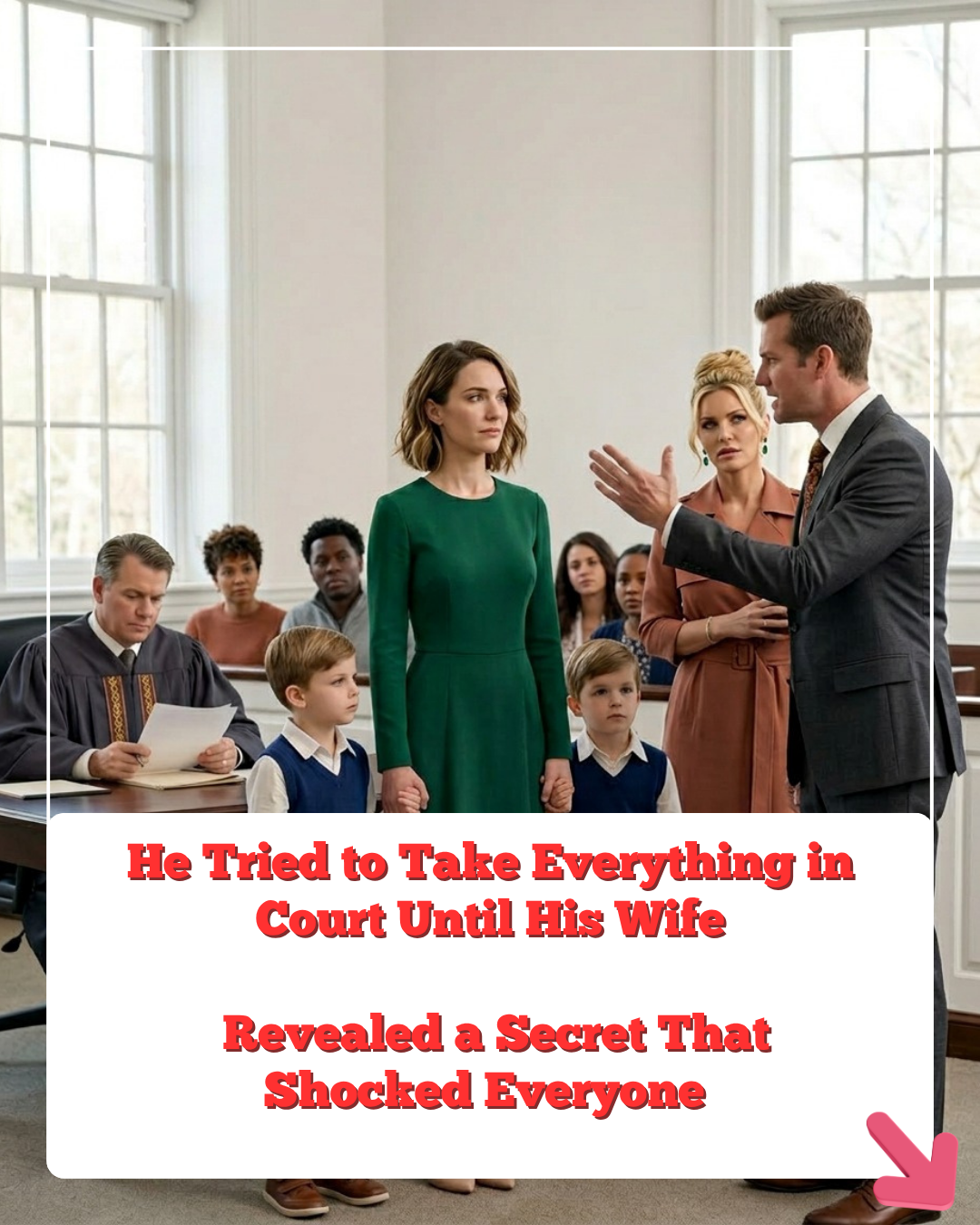
The courtroom felt unnaturally quiet that morning, as if even the air itself was waiting.
Everyone seemed prepared for a familiar scene—the kind they had witnessed many times—where a woman entered already defeated, already diminished by what she was about to face.
By nine-thirty, every seat was filled with silent judgment. A weary clerk sorted paperwork. Two law students whispered in the back, still untouched by real consequences. A rigid middle-aged woman observed everything with sharp, critical eyes. Near the front, reporters waited discreetly, drawn not by justice but by the promise of scandal—because the husband was wealthy, the rumored mistress was socially visible, and the city thrived on stories it could easily consume.
At the right-hand table sat Julian Reeves, polished and confident, dressed in charcoal gray. He carried the effortless arrogance of a man who mistook luck for superiority. He glanced repeatedly at the door and the clock, not with concern, but annoyance—irritated that this process dared to take his time. Behind him sat Vanessa Cole, poised and elegant in a carefully curated cream outfit, projecting effortless wealth and control. She expected the wife to appear broken—emotional, messy, predictable. In her mind, emotion equaled weakness.
Julian’s lawyer, Robert Hanley, stood calm and composed. Everything about him was precise—his posture, his files, his rehearsed arguments. To him, this case was simple: a prenuptial agreement, a financially dependent wife, a wealthy and credible husband, and two young children whose “stability” could easily be argued. He had built his career on cases like this.
At 9:37, the judge entered. Judge Harold Whitmore was known for valuing facts over emotion. When the case Reeves v. Carter was called, the room sharpened with anticipation.
“Your Honor, we are ready,” Hanley said smoothly.
But the respondent’s table was empty.
No answer.
Julian exhaled impatiently. Vanessa leaned closer, whispering, “Maybe she changed her mind.”
“That would be the smartest thing she’s done in years,” he replied.
The judge’s patience thinned. Just as he prepared to proceed without her—
The courtroom doors opened.
The sound wasn’t loud, but in the silence, it carried weight. Heads turned. Then the entire room followed.
She didn’t rush.
She didn’t apologize.
She didn’t look desperate.
She walked in calmly, posture straight, expression steady, wearing a simple navy coat. In each hand, she held one of two identical boys. The twins walked beside her in silence—calm, composed, observant in a way that felt almost unsettling.
A whisper rippled through the room.
“She brought children?”
Vanessa laughed softly.
Julian leaned back, watching with faint disdain. “Still trying to make a scene,” he muttered.
But the woman ignored him.
She ignored Vanessa.
She ignored the crowd already judging her.
Step by step, she reached her table. The boys stood beside her, holding her hands—quiet, steady, present.
“You are late,” the judge said.
“I’m here, Your Honor,” she replied calmly. “And they needed to be here too.”
Vanessa scoffed, but the judge shut her down instantly. Silence returned, heavier than before.
Hanley stood to present his case: a valid prenuptial agreement, a financially unstable wife, and a request for full custody. His argument was polished, precise, stripped of sympathy.
When he finished, the judge turned to her.
“Do you have representation?”
“No.”
“Will you speak for yourself?”
“Yes.”
The room waited.
She looked at her sons, then opened her bag.
“I signed that agreement,” she said slowly, “because I trusted him.”
Julian rolled his eyes.
But she didn’t look at him.
“I trusted that love meant honesty. That a shared life meant shared truth.”
Hanley cut in, dismissing her words as irrelevant.
“I know,” she said calmly. “I’m not denying the agreement. I’m saying something is missing.”
She placed an envelope on the table.
The judge opened it—and everything changed.
As he read, his expression shifted.
“Mr. Reeves,” he asked, “are you aware of whose name the original business registration is under?”
Julian laughed. “Mine, obviously.”
She shook her head.
“No.”
The room froze.
“You had the idea,” she said quietly, “but I built the system. I filed the original registration. I structured everything—under a private holding, because you insisted my name stay hidden.”
Julian denied it.
The judge corrected him.
The documents told a different story.
Her real name wasn’t Amelia Carter.
“It’s Eleanor Vance.”
Recognition spread through the room like shock.
Not just a wife—
But someone powerful, hidden in plain sight.
From there, everything unraveled.
Financial records.
Hidden transfers.
Private recordings.
Julian’s own voice filled the courtroom, calmly discussing removing her, taking custody, and claiming the company as his own.
Silence turned heavy with realization.
The judge’s ruling was clear:
Custody denied.
Assets questioned.
Misconduct referred for investigation.
Julian lost control of the narrative.
Eleanor didn’t celebrate.
She simply turned to her sons.
“Are we leaving now?” one asked softly.
“Yes,” she said.
She walked out the same way she entered—calm, steady, finished.
Outside, cameras flashed and reporters shouted.
She ignored them all.
Inside the car, her sons asked simple questions—
Why were people there?
Did we do something wrong?
Are we going home?
She answered gently:
“You did everything right.”
Because in the end, this wasn’t about revenge.
It was about truth—
revealed carefully, precisely, at the exact moment it could no longer be ignored.