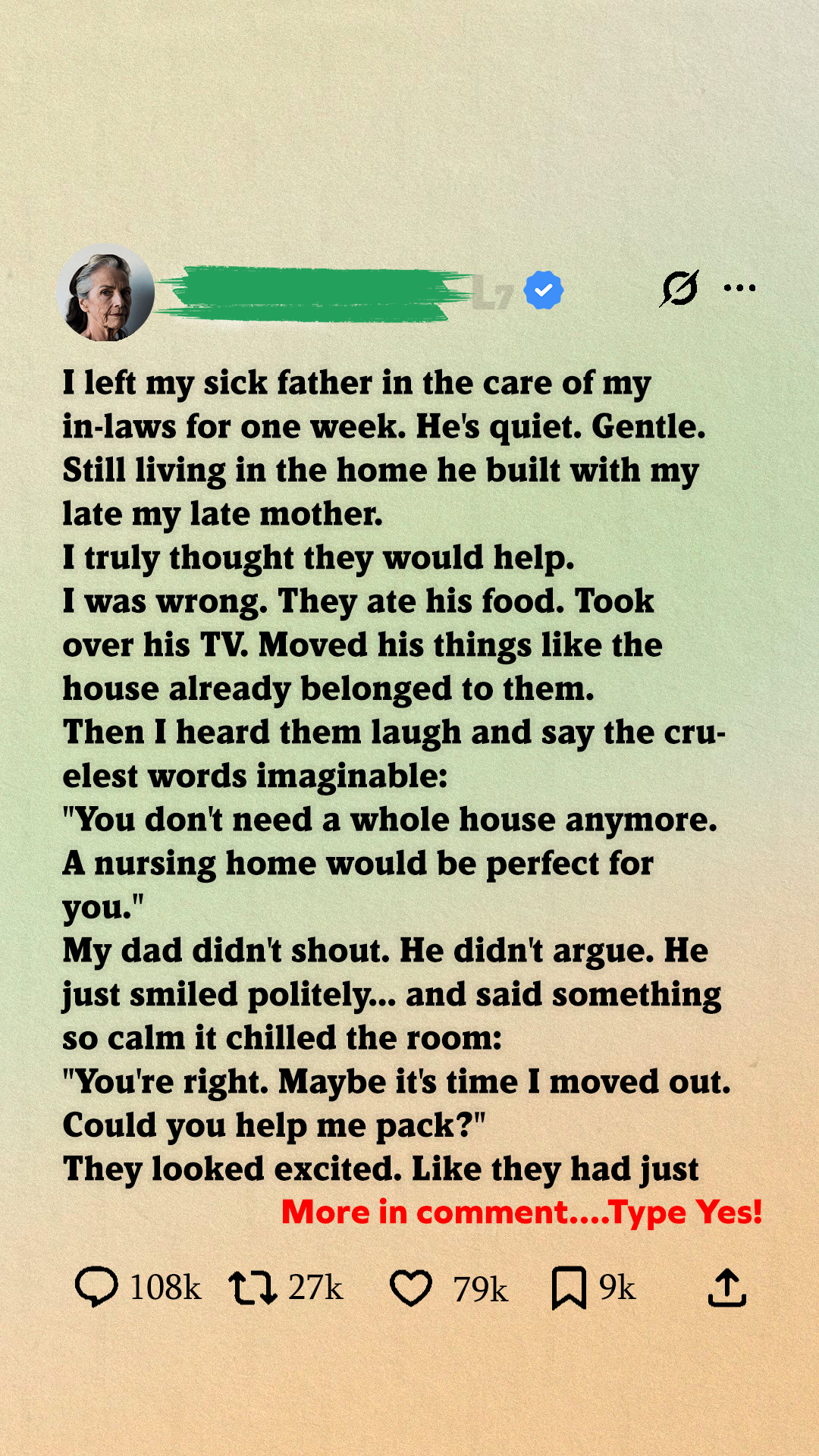
My dad has always been a gentle man—the kind who says “thank you” even when he’s the one being hurt. He never raises his voice, never argues in public, never complains. Even after my mom
passed away, he stayed quiet, holding onto the life they built together.
That house wasn’t just walls and furniture. It was everything—my childhood, my mother’s laughter, her cooking, her garden, the smell of coffee in the mornings. It was the last place my dad could still feel her presence. And even as illness slowly drained his strength, he refused to leave.
“This is my home,” he would say. “I’m not dying anywhere else.”
So when I had to travel for a week, I worried about leaving him alone. My husband suggested his parents stay with my dad to help. I hesitated—they were never truly warm—but I agreed anyway. I wanted to believe they would be kind.
At first, things seemed fine. But by the third day, my dad’s voice changed. He spoke less, sounded weaker. In the background, I heard loud TV, laughter that didn’t belong in that quiet house. When I asked what he was eating, he hesitated. That’s when I felt it—something wasn’t right.
On the fifth day, he didn’t answer my calls. When my mother-in-law finally picked up, she brushed it off. “Old people sleep a lot,” she said casually. When my dad came on the phone, his voice was faint. Then I heard them—talking about how the house was too big for him, suggesting a nursing home like it was a simple solution.
And then my dad said something that broke me.
“…You’re right.”
But something in his tone didn’t feel like defeat.
The next day, he told me they were helping him pack. Panic hit me, but he calmly added, “They think they’ve won.”
That’s when I understood—he wasn’t giving up. He was watching.
I came home early. The garden was disturbed, boxes stacked outside. Inside, my father-in-law sat in my dad’s chair like it was his. My mother-in-law was throwing away my dad’s food. They acted like they already owned the place.
But my dad signaled me to stay quiet.
Two days later, the truth came out. As they confidently discussed selling the house, the doorbell rang. They expected a realtor. Instead, it was a lawyer and a police officer.
The lawyer revealed everything—the house wasn’t just my dad’s. My mother had left her share to me. I was a legal co-owner.
And my in-laws? They were trespassing.
Within minutes, their confidence collapsed. The same people who acted like owners were now scrambling to pack. My dad simply said, “I asked you to help me pack so I could see who you really are.”
After they left, the house felt like home again. Quiet. Peaceful.
My dad sat down, exhausted but calm. “People think being quiet means being weak,” he said. “But quiet people hear everything… and when the time is right, they act.”
In that moment, I realized—he was never powerless. He was protecting what mattered most.
And my in-laws didn’t just lose a house.
They lost their place in our lives forever.