END PART : We spent the next four hours talking. The volunteer quietly locked the office door and left us alone with coffee. Eddie explained everything. In 1971 his convoy had been attacked. He was badly wounded.He spent months in military hospitals.
During the confusion, nearly everything he owned disappeared.
Including my address.
“I remembered your first name,” he said.
“I remembered Sycamore Grade School.”
“But I couldn’t remember the town or the state.”
He smiled sadly.
“I wrote letters that never found you.”
I stared at him.
“I thought…”
“I know.”
“You thought I died.”
He nodded.
“I figured you probably thought exactly that.”
He reached into a worn leather folder he’d carried for years.
Inside were faded photographs.
Old Army papers.
And one carefully folded envelope.
Yellow with age.
“I wrote this after I got home.”
He handed it to me.
“I never mailed it.”
My hands trembled as I unfolded the brittle paper.
“Dear Margaret,”
“I made it home.”
“I’m alive.”
“If I ever find you, the first thing I’m going to do is thank you for keeping me sane.”
The letter ended there.
No dramatic declarations.
No promises.
Just gratitude.
I cried all over again.
“I still have every letter you ever sent,” Eddie admitted.
I looked up.
“You do?”
“They’re in a wooden box.”
“You kept them?”
“Margaret…”
He smiled gently.
“Those letters reminded me that somewhere in America, life was still normal.”
He chuckled.
“I knew exactly when your little brother finally learned to ride a bike.”
“You remembered that?”
“I remembered everything.”
I told him about Kenneth.
About our children.
Our grandchildren.
The little cabin we’d bought after retirement.
The garden Kenneth loved.
The fishing trips.
The laughter.
The funeral.
Eddie listened quietly.
When I finished, he said something I’ll never forget.
“I’m glad you found a good man.”
“I did.”
“You deserved one.”
“I had fifty-two wonderful years.”
“I’m happy for you.”
There wasn’t a trace of regret in his voice.
Only sincerity.
Then it was my turn.
“What about you?”
He smiled softly.
“I married Linda in 1975.”
He reached into his wallet and showed me a photograph.
A beautiful woman with kind eyes.
“She passed away six years ago.”
“I’m so sorry.”
“We had one daughter.”
He laughed.
“She’s convinced retirement means I’m supposed to stop volunteering.”
“So why don’t you?”
He looked around the VFW hall.
“Because helping veterans saved me after Linda died.”
I understood completely.
Sometimes purpose arrives disguised as service.
Over the following months, we became friends again.
Not teenagers writing letters.
Not people wondering what might have been.
Just two widowed grandparents who shared an unusual piece of history.
Every Thursday we met for coffee.
Sometimes we’d laugh until the waitress asked if we needed another pot.
Sometimes we’d sit quietly remembering people we’d loved.
Neither of us tried to replace those we’d lost.
That was never the point.
The point was simply not being alone.
One afternoon Eddie handed me a small package.
Inside was a faded pressed flower.
Perfectly preserved.
“I carried this through Vietnam,” he said.
My eyes widened.
“The flower I mailed you?”
He nodded.
“You sent it back in one of your letters because you said flowers belonged in gardens, not war.”
I barely remembered doing that.
“I kept it anyway.”
I held the fragile petals carefully.
Somehow they had survived jungles.
Hospitals.
Moves.
Half a century.
And now they rested in my palm again.
The following Memorial Day, the VFW asked if Eddie and I would speak to local high school students.
We stood together in front of nearly two hundred teenagers.
I told them about writing letters.
About ordinary stories.
About burnt mashed potatoes.
The room laughed.
Then Eddie stepped forward.
He looked at the students for a long moment before speaking.
“You think your words don’t matter.”
He paused.
“They do.”
He held up one of my old letters.
“This young woman never wrote about politics.”
“She never wrote speeches.”
“She simply reminded one scared nineteen-year-old kid that home still existed.”
The room became completely silent.
“I survived because of doctors.”
He smiled toward me.
“But I endured because somebody kept reminding me what I was coming home to.”
There wasn’t a dry eye in the auditorium.
Afterward, a teenage girl approached us.
She held back tears.
“My brother just joined the Army.”
She hesitated.
“I’ve been terrible about writing.”
Eddie smiled.
“Then start tonight.”
She nodded.
“I will.”
Watching her walk away, I realized something beautiful.
Kindness has a strange way of traveling through generations.
One letter inspires another.
One act of compassion becomes someone else’s reason to keep going.
Today, Eddie is eighty.
I’m seventy-eight.
Every Thursday we still meet for coffee.
Sometimes we argue about crossword puzzles.
Sometimes we compare pictures of grandchildren.
Sometimes we simply sit in comfortable silence.
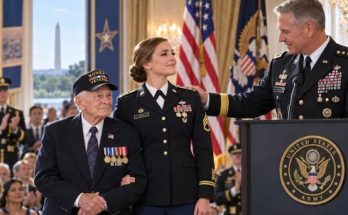
The letters that began our friendship are now stored together in a display case at the local veterans museum, alongside one faded photograph of two smiling old friends standing beneath an American flag.
Visitors often ask if we were childhood sweethearts.
We smile and shake our heads.
“No.”
“We were simply strangers who refused to let each other feel alone.”
Looking back, I often think about that sixteen-year-old girl worrying whether her stories were too ordinary.
She had no idea that ordinary was exactly what someone fighting a war needed to survive.
And every Thursday, when Eddie raises his coffee mug and says, “Thanks for writing back,” I silently thank my English teacher for assigning one simple classroom project that lasted a lifetime.