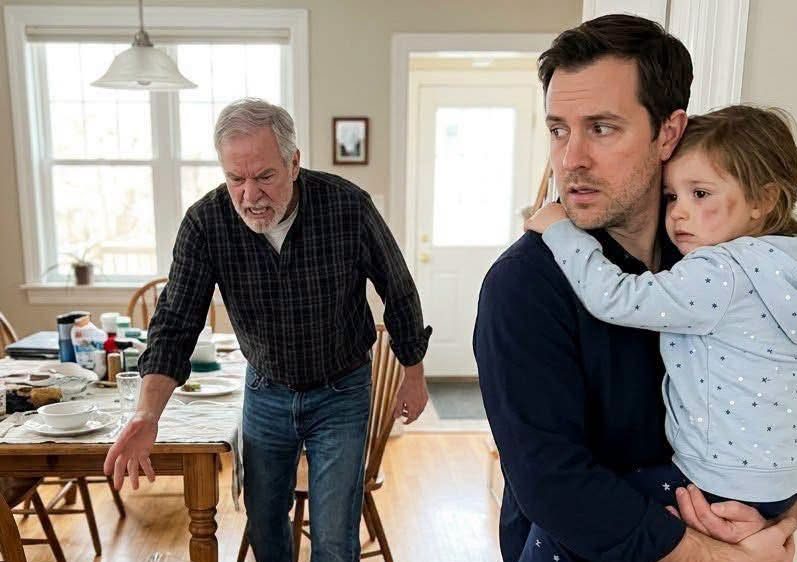
Daniel’s eyes stayed fixed on the phone in his hand, its lens still angled toward my father near the dining room entrance. I couldn’t tell whether he had kept recording. I couldn’t tell whether he had captured the second Dad threw the glass while I was holding Rosie.
But Daniel wasn’t looking at me anymore. He was looking at the screen.
And somehow that tiny detail cut through everything else happening in the room. My mother’s shouting.
Bethany standing beside the red stain spreading across the white rug.
My father’s chair shoved away from the table.
Rosie’s terrified breathing against my neck.
Twenty-two minutes before I found my daughter hiding in a dark bathroom, I had walked into that house believing the hardest part of the afternoon would be keeping a four-year-old polite through a family birthday party.
Rosie had held my hand when we came through my parents’ door.
She was wearing her pale blue hoodie with the little white stars she loved, and she was carrying Marcus’s present wrapped in dinosaur paper.
I still remembered the gas station receipt because later every minute started feeling important.
2:08 PM.
That was the time printed at the top.
I pulled into my parents’ driveway at 2:31.
On the ride over, Rosie had asked me whether Aunt Bethany would be there.
I told her yes.
Then, because I was trying to teach my daughter manners instead of teaching her to distrust her own relatives, I reminded her to be polite.
That sentence would bother me later.
Bethany was three years older than me, which meant I had watched our family make excuses for her for most of my life.
If Bethany insulted somebody, there was always an explanation.
If she humiliated someone, they were too sensitive.
If she picked a fight, someone had provoked her.
If she crossed a line, Mom would sigh and say some version of the same thing: that was just Bethany being Bethany.
The phrase had followed us from childhood into adulthood.
It made every cruel thing sound like weather.
Unpleasant, maybe, but nobody’s responsibility.
I had spent years accepting that arrangement because arguing about Bethany usually meant arguing with the entire family.
Rosie changed the math.
At first, though, nothing looked wrong.
People were talking over one another.
There was cake on the table.
Marcus was opening presents.
Daniel had his phone out filming parts of the party.
My father was planted at the head of the table like he always was in his own house, and Mom was moving between people, keeping the celebration going.
Somewhere in the middle of all of that, Rosie disappeared.
Nobody announced it.
Nobody asked where she had gone.
I was the one who noticed I couldn’t see the pale blue hoodie anymore.
I checked the backyard first.
Then the playroom.
Then the area around the cake table.
I walked down the hallway thinking maybe she had gotten tired of the noise and wandered somewhere quiet.
The party music covered most of the sounds coming from the house.
Underneath it, though, I heard something small from the guest bathroom.
The light was off.
That was the first thing I noticed when I opened the door.
Then I saw Rosie behind the toilet.
She had folded herself into the corner with her knees pulled against her chest.
She was trying so hard not to cry that her whole face looked tight.
Her left cheek was swollen.
Purple was already spreading under the skin.
Then I looked at her arms.
There were small round marks across them.
For a second, I didn’t move toward her.
That may sound strange to anybody who has never had their own family rewrite something while it was still happening.
I knew exactly what was coming if I carried Rosie out there with nothing except my word.
Bethany would say I misunderstood.
Mom would say we were making a scene.
Dad would tell me not to start trouble in his house.
Someone would insist Rosie had fallen or bumped into something.
So before I touched my daughter, I took pictures.
2:54 PM.
Bathroom photo one.
2:55 PM.
Bathroom photo two.
2:55 PM.
Rosie’s left arm.
I hated myself for needing evidence before I could comfort her.
But I knew my family.
Then I crouched beside her.
“Baby, what happened?” I whispered.
Rosie didn’t answer immediately.
She looked toward the bathroom door first.
That look told me almost as much as her words did.
Then she said, “Aunt Bethany.”
I asked her what Bethany had done.
Rosie told me Bethany had said she was too loud.
She said Bethany told her that babies who cried needed to learn.
She didn’t give me a long explanation.
She was four.
She gave me the pieces she understood.
Then she crawled into my arms so fast that her forehead bumped my collarbone.
I wrapped both arms around her.
I told her nobody was going to touch her again.
Ten feet away, my relatives were still eating birthday cake.
That detail kept repeating in my head.
Ten feet.
My daughter was hiding behind a toilet in the dark, and ten feet away adults were laughing, filming presents, passing plates, and celebrating as though nothing had happened.
I carried Rosie into the dining room.
The change in the room happened in pieces.
My mother stopped clapping.
Daniel lowered the phone he had been using to film Marcus.
My father turned around from the head of the table.
There were eight adults sitting there.
The birthday candles were still smoking.
Rosie clung to my shirt.
I didn’t make a speech.
I asked one question.
“Who did this?”
Bethany was sitting near the window with a glass of red wine in her hand.
For half a second, something crossed her face that looked like recognition.
Then she leaned back.
And laughed.
“Oh, relax. It was just a joke.”
Rosie’s fingers tightened against my shirt.
Bethany kept talking.
She said Rosie had been whining.
She said she had been crying.
She said somebody needed to teach her that the world wasn’t going to baby her forever.
My mother finally told Bethany to stop talking.
But Mom never walked over to Rosie.
She never touched her swollen cheek.
She never asked to see her arms.
That mattered.
Bethany looked directly at my shaking daughter and said, “See? She’s fine. She just wants attention.”
My father leaned back in his chair.
“Don’t start drama in my house.”
His house.
That was what mattered to him.
Not the child in my arms.
Not the bruise spreading across her face.
Not the fact that she had hidden herself in a dark bathroom because she was afraid.
The disruption was the emergency.
Bethany took another sip of wine.
Then she said two words that made whatever restraint I had left disappear.
“They’ll heal.”
My hand moved before I had time to form another thought.
I slapped her across the face.
The sound cracked through the dining room.
Bethany’s head snapped sideways.
Her wineglass fell onto my mother’s white rug, and red wine began soaking through the fibers.
For the first time that afternoon, everybody seemed capable of recognizing that something serious had happened.
Bethany put a hand to her cheek.
“You psycho.”
I looked at the people around the table.
“Call the police,” I said. “Please. Tell them exactly what happened.”
Nobody reached for a phone.
That told me everything I needed to know about the room.
I had hit Bethany in front of witnesses.
I wasn’t pretending otherwise.
I wasn’t asking anyone to hide it.
I was telling them to call and report the entire situation.
Nobody did.
So I turned toward the front door with Rosie still in my arms.
I wanted distance between my daughter and every person in that dining room.
My mother came after me.
“You are not leaving with her like this,” she said. “Do you know how this will look?”
There it was.
Not, “Is Rosie okay?”
Not, “We need to get her checked.”
Not, “What did Bethany do?”
How will this look?
My mother’s crisis was reputation.
She was thinking about what relatives might say afterward.
What story would leave the house.
Who would blame whom.
How the birthday party would be remembered.
Rosie whimpered against my neck.
Mom snapped that Bethany had made a mistake.
Then she said, “Families handle things inside the family.”
Maybe that sentence was supposed to remind me where I belonged.
Instead, it clarified something I should have understood years earlier.
I looked down at Rosie.
“She is my family,” I told Mom. “You are not.”
That was when I heard my father’s chair scrape hard against the floor behind us.
I turned enough to see him standing beside the table.
One of his hands closed around a drinking glass.
The entryway was open enough that every adult nearby could see what he was doing.
Nobody stopped him.
Nobody stepped between us.
Nobody told him to put it down.
Rosie’s fingers dug into my shirt.
Dad’s arm came forward.
The glass left his hand.
Rosie’s body flinched against mine before my brain had fully caught up.
I pulled her tighter to my chest and turned my shoulder toward my father instinctively.
The entire argument changed in that second.
Until then, they had been trying to make the afternoon about my reaction.
Bethany had hurt Rosie, but somehow I was the one causing drama.
Bethany had dismissed visible injuries, but somehow I was the one who needed to calm down.
My mother had barely looked at her granddaughter, but somehow the biggest concern was how leaving would appear to other people.
Now my father had thrown a glass while I was holding a four-year-old child.
And there were witnesses.
Eight adults had been sitting in or around that dining room.
They had watched the conflict build.
They had heard Bethany call Rosie’s injuries a joke.
They had heard my father order me not to start drama.
They had watched my mother try to keep me from leaving.
And now they had seen the glass leave Dad’s hand.
Bethany was still near the white rug with one hand against her cheek.
The red wine had spread farther through the fibers.
Mom remained between me and the dining room, still talking as though I were the dangerous one.
Dad’s chair remained shoved away from the table.
Rosie buried her face into my neck.
Her breathing came fast and shallow through my shirt.
That sound ended the last argument I was having with myself.
Until then, some small part of me had still been waiting for somebody in my family to react like a normal person.
Maybe Mom would finally see Rosie’s cheek clearly and understand.
Maybe Dad would look at his granddaughter and realize how far things had gone.
Maybe Bethany would stop defending herself long enough to admit what she had done.
Maybe one of the other adults would stand up and say this wasn’t acceptable.
I was finished waiting.
I didn’t need Bethany to apologize.
I didn’t need Mom to agree with me.
I didn’t need Dad’s permission to walk through his front door.
I didn’t need the family to vote on whether Rosie’s fear was serious enough.
My daughter needed to leave.
That was the only decision that mattered anymore.
And then I noticed Daniel.
He was easy to overlook because he wasn’t shouting.
He wasn’t blocking the doorway.
He wasn’t defending Bethany.
He wasn’t arguing with me.
He was standing there holding the same phone he had used to record Marcus opening presents.
Except he had never lowered it all the way.
The device was still raised in his hand.
Its position was wrong for someone who had finished filming a birthday.
It was angled toward the entryway.
Toward my father.
I looked at Daniel, trying to understand what I was seeing without loosening my grip on Rosie.
From where I stood, I couldn’t see whether a recording indicator was still running.
I couldn’t know when he had started filming again, if he ever stopped at all.
Maybe he had captured only the presents.
Maybe he had caught part of the argument.
Maybe the phone had recorded Bethany laughing.
Maybe it had recorded my mother worrying about appearances.
Maybe it had recorded Dad picking up the glass.
I didn’t know.
And for the first time since I had opened that bathroom door, I stopped thinking about what my family would claim later.
Because later was exactly where their power usually lived.
Later, Bethany could soften her language.
Later, Mom could say everybody had been emotional.
Later, Dad could describe the glass differently.
Later, the eight adults in that room could remember only the pieces that made them comfortable.
That was why I had photographed Rosie’s injuries before lifting her from behind the toilet.
I already understood what happened to facts inside my family.
They became opinions.
They became misunderstandings.
They became private matters.
They became something we weren’t supposed to discuss because discussing them supposedly damaged the family more than the original act did.
The timestamps on my phone couldn’t be embarrassed into changing.
2:54 PM.
2:55 PM.
2:55 PM.
The swelling on Rosie’s cheek couldn’t care about my mother’s reputation.
The marks on her arms didn’t know they were supposed to stay inside the family.
And whatever Daniel’s phone had captured would not depend on Bethany’s version of events.
That possibility shifted something inside me.
Not relief.
I was too angry and too scared for that.
It was something colder and more practical.
For years, family gatherings had depended on everybody agreeing afterward about what had supposedly happened.
Bethany’s cruelty survived because somebody always found a softer word for it.
Dad’s temper survived because people learned when to stop challenging him.
Mom’s obsession with appearances survived because silence was treated like loyalty.
But a four-year-old couldn’t survive on those rules.
Rosie had already learned enough in one afternoon to hide in the dark and check the doorway before saying her aunt’s name.
I wasn’t going to teach her the next lesson my family wanted taught.
I wasn’t going to show her that adults could hurt her and then decide together that keeping the peace mattered more.
I tightened one arm under her legs and kept the other across her back.
Her pale blue hoodie was wrinkled against my chest now.
The tiny white stars looked painfully ordinary.
She had come to a birthday party carrying a dinosaur-wrapped present.
She should have been asking for cake.
Instead she was clinging to me while the adults around her fought over whether her injuries were inconvenient.
I looked at the doorway again.
Then at Dad.
Then at Daniel.
He still wasn’t watching me.
His attention remained on the phone screen.
That was the part I couldn’t stop noticing.
Everyone else in the room seemed desperate to control the story while it was still happening.
Daniel appeared to be checking whether the story had already been captured.
I didn’t know what was on that phone.
I didn’t know whether the recording had caught the moment my father’s arm moved or the instant the glass left his hand.
I didn’t know whether Daniel would show it to me, erase it, defend Dad, or suddenly decide that family matters should stay private too.
Nothing about my relatives that afternoon made trust easy.
But I knew what I had already seen with my own eyes.
Rosie in the dark.
The bruise on her cheek.
The round marks on her arms.
Bethany laughing.
Mom worrying about appearances.
Dad reaching for the glass.
Those facts no longer needed unanimous approval.
My daughter was still shaking in my arms.
The front door was still in front of me.
And Daniel was still staring down at the screen.