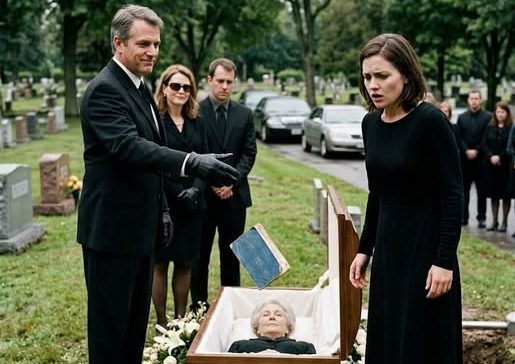
Richard’s gold watch tapped against his palm as he stood beside Margaret’s casket, and the muddy blue passbook was still tucked under his arm.He glanced at it once, then at the casket.
“Look here, it is nothing more than an old notebook,” Richard said.
He flung the passbook onto the polished wood.
It landed near the spray of white flowers Margaret had chosen for her own funeral.
Susan smoothed her hair behind both ears.
“Sweetheart, there is no reason to make a scene,” she said.
“I am not making a scene.”
Richard tapped the face of his watch.
“I am clearing up a family matter.”
Tyler stood a few feet away, spinning his car keys around his index finger.
“Sure,” he said. “Looks pretty cleared up to me.”
I adjusted Margaret’s silver ring on my right middle finger.
The ring had always been loose enough to turn when I was nervous.
I looked at the blue cover again.
Mud marked one corner.
“Why did you put it there?” I asked.
Richard turned toward me.
“Because nobody needs an old bank book from a woman who is already gone.”
The words sat between us.
I looked at Susan.
She gave me a small smile that did not reach her eyes.
Tyler stopped spinning his keys.
“Can we go now?”
Richard reached for the passbook.
Then he stopped.
His fingers hovered over it.
“Leave it,” he said.
I looked at him.
“You just said nobody needed it.”
“That does not mean you need to make a project out of it.”
He turned away before I could answer.
The minister closed his folder.
People began moving along the cemetery path.
Dry leaves scraped across the asphalt under their shoes.
Tyler fell into step beside me.
“Grandma would probably want us to spend whatever was left,” he said.
“She did not leave much.”
“Then burgers.”
I looked at him.
“Tyler.”
“What?”
“That is not funny.”
He shrugged.
“I am hungry.”
He spun the keys once around his finger and walked faster.
I stayed behind.
At the cars, Susan was already opening the passenger door.
She smoothed her hair behind her ear again.
“Chloe, sweetheart, come on.”
“I will be there in a minute.”
Richard looked back at me from beside his truck.
His expression hardened.
“Do not start digging through your grandmother’s papers.”
“I was not planning to.”
“Good.”
He tapped his watch.
“Then we understand each other.”
He got into the truck.
I watched the blue passbook through the cemetery gate.
It was still lying where he had thrown it.
Why had he cared enough to throw it away if it meant nothing?
I did not ask him.
I suppose.
The cars pulled away one by one.
I waited until they were gone.
The cemetery became quiet except for leaves moving over the path.
I walked back toward Margaret’s grave.
The passbook had slid closer to the edge of the open ground.
One corner was covered with damp soil.
I stopped several feet away.
I could still hear Tyler’s voice in my head.
Burgers.
I almost turned around.
Then I remembered Margaret at her kitchen table, holding the same blue book in both hands.
She had been very careful with it.
She had also once told me something I had not understood at the time.
“If you ever have to take that book to the bank, ask for Arthur.”
I had asked who Arthur was.
“A teller who knows how to read what other people overlook.”
That was all she had said.
Now I was standing beside her grave with mud on my shoes.
I crouched down.
The passbook was partly pressed into the soil.
I reached for it.
My fingers touched the cover.
The mud was colder than I expected.
I pulled once.
It stayed lodged.
I dug around the edge with my bare fingers.
The cover came free with a soft scrape.
I held it in my lap.
A smear of dark earth crossed the blue cloth.
I rubbed at it with my thumb.
The cover had a small brass clasp.
It was still closed.
I turned it over.
No name.
No account number.
Only the worn blue cloth and a narrow strip of faded stitching.
Why had Richard been so certain it was worthless?
I opened the clasp.
The first page was yellow with age.
My grandmother’s handwriting appeared near the top.
I leaned closer.
“Chloe, if you are reading this, do not let Richard take this to the bank without Arthur.”
I read the sentence twice.
My fingers moved to the silver ring.
Arthur.
The name sounded different now.
I turned the page.
There were rows of pencil marks.
Dates.
Small figures.
Initials.
I could not make sense of them from where I sat.
At the bottom of the page, another line had been written in Margaret’s hand.
“Ask before you sign anything.”
I stared at it.
Who had she expected me to sign something for?
I closed the book.
Then I opened it again.
The numbers were still there.
The book was not blank.
That much was clear.
But I could not tell what the numbers meant.
I slipped the passbook into my coat pocket.
A car turned onto the cemetery road.
I looked up.
For one second I expected Richard’s truck.
It was only a county sedan passing the entrance.
I waited until it disappeared.
Then I walked to my old sedan.
The vinyl seat was cold when I climbed inside.
I shut the door and placed the passbook on my lap.
Mud had dried along the edge of the cover.
I found a napkin in the glove box and wiped it away.
The blue cloth underneath was darker than I remembered.
I opened to the first page again.
The warning was still there.
Arthur.
Do not let Richard take this to the bank.
I traced the name with one finger.
Why had Margaret singled out one bank employee?
I turned several pages.
The writing became harder to read.
There were deposits recorded in careful columns.
Five dollars.
Ten dollars.
Twenty dollars.
Then another date.
Then another amount.
I reached for the small reading glasses I kept in the center console.
Before I could put them on, my phone lit up.
Susan.
I answered.
“Chloe?”
“Yes.”
“Are you still at the cemetery, sweetheart?”
“Why?”
There was a pause.
“We forgot something.”
“What?”
“The papers your grandmother kept in the house.”
I looked down at the passbook.
“What papers?”
“I do not know. Richard wants to make sure nothing important gets misplaced.”
I adjusted the ring.
“Why would anything be misplaced?”
Susan’s voice softened.
“You know how families get after a funeral.”
I looked at the blue book again.
“Did Richard ask you to call me?”
Another pause.
“Please come home when you are finished.”
The call ended.
I set the phone down.
The passbook lay open across my knees.
One page had a faint red mark near the bottom.
I leaned closer.
It was not large enough to read through the yellowed paper.
I turned the page.
The red mark appeared again.
I stopped.
There were several more entries beneath it.
I counted them.
Seven.
Seven separate deposits, each written in Margaret’s careful hand.
I reached for the reading glasses.
My phone lit up again.
This time it was Richard.
I let it ring.
The screen went dark.
Then it lit up again.
I picked up the phone.
“Yes?”
“Where are you?”
“At the cemetery.”
“Why?”
“I went back for something.”
Silence.
“What did you take?”
I looked at the passbook.
“Nothing that belongs to you.”
“Look here, Chloe.”
His voice had changed.
“Give me the book.”
I said nothing.
“Did you hear me?”
“Yes.”
“Bring it to the house.”
“Why?”
“Because I said so.”
I heard the watch tap against something on his end of the call.
“Your grandmother had no business leaving you financial papers.”
“Then why are you worried about this one?”
He did not answer.
I looked down at the first page.
Arthur’s name was still visible above my thumb.
“Who is Arthur?” I asked.
Richard ended the call.
I sat there with the phone in one hand and the blue passbook in the other.
The cemetery gate stood open in front of me.
I turned the first page back.
Margaret’s pencil marks looked faint beneath the afternoon light.
The red mark on the later page was clearer now.
I counted the entries again.
Seven.
Then I noticed a final line at the bottom.
It had been stamped, not written.
The letters were too faded to make out.
I closed the book.
My phone lit up once more.
This time there was no call.
There was a message from Susan.
“Please do not make this harder than it needs to be, sweetheart.”
I slipped the phone into my coat.
Then I looked at the muddy blue cover and wondered what my father wanted to bury, I suppose.
Susan set a chipped teacup on the counter and reached for the saucer beside it. Her fingers caught the edge, and the saucer struck the sink with a sharp crack before settling in two pieces.
“Oh, sweetheart.”
She picked up the larger piece and turned it over. A brown line ran through the old blue flowers Margaret had painted by hand.
“I suppose that one finally gave up,” I said.
Susan tucked a strand of hair behind her ear. “Your grandmother kept every little secret she had, but she could not keep a saucer in one piece.”
I wrapped another cup in newspaper and placed it in the box. The paper smelled faintly of peppermint tea.
“What secrets?”
Susan gave me a small smile. “You know how she was.”
“No. I know how she made tea.”
She looked toward the hallway before placing the broken saucer in the trash. “Sweetheart, we just need to make sure there are no outstanding utility bills.”
The box had room for three more cups. I reached for a fourth and stopped when I saw the cabinet door standing open behind Susan.
“Who opened that?”
Susan smoothed her hair behind both ears. “Your father was looking through the kitchen drawers earlier.”
“For what?”
“Financial papers, I suppose.”
She said it lightly, but she kept one hand on the box lid.
Richard had never cared which cupboard held the tea towels or where Margaret kept her flour. Now he was checking drawers.
I folded the newspaper around a cream colored cup with a tiny green leaf painted near the handle. “Did he tell you what he was looking for?”
“He said there might be an account book.”
“An account book?”
Susan’s smile disappeared for half a second. “He is trying to settle the estate.”
I put the cup into the box.
“Since when does settling an estate require searching under teacups?”
Susan did not answer. Instead, she carried the box toward the dining room, and I heard the cardboard scrape against the doorway.
I followed her to Margaret’s bedroom because I wanted a quiet place to think, but the room had already been disturbed. The top drawer of the dresser stood open, and three of Margaret’s folded blouses had been moved onto the chair.
I knelt beside the bed and reached underneath for the dust cloth I had seen there the day before. My fingers touched metal.
I pulled out an old cookie tin with faded strawberries on the lid.
“What’s in there?” Susan asked from the doorway.
“Buttons, maybe.”
She stepped closer.
I lifted the lid.
Inside was a hand embroidered napkin folded into a square, with a faint peppermint stain near one corner.
I unfolded it across my knee. The stitching was uneven, the way Margaret’s always had been when she worked without her glasses.
There was a date sewn into the corner.
March ninth.
I ran my thumb over the thread.
“That’s all?” Susan asked.
I folded the napkin again.
“Just linen.”
Susan watched my hands.
“Your father is going to want every paper you find.”
“I haven’t found any papers.”
She looked at the cookie tin.
“I meant financial papers.”
The hallway floor creaked before either of us spoke again.
Richard appeared at the bedroom door with his heavy gold watch showing beneath his shirt cuff.
“Look here, Chloe.”
He tapped the watch face once with his index finger.
“If you found bank statements, passbooks, certificates, anything with an account number, hand it over.”
I slipped the napkin into my coat pocket.
“I found old household papers.”
“Household papers?”
“Recipes. Utility bills. Receipts.”
His eyes moved to the bed.
“Where are they?”
“I haven’t decided what to keep.”
Susan stepped beside him. “Richard, she is only sorting.”
He turned toward her.
“I asked Chloe a question.”
I looked at the floor between us.
“You can sort the rest yourself,” he said.
Then he walked away.
Susan stayed.
“You should not make this harder than it has to be, sweetheart.”
I touched the silver ring on my right middle finger.
“Was I making it harder?”
She opened her mouth, then closed it.
From the living room came the scrape of a drawer.
Tyler’s voice followed.
“Found another envelope.”
I stepped into the hallway.
Tyler was bent over Margaret’s desk, spinning his car keys around his index finger with one hand while pulling open the bottom drawer with the other.
“What are you looking for?” I asked.
“Paperwork.”
“Why?”
He shrugged. “Dad wants it.”
He lifted a stack of old birthday cards and flipped through them.
“Seriously, Chloe, there is probably nothing here.”
He tossed the cards back.
One landed upside down beside a framed photograph of Margaret and my grandfather.
I picked it up.
Tyler had already opened the next drawer.
“Did Dad tell you about his truck?” he asked.
“What about it?”
“He got it in March.”
I looked at him.
“March what?”
He spun the keys once more.
“March ninth, maybe. I don’t remember.”
The keys stopped against his palm.
“Why?”
“Just asking.”
He shrugged and bent back over the drawer.
I slipped my hand into my coat pocket and touched the embroidered corner of the napkin.
March ninth.
I went back into the bedroom and pulled the napkin out.
The date stitched into the corner of the linen was the exact day my father bought his new truck.
I carried the napkin home folded inside my coat pocket. When I set it beside the muddy blue passbook on my apartment table, the stitched date and the ledger pages seemed to belong to the same puzzle.
The lamp on my desk threw a yellow circle across the paper.
Mud still clung to the edge of the cover. I brushed it away with a dry cloth and opened to the first page.
Margaret’s pencil warning about Arthur sat where I had left it.
Below that were rows of deposits.
Five dollars.
Ten dollars.
Twenty dollars.
The amounts changed, but the spacing did not. Every few weeks, another entry appeared. Every few weeks, another careful deposit.
I turned a page.
Then another.
The paper smelled faintly of age and peppermint tea.
At first I thought it was an ordinary savings record.
By the fourth page, I stopped believing that.
The deposits stretched across years.
Nobody I knew saved with that kind of rhythm unless they were aiming at something specific.
I adjusted my grandmother’s silver ring on my right middle finger and turned to the final section.
A red stamp crossed the last entry.
Most of the ink had faded.
The shape remained.
I leaned closer.
The letters were too blurred to read.
My phone sat beside the book.
I picked it up and called Beatrice.
She answered on the third ring.
“You’re working late again?” she asked.
“I’m staring at something from my grandmother’s house.”
“That sounds dangerous.”
I laughed despite myself.
“You remember Margaret Henderson.”
“The woman who always brought cinnamon rolls to church suppers?”
“The same one.”
A cupboard door closed on her end of the line.
“What about her?”
I ran a finger down the ledger.
“Did she ever mention working extra jobs?”
There was a pause.
“Why?”
“Because these deposits don’t make sense.”
Another pause.
Then I heard a chair scrape.
“She worked those extra shifts at the bakery for a reason,” Beatrice said over the phone.
I looked back at the figures.
“What reason?”
“I don’t know. She never told anybody. She’d finish a shift, put cash in an envelope, and leave.”
“How often?”
“Pretty often.”
The answer only deepened the question.
I flipped to another page.
The dates lined up too neatly.
“Did she ever talk about my father?”
Silence met me for a moment.
Then Beatrice cleared her throat.
“Not directly.”
“Not directly?”
“She’d ask odd questions.”
I sat straighter.
“What kind of questions?”
“About bank records. About signatures. About whether documents stayed on file.”
The page under my hand suddenly felt heavier.
“She asked that?”
“More than once.”
I stared at the red stamp.
“Did she seem worried?”
The line crackled.
“Chloe, your grandmother wasn’t a fearful woman.”
“That’s not what I asked.”
Another silence.
Then she answered.
“She seemed prepared.”
The word stayed with me after the call ended.
Prepared for what?
I reopened the ledger.
A folded slip fell from between two pages and landed beside my elbow.
I almost missed it.
The paper was yellowed and thin.
I unfolded it carefully.
A receipt.
Thirty two dollars.
Paid in cash.
The date was almost ten years old.
At the bottom sat four typed words.
Safety Deposit Key Replacement.
I read it twice.
Then a third time.
The receipt had been hidden so neatly that it looked deliberate.
I turned it over.
Nothing on the back.
No note.
No explanation.
Just the amount.
Thirty two dollars.
I slid it inside a notebook and kept reading.
Near midnight, I spread the ledger pages across my table.
The deposits continued year after year.
Not random.
Not occasional.
Planned.
Someone who missed a payment one month added extra the next.
Someone keeping a promise.
I did not go to bed until I had copied every date onto a legal pad.
The next morning, an old wall calendar lay open across my living room floor.
I matched dates.
Circled them.
Crossed them out.
Started again.
The pattern finally appeared near the bottom of October.
I sat back and stared.
Most deposits happened within days of bakery pay periods.
Others matched seasonal work schedules.
Christmas.
Thanksgiving.
Summer fairs.
Extra income became deposits.
Deposits became years.
Years became a balance large enough to matter.
The question was why.
My phone buzzed.
A text from Susan.
Sweetheart, your father wants to know if you found any paperwork.
I set the phone face down.
A minute later another message arrived.
Just old bills and records, sweetheart.
I did not answer.
Instead I picked up the embroidered napkin.
March ninth.
The same day Richard bought his truck.
The same period when Margaret’s deposit amounts suddenly increased.
That contradiction sat in front of me all morning.
By noon I had added one more column to my notes.
Dates from the passbook.
Dates from the napkin.
Dates from old receipts.
Pieces that should not have fit together but did.
Then I reached the final ledger page again.
The red stamp waited there.
This time I held it beneath brighter light.
A few letters emerged.
Not enough.
Just enough to bother me.
R.
E.
S.
Nothing more.
My phone rang.
Tyler.
I almost ignored it.
Instead I answered.
“What?”
“Dad says you’re still going through Grandma’s papers.”
He sounded bored.
In the background I heard keys spinning against metal.
“Maybe.”
“You looking for treasure or something?”
“No.”
“Because if you find any, burgers are on you.”
I closed my eyes.
“Tyler.”
“What?”
“Did Dad ever ask Grandma about bank accounts?”
The line went quiet.
For one second.
Maybe two.
Then he laughed.
“Why would I know that?”
It was not an answer.
“You were around.”
“Everybody was around.”
“Tyler.”
He exhaled.
“Look, he went downtown a lot this year. That’s all I know.”
Downtown.
The bank sat downtown.
Before I could ask another question, he changed subjects.
“You coming by the house later?”
“No.”
“Suit yourself.”
He hung up first.
I looked at the red stamp again.
Downtown.
Prepared.
Signatures.
Questions about records.
The pieces brushed against each other without connecting.
By late afternoon I had made a decision.
The ledger belonged in front of someone who understood it.
I wrapped the blue passbook in a clean towel.
Then I tucked the receipt inside.
The next morning found me parked outside First State Bank.
The building looked smaller than I remembered.
People moved in and out carrying envelopes and coffee cups.
A woman held the door open for an older man.
A delivery truck rolled past.
Ordinary.
Completely ordinary.
I sat in the driver’s seat and did not move.
The towel rested across my lap.
Inside it lay the passbook.
And the receipt.
And questions that kept multiplying.
My grandmother had hidden the book.
My father had wanted it gone.
Neither fact felt accidental anymore.
A man crossed the sidewalk carrying a worn leather folder.
For a moment I thought it was Richard.
It wasn’t.
Still, I watched him disappear through the entrance.
The bank doors closed behind him.
I checked my phone.
No new messages.
No missed calls.
The dashboard clock ticked forward another minute.
I unwrapped the towel.
The cover of the passbook was cleaner now than the day I pulled it from the soil.
The pages remained fragile.
One corner curled upward.
Something caught my eye.
A tiny handwritten notation beside the final deposit.
Not a full sentence.
Just initials.
M.H.
And a number.
I had not noticed it before.
I leaned closer.
The number looked incomplete.
Perhaps worn away.
Perhaps written in haste.
I could only make out the first digit.
Six.
Nothing after it.
Another loop.
Another question.
A woman emerged from the bank carrying a stack of forms.
She paused near the entrance and spoke to someone inside.
The name Arthur drifted faintly across the sidewalk.
Then the door swung shut.
I looked toward the building.
The name tugged at a memory.
Margaret’s pencil note on the first page.
Arthur.
I unfolded the passbook to check it again.
The warning sat exactly where I remembered.
Short.
Direct.
Trust Arthur.
That was all.
No explanation.
No reason.
Just a name.
I folded the page back.
People trusted bank managers every day.
Maybe that was all it meant.
Maybe not.
A city bus hissed to a stop across the street.
Passengers climbed off.
A mother carried groceries.
A man checked his watch.
Life continued while I sat motionless with my grandmother’s secrets in my lap.
I opened to the final page one last time.
The red stamp stretched across the entry.
Age had stolen most of its color.
Not all of it.
I angled the paper toward the sunlight.
The remaining letters sharpened.
The answer was finally there.
Not the whole answer.
Only the next piece.
The red ink of the stamp was faded, but the letters spelling out restricted were entirely clear.
The brass handle of the bank door felt cold against my palm as I stepped inside the lobby of the First State Bank. The air in the branch was warm, smelling of peppermint tea and the sharp oil they used to polish the oak counters.
I walked to the teller window at the end of the line, where a small nameplate read Beatrice. The blue passbook was heavy in my coat pocket, wrapped in a kitchen towel to keep the dry Ohio mud from smudging my lining.
Beatrice looked up from her computer screen with a professional smile, her eyes dipping to the bundle I placed on the marble counter. I unfolded the towel and pushed the ledger toward her, the faded blue cover still showing the dark water stains from the cemetery soil.
The teller reached out, her fingers stopping an inch from the paper as she read the name Margaret Henderson printed across the label. Her expression changed, the color leaving her cheeks as she pulled her hand back quickly.
“Just one moment, please,” Beatrice whispered, her voice barely carrying over the low hum of the lobby.
She did not touch the book, but instead turned and walked rapidly toward the glass-walled office at the back of the lobby. Through the glass, I saw her speak to Arthur Vance, the branch manager, pointing back toward my window with a hand that seemed to lack its steady posture.
Mr. Vance looked up from his desk, his eyes locking onto me through the pane before he stood and opened his office door. He walked with a precise, measured gait, his leather shoes silent on the green carpet of the lobby.
“Chloe,” Mr. Vance said, his slow, professional sentence hanging in the quiet air between us. “Please, bring your grandmother’s ledger and come into my office.”
I picked up the book and followed him, adjusting the silver ring on my right middle finger as I took a seat in one of the low leather chairs opposite his desk. The room was neat, organized by someone who valued strict rules, with only a small blue microfiber cloth sitting beside his black desk blotter.
Mr. Vance picked up the cloth and began to polish his reading glasses, his movements deliberate as he waited for me to set the passbook down. I placed it on the dark wood of his desk, the yellowed pages showing through the split seam of the spine.
“Your grandmother was a remarkable woman,” Mr. Vance said, sliding his clean glasses back onto his nose. “She visited this branch every second Tuesday for over twenty-five years, always sitting in that very chair.”
“She told me to find you if I ever needed to understand her savings,” I said, my voice sounding thin in the quiet office. “I found this in the cemetery, after my father discarded it.”
Mr. Vance leaned forward, his hands resting flat on the mahogany desk as he looked at the faded red stamp inside the cover. “Margaret was very specific about the instructions she left with us regarding this particular trust, Chloe.”
“What does the restricted stamp mean?” I asked, watching him closely.
“It means no funds can be disbursed without a secondary verification process,” he said, his slow words choosing their path carefully. “An administrative safeguard she insisted upon when the account was first established.”
I leaned back against the leather cushion, my mind trying to piece together why my grandmother would need to shield her modest bakery earnings. She must have spent those long winter nights planning this protection, fearing what would happen when her strength finally failed her, I suppose.
Before Mr. Vance could explain further, the glass door behind me clicked open, and the scent of damp wool and tobacco filled the small room.
I turned to see my father standing in the doorway, his heavy winter coat unbuttoned and his vintage leather briefcase clutched in his left hand. Yesterday, Susan had mentioned that Richard was heading to the downtown branch to cash a small check for the driveway contractor, but his presence now felt like an icy hand on my neck.
“Look here,” my father said, his voice cutting through the quiet office as he looked from Mr. Vance to the blue ledger on the desk. “I was told my daughter was in here trying to cause administrative trouble with settled estate matters.”
Mr. Vance did not look up immediately; instead, he took his blue microfiber cloth and began to polish his glasses once more with slow precision. “Richard, your daughter has merely brought in a piece of bank property that was in danger of being lost.”
“That book is trash from a cleared-out drawer, and it belongs in the bin,” my father said, his index finger tapping the face of his heavy gold watch with a sharp, metallic click. “Chloe has no legal standing to discuss my mother’s private financial records.”
“The account associated with this ledger remains under review,” Mr. Vance said, his precise tone dropping a degree in warmth. “As the executor, you are aware of the pending probate schedules, Richard.”
“I am aware of my responsibilities,” my father said, his jaw tightening as he stepped back into the lobby. “Chloe, get your things and get out of this bank before you make a fool of yourself.”
The humiliation was a physical weight, pressing down on my shoulders as the remaining bank tellers watched us from their stations behind the marble counter. I gathered the blue book, wrapping it back in the kitchen towel, and walked past my father without looking at his face.
The air outside was crisp, the dry leaves scraping across the asphalt of the parking lot with a sound like tearing paper. I walked quickly toward my old sedan, the cold vinyl of the driver’s seat waiting for me in the shadow of the brick bank building.
Before I could insert the key into the ignition, the shadow of my father blocked the driver’s side window, his face dark with a silent fury. He had followed me out, leaving his truck idling near the entrance with the exhaust rising in gray plumes against the brick wall.
“You have no business carrying that garbage into a professional establishment,” Richard said, his voice dropping to a harsh whisper that made me pull my shoulders in.
“Grandmother wanted me to have it,” I said, keeping my hands on the steering wheel to hide their unsteadiness.
“Your grandmother was a confused old woman who didn’t understand how the world works,” he said, leaning closer until his face was inches from the glass. “If you keep digging into things that don’t concern you, Chloe, you will find yourself completely on your own.”
I adjusted the silver ring on my finger, staring straight ahead at the brick wall of the bank, refusing to let him see the fear that always threatened to rise when he raised his voice. He believed he was merely protecting his control over the estate, hiding his failed investments from the rest of the family while he waited for the probate court to grant him the house, I suppose.
“I’m not stopping,” I said, my voice barely louder than the hum of his truck’s engine in the distance.
My father’s fingers gripped the top of my car door so tightly his knuckles turned white.
He kept his hand on the door while I reached for the phone in my coat pocket.
“Why were you at the bank?”
The question came out quieter than I expected.
Richard’s gold watch tapped against the car roof. “Look here. You have no reason to involve yourself in Margaret’s old accounts.”
“Arthur Vance asked me to bring the passbook back.”
His eyes moved to the folded towel on my passenger seat.
“Arthur.”
He said the name as if it had been left on a bill he did not want to pay.
“I am trying to settle the estate,” he said. “That is all.”
He took his hand from the door and stepped back. “Then stop making this harder than it needs to be.”
I waited until he crossed the parking lot before I called Arthur.
He answered on the fourth ring.
“Chloe, I was hoping you would call.”
“I need to ask you something about my grandmother.”
“Then I will listen.”
I sat on the edge of my sofa with the blue passbook beside me. A streak of dried mud still marked its spine.
“Richard was at the bank,” I said.
Arthur was quiet for a moment. “Yes.”
“You knew he would be there?”
“I knew he had business with the branch.”
I turned the passbook over in my lap.
“Why did the teller look frightened when she saw it?”
Arthur drew a slow breath. “Because the account has restrictions attached to it, and because your grandmother was very particular about who could receive information.”
“Can you tell me what she was doing there all those years?”
“Not everything.”
“Then tell me what you can.”
“I can tell you that Margaret came in regularly. She never stayed long. She usually carried one folder.”
“A blue folder?”
“No. Brown leather.”
I rubbed my thumb over the passbook’s worn edge.
“Did she ever mention me?”
“More than once.”
The answer made me sit straighter.
“What did she say?”
Arthur paused. “She said she wanted you protected from family pressure.”
I looked toward the kitchen, where Margaret’s old peppermint tea tin sat on my counter.
“Protected from Richard?”
“I will not put words in her mouth.”
“Then what can you put in mine?”
He gave a small laugh.
“Your grandmother had a very precise way of speaking. She said, ‘Chloe will need proof, not promises.’”
I wrote those words on the back of an unopened electric bill.
Arthur continued, “If you want me to help, I need documentation that connects the dates you found at the house with the bank records.”
“The napkin?”
“The napkin would help.”
“You want a hand-embroidered napkin as bank documentation?”
“I want whatever your grandmother deliberately marked.”
I looked down at my right hand and adjusted the silver ring on my middle finger.
“Where do we meet?”
“Tomorrow morning. The Oak Diner, eight o’clock. I will be off duty.”
“Why there?”
“Because I need to speak with you outside the branch.”
The words stayed with me after we ended the call.
I placed the phone beside the passbook and opened Margaret’s kitchen drawer. Beneath a stack of old receipts, I found the embroidered napkin folded into a square.
March ninth was stitched into one corner.
I tucked it inside my coat.
The diner smelled of toast and peppermint tea the next morning. Arthur was already in a booth near the front window, his blue microfiber cloth folded beside his coffee cup.
He stood when I approached.
“Good morning, Chloe.”
“Good morning.”
He pointed to the seat across from him.
“You look tired.”
“I spent half the night reading bank dates.”
“That is not a recreational activity.”
I smiled despite myself.
Arthur smiled too, then pushed the menu toward me.
“You should eat.”
“I am not hungry.”
“Then order toast. It is easier to regret skipping breakfast than eating it.”
I ordered toast and tea.
Arthur polished his reading glasses before putting them back on.
“I reviewed the account history after our call,” he said.
“Can you tell me how it began?”
“Not yet.”
I frowned.
“I thought you said you wanted to help.”
“I do. But I cannot hand you records simply because we know each other through your grandmother.”
“We do not know each other through my grandmother.”
Arthur folded his hands.
“Then let me say it precisely. I am your grandmother’s banker, and you are involved in an estate matter that now touches a restricted account.”
A waitress set down my tea.
Arthur waited until she left.
“Margaret made small deposits over many years,” he said. “She was careful about them.”
“How careful?”
“She came in on dates she had written on slips of paper. She would check the balance herself. Then she would ask me to confirm the account remained restricted.”
“Why would she need to check that?”
“Because she did not trust that a promise would survive a change in staff.”
I looked at him.
“She expected someone to try?”
Arthur removed his glasses.
“She expected pressure.”
My toast arrived.
I broke off a corner and left it on the plate.
“Was Richard that pressure?”
Arthur did not answer.
That silence told me enough to ask a different question.
“Did she ever tell you where the money came from?”
His fingers moved to the blue cloth.
“That is one of the documents I need to verify before I answer.”
I pulled the embroidered napkin from my coat.
Arthur’s expression changed when he saw the date.
“March ninth.”
“You recognize it.”
“I recognize the handwriting beside the stitching.”
I turned the napkin toward him.
There was a tiny pencil mark under the date, almost rubbed away.
Arthur leaned closer.
“Your grandmother used that date more than once.”
“Why?”
“I cannot tell you yet.”
“Then tell me what you can.”
He touched the corner without lifting the napkin.
“She came into the branch on March ninth several years ago. She asked about a safety deposit box.”
My hand stopped over the teacup.
“You mean she had one?”
“Yes.”
“Why did nobody tell me?”
Arthur looked toward the window.
“Because she did not want anyone else to know.”
I swallowed.
“Does Richard know?”
Arthur put his glasses back on.
“I do not know.”
I thought of Richard’s vintage leather briefcase, always close to him whenever estate papers appeared.
“Was the box connected to the account?”
Arthur shook his head.
“Not directly.”
“Then what was inside it?”
“I never saw the contents.”
The answer should have ended the conversation.
Instead, Arthur reached into his coat pocket and removed a small notepad.
“Your grandmother paid thirty-two dollars for the box key and related service.”
I stared at the number.
“Thirty-two dollars.”
“That was the receipt amount.”
“Do you have the receipt?”
“Not with me.”
“Where would I find it?”
Arthur turned the notepad around and wrote a line.
“Check the papers she kept separate from household bills.”
I read his handwriting.
“Why separate?”
“Because she did not want the receipt mistaken for an ordinary expense.”
The waitress came by and refilled our coffee.
Arthur waited until she left.
“Chloe, there is another reason I asked you to meet me here.”
“What is it?”
“If I continue helping you through the bank, I have to document every step.”
“Because of Richard?”
“Because of the account.”
He folded the napkin carefully and handed it back.
I put it beside my purse.
“I can keep your questions private,” he said. “I cannot make the bank’s records private from the proper legal process.”
“So you are risking your job.”
“I am following the rules.”
“That is not what I asked.”
Arthur looked at me for a long second.
“No. It is not.”
For the first time since the funeral, I had an ally who was not asking me to choose between family and the truth.
We left the diner a little after nine.
In the parking lot, Arthur stopped beside his car and pointed toward my coat.
“Do you still have the napkin?”
“Yes.”
“Keep it with you.”
I slipped my hand over the pocket.
“Why?”
“Because dates can matter more than people expect.”
He reached for his car door, then stopped.
“There is one more document you should look for.”
“The trust papers?”
“No.”
“The bank statements?”
“No.”
He looked directly at me.
“The receipt for the safety deposit box key.”
“I have not seen it.”
“Then search for it before you confront Richard again.”
I nodded.
Arthur opened his car door.
“What am I supposed to be looking for in that box?”
He rested one hand on the roof.
“I cannot tell you what you will find.”
“Arthur.”
He looked back.
“You said my grandmother wanted me protected.”
“She did.”
“Protected from what?”
Arthur’s face tightened.
“From anyone who thought her wishes could be changed after she was gone.”
He got into the car.
I stood beside my sedan and watched him start the engine.
Before he pulled away, he lowered the window.
“Your grandmother wanted you to have this security, no matter what,” Arthur said.
I watched him walk to his car, carrying the napkin like it was a piece of evidence, I suppose.
Richard pulled a folded sheet from the inside pocket of his jacket and placed it beside the lamp. The corner of the paper had already been bent twice.
“Sit down, Chloe.”
I stayed in the armchair nearest the window. Susan was on the sofa, smoothing her hair behind both ears before settling her hands in her lap. Tyler stood by the bookshelf, turning his car keys around one finger.
Richard tapped his heavy gold watch with one finger.
“We have spent enough time making this harder than it needs to be,” he said.
I looked at the folded sheet.
“What needs to be easier?”
He opened the paper and slid it across the coffee table. A car brochure lay underneath it, glossy and new.
“Look here. You need transportation. Your sedan is barely holding together.”
“My sedan runs.”
“That is not the point.”
He pushed the brochure closer. A silver sedan filled the front page, with a price printed in small black numbers at the bottom.
Tyler leaned over to see it.
“That one’s nice.”
Susan smiled at him. “It certainly is, sweetheart.”
Richard kept his eyes on me.
“I will buy it for you. No loan. No monthly payments. You sign the estate waiver, and we put this whole probate mess behind us.”
I touched my grandmother’s silver ring and turned it once on my right middle finger.
“What exactly am I waiving?”
Richard reached for the paper again, but stopped with his fingers resting on its edge.
“Your claim to anything beyond what has already been arranged.”
“Which means?”
“It means you stop digging through Margaret’s papers.”
The room went quiet except for Tyler’s keys clicking softly against one another.
I picked up the waiver. The first page had my name typed correctly. The second page had several paragraphs about property, personal accounts, and claims against the estate.
“How much is the car?”
“That does not matter.”
“It matters if you are offering it instead of my share.”
He leaned back.
“Chloe, I am trying to help you.”
I turned another page.
At the bottom was a blank line for my signature.
Susan crossed one ankle over the other.
“We only want what is best for your future, sweetheart,” Susan said.
Her voice was gentle enough to make the words sound harmless.
I placed the waiver face down.
“Then why does this say I release all claims?”
Richard’s watch received another tap.
“Because lawyers write things broadly.”
“Your lawyer wrote this?”
“He prepared the estate papers.”
“And the car?”
“I would arrange that myself.”
Tyler stopped spinning his keys.
“You are really going to turn down a free car?”
I looked at him.
“You would sign it?”
He shrugged.
“I would not make a whole drama out of it.”
Richard stood and gathered the brochure.
“You are being stubborn.”
“No.”
I slid the waiver back toward him.
“I am not signing it.”
His mouth tightened.
Susan reached for the teacups on the side table.
“Let’s have some tea before anybody says something they will regret.”
She carried the cups into the kitchen, and Tyler followed her. Richard remained beside the coffee table, staring at the unsigned line.
The peppermint smell reached me a minute later.
Susan filled the kettle and set three cups on the counter. She kept smoothing her hair behind her ears, first on the left, then on the right.
“Your father is trying to give you a fresh start,” she said.
“I know what he offered.”
“He has always wanted you settled.”
“Then why does settling me require a signature?”
Susan lifted the kettle.
“You have to understand that families sometimes have to close a chapter.”
The water struck the tea bags with a soft hiss.
“What chapter?”
She did not answer that.
Instead, she stirred sugar into one cup and pushed it toward me.
“Your grandmother would not want us fighting.”
I wrapped both hands around the warm cup.
“She left the passbook for a reason.”
Susan’s spoon stopped against the porcelain.
For a second, she looked toward the doorway.
Then she smiled again.
“Margaret kept old papers. That does not mean every old paper has a meaning.”
I looked down at the tea.
A small peppermint leaf had escaped the bag and floated near the rim.
“Did Richard tell you what is in the waiver?”
Susan set the spoon down.
“Sweetheart, I do not read legal papers.”
“But you knew about the car.”
“He told me this morning.”
“When did he decide to offer it?”
She reached for the sugar bowl and moved it three inches to the left.
“I cannot keep track of every conversation between you and your father.”
I took one sip of tea.
It was too hot.
“Then why did you say this was about family unity?”
Susan looked at me over the cup she had just lifted.
“Because it is.”
Tyler came back into the kitchen and opened the refrigerator.
“Anybody want milk?”
“I do,” Susan said.
He poured it into her cup.
The ordinary little gesture almost made me laugh. For a few seconds, we looked like people having tea after lunch, arguing about paperwork instead of inheritance.
Then Richard entered with the waiver folded neatly in his hand.
“We are not finished,” he said.
I set my cup down.
“Neither am I.”
He stared at me, then slipped the paper into his jacket.
“Think about the car.”
“I will think about the waiver.”
He walked toward the hallway.
At the doorway, he stopped.
“That old book is not worth this.”
He did not turn around when he said it.
I watched his hand disappear into his jacket pocket.
After he left, Tyler remained at the kitchen table, rolling one car key between his thumb and forefinger.
“You should take the deal.”
“Why?”
“Because you need a car, and Dad wants this done.”
“What happens if I do not sign?”
He looked toward the hallway.
“Then he gets more difficult.”
That was the closest Tyler came to warning me.
By evening, the house had gone quiet again. I stood on Margaret’s porch with my coat buttoned to the neck while Tyler sat on the top step beside me.
His car keys rested in his palm.
“You know, Chloe, nobody is asking you to give up your whole life.”
“The waiver says I release my claims.”
“Legal wording.”
“That is what Dad said.”
Tyler rubbed the edge of one key with his thumb.
“He is trying to settle probate.”
“Then why offer me a new car?”
“Because he can.”
“Since when?”
He gave me a sideways look.
“You ask too many questions.”
I almost smiled.
“That sounds familiar.”
He looked down the street.
“Just take the car. Get a decent one. Sign the paper. Move on.”
“Move on from what?”
He did not answer.
Instead, he pointed toward the driveway.
“Dad left his truck open.”
I turned.
The rear door of Richard’s truck stood ajar. Inside, his vintage leather briefcase rested on the seat, its brass clasps open.
Tyler stood up.
“I should tell him.”
“Why?”
He shrugged.
“Because he hates leaving that stuff out.”
We walked down two porch steps.
The briefcase was open wide enough for me to see several folders inside. One had the blue edge of a bank form. Another showed the corner of a statement with Margaret’s name printed across the top.
Tyler reached toward the truck door.
“Do not.”
He stopped.
“Why not?”
“I want to look.”
He glanced at the house.
“You really are not letting this go.”
“I am not signing anything until I know what he is asking me to surrender.”
He moved aside.
I leaned closer to the open briefcase.
A thin folder lay on top of the others. Across its tab were three handwritten letters and a date I could not make out from where I stood.
I reached toward it.
Headlights turned into the driveway.
Tyler stepped back from the truck.
“That is Dad.”
Richard’s truck lights swept across the porch, and the briefcase remained open behind him.
I kept my hand on the clipboard until Arthur Vance reached across his desk and turned the page toward himself. He did not touch the quickclaim deed.
“Leave that here for now,” he said.
I slid it aside. The corner of my grandmother’s muddy blue passbook showed beneath my coat, and Arthur noticed it before he reached for his keyboard.
“You brought the original.”
“I thought you should see it.”
“I do.”
He polished his reading glasses with the small blue microfiber cloth, then put them on and typed Margaret Henderson’s name into the bank’s system.
The office was quiet except for the keys and the soft click of the wall clock. I adjusted my grandmother’s silver ring on my right middle finger.
“Arthur, before you show me anything, tell me one thing. Was that account really still open?”
“It was open.”
“Then why did the passbook look abandoned?”
He stopped typing.
“Because the passbook was not the account.”
He turned the monitor slightly, but the screen was too far away for me to read the small print.
“There are records behind this number that were not printed in the book.”
“What records?”
Arthur looked toward the closed office door.
“That is what we need to discuss.”
He opened a drawer and took out a thin folder. There was a yellow tab on the side with Margaret’s name written in black ink.
I recognized her handwriting immediately.
“She used to write that way on grocery lists,” I said.
Arthur placed the folder beside the keyboard.
“Your grandmother was very particular about signatures.”
“She had a right to be.”
He opened the folder, then stopped at the second page.
“This is where I need you to be patient.”
“Patient about what?”
Arthur looked at the passbook.
“About who was trying to move the money.”
He pulled up a scanned document on the monitor. The image was gray and slightly crooked, but the signature at the bottom was clear.
Margaret Henderson.
Or what was supposed to be Margaret Henderson.
Arthur put the original passbook beside the keyboard and opened it to the final red stamped entry.
“Restricted,” he said.
“I know that word.”
“You know the word. You do not yet know what it did.”
He tapped the stamp with one finger.
“This account could not be emptied by one person.”
“Why?”
“Because Margaret placed a restriction on it years ago.”
He turned another page in the folder.
“Any withdrawal above the permitted amount required dual signatures and an additional review.”
I looked at him.
“Then how did anyone try to take it?”
Arthur did not answer right away.
He reached for a second document, unfolded it, and laid it flat.
The paper had been copied from a bank record. At the bottom was a signature I had seen only in my father’s handwriting on birthday cards and property papers.
Arthur put a sheet of clear plastic over the signature.
Then he placed Margaret’s known signature beside it.
“Look at the capital H,” he said.
I leaned closer.
“The loops are different.”
“They are.”
“And the last name.”
“Different again.”
He moved his finger along the letters.
“Your grandmother’s final stroke lifted here. This one presses down.”
I looked from one signature to the other.
“You’re saying this isn’t hers.”
Arthur took off his glasses.
“This signature was not written by Margaret Henderson.”
The sentence stayed between us.
I looked at the date above it.
“Three weeks before she passed away.”
Arthur nodded.
“Three weeks.”
“Who signed it?”
He did not answer.
Instead, he reached for the ledger database and brought up the transaction record.
“Sixty-eight thousand dollars,” he said.
My fingers closed around the edge of the chair.
“That was the whole trust?”
“That was the balance.”
“And someone tried to withdraw all of it?”
“Yes.”
I looked at the signature again.
The letters had not changed.
My father’s heavy gold watch came back to me, tapping against his wrist whenever he wanted someone to hurry.
“Arthur, whose name is on the withdrawal request?”
He turned the monitor toward me.
“Richard Henderson.”
I read it twice.
“That is my father.”
“I know.”
I stared at the date again.
“Why didn’t the money leave?”
Arthur folded his hands over the folder.
“Because your grandmother had placed another instruction on the account.”
“What instruction?”
“Any unusual withdrawal required a second review.”
“And that stopped him?”
“It stopped the transfer.”
He opened another screen.
“The system flagged the request before the funds could move.”
I rubbed my thumb across the silver ring.
“So the money is still there.”
“Yes.”
I looked down at the blue passbook.
For weeks, I had thought Richard wanted the old book because he could not stand seeing Margaret leave anything to me. I had thought his contempt was about control, about the house, about the estate papers scattered through her drawers.
Now there was a number beside his name.
Sixty-eight thousand dollars.
Arthur closed the database window.
“There is another part you should see.”
He opened a second record.
The withdrawal request had been marked restricted.
Then below it was a note entered by a bank employee.
“Signature variance. Hold funds. Manager review.”
I read the words slowly.
“Who wrote that note?”
“I did.”
“You?”
Arthur nodded.
“When?”
“The morning after the request arrived.”
I looked up.
“Did my father come here?”
“He did.”
“What did he say?”
Arthur adjusted his glasses.
“He asked why the transfer had not gone through.”
“And you told him?”
“I told him the account required additional authorization.”
“Did he admit the signature was his?”
“No.”
Arthur closed the folder.
“He said he would return with the proper paperwork.”
I pictured Richard standing at this desk, tapping his watch, telling Arthur to hurry.
“Did he come back?”
“Not with what he needed.”
The office phone rang once.
Arthur picked it up, listened, then set it down.
“That was the lobby.”
“Who is there?”
He looked at me.
“Your father.”
I stood before I had decided to.
Arthur lifted one hand.
“Do not go out yet.”
“Does he know I’m here?”
“I do not know.”
He reached over and closed the folder.
“Then we should make sure he does not see these documents.”
The bank lobby looked ordinary whe