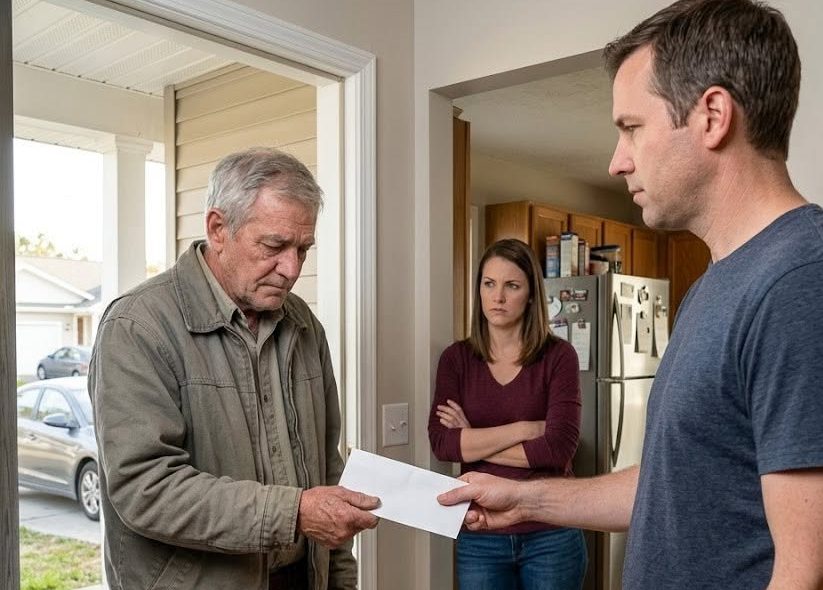
I watched Raymond slide the brown envelope deeper into his jacket, and for once he did not look at me when he spoke.
“Do not let her ask you what is inside it.”
I glanced toward the kitchen doorway. Natalie was still there, one hand on a stack of unopened mail, the envelopes squared so neatly that their corners lined up.
“She is going to ask,” I said.
“Then you do not have to answer.”
Raymond stepped away from the table. The chair behind him scraped the floor, and he stopped to push it back into place before reaching for his cane.
“You gave me a thousand dollars,” he said. “You have a right to ask why.”
“I already did.”
“And I gave you part of the answer.”
“Documents, legal help, and a test.”
He nodded.
“What kind of test?”
Raymond looked toward the doorway again.
“A signature test.”
I waited, but he only adjusted the cuff of his shirt.
“Whose signature?”
He picked up the folded receipt from the table and put it into his jacket pocket.
“That is why I need the documents first.”
Natalie moved one envelope from the stack to the other, though neither stack had changed size.
“Raymond,” she called, “do you want coffee before you go?”
“No, thank you.”
She looked at me.
“Does he?”
“I do not know.”
Raymond gave me a small look that I could not read.
“I can manage coffee at home.”
He walked toward the doorway. Natalie stepped aside for him, then looked down at the envelope in his jacket.
“What did you two decide?”
Raymond did not answer.
I said, “I gave Dad some emergency cash.”
“How much?”
The question came so quickly that I looked at her.
“A thousand.”
She put the top envelope back on the stack.
“That is quite a bit to take out without talking to me.”
“He asked me.”
“I heard him.”
Raymond reached for the doorknob.
“I will call you tonight, Grant.”
Natalie turned toward him.
“You could have asked us before taking that kind of money.”
Raymond’s hand stayed on the knob.
“I asked my son.”
Nobody answered that.
At 2:27, I walked him as far as the kitchen doorway while Natalie carried the mail toward the counter. The brown envelope had disappeared beneath his jacket.
Raymond stopped beside the small table where we kept the keys and spare batteries.
“I need proof before I explain myself.”
“Proof of what?”
He rubbed his thumb along the edge of his wallet.
“Proof that can stand on its own.”
“That sounds like you are expecting me not to believe you.”
“I am expecting you to hear both sides.”
“Whose side?”
He looked at the floor for a second.
“I do not want you carrying this before I have the papers.”
Natalie opened one of the envelopes behind us.
“Carrying what?”
Raymond looked at me.
“That is exactly why.”
Natalie held up the opened envelope.
“Why what?”
He reached for his coat.
“I should go.”
She put the letter on the counter.
“Raymond, if there is a problem with the property, you can just say so.”
He buttoned the coat slowly.
“I am trying to.”
She gave a short laugh.
“Then say it.”
Raymond did not.
I stepped between the table and the doorway.
“Are you worried about something happening between Natalie and me?”
He looked at me for a long second.
“I am worried that somebody could accuse me of interfering in your marriage.”
Natalie stopped sorting the mail.
“Who would accuse you?”
Raymond picked up his cane.
“That is another question I want the records to answer.”
He walked outside.
I followed him into the backyard at 2:41, pulling the door almost shut behind me. The grass needed cutting along the fence, and an old plastic chair had tipped over near the shed.
“You cannot leave me with that,” I said.
Raymond set his cane against the fence.
“I know.”
“What documents do you need?”
“Bank records first.”
“Which bank records?”
“The ones connected to the lake lot.”
I waited.
“Anything else?”
“Property papers.”
“From when?”
“March.”
“March what?”
He looked at me.
“March 9.”
The date sat there between us.
“Did I sign something?”
Raymond looked down at his shoes.
“Do you remember signing anything on March 9?”
“No.”
He nodded once.
“That is useful.”
“Useful?”
“It means you are already answering the right question.”
I took a step closer.
“Dad, if my name is on something, I need to see it.”
“You will.”
“When?”
“When I know you cannot be talked out of what you see.”
“By Natalie?”
He picked up his cane.
“I did not say her name.”
“You did not have to.”
Raymond started toward the gate.
I followed.
“What does the test have to do with the property papers?”
“Someone needs to compare a signature.”
“Mine?”
He stopped at the gate.
“I need independent proof.”
I opened it for him.
“How much will that cost?”
“More than I have left.”
“You should have told me.”
“I did.”
“You told me you needed money. You did not tell me what it was for.”
Raymond looked back at the house.
“I am trying to do this without making you choose before you have the facts.”
That was the first sentence he had said all afternoon that sounded less like a request and more like a warning.
At 2:56, I found the envelope of emergency cash on the porch table. I had counted it twice before handing it over, ten hundred dollar bills, still crisp from the bank.
Raymond held out his hand.
I gave it to him.
He folded the envelope once and slipped it into his jacket.
“Thank you.”
“You do not have to thank me.”
“I do.”
He started down the steps.
The screen door opened behind us.
Natalie stood there with the unopened mail tucked against her hip.
“Raymond.”
He turned.
She looked at me first.
“Did he give you the full thousand?”
Raymond said nothing.
I looked at her.
“Yes.”
“All of it?”
“Yes.”
She nodded as if confirming a figure from a bill.
“I just wanted to be sure.”
Raymond’s fingers closed over the outside of his jacket.
“Why?”
Natalie glanced at him.
“Because I was trying to understand what was happening.”
“You know now.”
She looked at me.
“Grant, can you come inside?”
I stayed on the porch.
“Why?”
“Because I do not think Dad should leave with money we may need to account for.”
Raymond said, “It is his money.”
Natalie kept her eyes on me.
“I did not say it was not.”
The kitchen clock showed 2:56, four minutes ahead of the actual time. I had stopped correcting it because Natalie liked having it fast.
Raymond opened the gate.
“Grant, I will call you when I have something.”
“What happens if you do not?”
“Then call Priya.”
“Priya who?”
“Priya Desai. My attorney.”
The name was new to me.
Natalie shifted the mail from one arm to the other.
“You have an attorney now?”
Raymond looked at her.
“I have had one for some time.”
Natalie said nothing.
He walked through the gate.
I watched him reach the sidewalk, then turn back.
“I need the money because once I tell you, I need you to believe the documents, not just me.”
I nodded.
He put one hand inside his jacket.
“Do not let her ask you what is inside it.”
Then he turned and kept walking, while Natalie remained behind me on the porch with the mail pressed against her side.
Raymond kept one hand inside his jacket while he used the other to straighten a stack of receipts on the kitchen table.
“Coffee is getting cold,” I said.
“Then I had better drink it.”
He pulled the blue three-ring binder closer. I had brought the coffee from the counter, and the binder was already open to pages covered with dates, account numbers, and small pencil marks. Raymond folded one receipt into exact thirds before sliding it into a clear sleeve.
“You still do that,” I said.
“Paper behaves better when it has a place.”
He turned another page, and my name appeared beside a date.
March 9.
I put my cup down.
“Why is my name there?”
Raymond looked at the line for several seconds before answering.
“That is the date I need you to remember.”
“I remember March. I do not remember signing anything for the lake property.”
His finger rested beside the date.
“Do you remember being asked to sign something?”
“No.”
He closed the binder halfway.
“That is different.”
I pulled the binder toward me, but he put his palm on the cover.
“Not yet, Grant.”
“Then tell me what I am looking at.”
“Copies first. Originals later.”
He opened a drawer beside the table and took out a yellow folder. A small handwritten note was clipped to the front. I could read only the first words, “March 9, property.”
“Where did you get that?”
“From my files.”
“Did I give it to you?”
“No.”
The answer was too quick for comfort.
Raymond reached for his coffee and made a face.
“You make coffee like Natalie.”
“That bad?”
“Worse. Hers at least has the decency to be hot.”
I laughed despite myself, and he smiled once before returning to the binder.
“Do you remember authorizing any transfer connected to the lake lot?”
“No.”
He nodded, but he did not look satisfied.
“Then we have to find out what your name was used for.”
I looked again at March 9.
“What document has my name on it?”
Raymond shut the binder.
“You will see it when the record is complete.”
At 9:05, Walter Bell had a transaction history open on his monitor when Raymond and I walked into the bank branch near the town square.
Walter turned the monitor slightly toward Raymond.
“Let me show you what the record says.”
He scrolled through several entries and stopped at a date in March. Raymond leaned forward in his chair.
“There.”
Walter pointed to a reference number.
“That is the lake property transaction.”
I moved closer.
“Can you print that page?”
Walter looked at Raymond.
“I can print what your authorization covers.”
Raymond reached into his pocket for the old leather wallet he carried everywhere.
Walter shook his head.
“Not that one. The archived request needs written authorization.”
Raymond stared at the screen.
“How long?”
“Today, if you want the archive request entered today.”
“And if I wait?”
Walter glanced at the screen again.
“I would not wait.”
Raymond took the request form Walter offered him.
I watched him write slowly, stopping once to check the account number.
“What is missing from the record?”
Walter did not answer.
Raymond folded the form and put it inside the binder.
“That is why we came.”
Walter looked at me.
“Your father is asking for records that have a limited retention period.”
“How limited?”
Walter tapped the screen.
“I need his written request before I can tell you more.”
Raymond stood.
“Then we will give you the request.”
At my office at 11:30, I opened the bottom drawer and pulled out the folder where I kept property papers, tax notices, and the few documents Natalie and I had signed together.
I searched March.
Then February.
Then April.
Nothing carried the March 9 date.
I checked the scanner folder on my computer.
Nothing.
I opened the file cabinet again and went through each folder by hand. A property tax bill. A homeowners insurance renewal. A repair invoice. A copy of our mortgage statement.
No March 9 document.
I called Natalie.
She answered on the fourth ring.
“Are you coming home for dinner?”
“Yes.”
A pause.
“Why?”
“I found a date in Dad’s records.”
“Which date?”
“March 9.”
She did not answer right away.
“Why are you asking me?”
“I am looking for something I apparently signed.”
“Apparently?”
“That is what the record suggests.”
She exhaled.
“Grant, your father has been keeping records for months.”
“That does not answer my question.”
“No. It does not.”
I looked at the empty folder on my desk.
“Do you remember signing anything related to his lake property?”
“I remember paperwork.”
“What paperwork?”
“Property paperwork.”
“That is not an answer.”
She went quiet.
Then she said, “Come home.”
At 7:18, Natalie cleared the plates while I dried them and set them in the cabinet.
She had left one fork beside the sink.
I moved it onto the counter.
“Do you remember March 9?”
She stopped wiping the table.
“Why?”
“Because Dad’s records show a property document with my name attached to that date.”
Natalie picked up the fork and placed it beside the other silverware.
“Are you asking me because you think I did something wrong, or because Dad thinks I did?”
“I am asking because I do not remember signing anything.”
She opened the drawer and took out a dish towel.
“Raymond has always been suspicious of paperwork.”
“That is not what I asked.”
“Then what are you asking?”
“Did you see a March 9 document?”
She wiped an already clean spot on the counter.
“Maybe.”
“Maybe?”
“Grant, there were documents.”
“Where are they?”
She straightened the mail into a neat stack.
“I do not keep your father’s files.”
“I did not ask about his files.”
Her hand stopped on the top envelope.
“You gave him a thousand dollars.”
I looked at her.
“How do you know the amount?”
She picked up the envelope and turned it over.
“Because I live here.”
“That does not explain how you knew.”
She put the envelope back exactly where it had been.
“You are making this larger than it is.”
“What did Dad ask you about?”
“Nothing.”
“Then why do you know what he withdrew?”
She reached for the stack of mail again.
“Are you really saying you think I am hiding something from you?”
“I am saying I found a document reference with my name on it.”
“And now you are searching my memory for a crime.”
“I did not say that.”
“You did not have to.”
She carried the plates to the sink.
I watched her put the last one down.
“Where did you see the March 9 document?”
She turned toward me.
“Why are you investigating your father?”
The question sat between us while the kitchen clock showed 7:18, four minutes ahead of the actual time.
I did not answer.
Natalie dried her hands and moved the mail stack another inch.
“I think you should stop looking before you damage something you cannot repair.”
I picked up my keys.
“Then I need to find out what I am looking for.”
She did not stop me.
The blue binder was waiting on Raymond’s table the next morning, and March 9 was still written beside my name.
But now there was another date written underneath it.
March 9, property.
And Raymond had not written it.
Raymond slid the top copy toward me and pressed his index finger beside a date.
“Do you remember authorizing a transfer connected to the lake lot?”
I looked at the line, then at him. “What transfer?”
He did not answer right away. He wrote March 9 on the tab of the blue binder, then checked the number beneath it.
“Forty one thousand two hundred dollars.”
The number sat there in black ink. I pulled the chair closer.
“That came from the lake lot?”
“Yes.”
“And I authorized it?”
Raymond lifted his eyes from the page. “That is what the record says.”
I waited for him to add something. He did not.
The kitchen clock on the wall showed 10:23, though I had stopped paying attention to it days before. Raymond turned another statement over and placed it behind the first.
“Was there a property paper?” I asked.
“There was a document dated March 9.”
“With my name?”
He tapped the binder twice.
“That is why I need the certified copy.”
I reached for the page, but Raymond covered the lower corner with his hand.
“Not yet.”
I pulled my hand back. “Then tell me what you are asking me to pay for.”
“Certified records. The legal retainer. And the signature verification test.”
“The test is for the March 9 paper?”
“Yes.”
He said it plainly, without dressing the answer up.
“How much is left?”
Raymond counted with the pencil beside the statements.
“Enough for the record request and the appointment. Not enough if the bank makes us move quickly.”
I looked at the $1,000 envelope I had given him the day before. It was no longer on the table.
“Then we move quickly.”
Raymond closed the binder halfway.
“Grant, I do not want you carrying this.”
“I am already carrying it.”
He rubbed the edge of one receipt between his fingers, then folded it into exact thirds before putting it back in the binder.
“Then carry the paperwork. Not my guesses.”
That sentence stayed between us while he gathered the copies into a neat stack.
By 1:40, the certified copy fee had become one of the numbers I was writing down. Priya met Raymond in the financial office at Valley Regional Hospital, and I stood near the door while she checked the receipt for the $425 legal retainer.
She tapped the corner of the receipt twice.
“The appointment is still available,” she said.
Raymond nodded. “For the signature test?”
“Yes. We need the known signatures and the March 9 document.”
I looked at her. “How soon?”
“Thursday morning.”
“That is three days.”
“Correct.”
Raymond reached for his wallet.
Priya stopped him with two fingers against the receipt. “The retainer is already paid.”
“I know.”
“Then keep the wallet closed.”
He gave her a small smile. “You always did know when to stop me.”
For a second, the room felt ordinary. Priya straightened the papers, Raymond complained that the hospital coffee had become worse since he started drinking it, and I laughed despite myself.
Then Priya put the receipt into the blue binder.
“The records request is separate,” she said. “The bank charges $31 for the research.”
I wrote that down.
“Thirty one dollars.”
“And certified copies are $68.”
I added that beneath it.
Raymond watched my pen.
“You are making a list.”
“I need to know what I am paying for.”
“You will.”
Priya looked at Raymond, then at me.
“The appointment cannot wait indefinitely.”
Raymond’s face tightened.
“I know.”
The word sounded different this time, because the date on the bank request was already printed at the bottom.
At 3:15, I held a flashlight in Raymond’s garage while he worked the key to a locked cabinet behind a stack of paint cans.
“That cabinet has been stuck since before you were born,” he said.
“Then why are you trying the key?”
“Because I have run out of better ideas.”
The lock turned halfway and stopped.
Raymond adjusted the flashlight in my hand.
“Lower.”
I lowered it.
“Left.”
I moved the beam.
“There.”
A narrow brass key lay beneath an old instruction manual on the cabinet shelf. Raymond picked it up and rubbed the dirt from its teeth with his thumb.
“That is the one.”
“What does it open?”
He closed his hand around it.
“Not today.”
I looked at him.
“Dad.”
He put the key into my palm.
“Keep it.”
“Why?”
“Because I may ask you for it later.”
I turned the key over. The brass was worn smooth where somebody had handled it for years.
“What does it open?”
Raymond took the flashlight from me and shut the cabinet.
“When you need to know, I will tell you.”
He walked toward the garage door.
I slipped the key into my wallet.
The blue binder stayed on his workbench.
“Are you sure that is all you want me to do?”
Raymond stopped.
“No.”
He looked back at the binder.
“I want you to see the paper.”
“The March 9 document.”
“Yes.”
“If my name is on that paper, Dad, I need to see it.”
Raymond nodded once.
“You will.”
He did not say when.
At 4:42, Walter Bell was closing his desk at the bank branch near the town square when Raymond placed the request form in front of him.
Walter read the first page, then turned his monitor slightly toward Raymond.
“Let me show you what the record says.”
He pointed to the account history.
“The transaction you want is outside the ordinary statement period.”
“Can you retrieve it?”
“I can request it.”
“Today?”
Walter checked the clock.
“Today.”
I stood beside Raymond while Walter filled in the archive request.
“How long will it take?”
Walter looked at the screen.
“Normally, I would tell you two business days.”
“Normally?”
“The retention window on this transaction closes at the end of the second week.”
Raymond leaned closer.
“When?”
“Friday.”
I looked at Raymond.
“That is four days.”
Walter nodded.
“That is why I am putting the request through now.”
Raymond took out his wallet.
Walter held up a hand.
“The $31 research fee can be paid after the request is accepted.”
Raymond left the wallet open.
“What do you need?”
“Written authorization.”
Raymond signed.
Walter turned the monitor toward me.
“There is another line here that may matter.”
I read the description, but the account number was incomplete.
“What is that?”
“An associated account.”
“Whose?”
Walter moved the screen back.
“I cannot tell you that from this page.”
Raymond’s jaw tightened.
“Can you retrieve the complete record?”
“With the authorization you just signed, yes.”
I looked at the request form.
“Does it show the March 9 document?”
Walter glanced at Raymond before answering.
“It references a property transfer.”
My eyes went back to the date.
“March 9.”
“Correct.”
Raymond folded the request form once.
Then again.
He stopped before the third fold.
“That is the paper.”
I looked at him.
“What paper?”
“The quitclaim deed.”
The word was unfamiliar in my mouth.
“That is connected to the $41,200?”
“According to the records, yes.”
I waited.
“Where did the money go?”
Raymond looked toward Walter.
Walter turned the monitor slightly away from us.
“The archived record will show that.”
Raymond took the request form and slid it into the blue binder.
“We are done here.”
Outside, I caught up with him before he reached the Buick.
“Why did you not tell me the document was a quitclaim deed?”
“Because I wanted the bank record first.”
“You have known the date.”
“Yes.”
“You have known the amount.”
“Yes.”
“And you know my name is on it.”
Raymond opened the Buick door.
“I know the record says your name is on it.”
I stood there.
“That is not the same thing.”
“No.”
He rested one hand on the roof of the Buick.
“I need you to keep that distinction.”
I looked at the blue binder under his arm.
“Do you think I signed it?”
Raymond did not answer.
That was answer enough to make me reach for the driver’s door.
He stopped me.
“Grant.”
I turned.
“Do not call Natalie yet.”
I kept my hand on the door handle.
“Why?”
“Because you do not have the document.”
“And when I do?”
Raymond looked down at the brass key in my wallet, as if he could see it through the leather.
“Then you decide what you believe.”
He got into the Buick.
I stood there with the question still open, while the bank’s front door locked behind us.
Raymond drove away with the blue binder on the passenger seat.
I stayed at the curb and called my office.
“I need the afternoon off,” I said.
The answer came after a pause.
“Can you finish the report tonight?”
“Yes.”
I ended the call and looked at the $31 fee written in my notebook.
Then I wrote one more number beneath it.
41,200.
I did not know where it had gone.
Raymond was already turning the corner when my phone lit up with Natalie’s name.
I put both hands flat on the table and looked at the March 9 date again.
“What document was signed on March 9?”
Natalie kept measuring coffee into the filter. She did not look up.
“Are you really saying you think I know what your father is talking about?”
“I am asking whether you remember it.”
She pressed the lid onto the coffee canister and set it beside the machine.
“Raymond has always been suspicious of me.”
“That is not an answer.”
“It is the answer to why we are sitting here at six thirty-five in the morning talking about paperwork neither of us has seen.”
The kitchen clock showed 6:39. I had stopped correcting it weeks ago because Natalie always said four minutes did not matter.
I reached for my coffee, then left it where it was.
“Dad asked me if I remembered signing something on March 9.”
Natalie opened the cabinet above the counter.
“Did he tell you what it was?”
“No.”
“Then why are you asking me?”
“Because you knew exactly how much money he took from my emergency cash.”
Her hand stayed inside the cabinet.
For three seconds she did not move.
Then she took out two mugs.
“Grant, I know because you told me.”
“I told you he needed money. I did not tell you the amount.”
She placed the mugs down with their handles lined up.
“Are you really saying I was keeping a ledger on your father?”
“No.”
“You sound like you are.”
I rubbed the edge of the envelope in my pocket, then stopped before I pulled it out.
“I am listening. I am asking a simple question.”
Natalie poured coffee into one mug.
“Then ask Raymond. He is the one with the documents.”
“What did you sign on March 9?”
She looked at me then.
“I did not sign anything on March 9.”
The answer came so evenly that it left me with nowhere to put the next question.
She turned back to the counter.
“Grant, your father has spent months making me sound suspicious because I would not let him dictate our finances.”
“Our finances?”
“Yes.”
She slid my mug toward me.
“That is what this is about, isn’t it?”
I did not drink it.
She picked up her own mug and walked toward the sink.
“I think you should stop looking before you damage something you cannot repair.”
At 9:50, Priya Desai was waiting behind a narrow desk in a strip mall office with a blue folder open in front of her.
She stood when I entered.
“Grant Mercer?”
“Yes.”
“Please sit.”
There were no family photographs on her desk. Only a legal pad, a black pen, and three documents turned face down.
She tapped the corner of each document twice.
“Before we discuss Raymond’s file, I need to confirm who you are.”
I gave her my driver’s license.
She checked it against a form, then returned it.
“Relationship to Raymond Mercer?”
“My father.”
“Are you acting under a power of attorney?”
“No.”
“Does Raymond have one in place?”
“I do not know.”
She wrote something down.
I looked at the face down documents.
“I came because he told me to see you.”
“I know.”
“Then why can you not show me the file?”
“Because knowing why you are here is not the same as knowing what you are authorized to receive.”
I leaned back.
“Did my father tell you not to trust me?”
“No.”
“Did he tell you Natalie was involved?”
Priya’s pen stopped.
“I am not going to answer questions by guessing what you want me to say.”
“I am not asking you to guess.”
“You are asking me to skip steps.”
She turned one of the forms toward me.
“This is the authorization Raymond signed.”
I read the date.
It was from three weeks earlier.
“Why did he sign this?”
“Because he wanted you to receive certain records in a particular order.”
“Why?”
“He gave me a reason.”
“What reason?”
Priya closed the form.
“He wanted you to see the documents before anyone explained them to you.”
I looked at the sealed brown envelope on the corner of her desk.
“Is that part of it?”
“Yes.”
“Can I open it?”
“Not here.”
She moved the envelope closer to herself.
“Your father was very specific.”
I stood.
“You are making this harder than it needs to be.”
“Perhaps.”
She placed the authorization back into the folder.
“But he was also specific about one other point.”
“What point?”
She looked directly at me.
“He did not want me persuading you.”
I left without the file.
By 12:25, Raymond was awake in a hospital waiting room chair, but he looked smaller than he had that morning at the house.
His hands rested on the arms of the chair.
I sat beside him.
“How are you doing?”
He gave me a tired smile.
“That depends on whether you came to argue.”
“I did not.”
“Good.”
A nurse passed through the doorway with a clipboard. Raymond waited until she was gone.
“Did you see Priya?”
“Yes.”
His eyes moved to mine.
“Did she give you anything?”
“No.”
He nodded once.
“Did she explain why?”
“She said you wanted me to see the records in a certain order.”
Raymond looked toward the table.
The brown envelope was there.
I followed his eyes.
“You could have told me that.”
He lifted one hand and pointed toward the envelope.
Then he pointed toward the hallway.
“Priya?”
He nodded.
“You want her to explain it?”
Another nod.
I reached for his hand.
His fingers closed around mine for a moment.
“Why did you make her control this?”
His lips moved, but the words did not come.
He tried again.
“Proof.”
That was all.
I waited.
He pointed toward the envelope again.
Then he leaned back and closed his eyes.
I stood when Priya appeared in the doorway.
She had the same black folder tucked against her side.
“Is he able to talk?”
“Not enough for what I need.”
Priya nodded.
“He expected that.”
“Did he expect me to be this confused?”
She glanced at Raymond.
“He expected you to have questions.”
“That is a careful answer.”
“It is the only one I can give you here.”
We stepped into the corridor.
I lowered my voice.
“Is Natalie involved?”
Priya did not answer immediately.
She looked at the envelope through the open doorway.
“Grant, I cannot answer that until you read what your father left you.”
“That sounds like you already know the answer.”
“I know what is in the documents.”
“And you think I cannot handle hearing it?”
“I think you should not hear it from me.”
She walked with me toward the waiting area.
I stopped beside the wall.
“What did Dad tell you about my marriage?”
“Very little.”
“Then why did he make this so careful?”
Priya turned the folder in her hands.
“Because he was afraid that if you heard an accusation first, you might spend the rest of the day defending someone instead of reading a record.”
I looked back toward Raymond’s room.
“Did he say who I would be defending?”
“No.”
“Did he say why?”
“He said you should have the choice.”
She reached into the folder.
I expected another form.
Instead, she took out the brown envelope.
Its flap was sealed.
She held it by the edges.
“Your father did not ask me to convince you, Grant. He asked me to make sure nobody could convince you before you saw the records.”
I looked at the envelope.
There was a faint crease across the lower corner, as if someone had carried it carefully for a long time.
“What is in it?”
“Documents.”
“Which documents?”
Priya’s eyes stayed on mine.
“The ones he believed you needed to see first.”
She walked back into the waiting room.
I followed.
Raymond was watching us now.
Priya set the envelope on the hospital table.
Raymond looked at it, then at me.
I reached toward the seal.
Priya stepped back.
“Read it before you call anyone.”
“Anyone?”
She did not answer.
The hospital room door opened behind us.
A nurse called Raymond’s name.
He turned his head toward the door, then back toward me.
Priya placed two fingers on the envelope and slid it closer.
I put my hand on it.
She let go.
Priya tapped the corner of the first document twice before sliding it toward me. The $425 retainer sat on the line beneath her finger.
“The examiner compares the March 9 signature with signatures you made at known dates,” she said. “You do not have to prove anything yourself.”
I looked at the blank space beside the payment line. My savings account had been thin for months, and the amount would take most of what was left that I could reach without moving money from another account.
“What happens if the examiner says it is mine?”
“Then we deal with that.”
“And if it is not?”
“Then we have independent evidence.”
She pushed a pen toward me. “I need your decision before we order the examination.”
I rubbed my thumb along the edge of the pen instead of picking it up. “How long?”
“Three business days, if the examiner receives the samples today.”
“And the $425?”
“Nonrefundable.”
I took out my checkbook. “Do it.”
Priya watched me write the amount. “You do not have to spend your savings to prove your father right.”
“I am not paying to prove Dad right.”
I tore out the check and set it beside the retainer form. “I am paying to find out who signed my name.”
Priya nodded once and tapped the document twice. “That is the correct question.”
She gathered the papers into the blue binder, leaving the brown envelope where it was. I did not ask her to open it. I was not ready to have another answer placed in front of me before I had finished with the first question.
At 3:45, Walter Bell turned his monitor slightly toward me in the bank records office. A gray printer beside his desk had already produced four pages, each stamped with the date of the request.
“Let me show you what the record says,” Walter said.
He scrolled slowly through the transaction history. “The lake lot proceeds entered Raymond’s account on March 7.”
I leaned closer. “That is the $41,200?”
“That is the amount connected to the sale.”
He printed another page. The machine clicked and hummed while Walter checked the screen.
“March 9,” he said. “Here is the withdrawal activity.”
I looked at the line beneath it. “That is all?”
“No.”
Walter stopped scrolling.
“What is missing?”
He pointed to a blank space between two entries. “There should be a transfer line here.”
“Should be?”
“The archived record shows an outgoing transaction, but the first printout did not include the destination field.”
I looked at him. “Can you print it?”
“Not from this screen.”
“Why not?”
“Because the archived image has to be pulled separately.”
He reached for a folder beside the monitor and opened it. “That request is covered by the authorization your father gave Priya.”
“How long does that take?”
Walter checked the date stamped on the request. “The retention window closes at the end of the second week.”
“How much time?”
“Nine days.”
He wrote the number on the corner of his notepad. Then he turned the monitor back toward himself.
I watched the blank space on the printed page. “So there is a transaction, but we do not know where it went.”
“That is what I am trying to retrieve.”
“Could the missing field be a bank error?”
“It could.”
He closed the folder. “Or it could be the part of the record we need.”
I put the incomplete pages into the blue binder and felt the weight of the $425 check in my mind more than the weight of the paper in my hand. One question had become two.
Raymond was awake when I reached his room at 5:20. His eyes went to the binder before they came to me.
“That does not look complete,” he said.
“It is not.”
I pulled the chair closer to the bed and opened the records to the page with the blank transfer line.
“Walter found an outgoing transaction. The destination did not come through on the first printout.”
Raymond looked at the page for several seconds.
“Can they get the rest?”
“Walter has requested the archived image.”
Raymond nodded.
“You knew there was a missing line.”
“I suspected there would be.”
I closed the binder. “Dad.”
He looked at me.
“You could have told me.”
“I could have told you many things.”
“That is not an answer.”
“No.”
He reached toward the small table beside his bed. His fingers found something beneath a folded tissue, and he brought out an old brass key.
I had seen it before, but never in his hand with that careful expression.
“What does it open?”
“A lockbox.”
“Where?”
“At home.”
“Then why are you giving it to me?”
“Because if the rest of the record is found, you may need the original receipt.”
I held out my hand.
Raymond placed the key in my palm and closed my fingers over it.
“Keep it until the rest is found.”
I looked down at the brass.
“What else is in the box?”
“One paper I should have given you long ago.”
He did not add anything.
I put the key beside the binder. “What paper?”
“You will decide when you see it.”
I waited for more, but he reached for his water instead. The nurse had left a plastic cup with a bent straw on the table, and Raymond frowned at it.
“That straw is useless,” he said.
I laughed before I could stop myself.
“You have always hated those.”
“I hate straws that point at my nose.”
It was such an ordinary complaint that for a few seconds we were simply father and son arguing about a hospital cup.
Then my eyes went back to the brass key.
At 6:05, I sat in the Buick with the hospital parking receipt on the dashboard and called Natalie. The brown envelope was still beside me.
She answered on the second ring.
“How is your dad?”
“He is awake.”
“Did Priya show you the documents?”
“Not all of them.”
There was a short pause.
“Are you going to tell me what is in the envelope?”
“Not tonight.”
“Grant, if this is about money, I can help.”
“I know.”
“I could reimburse Raymond directly.”
I looked at the brass key in my hand.
“That is not necessary.”
“It would settle this.”
“Not without knowing what I am signing.”
Her voice changed only slightly. “I have a property authorization that would make the repayment cleaner.”
“What kind of authorization?”
“It would let me handle the transfer without making Raymond wait.”
“Send it to Priya.”
“I would rather send it to you.”
“Why?”
“Because it is between us.”
I looked through the windshield at the hospital entrance. A man in a blue shirt held the door for an older woman carrying a paper bag.
“Natalie, I am taking care of Dad.”
“I know.”
“I will not discuss the envelope tonight.”
“Then at least let me make this easier.”
“How?”
“I reimburse him. You sign the authorization. The money is handled, and nobody has to keep digging through old records.”
The brass key pressed against my palm.
“I will take care of Dad, but I am not signing anything tonight.”
She did not answer right away.
“Are you really saying you would rather spend your savings than let me fix this?”
“I am saying I want the records first.”
“All right.”
Her voice was quiet.
“Then do not sign anything until you have read what I send.”
The call ended.
I looked at the envelope on the passenger seat. Then I looked at the key.
For the first time that afternoon, the two objects seemed connected, although I could not yet say how.
I put the brass key in my wallet instead of returning it to Raymond.
The check lay beside my coffee cup, face up, with Raymond’s name written across the payee line. Natalie turned the eggs with one hand and kept the other on the counter.
“I want to make this right with your dad,” she said.
I picked up the check. Four hundred and twenty-five dollars.
“Why this amount?”
“Because that is what he said he needed for the lawyer.”
She slid a plate toward me and added toast without asking whether I wanted it. That small habit belonged to ordinary mornings, and for a few seconds I let it.
“I thought you wanted him to stop asking me for money.”
“I did.”
She wiped a spot of egg from the stove. “I was wrong about that.”
I looked at the check again. The paper was fresh, but the date had already been printed in the corner.
“You called the bank yesterday?”
“No.”
“Then how did you know the exact amount?”
She reached for the coffee pot and filled my cup.
“Grant, you told me.”
I had told her about the four hundred and twenty-five dollars. I had not remembered saying it.
She sat across from me and broke a piece of toast in half.
“Maybe your dad and I both made this harder than it had to be.”
The words were gentle enough to make me want them to be true.
I folded the check once and set it back beside the cup.
“Did you sign this?”
“Yes.”
“For Raymond?”
“For Raymond.”
She smiled, but her hand moved toward the stack of unopened mail and straightened every envelope into one line.
“I want you to take it to him.”
I put the check in my shirt pocket.
“I will.”
“Thank you.”
There was nothing else she needed to say, and that bothered me more than an argument would have.
At 9:15, Raymond was sitting up with the tray table pulled close, a blue plastic cup beside his hand. I held the check between two fingers.
“Natalie gave this to me.”
Raymond looked at the check, then at me.
“She offered to repay you?”
“She said she wants to make things right.”
He reached for his glasses and settled them higher on his nose.
“Did she ask you to sign anything?”
The question landed harder than the check had.
“No.”
Raymond waited.
“She offered money,” I said. “That is all.”
He turned his head toward the window.
“Did she put the check beside any papers?”
“No. Why?”
He rubbed the corner of the blanket between his fingers.
“Because a repayment can have a second page.”
I pulled a chair closer.
“Second page of what?”
He looked at the check again.
“Do not sign anything she brings you until Priya sees it.”
“She has not brought me anything.”
“Good.”
I put the check on his tray.
“Did you expect her to?”
Raymond reached for the check, folded it once, and placed it beneath his glasses case.
“I expected her to want the account settled quickly.”
“She said she was wrong about you.”
He gave a small nod.
“She can be sorry and still want something.”
I had no answer for that.
Raymond looked at me.
“Grant, you already spent money helping me. I do not want you spending more unless we know what it buys.”
“I can handle four hundred and twenty-five dollars.”
“I know.”
He tapped the check with one finger.
“That is why I am asking about the paper behind it.”
I left the check with him.
At 11:40, Priya had the blue binder open across her desk, with the pages arranged in neat groups. She tapped the corner of the first document twice before sliding it toward me.
“Sign here.”
I read the authorization before picking up the pen.
“This lets Walter release the archived records?”
“Yes.”
“All of them?”
“The records Raymond authorized. Nothing beyond that.”
I signed my name.
Priya took the page and placed it in a separate folder.
“Now we wait for the bank.”
She opened the binder again.
A string of numbers ran across the top of the next page.
“Do you recognize this account?”
I read it once.
Then again.
“That is our household account.”
Priya’s finger stayed beside the number.
“Whose name is on your household account?”
“Natalie’s and mine.”
She did not move the page.
“Raymond’s transfer record points here.”
I looked at the number again.
“That cannot be right.”
Priya closed the binder halfway.
“Why?”
“Because that account is where our mortgage payment comes from.”
“Then you should recognize it.”
“I do.”
She opened the binder again.
The page beneath it carried Raymond’s name and a date I had already seen twice.
“How much was transferred?”
Priya looked at me before answering.
“Forty-one thousand two hundred dollars.”
I pushed my chair back an inch.
“Into our account?”
“Into an account carrying the same number.”
“Whose name is on the statement?”
Priya turned the page toward me.
I read the name.
Natalie.
For a few seconds, the office was quiet except for the scratch of her pen as she marked the page number.
“Do you want to stop?” she asked.
I looked at the authorization I had just signed.
“No.”
She nodded.
“Then we continue.”
She put the page back into the blue binder and tapped its corner twice.
“I will need you at the bank.”
“Today?”
“Today.”
I called Natalie from the parking lot.
She answered before the second ring.
“How did it go?”
“Fine.”
“Did Priya tell you anything?”
I watched a man carry a box across the sidewalk.
“She is getting the bank records.”
Natalie was quiet for a second.
“That sounds serious.”
“It is paperwork.”
“Grant.”
I waited.
“Come have lunch with me.”
At 1:05, we sat across from each other in the hospital cafeteria, with two paper cups between us. Natalie had brought a sandwich and set half of it on my tray.
“I should have listened to you sooner,” she said.
I looked at her.
“About Raymond?”
“Yes.”
She peeled the paper from her sandwich in one careful strip.
“He is your father. I should not have made you feel like you had to choose.”
I had not said that I felt that way.
“I did not ask you to apologize.”
“I know.”
She pushed the sandwich toward me.
“Take it. You barely ate this morning.”
I took it because refusing would have made the moment larger.
She smiled.
“See? We can still have lunch.”
For the first time that day, I almost believed the morning could be put back where it had been.
Then she reached across the table and touched the edge of my napkin.
“Let the lawyers handle Raymond’s bill. Let him have his money back. Then let this end.”
I looked at her hand.
“What do you mean, let this end?”
“The arguing. The checking. The questions.”
“I am checking because the records are incomplete.”
She pulled her hand back.
“Your dad has always kept records.”
“So have I.”
“Not like this.”
She picked up her cup and took a drink.
“Maybe your dad and I both made this harder than it had to be.”
She had said those words that morning, but now they sounded practiced.
I did not mention the account number.
I wanted to hear what she would say without knowing I had seen it.
She looked at me.
“Did Priya show you anything?”
“Not much.”
Natalie nodded slowly.
“Good.”
I set my sandwich down.
“Why is that good?”
“Because you should not have to spend your lunch reading bank records.”
She smiled again, and for a moment she looked exactly like the woman who had packed my lunches and reminded me about dentist appointments.
Then her eyes moved to the pocket where I had put the check.
“You still have Raymond’s check?”
“No.”
It was a lie.
She did not challenge it.
She simply reached for her purse and began searching for her keys.
“Take your father his lunch.”
I watched her put the keys back.
“What about the check?”
She stood.
“I thought you said you gave it to him.”
I said nothing.
She picked up her tray.
“Grant?”
“I have to go.”
She nodded.
“All right.”
I stayed at the table until she disappeared through the cafeteria doorway.
Then my phone lit up.
Priya’s name was on the screen.
I answered.
“The bank found the archived record,” she said.
“How much?”
There was a short pause.
“Forty-one thousand two hundred dollars.”
I closed my eyes for one second.
“Is it the same account?”
“No.”
My hand tightened around the phone.
“Then whose account is it?”
Priya did not answer immediately.
“Grant, I need you to come back to my office.”
I stood.
“Why?”
“Because the account number you recognized is only part of the trail.”
I grabbed my keys.
“What is the other account?”
Priya’s voice became very quiet.
“It is controlled by Natalie.”
I stopped beside the cafeteria table.
“And there is another document,” she said.
“Which document?”
“The March 9 quitclaim deed.”
I looked down at the empty chair across from me.
“Does it have my name on it?”
Priya was silent for one second.
“Yes.”
I started walking.
“Then show me.”
Natalie slid the check back toward herself and picked up the March 9 deed from beside it.
“I think you should leave that paper here.”
Her fingers stopped at the corner of the page. “Why?”
“Because it belongs with Raymond’s records.”
She looked at the deed, then at me. “Are you saying you trust him more than you trust me?”
I rubbed my thumb across the edge of the table.
“I am saying I am not ready to answer that.”
She set the deed down with unusual care. Then she moved the sugar bowl two inches to the left.
“Then you should tell me what Priya showed you.”
“She has not shown me the whole file.”
“Grant.”
“I am listening.”
She looked toward the kitchen clock. It was nearly seven in the morning, though the room had already taken on the stale quiet of a much later hour.
“Your father has been collecting papers about me for months,” she said.
“I know.”
“No, you do not.”
She picked up the check again.
“If you take that back to Priya, you are choosing his version before you have heard mine.”
I reached for the deed.
Natalie covered it with her hand.
For three seconds neither of us moved.
Then she lifted her hand and pushed the deed across the table.
“Take it,” she said. “If you are going to accuse me, at least take the paper with you.”
I put the deed into my folder, but I left the check where it was.
“Why is your check dated March 9?”
She looked at the date and gave a small shrug.
“I wrote it when I first thought I could settle this.”
“Settle what?”
She did not answer.
Instead, she gathered two envelopes from the counter and squared them against each other.
“Go see your father,” she said. “Ask him why he waited.”
I stood there with the folder under my arm.
“Waited for what?”
Natalie straightened the salt shaker.
“For you to stop listening to me.”
I left the check on the table.
By 8:30, Priya had already arranged the brown hospital envelope, three bank statements, and two certified copies across her desk. She tapped the corner of each document twice before sliding the first one toward me.
“Start here.”
I opened the envelope.
The first page was a bank statement with a yellow mark beside a transfer dated March 9. The amount was $41,200.
“That is the lake lot money?”
“Yes.”
I read the line twice.
The receiving account ended in four digits I recognized.
“That is our household account.”
Priya nodded.
“Who controlled it?”
“Your wife.”
She did not say it sharply. She did not need to.
I turned the page.
The next sheet showed the same transfer with a bank notation beside it.
“Why was this missing from Walter’s first printout?”
“The archived line required a separate retrieval request.”
“And Raymond knew?”
“Raymond knew the transaction existed. He did not know exactly what the archived record would show until Walter found it.”
I placed the paper flat.
“Then why did Dad ask me for a thous