“It was a work bag,” she said. “I didn’t know what was in it.” “You were told.” “I thought she was being dramatic.” Bell glanced at me. I kept my voice even. “The bag contained an inspection tablet, federal documents,
and assessment notes related to this waterfront facility.” Delphine stared at me.
“For what?”
“That information is not yours to ask about.”
Her eyes moved past me toward the water.
The bag had disappeared beneath the gray surface, leaving only a spreading circle of ripples.
For the first time since she had arrived, Delphine looked frightened.
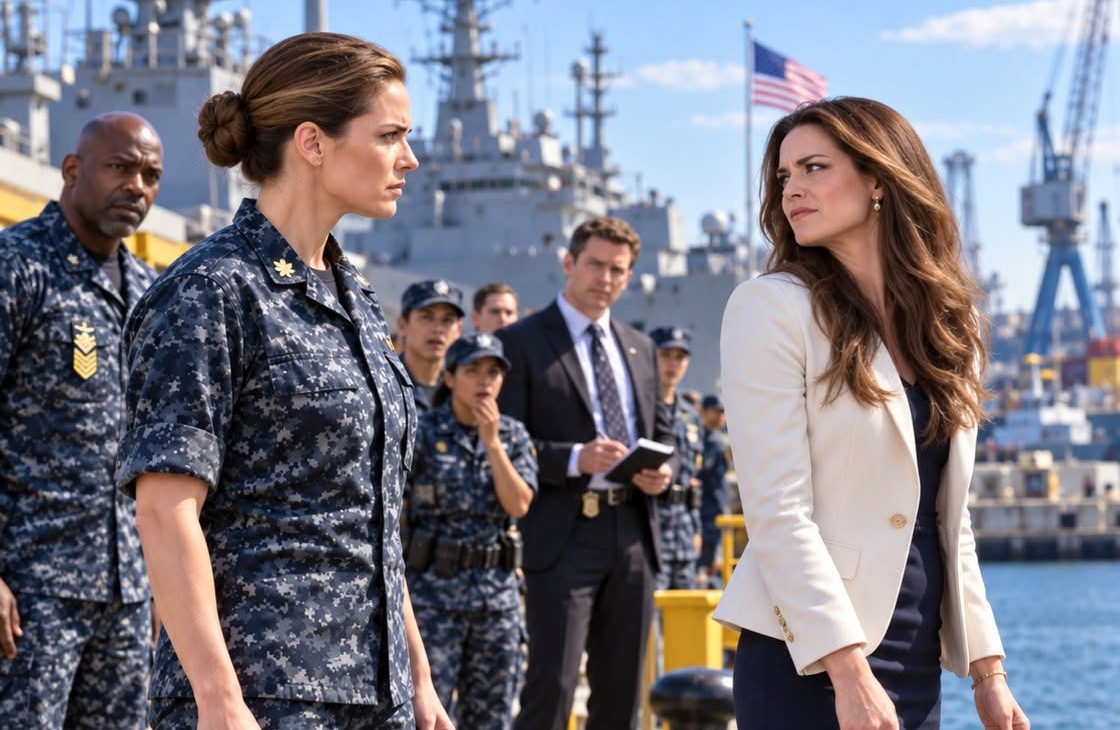
Master Chief Kettleman was speaking into his radio, giving harbor patrol our location and requesting a recovery team.
Rosalind Vega had moved behind a stack of cargo barriers, where she was speaking with the pier supervisor and recording the time of each event in the inspection log.
Around us, the retirement event had fallen strangely quiet.
The sailors and contractors who had been setting up tables now watched without pretending not to.
Someone had stopped the music.
A uniformed petty officer stood near the catering van with his arms folded, his gaze fixed on Delphine.
I felt the familiar weight of family history pressing against the present.
All my life, Delphine had been able to turn a room toward me.
When we were children, she could make our parents believe I had started an argument simply because I had stopped answering her.
In high school, she told relatives that I was “too sensitive” after she read my private journal aloud to our cousins.
At family gatherings, she made jokes about my career until everyone laughed, and then accused me of being humorless when I did not join them.
I had learned to survive by becoming quiet.
Silence had been my shield.
It had also become the story everyone told about me.
“She doesn’t care.”
“She thinks she’s better.”
“She never explains herself.”
Now, standing on the pier while harbor patrol prepared to search for my bag, I wondered if I had mistaken endurance for peace.
Bell turned back to Delphine.
“Do you have identification?”
She reached into her coat with unsteady fingers and handed him her driver’s license.
He studied it, copied the information into his notebook, and returned it.
“Were you aware this area was being used for a federal inspection?”
“No.”
“Did you enter the pier through the designated access point?”
“I was delivering food.”
“To whom?”
“An event coordinator.
I was hired to cater a retirement reception.”
“Name?”
Delphine looked at me.
The question seemed to unsettle her more than anything else had.
“Barton Maritime Services,” she said.
Rosalind, who had been walking back toward us, stopped.
“Barton?” she asked.
Delphine gave her a defensive look.
“Yes.”
Rosalind turned to me.
“Commander, Barton isn’t on the approved vendor list for today’s event.”
“They’re not the host?”
I asked.
“No.
The retirement reception is being sponsored by the Atlantic Maintenance Consortium.”
Delphine shook her head.
“That’s not what I was told.”
Bell’s attention sharpened.
“Who contacted you?”
“A woman named Kayla.
Kayla Mercer, I think.”
“Do you have a phone number or written agreement?”
“It was all done by text.”
“May I see the messages?”
Delphine hesitated.
The old instinct rose in me—to step in, to tell Bell this was not necessary, to protect her from the consequences of a terrible decision.
But protecting Delphine had never made her safer.
It had only taught her that I would absorb the impact.
“I can show you,” she said finally.
She unlocked her phone and handed it over.
Bell did not take it.
Instead, he asked her to hold it where he could see the screen while she opened the conversation.
I noticed that detail.
He was not treating her as an enemy.
He was preserving her choices and his own procedure at the same time.
Delphine scrolled through the messages.
There were several exchanges about menus, delivery times, and the number of guests.
The final message had been sent at 7:46 that morning.
Use the west service gate.
Someone will meet you.
Don’t go through the main entrance.
My stomach tightened.
“Why did they tell you to use the west gate?”
Bell asked.
“They said the main entrance was crowded.”
“It’s a controlled access point.”
“I didn’t know that.”
“You’ve catered on military property before?”
“Once,” she said.
“Years ago.”
“And you were given credentials?”
“They said I could use the service gate.”
“Who met you?”
Delphine looked down at her phone.
“No one.”
“What did you do?”
“I drove to the gate, but it was locked.
So I came around to the pier.”
“You entered from the public side?”
“I followed the signs.”
Rosalind glanced toward the service road.
“There are no signs directing civilian traffic to Pier 12.”
Delphine’s face tightened.
“I was trying to find the event.”
I believed that part.
Delphine was many things, but she was not careless with her business.
She had built her catering company from one rented kitchen and a borrowed van.
She knew permits, delivery windows, guest counts, and venue rules better than anyone I knew.
Yet she had followed an unknown person’s instructions onto a restricted waterfront.
That did not make what she had done to my bag less serious.
It simply meant there was more to understand.
A harbor patrol boat appeared beyond the breakwater.
Its engine grew louder as it approached, and a diver began preparing equipment on the aft deck.
Bell stepped aside with me.
“Commander,” he said quietly, “I need to ask whether anyone else had access to your bag before the incident.”
“My vehicle was parked in the inspection lot.”
“Was it secured?”
“Yes.”
“Was the bag with you the entire time?”
I thought back.
The morning had begun before sunrise.
I had stopped at the operations building to collect the tablet, inspection binder, and protective case.
From there, I had driven directly to the waterfront.
“I carried it from the building to my vehicle,” I said.
“Then from the vehicle to the pier.”
“Did you ever leave it unattended?”
“For approximately seven minutes while I spoke with the pier supervisor.”
“Where was it?”
“On the passenger seat of my vehicle.”
“Was the vehicle locked?”
“Yes.”
Bell made a note.
“Did you notice anything unusual before your sister arrived?”
I hesitated.
The question opened a small door in my memory.
The passenger door had seemed slightly ajar when I returned to the vehicle.
I had assumed I had failed to close it completely.
The tablet case had been turned sideways, though I remembered placing it flat.
At the time, I had been focused on the inspection schedule.
“I noticed the bag’s position had changed,” I said.
Bell looked up.
“By how much?”
“I can’t say.
I thought I had moved it without remembering.”
“Did you check the contents?”
“No.”
“Why not?”
“Because I was late.”
He wrote that down too.
Across the pier, Delphine stood alone near the catering van.
Kettleman had arranged for one of the sailors to remain with her while the initial report was prepared.
No one was threatening her.
No one was shouting.
Still, she looked smaller than she had an hour ago.
I knew that feeling.
Not fear of punishment.
Fear that the version of yourself you had performed for years was beginning to fall apart in front of strangers.
The diver entered the water.
Minutes passed.
The wind carried the smell of fuel and salt across the pier.
My hands were cold, but I kept them behind my back, refusing to let anyone see them shake.
Then the diver surfaced with the bag.
It was placed into a recovery container and carried onto the dock.
Water streamed from the canvas.
The zipper had opened halfway, and a few laminated pages floated inside the container.
Bell put on gloves.
“Commander, can you identify the contents without touching them?”
“Yes.”
He opened the outer flap carefully.
The inspection binder was there, swollen but intact.
The tablet case had separated from the bag and was lodged beneath the binder.
A small evidence pouch containing access cards had been torn loose but remained sealed.
I exhaled.
“The tablet is protected,” I said.
“The case is rated for immersion.”
“Good.”
Bell inspected the binder without removing it.
“Anything missing?”
“I need the documents dried and inventoried.”
A recovery technician carried the container to a folding table under a portable canopy.
Rosalind helped me identify each item while Bell photographed the contents.
The binder held the inspection schedule, infrastructure drawings, contractor reports, and my handwritten notes.
Several pages had bled at the edges, but the protective sleeves had done their job.
The tablet powered on after the technician connected it to an approved portable battery.
The screen lit up.
No one spoke for several seconds.
Then Rosalind leaned closer.
“The assessment folder is open.”
“That may have been the last screen displayed,” I said.
Bell examined the tablet without touching it.
“Commander, were you the last person to access this device?”
“Yes.”
“When?”
“Approximately 7:55.”
He looked at the system log.
“According to this, the device was unlocked at 8:12.”
I stared at him.
“That’s impossible.”
“Why?”
“Because the tablet was in the bag.”
“Your sister approached you at what time?”
“About 8:25.”
Bell turned the screen toward me.
There were three recorded authentication events.
The first at 7:55, when I had opened the inspection folder.
The second at 8:12.
The third at 8:14.
“Could it have unlocked accidentally?”
I asked.
“Not with the access protocol installed.”
I looked toward my vehicle.
It was parked approximately fifty yards away, beyond a line of barriers.
Bell continued, “At 8:14, a file was copied to an external device.”
The cold in my hands spread up my arms.
“What file?”
He read the name from the screen.
“Appendix C.
Waterfront Vendor Access Log.”
Rosalind’s expression changed.
“What’s in that appendix?” she asked.
“Every contractor and vendor authorized to enter the waterfront during the inspection period,” I said.
“Company names, vehicle identifiers, temporary access times.”
“Was it classified?”
Bell asked.
“Controlled information.
Not for public distribution.”
The recovery technician looked up from the drying table.
“Commander, the binder is missing one section.”
I moved closer.
He pointed to the divider marked Appendix C.
The tab was there.
The pages were not.
For a moment, no one moved.
The binder had been secured in a protective sleeve.
The pages could not have simply washed away without tearing the sleeve apart.
The other sections were present, damp but intact.
Bell studied the empty divider.
“Was the appendix in the binder when you left the operations building?”
“Yes.”
“You’re certain?”
“I reviewed it in my office before I departed.”
“Who else knew it was there?”
“Master Chief Kettleman.
Ms.
Vega.
The inspection team.”
“And anyone who accessed the tablet?”
I looked again at the device.
The file had been opened, copied, and closed before Delphine ever came toward me.
My sister had thrown the bag into the water.
But she had not been the first person to handle it.
Bell lowered his voice.
“Commander, I need to ask you something difficult.”
I met his eyes.
“Ask.”
“Is it possible your sister knew what was in the bag before she threw it?”
“No.”
He waited.
I thought of Delphine’s fury, her accusations, the way she had marched toward the edge while I warned her to stop.
I thought of how confidently she had behaved—until she saw my rank.
“No,” I repeated.
“She didn’t know about the documents.”
Bell nodded, but he did not look satisfied.
“Then someone else may have.”
Behind us, Delphine had been listening.
She stepped closer, clutching her phone.
“I didn’t take anything,” she said.
No one had accused her.
Perhaps that was why the words sounded so sincere.
Bell turned to her.
“Did you touch the bag before you threw it?”
“No.”
“Did you open it?”
“No.”
“Did anyone approach you or speak to you before you came over here?”
Delphine looked toward her van.
A small blue folder rested on the driver’s seat.
“I don’t know,” she said.
“Think carefully.”
She pressed her lips together.
“Someone was standing near the van when I arrived.”
“Who?”
“I assumed he worked for the event.”
“Describe him.”
“Medium height.
Dark jacket.
A baseball cap.”
She glanced at me.
“He asked if I was Delphine Vale.”
The sound of my own surname in her mouth made something inside me turn.
“What did he say?”
Bell asked.
“He said my sister had been asking questions about my business.”
I felt Rosalind’s eyes on me.
“Did I ever ask questions about your business?”
I said.
Delphine shook her head quickly.
“No.”
“What else?”
“He said you were going to make a report that would cost me the contract.”
“That’s not true.”
“I know that now.”
Her voice cracked—not dramatically, but with the embarrassment of someone hearing her own mistake spoken aloud.
“What did he look like?”
Bell asked again.
“I told you.
Dark jacket.
Cap.
He had a badge clipped to his belt.”
“What kind of badge?”
“I couldn’t see it.”
“Did he give you the messages?”
“No.
He said the event coordinator had explained everything.”
Bell glanced at me.
“Did he tell you to confront your sister?”
Delphine did not answer immediately.
That silence told us enough.
“He said I shouldn’t let you interfere,” she whispered.
I closed my eyes for a second.
All morning, I had assumed Delphine had created the entire scene out of old resentment.
Now I understood that someone had reached into that resentment and pulled.
It did not excuse her.
But it explained why her anger had seemed so certain from the moment she arrived.
I opened my eyes.
“Delphine,” I said, “why did you believe him?”
Her face changed.
Not anger this time.
Shame.
“Because he knew things.”
“What things?”
“He knew Mom had left the house to me.”
I said nothing.
“He knew you had refused to discuss the estate with me.
He knew you hadn’t spoken to me since Christmas.”
She looked down at her phone.
“He told me you were using your position to punish me.”
“I never mentioned your business to anyone at work.”
“I know.”
“You could have called me.”
She laughed once, but there was no humor in it.
“You never answer when I call.”
“That isn’t true.”
“It is when you think the conversation will be difficult.”
The words struck more deeply than I wanted them to.
Because they were not entirely false.
Bell stepped back, giving us a little space while remaining close enough to hear.
Delphine looked at me across the wet recovery table.
“I thought you had come to ruin the one thing I built,” she said.
“I came to inspect a pier.”
“I know that now.”
“And you still threw my bag.”
Her eyes filled, but she did not look away.
“I was angry.”
“You were.”
“I wanted you to stop looking at me like I was a problem you had to solve.”
“I wasn’t looking at you.”
“You always are, Marlo.
Even when you’re silent.”
For years, I had believed silence made me invisible.
Standing there, I realized it had not.
It had made me impossible to understand.
A harbor patrol officer approached Bell and handed him a small waterproof evidence pouch.
Inside was a folded set of papers, soaked and wrinkled.
Bell examined them through the plastic.
“Commander,” he said, “these were found beneath the pier, approximately twenty feet from where the bag entered the water.”
I recognized the divider immediately.
Appendix C.
The pages were damaged, but the top sheet remained legible.
At the bottom was a list of temporary vendor vehicles approved for the waterfront that morning.
I read down the entries.
Atlantic Maintenance Consortium.
Kettleman’s approved supply contractor.
The Navy retirement event.
Then I reached the final line.
Barton Maritime Services—temporary access granted, 0810 hours.
Vehicle: white catering van.
Driver: Delphine Vale.
I looked at my sister.
She stared at the page as if it had betrayed her.
Bell turned the sheet over.
Written in pencil across the back, in handwriting I recognized from my own inspection notes, were six words:
Access approved by someone inside.
Then, beneath that, a name had been circled.
Not Delphine’s.
Not mine.
Rosalind Vega’s.
PART 3
I looked at Rosalind.
She did not flinch.
That was the first thing I noticed.
Most people, when a suspicion landed near them, began explaining before anyone had asked.
Rosalind only stared at the damp page, her face composed but her hands held tightly together at her waist.
“I didn’t approve that access,” she said.
Bell studied her.
“Your name is listed as the approving authority.”
“My name appears on the form.
That isn’t the same thing.”
“Were you authorized to approve temporary vendor access?”
“For the civilian contractors assigned to the project, yes.
Not for an unlisted catering company.”
“Did you sign this?”
Rosalind leaned over the evidence pouch without touching it.
“That is not my signature.”
I examined the writing at the bottom of the page.
The approval line was cramped and uneven, unlike Rosalind’s precise block lettering.
“Then why is your name on it?”
I asked.
She looked at me.
“That’s what I was trying to determine.”
The answer unsettled me more than a denial would have.
Bell turned to the harbor patrol officer.
“Where exactly was this found?”
“Under the western edge of the pier,” the officer said.
“Caught against a support brace.
We recovered three loose pages and the divider.”
“Any other items?”
“Not from the bag.”
Bell nodded, then crouched beside the recovery container.
He examined the torn protective sleeve through the clear plastic.
“The pages may have separated when the bag struck the water,” he said.
“But the handwriting on the back suggests the note was already there.”
I looked at my own writing again.
Six words.
Access approved by someone inside.
Then Rosalind’s name, circled.
I remembered writing it.
Not when I left the operations building that morning.
Earlier.
During the first review of the vendor access list.
At 7:40, I had noticed that Barton Maritime Services appeared on a preliminary entry sheet even though the company was not included in the event sponsor’s submission.
I had circled Rosalind’s name because she was listed as the person who had entered the approval into the system.
I had intended to ask her about it.
Then the pier supervisor called with a question about a loading zone, the schedule shifted, and Delphine arrived.
I had forgotten the note was in the binder.
“I wrote this,” I said.
Rosalind’s expression tightened.
“You suspected me?”
“I noticed a discrepancy.
I hadn’t reached a conclusion.”
“You circled my name.”
“Because your name was attached to the approval.”
“You could have asked.”
“I was going to.”
“When?”
The question was quiet, but it carried more weight than the situation required.
I looked away.
That was the pattern, I realized.
I gathered facts privately, waited for the perfect moment, and then acted as though silence had prevented harm.
Rosalind had worked beside me for nearly two years.
She had earned my trust through competence, patience, and the rare ability to tell me when I was wrong without making it personal.
Still, I had written her name down before speaking to her.
“I should have asked before I made the note,” I said.
“Yes,” she replied.
There was no anger in her voice.
That made it worse.
Bell glanced between us.
“Ms.
Vega, when did you first see Barton Maritime Services on the access list?”
“Yesterday afternoon.”
“Who sent you the request?”
“It came through the contractor portal.”
“From whom?”
Rosalind gave the answer immediately.
“The Atlantic Maintenance Consortium.”
“Did you verify it?”
“I verified the sponsor’s account.
The request came through their administrative contact.”
“Name?”
“Graham Pike.”
Kettleman, who had been coordinating security near the edge of the pier, looked over.
“Pike is the consortium’s logistics director,” he said.
“He’s been handling the retirement event.”
“Was he on-site this morning?”
Bell asked.
“He was scheduled to be,” Rosalind said.
“I haven’t seen him.”
Bell made another note.
“Did you approve the request?”
“No.
I flagged it.”
“Why?”
“Because Barton wasn’t included in the original vendor packet.
I sent the request back for confirmation.”
“Did you receive a response?”
Rosalind shook her head.
“Not from Pike.”
“Then how did the access approval appear?”
“I don’t know.”
Bell looked at the tablet technician.
“Can you access the system logs from here?”
The technician nodded.
“If the network connection holds.”
He carried the tablet beneath the canopy and connected it to a secure hotspot.
The screen filled with a series of timestamps and access records.
I stood beside Rosalind, careful not to crowd her.
At 7:38, an access request had been submitted for Barton Maritime Services.
At 7:42, Rosalind had flagged the request for verification.
At 7:58, a user with her credentials had reopened the request.
At 8:01, temporary access had been approved.
At 8:10, Delphine’s vehicle identifier had been added to the active vendor list.
At 8:12, the tablet in my bag had been unlocked.
The sequence formed a clean line between the office, the pier, and my sister.
Too clean.
“Your credentials were used at 7:58,” Bell said.
Rosalind’s face had gone still.
“I was in the conference room.”
“With whom?”
“Kettleman.
Two representatives from the harbor contractor.
We were reviewing the inspection schedule.”
Kettleman nodded.
“She was there from 7:45 until approximately 8:20.”
“Did you leave at any point?”
Bell asked her.
“No.”
“Did anyone else have access to your account?”
“Not knowingly.”
“Where was your access badge?”
“On me.”
She touched the clipped badge at her belt.
Bell looked at it.
“Was it ever missing?”
Rosalind hesitated.
“No.”
“Please think carefully.”
“I said no.”
Her answer came too quickly this time.
I watched her lower her eyes.
“What?”
I asked.
She drew a breath.
“Yesterday, after the afternoon briefing, I couldn’t find it.”
Kettleman turned toward her.
“You didn’t report that.”
“I found it in the copier room.”
“When?”
“About twenty minutes later.”
“Was it where you left it?”
“No.
It was on top of the machine.”
“And you didn’t think that was unusual?”
“I thought I had set it down.”
Kettleman’s expression sharpened.
“You never set it down.”
“I know that now.”
Bell asked, “Did anyone else have access to the copier room?”
“Most of the project staff.”
“Who was present when you found the badge?”
Rosalind’s mouth tightened.
“Graham Pike.”
A silence settled over the group.
The wind moved across the pier, lifting the corners of the drying sheets beneath the canopy.
Delphine stood several feet away, listening.
Her eyes moved from Rosalind to me, then to the vendor list.
“I know that name,” she said.
Bell turned.
“How?”
“He was the one who contacted me.”
I felt something inside me pull tight.
“Graham Pike sent you the messages?”
“No.
Not directly.”
“Then what do you mean?”
“He was mentioned in the messages.”
She opened her phone and scrolled.
Her fingers trembled less now, as if having admitted the worst part had made the rest easier.
“There was a message from Kayla,” she said.
“She said the event had been approved through Mr.
Pike’s office.”
“Do you know Kayla’s last name?”
Bell asked.
“Mercer.
She said she worked for the consortium.”
“Did you speak with her?”
“Once.
She called yesterday to confirm the menu.”
“Did she sound like someone you had dealt with before?”
“No.”
“Did she provide a contract?”
“Yes.”
Delphine opened an attachment and held the phone toward him.
Bell examined it without taking the device.
“May I see the header?”
She enlarged the document.
The logo at the top belonged to the Atlantic Maintenance Consortium.
Beneath it was a typed approval line bearing Graham Pike’s name.
Rosalind leaned closer.
“That isn’t our current letterhead,” she said.
“What’s wrong with it?”
I asked.
“The logo is from two years ago.
They changed the branding after the merger.”
Bell took a photograph of the screen.
“Could this have been copied from an old document?”
“Easily,” Rosalind said.
“But the signature is also wrong.”
Delphine looked at her.
“You know his signature?”
“I process his access requests.”
“Then why didn’t you tell me the contract was fake?”
“Because I hadn’t seen it until now.”
Delphine’s eyes dropped.
The shame between us was no longer private.
It sat in the open air, beside the recovery table and the soaked federal binder.
“I should have called you,” she said.
“Yes.”
“I thought you’d tell me I was being foolish.”
“I might have.”
She nodded as though she deserved that answer.
“I know.”
There was a time when I would have used the moment to say nothing.
Let her carry the discomfort.
Let silence become punishment without my having to admit I was punishing her.
Instead, I said, “But I would have helped you verify it.”
She looked up.
That small change in her face hurt more than anger would have.
Bell stepped away to speak with the harbor patrol officer, giving us a few seconds.
Delphine came closer.
“I didn’t know about the appendix,” she said.
“I believe you.”
“I didn’t know about the tablet.”
“I believe you.”
“You still think I did something unforgivable.”
I looked at the river.
The water moved steadily beneath the pier, indifferent to our explanations.
“You threw a federal bag into the water after I told you not to.”
“I know.”
“You put people in a difficult position.”
“I know.”
“You could have damaged information that didn’t belong to either of us.”
Her eyes filled, but she remained steady.
“I know.”
I turned back to her.
“Understanding why you did it doesn’t make it harmless.”
“I’m not asking you to pretend it was.”
“What are you asking?”
She pressed her phone against her palm.
“I’m asking whether this is the first time you might believe me when I say I didn’t mean to hurt you.”
I had no immediate answer.
Because the truth was not simple.
I believed she had not intended to compromise the inspection.
I believed someone had exploited her anger.
I believed she had still made the choice to take my bag and throw it.
Forgiveness, I was learning, was not the same as removing responsibility.
“I believe you didn’t know what was in the bag,” I said.
“I don’t know yet what I’m ready to forgive.”
She nodded slowly.
“That’s fair.”
The words were unfamiliar coming from her.
Not because she had never said them, but because she had never said them without adding a defense afterward.
This time, she let them stand.
Bell returned with a harbor patrol officer and a small plastic evidence envelope.
“We found one more item,” he said.
Inside was a key card.
I recognized the blue stripe immediately.
It belonged to the temporary access credential issued to Rosalind the previous afternoon.
Rosalind reached toward it, then stopped herself.
“That was in my badge holder,” she said.
“Was the badge holder ever separated from you?”
Bell asked.
“No.”
“Your card was found beneath the pier, near the papers.”
She stared at the envelope.
“I don’t understand.”
“Neither do I,” Bell said.
“But we’ll determine whether it was used.”
The technician called from beneath the canopy.
“Agent Bell, I have the access history.”
We gathered around the tablet.
The credential number matched Rosalind’s card.
It had been used at the west service gate at 8:09.
Then again at the administrative building at 8:11.
The second use was impossible.
Rosalind had been in the conference room when the gate entry occurred.
The building entry was on the opposite side of the facility, nearly a ten-minute walk away.
Someone had used her credentials twice within two minutes.
“Could the system have duplicated the entry?”
I asked.
“Not with two separate readers,” the technician said.
Bell pointed to the screen.
“What about the camera records?”
The technician opened the corresponding files.
The west gate camera showed a white catering van entering at 8:09.
The image was grainy, but the vehicle was unmistakable.
The administrative building camera showed a person entering at 8:11.
The person wore a dark jacket and a baseball cap.
His face was turned away from the lens.
In one hand, he carried a slim black case.
I felt the blood drain from my face.
The case was the same shape and color as the protective sleeve that had held the inspection appendix.
“Can you enlarge that?”
Bell asked.
The technician adjusted the image.
The figure’s face remained hidden, but a badge clipped to his belt came into view.
The camera caught only a partial reflection.
A silver rectangle.
A red diagonal stripe.
Rosalind made a small sound.
“That isn’t a contractor badge,” she said.
“What is it?”
Bell asked.
She looked at me.
“It’s a federal visitor credential.”
The technician advanced the footage by one frame.
The figure turned slightly.
For less than a second, the camera caught the side of his face.
Delphine stepped forward.
Her voice was barely audible.
“That’s the man who spoke to me by the van.”
Bell froze the image.
I stared at the blurred profile.
The jawline was familiar.
Not because I knew him personally.
Because I had seen him that morning, standing beside the inspection vehicle, pretending to check a clipboard while I carried my bag toward the pier.
Kettleman leaned closer to the screen.
“Commander,” he said carefully, “that’s not Graham Pike.”
“No,” I replied.
Bell’s hand moved to the radio at his shoulder.
The frozen image sharpened just enough to reveal the visitor credential’s printed name.
M.
Vale.
PART 4 (THE END)
The name on the credential seemed to hold the entire morning in place.
M.
Vale.
Delphine stared at the screen.
“That’s your name,” she said.
“It’s my initial,” I replied.
“But that isn’t my credential.”
Bell looked at me.
“How many active visitor credentials are issued under your name?”
“None.
My command credential is a permanent identification card.
I don’t use visitor access.”
“Could someone have printed one using your information?”
“Possibly.
But they would need access to the credential system or a template.”
Rosalind was still studying the frozen image.
“The stripe is wrong,” she said.
Bell turned toward her.
“Explain.”
“Temporary federal visitors have a blue diagonal stripe.
That one is red.
Red indicates a port authority escort credential.”
Kettleman’s expression hardened.
“Those are issued through the maritime liaison office.”
“Who has access to the printer?”
Bell asked.
“Facilities administration,” Rosalind said.
“And approved security personnel.”
The technician enlarged the credential in the image.
The name remained indistinct, but the first initial and surname were visible.
Bell made a copy of the frame.
“Commander, we need to secure the operations building and preserve the access records.”
“Agreed.”
He looked toward Delphine.
“Ma’am, I’m going to ask you to remain available while we sort out the messages and the person who contacted you.”
Delphine glanced at me.
“Am I under arrest?”
“No,” Bell said.
“But your phone and your statements may be important to the investigation.
You are free to consult counsel before providing anything further.”
She looked as though she expected me to answer for him.
I didn’t.
Not because I wanted her frightened.
Because for the first time, I understood that helping her did not mean taking control of every decision.
Delphine swallowed.
“I’ll cooperate.”
Bell nodded.
Kettleman began directing the sailors to restrict movement around the pier.
The event guests had been moved to the far side of the facility, and the contractors were being asked to remain where they were until security completed a preliminary sweep.
No one raised their voice.
That restraint made the situation feel more serious, not less.
I stepped beneath the canopy beside Rosalind.
“You should have told me about the badge,” I said.
“Yes.”
“And I should have asked about the vendor approval before writing your name in the binder.”
“Yes.”
We stood shoulder to shoulder, watching the technician preserve the tablet logs.
“I’m sorry,” I said.
She looked at me then.
“I believe you.”
It was not forgiveness, but it was a beginning.
Bell approached with a security officer carrying a sealed evidence box.
“The administrative building camera shows Pike entering the records corridor at 8:11,” he said.
“We’re checking whether the badge system captured any additional movement.”
“Could he have used the credential?”
I asked.
“Not the one found beneath the pier.
That belonged to Ms.
Vega.
But someone could have cloned the number.”
Rosalind’s mouth tightened.
“Why would they use Commander Vale’s name?”
“To make the access appear connected to the inspection,” Bell said.
“Or to create suspicion around her.”
I looked at the empty divider in the binder.
Someone had taken Appendix C, copied the access log, and left my handwritten note visible enough to point toward Rosalind.
The goal had not simply been to obtain information.
It had been to make us distrust each other.
Bell continued.
“The person who approached your sister knew enough about the family conflict to make her believe the story.”
Delphine stood a few feet away, listening.
“He knew about Mom’s house,” she said quietly.
“He knew Marlo and I had argued over the estate.”
Bell looked at her.
“Who knew those details?”
“Family.
Friends.
Anyone who had been around us.”
I felt a familiar discomfort rise.
Our private history had never been private in the way we imagined.
Delphine had talked about the estate at gatherings.
I had complained about her decisions to colleagues without naming her.
Relatives had carried pieces of our conflict from one person to another until the story no longer belonged to either of us.
Still, one person had been close enough to know the details and connected enough to the waterfront to exploit them.
“Kayla Mercer,” I said.
“She called Delphine about the event.”
Bell nodded.
“We’re locating her now.”
The technician lifted his head.
“I’ve found something.”
We gathered around the tablet again.
The access system showed that Rosalind’s credentials had been used at 7:58 from a terminal in the administrative building.
The terminal’s camera had captured only the back of the user, but the system also recorded a printer request.
At 7:59, someone had printed a temporary credential.
The file name was MVALE_ESCORT.
“Can you identify the account?”
Bell asked.
The technician opened the record.
“G.
Pike.”
No one spoke.
The name was suddenly less mysterious than it had been five minutes earlier.
Pike had used Rosalind’s stolen badge information to enter the administrative building.
He had used the printer to create a credential in my name.
Then he had accessed the inspection tablet, copied the vendor log, and removed the appendix.
But why involve Delphine?
Bell answered the question before I could ask it.
“He needed a reason for the bag to leave your possession,” he said.
“If he had taken it himself, security footage would have shown a direct theft.
By provoking your sister, he created a public confrontation and an apparent accident.”
Delphine’s face drained of color.
“He knew I would do that?”
“He knew enough about you to try,” Bell said carefully.
“Your decision was still your own, but he appears to have counted on your anger.”
She looked at me.
“I’m sorry.”
This time, the words were not defensive.
I believed her.
That did not erase the damage.
It did not erase the fact that I had warned her twice and she had ignored me.
But it changed the shape of the moment.
“You need to tell the truth about what happened,” I said.
“I will.”
“Even if it makes you look foolish.”
She gave a small, pained smile.
“That part won’t be difficult.”
Bell’s radio crackled.
A security officer had located Graham Pike in a conference room near the event staging area.
He had not attempted to leave.
Kayla Mercer was with him.
Bell listened, then looked at me.
“Commander, I recommend you remain here while we conduct interviews.”
“I will.”
He walked away with two security officers.
The waiting was harder than the discovery.
For years, I had managed emergencies by dividing them into tasks.
Identify the problem.
Establish the facts.
Control access.
Protect the mission.
Family did not respond well to procedures.
Delphine stood near the edge of the canopy, arms folded tightly across her chest.
Her catering van remained parked beside the service road, doors open, trays of food secured inside.
She had built that business with patience and stubbornness.
I had seen her work through holidays, failed deliveries, rising costs, and customers who changed their guest counts at the last minute.
I had known her strength.
I had also used her worst habits as proof that she was beyond reach.
“Are the food trays ruined?”
I asked.
She looked toward the van.
“No.
The hot items are in insulated carriers.”
“Then the event can still happen.”
She gave me a disbelieving look.
“You’re worried about the event?”
“I’m worried about everything.”
That made her laugh softly.
It was the first familiar sound between us all morning.
“I was so sure you were there to interfere,” she said.
“Why would I do that?”
“Because you’ve always believed I make bad decisions.”
“Sometimes you do.”
She nodded.
“And you never make bad decisions?”
“I make different ones.”
“More respectable?”
“More private.”
Her smile faded.
I looked at the wet binder on the table.
“I thought if I stayed calm and said nothing, I couldn’t make things worse.”
“You made things quieter,” she said.
“That isn’t always the same.”
“No.”
The admission seemed to surprise both of us.
I had spent years believing that if I defended myself, I would become as loud and cruel as Delphine.
I had confused boundaries with retaliation.
I had allowed her version of me to stand because correcting it felt exhausting.
“I should have told you when Mom’s lawyer contacted me,” I said.
Her brows drew together.
“About the house?”
“Yes.”
“You said you didn’t want anything.”
“I didn’t.
But I should have told you directly instead of letting you hear it from the attorney.”
“I thought you were trying to take your share and leave me with the repairs.”
“I knew you wanted the house.
I signed my interest over because I thought it would be easier.”
“For whom?”
I looked at her.
“For both of us.”
She shook her head.
“You gave me the house and then acted like you had no reason to speak to me.”
“I thought the paperwork settled it.”
“Paperwork doesn’t settle everything, Marlo.”
The words were gentle, but they reached a place I had kept closed.
“No,” I said.
“It doesn’t.”
Before either of us could continue, Bell returned.
“Pike and Mercer are being interviewed separately,” he said.
“Pike’s office has already produced a series of irregular vendor requests.
Barton Maritime Services was added to the event list without authorization.
The company has outstanding safety violations at two other facilities.”
Rosalind exhaled.
“So they wanted the inspection log.”
“More than that,” Bell said.
“Pike appears to have been trying to identify which vendors would be subject to additional review.
The copied appendix included vehicle access times and inspection routes.”
“Was he planning to interfere with the inspection?”
I asked.
“We’re still determining that.
But he had no legitimate reason to access your tablet.”
“And the credential in my name?”
“Pike claims it was created as a temporary escort pass for you.”
I stared at him.
“He expects us to believe that?”
“No.
But that’s his statement.”
Bell handed me a sealed evidence photograph.
It showed the credential more clearly.
The printed name was M.
Vale, but beneath it, in small lettering, was an escort designation tied to Pike’s office.
“He used my name to make the pass look official,” I said.
“Likely.”
“Did he enter the pier with it?”
“Not according to the gate camera.
He entered the administrative building, accessed your tablet, and left through the side corridor.
He may have handed the credential to someone else.”
“Who?”
“We don’t know yet.”
Delphine took a step closer.
“The man by my van?”
“Possibly,” Bell said.
“We’re comparing the camera image with Pike’s employees.”
She looked at me.
“Does that mean I was just convenient?”
Bell answered before I could.
“You were manipulated, but you also made a serious choice.
Both things can be true.”
Delphine nodded, absorbing the words.
I had expected her to argue.
She didn’t.
A security officer approached Bell and whispered into his ear.
Bell’s expression shifted.
“We found a second camera angle,” he said.
“The man who approached your sister was not Pike.
He was one of the event contractors, a driver named Owen Rusk.
He says Pike told him to deliver a message and retrieve a black case from the administrative building.”
“Did he know what was in it?”
I asked.
“He says no.
He believed it contained contract documents.”
“Where is the case?”
“Recovered from a storage room.
It contains printed copies of the vendor log and a USB drive.”
The case had been found.
The access information had been preserved.
The bag was damaged but recoverable.
The facts were finally beginning to settle into their proper places.
Bell looked at Delphine.
“Your messages with Kayla are important.
She appears to have created the false catering contract.
We’ll need copies.”
Delphine handed him the phone without hesitation.
“I’ll give you everything.”
“Thank you.”
When Bell stepped away, she turned toward me.
“I don’t expect you to defend me,” she said.
“I’m not going to lie for you.”
“I know.”
“But I will tell them exactly what happened.”
“That’s all I’m asking.”
I studied her face.
She looked tired, embarrassed, and older than she had that morning.
So did I, probably.
“I’m still angry,” I said.
“You should be.”
“I’m also relieved.”
“Because the bag was recovered?”
“Because you didn’t know.”
Her eyes glistened.
“I’m relieved you believe me.”
“I believe the evidence.”
She smiled faintly.
“That sounds like you.”
“It’s the best I can do today.”
“It’s more than you used to do.”
The harbor patrol boat pulled away from the pier, its wake spreading silver across the river.
The retirement event slowly resumed on the far side of the barriers.
Someone restarted the music, softer than before.
Rosalind came over with a dry folder.
“The inspection will continue,” she said.
“The command office is sending a replacement tablet and a clean copy of the assessment binder.”
“Good.”
She handed me a form.
“I drafted a preliminary incident statement.
I listed the credential issue, the missing appendix, and the recovery timeline.”
I read the first page.
At the bottom, she had left space for my signature.
“You included your badge loss from yesterday,” I said.
“Yes.”
“And your failure to report it.”
“Yes.”
I looked at her.
“You don’t have to make yourself responsible for someone else’s actions.”
“I’m responsible for not reporting it.
That matters.”
It was the kind of answer I would have given.
Hearing it from someone else made me understand how exhausting that standard could be.
“I’ll sign the statement,” I said.
“But we’ll separate your mistake from Pike’s misconduct.”
She nodded.
“Agreed.”
Delphine approached us.
“I need to speak to the event coordinator,” she said.
“The real one, if I can find them.”
“I’ll have security escort you,” Kettleman said.
She looked at him.
“Thank you.”
He gave a solemn nod.
“And for what it’s worth, ma’am, the food smells excellent.”
A startled laugh escaped her.
The tension eased by one small degree.
Before she left, I touched her arm.
She turned.
“We need to talk about the house,” I said.
“I know.”
“Not today.”
“Not today.”
“But soon.”
Her eyes searched mine.
“Are you going to disappear again?”
The question was quiet enough that only I heard it.
“No.”
She waited.
“I can’t promise I’ll always answer immediately,” I said.
“I can promise I won’t use silence to avoid you.”
She nodded.
“I can promise something too.”
“What?”
“I won’t throw anything into a river.”
I laughed despite myself.
The laugh became hers, and for a moment we stood together on the cold Norfolk pier as sisters instead of opposing witnesses.
Nothing was repaired by that moment.
Trust would take longer.
So would forgiveness.
There would be statements, interviews, legal questions, and consequences for the decisions each of us had made.
But the story between us had changed.
Delphine had not been innocent.
I had not been blameless.
Someone else had seen the distance between us and tried to use it, believing that old wounds were permanent openings.
They were not.
As Delphine walked toward the security escort, she stopped and looked back.
“Marlo?”
“Yes?”
“I’m proud of you.”
The words struck me more deeply than I expected.
For most of my life, I had wanted her approval and denied wanting it.
I had built a career, a reputation, and a carefully defended life without admitting that a part of me still waited for my sister to see me clearly.
I could have dismissed the words.
Instead, I let them reach me.
“Thank you,” I said.
“I’m proud of you too.”
She looked surprised.
“For what?” she asked.
“For staying.”
Her face softened.
Then she turned and followed the security officer toward the gate.
I watched until she disappeared beyond the barriers.
The river moved beneath the pier, carrying away the last circles left by the recovered bag.
Above it, the morning had brightened, and the steel structures along the waterfront shone beneath a thin wash of sunlight.
Master Chief Kettleman came to stand beside me.
“Commander,” he said, “the replacement binder will arrive within the hour.”
“Good.”
“And the inspection?”
I looked toward the facility, toward the workers waiting for direction, toward Rosalind organizing the revised schedule.
“We continue.”
He nodded.
I glanced once more toward the gate where Delphine had gone.
Then I picked up the incident statement, signed my name, and returned to work—not because work was easier than family, but because for the first time, I understood that both required the same thing.
The courage to face what had been damaged.
And the patience to build something trustworthy in its place.
– END OF PART 4 - LET SAY YES AND LIKE, SHARE THIS POST IN FACEBOOK SO THAT WE HAVE THE MOTIVATION TO SHARE MORE STORIES