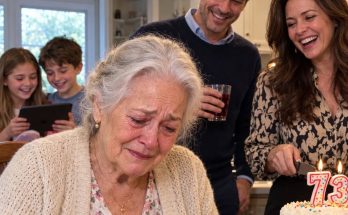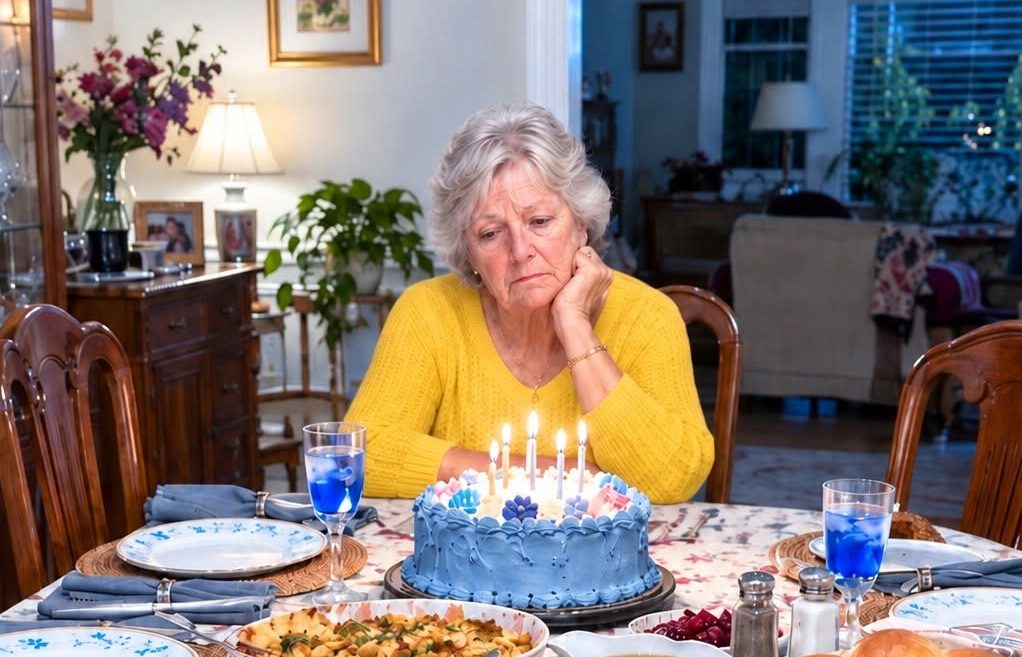
PART 1: THE BIRTHDAY NOBODY CAME TO I spent four painful hours waiting for my six children to arrive for my 60th birthday dinner. Not one of them showed up. None answered my calls.
By nine o’clock, I was sitting alone beside six untouched plates when three sharp knocks interrupted the silence.
A police officer stood outside, holding a folded note.
The moment I saw the handwriting, my hands began trembling.
It belonged to my fourth son, Grant.
And the message inside made me fear that something terrible had happened.
My name is Linda Henderson. I was sixty years old, and for most of my life, I had believed that being a mother meant giving everything you had without expecting anything in return.
I had six children.
Michael, my oldest, was forty-one. Sarah was thirty-nine. Daniel was thirty-six. Grant was thirty-three. Emily was thirty. And my youngest, Lucas, was twenty-seven.
They were my entire world.
When I was younger, my husband, Robert, dreamed of having a big family.
“Imagine all those children running around,” he used to say, resting his hand on my pregnant stomach. “Our house will never feel lonely.”
For a while, his dream became our beautiful reality.
Our little house was always noisy. Someone was always crying, laughing, arguing, or asking what was for dinner.
I remember birthday parties with homemade cakes, Christmas mornings with wrapping paper everywhere, and Sunday afternoons when all six children piled onto the living-room floor to watch television.
We weren’t wealthy, but we were happy.
At least, I thought we were.
Then, when our youngest was barely four, everything changed.
Robert became involved with another woman who lived overseas. At first, he claimed she was just a business acquaintance. Then he began traveling more frequently.
One afternoon, he came home, packed a suitcase, and told me he wanted a different life.
I still remember standing in the kitchen, holding a dish towel.
“What about the children?” I asked.
He didn’t even look at them.
“They’ll understand when they’re older.”
Then he walked out.
I was left with six young children, a mortgage, unpaid bills, and almost no savings.
I didn’t have the luxury of falling apart.
The following morning, I went to work at the supermarket. I stocked shelves during the day and cleaned office buildings at night.
Sometimes I slept only three hours.
I learned how to repair broken appliances because I couldn’t afford technicians. I learned to stretch one chicken into three meals. I learned to sew holes in school uniforms and turn old curtains into kitchen towels.
There were winters when I wore the same coat for five years because buying a new one meant taking money away from groceries.
But my children never went without birthday celebrations.
Even when I had barely enough money for electricity, I baked their favorite cakes.
I wanted them to grow up believing that they were loved, even if their father had chosen to leave.
Michael needed braces, so I took extra shifts.
Sarah wanted to attend a school trip, so I sold my wedding bracelet.
Daniel struggled with reading, so I spent evenings sitting beside him until he finally gained confidence.
Grant was the most sensitive. Whenever the other children teased him, he came to my bedroom and climbed onto my lap.
“Mom, promise you’ll never leave me.”
I would kiss his forehead.
“I promise, sweetheart. No matter what happens, I’ll always be here.”
Emily loved drawing, and Lucas was the baby who followed me everywhere.
I gave them everything I had.
And I never regretted it.
Years passed.
My children grew up, graduated, found careers, married, and started families of their own.
Michael became a real estate manager. Sarah became a nurse. Daniel started his own construction company. Grant worked as an electrician. Emily became a teacher, and Lucas found a job in software development.
I was proud of every one of them.
But somewhere along the way, something changed.
Sunday dinners became monthly visits.
Monthly visits became occasional phone calls.
Then even those calls became shorter.
“Mom, I’m busy.”
“Mom, we’ll come next weekend.”
“Mom, the children have activities.”
“Mom, can we talk later?”
I tried to understand.
I told myself this was simply what happened when children became adults.
Still, sometimes I sat alone in the kitchen looking at the family photographs and wondering when our noisy house had become so quiet.
Then my sixtieth birthday approached.
I didn’t want a party at a restaurant.
I didn’t want expensive jewelry or a vacation.
I wanted one thing.
All six of my children sitting around my dining table.
So, three weeks before my birthday, I created a family group message.
“Children, my sixtieth birthday is coming up. I would really love to have everyone home for dinner. No presents. No expensive arrangements. Just one evening together. Please tell me you can come.”
Michael replied first.
“Of course, Mom. Wouldn’t miss it.”
Sarah sent a heart.
Daniel wrote, “Count me in.”
Grant replied, “I’ll be there early to help.”
Emily sent several balloons.
Lucas wrote, “Love you, Mom. Save me some pie!”
I read those messages over and over.
For the first time in years, I felt like the little girl inside me had received something wonderful.
For two days before the celebration, I prepared everything.
I made roast chicken with rosemary because Michael loved it.
I prepared Sarah’s favorite mashed potatoes with garlic.
I cooked Daniel’s favorite beef stew.
I made Grant’s favorite macaroni and cheese.
I baked Emily’s apple pie with extra cinnamon.
And I prepared a chocolate cake for Lucas.
I even polished the old dinner plates I had inherited from my mother.
Six children.
Seven chairs, including mine.
I arranged everything carefully.
I bought fresh flowers and placed them in the center of the table.
At four o’clock, the house smelled wonderful.
At five, I changed into a blue dress I had purchased especially for the occasion.
I put on my mother’s pearl earrings and looked at myself in the mirror.
“Sixty years old,” I whispered. “And still lucky enough to have six beautiful children.”
At 5:30, I sent another message.
“Everything is ready! Drive safely. I love you all.”
Nobody responded.
At six, I called Michael.
Straight to voicemail.
I called Sarah.
No answer.
Daniel’s phone rang several times before going to voicemail.
I called Grant.
Nothing.
Emily didn’t pick up.
Lucas’s phone was switched off.
I tried the family group again.
“Is everyone okay? What time should I expect you?”
Silence.
At seven, I reheated the food.
At 7:30, I checked the driveway.
At eight, I lit the birthday candles.
There were sixty of them, although I had to use several smaller candles because the cake wasn’t large enough.
I sang “Happy Birthday” to myself in a voice that barely sounded like mine.
Then I blew them out.
I made a wish.
I wished that my children would remember that I was still their mother.
At nine o’clock, I finally sat down.
Six untouched plates surrounded me.
The roast chicken was cold. The potatoes had formed a skin. The candles had burned down.
I covered my face with the napkin I had carefully ironed that morning.
I wasn’t crying because I hadn’t received a birthday present.
I was crying because I had spent decades making sure my children never felt forgotten.
And now I felt completely forgotten myself.
Then came three firm knocks.
I hurried toward the door.
For one foolish second, I thought it might be Michael or Sarah.
But when I opened it, a young police officer stood on my porch.
“Are you Mrs. Linda Henderson?”
“Yes. Is something wrong?”
He looked at a piece of paper in his hand.
“Ma’am, I’ve been asked to deliver this to you.”
He handed me a folded note.
One word was written across the front.
Mom.
I recognized the handwriting immediately.
Grant.
My fourth child.
My fingers began trembling.
I unfolded the paper.
There were only three sentences.
“Mom, don’t call anyone. Don’t ask questions. Please trust the officer and go with him.”
I looked up.
“Officer, is my son safe?”
The young man hesitated.
“Your son will explain everything when we arrive.”
“Has something happened to him?”
“I can’t discuss the details here, ma’am. But I can assure you that your family is waiting.”
My heart began pounding.
“All six of them?”
He nodded.
I looked back at the dining room.
Six empty chairs.
Six plates.
A birthday cake nobody had touched.
I grabbed my coat, locked the front door, and followed him to the police vehicle.
As we drove away, I looked through the window at the glowing kitchen.
I believed I was leaving behind the saddest birthday of my life.
I had no idea that the place we were heading would reveal a secret involving all six of my children.
And when I finally understood why they had ignored every one of my calls, I would discover that the greatest surprise of my life had been waiting for years.
PART 2: THE SECRET BEHIND THE SIX EMPTY CHAIRS
The police vehicle drove for nearly forty minutes.
I recognized the roads as we left our neighborhood and entered the older part of town.
Finally, we stopped outside a large brick building.
It was the community center where my children had attended school events when they were young.
I stared at it through the windshield.
“Why are we here?”
The officer opened my door.
“Please come inside, Mrs. Henderson.”
I stepped out slowly.
The building was unusually quiet. Its front entrance was decorated with white flowers and small golden lights.
Then I noticed something strange.
A large sign stood beside the entrance.
It read:
HAPPY 60TH BIRTHDAY, MOM.
My breath caught.
Before I could say anything, the doors opened.
And there they were.
All six of my children.
Michael.
Sarah.
Daniel.
Grant.
Emily.
Lucas.
They stood together, smiling, but several of them had tears in their eyes.
For a moment, I couldn’t move.
Then I looked at Grant.
“You!”
I walked straight toward him.
“What happened? Why didn’t you answer my calls? Why did you send a police officer to my house?”
Grant stepped forward.
“I’m sorry, Mom.”
I pulled him into my arms.
Then I hugged Michael, Sarah, Daniel, Emily, and Lucas.
I couldn’t stop crying.
But there was something I didn’t understand.
“Why are you all here? Why did you let me sit alone for four hours? Do you have any idea what that felt like?”
Nobody answered immediately.
Michael finally stepped forward.
“Mom, we know. And we’re sorry.”
“Then explain.”
He looked toward Grant.
Grant nodded.
“Mom, tonight wasn’t supposed to happen the way it did. We planned something for you, but we needed you to believe you were coming here for another reason.”
I frowned.
“What reason?”
Daniel took a deep breath.
“Mom, eight months ago, we discovered something about Dad.”
The name made my stomach tighten.
“Your father?”
Sarah reached for my hand.
“Yes, Mom. We found out he had been trying to contact us.”
I stared at her.
“After all these years?”
Michael nodded.
“He contacted me first. He said he was getting older and wanted to reconnect with his children.”
I felt an old pain rise in my chest.
“What did he want?”
“At first, we thought he wanted forgiveness,” Daniel explained. “But then he started asking questions about the house.”
My house.
The small three-bedroom home where I had raised all six children.
I had worked for decades to pay off the mortgage.
It wasn’t luxurious, but it was mine.
“What about the house?”
Grant spoke quietly.
“Dad discovered that the property had increased significantly in value. He wanted to know whether you had transferred ownership to anyone.”
I shook my head.
“I don’t understand.”
Michael pulled a chair toward me.
“Mom, Dad has been telling people that you promised him half the property when he left.”
I almost laughed.
It was such an outrageous claim that I didn’t know what else to do.
“He abandoned us. He didn’t pay the mortgage. He didn’t send money for your school fees. He didn’t even call on Christmas for years. Why would I give him half my house?”
“That’s exactly what we asked,” Sarah said.
Daniel continued.
“He contacted a lawyer and claimed he had contributed to the original purchase. He even presented old documents suggesting that he still had an ownership interest.”
I felt cold.
“Can he take my house?”
“No,” Michael answered quickly. “We checked everything. The title is in your name, and the records support your ownership. But he was preparing to challenge it.”
I sat down.
For a moment, I couldn’t hear anything except the sound of my own breathing.
“Why didn’t you tell me?”
“Because we wanted to understand everything before frightening you,” Grant said.
“How long have you known?”
“About three months.”
Three months.
Three months of secrets.
Three months of conversations I hadn’t been part of.
Three months of my children apparently making plans without me.
I looked at them.
“Then why did you all ignore my birthday invitation?”
Emily stepped forward.
“Mom, we were organizing something else. We wanted tonight to be a surprise.”
“A surprise?” I repeated.
She nodded.
“There’s more.”
Lucas walked toward a small table near the stage.
On it sat a thick blue folder.
He picked it up and handed it to me.
Inside were photographs.
Photographs of our old house.
Photographs of the kitchen where I used to prepare school lunches.
Photographs of the backyard where the children had played.
And photographs of my children as babies.
I turned the pages slowly.
Then I found a photograph I hadn’t seen in years.
It showed all six children standing beside me in front of our old Christmas tree.
I was younger, thinner, and smiling.
On the back, someone had written:
The woman who gave us everything.
My eyes filled with tears.
“What is this?”
Daniel answered.
“It’s a project we’ve been working on for months.”
He pointed toward the stage.
A large screen lit up.
The first photograph appeared.
It showed our old kitchen.
Then another photograph appeared.
It was me carrying groceries home in the rain.
I recognized that day.
Michael had been sick, and I had walked nearly two miles because I couldn’t afford a taxi.
The next photograph showed me sleeping at the kitchen table beside a pile of schoolbooks.
I remembered that night too.
I had worked until midnight and stayed awake helping Sarah prepare for an examination.
Another photograph showed me holding Grant after he had fallen off his bicycle.
Then one of me standing outside the hospital with baby Emily.
The images continued.
My children had gathered photographs from relatives, old neighbors, school records, and family albums.
But the next part surprised me even more.
The screen displayed a letter.
It was written by my former neighbor, Mrs. Collins.
She had lived next door when the children were small.
The letter read:
“Linda was the kind of mother who made sure every child in the neighborhood had somewhere to go when things were difficult. I remember her working two jobs and still finding time to help other families. Her children were lucky, but I don’t think she ever understood how many lives she touched.”
I covered my mouth.
“Why are you showing me this?”
Grant took my hand.
“Because, Mom, we finally understand something we should have understood a long time ago.”
He paused.
“We grew up thinking you were simply our mother. We didn’t understand that you were also a person who was tired, frightened, and sometimes lonely.”
I began crying again.
Sarah continued.
“We became so busy building our own families that we forgot to ask whether you needed someone to sit with you.”
Emily wiped her eyes.
“We kept saying we would visit next weekend. Then another month passed. Then another.”
Michael lowered his head.
“And when you invited us for your birthday, we realized we had almost nothing planned for the woman who had given us everything.”
I looked at the six faces in front of me.
“But you still let me believe nobody was coming.”
Grant looked ashamed.
“We thought we could keep the surprise secret. We didn’t realize how much it would hurt you.”
I sat silently.
Then I noticed something else.
A small wooden box rested on the table.
My name was engraved across the lid.
Linda Henderson.
“What is that?”
Lucas smiled.
“That’s the real birthday present.”
I opened it.
Inside were six envelopes.
Each had one of my children’s names written on it.
Beneath them was a small silver key.
I looked at Michael.
“What does this key open?”
He smiled.
“Something we want you to see.”
He led me toward a door at the side of the stage.
When it opened, I stopped breathing.
The room beyond it had been transformed.
It was a beautiful apartment.
Not a huge one, but warm and bright.
There was a comfortable living room, a small kitchen, two bedrooms, and large windows overlooking a garden.
The walls were decorated with family photographs.
There was even a little reading corner with a comfortable chair and shelves of books.
I turned toward my children.
“Whose apartment is this?”
“Yours,” Daniel said.
I stared at him.
“Mine?”
Michael explained.
“We’ve been saving together for months. We found this place and purchased it as a family gift.”
“But why?”
Sarah smiled through her tears.
“Because you spent your entire life making sure we had a home. We wanted you to have a place where you could feel comfortable, safe, and loved.”
I couldn’t speak.
Then Grant pointed toward the hallway.
“There’s something else.”
At the end of the hall was a framed photograph.
It showed my children as adults, standing together.
Underneath it were six handwritten messages.
One from each child.
Michael wrote:
“Thank you for teaching me that responsibility means showing up.”
Sarah wrote:
“Thank you for caring for everyone, even when nobody noticed you needed care.”
Daniel wrote:
“Thank you for never giving up on me.”
Grant wrote:
“Thank you for answering my midnight calls, even when you were exhausted.”
Emily wrote:
“Thank you for teaching me that kindness is something we do, not something we talk about.”
Lucas wrote:
“Thank you for making home feel like home.”
I touched the frame.
Then I noticed a final envelope.
It was addressed to me.
But this handwriting was different.
Older.
I recognized it immediately.
Robert.
My ex-husband.
My heart sank.
“Where did you get this?”
Michael looked uncomfortable.
“Dad sent it to us several weeks ago. We didn’t know whether we should give it to you.”
I held the envelope.
“What does he want now?”
Grant answered.
“Please read it, Mom.”
I opened it carefully.
The letter was short.
“Linda,
I know I have no right to ask for anything after the way I left.
I have heard that the children have been trying to protect you from me. I deserve that.
I am not writing to demand your house or your forgiveness.
I am writing because I have been diagnosed with a serious illness, and I have spent too many years pretending that leaving you was the best decision I ever made.
It wasn’t.
I abandoned the best thing I ever had.
I would like to see you once, if you are willing.
Robert.”
I lowered the paper.
For several seconds, nobody spoke.
Then I asked the question that had been sitting in my heart.
“Does he know about tonight?”
Daniel nodded.
“He does.”
“Is he here?”
Grant looked toward the entrance.
“Yes, Mom. But we didn’t want him to come inside unless you wanted him to.”
I looked at my children.
I had spent thirty years raising them without their father.
And now, on my sixtieth birthday, I was being asked to decide whether I wanted to see the man who had left us.
Before I could answer, someone knocked softly on the open doorway.
I turned.
And there he was.
Robert.
Older.
Thinner.
His hair was almost completely gray.
He was holding a small bouquet of flowers.
For the first time in thirty years, my husband stood in front of me.
“Happy birthday, Linda,” he whispered.
I couldn’t move.
Then he said something that made all six of my children fall silent.
“There’s something else you need to know about the night I left.”
PART 3: THE TRUTH THAT CHANGED EVERYTHING
Robert stood in the doorway.
He looked nothing like the confident man I remembered.
His shoulders were bent, his face was pale, and his hands trembled slightly as he held the flowers.
I didn’t take them.
“Why are you here, Robert?”
He looked at the floor.
“Because I owe you the truth.”
I folded my arms.
“You owed me the truth thirty years ago.”
He nodded.
“I know.”
The room was completely silent.
Even my children seemed unsure what to say.
Robert slowly placed the flowers on a nearby table.
“When I left, I told myself I was choosing happiness. I convinced myself that the children would be better off without a father who no longer wanted to be married.”
I stared at him.
“That was your excuse?”
“No. It was selfishness.”
His voice cracked.
“The woman I left with eventually left me too. The life I thought I wanted didn’t turn out the way I imagined.”
I felt no satisfaction hearing that.
Only exhaustion.
He continued.
“I tried contacting Michael several years ago, but he refused to speak to me. Then I contacted Sarah. She told me I had no right to appear in her life after disappearing from yours.”
Sarah looked away.
Robert nodded.
“She was right.”
I looked at my children.
They had known more than I realized.
Robert continued.
“Recently, I received my diagnosis. I was frightened. I began thinking about everything I had lost.”
He paused.
“And I realized I had never thanked you.”
I almost laughed.
“Thanked me?”
“For raising our children. For keeping them together. For giving them a life when I walked away.”
I looked at him for a long moment.
“Robert, do you know what the hardest part was?”
He shook his head.
“It wasn’t the money. It wasn’t working two jobs. It wasn’t sleeping three hours a night.”
My voice began trembling.
“It was when one of the children got sick and asked where you were. It was when they had school performances and looked at the audience, hoping you might appear. It was when they cried themselves to sleep because they thought they hadn’t been good enough for you to stay.”
Robert covered his face.
“And every time they asked about you, I had to find a way to explain something I couldn’t understand myself.”
I took a breath.
“I never told them you were a terrible man. I never told them to hate you. I just told them that sometimes adults make choices they cannot take back.”
Tears ran down his cheeks.
“I don’t expect forgiveness.”
“Good,” I replied quietly. “Because forgiveness isn’t something you can demand.”
He nodded.
Then he looked toward our children.
“I also need to tell you why I contacted them about the house.”
My heart tightened.
“Go on.”
“When I became ill, I started thinking about my finances. I had been considering whether I could claim something from the property. I convinced myself that I had helped buy it before I left.”
Michael stepped forward.
“You told us you were going to challenge Mom’s ownership.”
Robert lowered his head.
“I did.”
“Why?” Daniel demanded.
Robert looked at me.
“Because I was afraid of running out of money. I thought I deserved something.”
I stared at him.
For a moment, I saw the man who had walked away from six children without looking back.
Then I saw an old, frightened man who had finally realized the consequences of his decisions.
But that didn’t erase what he had done.
“Did you understand what you were trying to take?” I asked.
He nodded.
“I understand now.”
“No, Robert. That house wasn’t just a building. It was where I raised your children. Every payment came from my work. Every repair came from my hands. Every birthday candle was lit there.”
I pointed toward my children.
“You left us with six children and a mortgage. I paid for that house with years of my life.”
He began crying.
“I know.”
“And you thought you could come back and claim half?”
“I was wrong.”
He reached into his coat and removed another envelope.
“I signed a legal statement withdrawing any claim I might have tried to make. I also instructed my attorney to leave the matter alone. I don’t want to take anything from you.”
He handed the envelope to Michael.
My oldest son examined it.
“It appears to be properly signed,” he said.
I nodded slowly.
Then I looked at Robert.
“Thank you for finally doing the right thing.”
He seemed relieved, but I wasn’t finished.
“I hope you receive the care you need. I hope you find peace. But I cannot pretend that thirty years of absence disappear because you brought me flowers.”
“I understand.”
“And if you want a relationship with your children, you will have to earn their trust. Not mine. Theirs.”
Robert nodded.
“I understand.”
He stepped back toward the door.
Then Grant called after him.
“Wait.”
Robert turned.
Grant walked toward him.
“I used to wait for you every Friday.”
Robert’s face crumpled.
“I know.”
“No, you don’t. I would sit by the window until Mom told me it was time to go to bed. I thought maybe you had forgotten the way home.”
Grant swallowed.
“I don’t hate you anymore. But I can’t pretend you were there when you weren’t.”
Robert nodded, unable to speak.
Grant returned to my side.
I took his hand.
And Robert quietly left.
For a few moments, nobody moved.
Then Lucas broke the silence.
“Mom, there’s one more thing.”
I turned toward him.
He smiled.
“Your birthday dinner.”
I almost laughed.
“My dinner?”
“Yes. We brought everything here. Your favorite dishes are in the kitchen.”
I looked at the clock.
It was nearly midnight.
“You’re telling me I missed my own birthday dinner twice?”
Everyone laughed.
For the first time that evening, the sound of laughter filled the room.
Michael helped me sit at the center of a long dining table.
Sarah brought out the roast chicken.
Daniel carried the potatoes.
Grant placed the macaroni and cheese in front of me.
Emily brought the apple pie.
Lucas appeared with the chocolate cake.
And there were six chairs around me.
This time, none were empty.
Before we began eating, Michael stood.
“I want to say something.”
He raised his glass.
“To Mom. The woman who worked two jobs, raised six children, never complained about what she didn’t have, and somehow made us believe we had everything.”
Sarah began crying.
Daniel raised his glass.
“To the woman who taught us that family isn’t about how much money you have. It’s about who shows up.”
Grant added:
“To Mom, who never stopped answering her phone, even when she was exhausted.”
Emily smiled.
“And to the woman who deserves to be celebrated more than once a year.”
Lucas lifted his glass.
“Happy birthday, Mom.”
I looked around the table.
Six grown children.
Six families.
Six people I had once carried in my arms.
I couldn’t stop crying.
But these were different tears.
They were not the tears of a woman who had been forgotten.
They were the tears of a woman who had finally been seen.
Then Michael placed another document in front of me.
“Mom, we also discussed something important.”
I looked at the paper.
It was a schedule.
Not a financial document.
Not a legal agreement.
A family calendar.
Every Sunday had a name beside it.
Michael and his family would visit the first Sunday of every month.
Sarah and her children would come the second.
Daniel would host dinner on the third.
Grant would spend Saturday mornings helping with anything I needed.
Emily would take me to her favorite places on the fourth weekend.
Lucas had reserved one evening every week for a phone call.
I looked up.
“What’s all this?”
Sarah smiled.
“We don’t want you waiting for us anymore, Mom.”
Daniel added, “We know we can’t give back the years we missed, but we can stop wasting the years we still have.”
I touched the calendar.
“You don’t have to schedule your lives around me.”
Michael shook his head.
“We aren’t doing it because we have to. We’re doing it because we want to.”
Then Grant leaned toward me.
“And Mom, there’s one more thing.”
I laughed.
“Another surprise?”
He smiled.
“Actually, yes.”
He reached into his pocket and handed me a small envelope.
Inside was a photograph.
It showed the seven of us standing outside my old house.
But there was something different about the picture.
It had been taken only a few days earlier.
On the back, Grant had written:
You spent sixty years making sure we always had somewhere to come home to. From now on, we’ll make sure you never have to feel alone.
I held the photograph against my chest.
That night, I finally understood something.
I had spent so many years believing that a good mother was someone who gave everything without asking for anything.
I thought that if I worked hard enough, sacrificed enough, and loved enough, my children would never feel the pain of being abandoned.
But somewhere along the way, I had forgotten that mothers grow older too.
They need phone calls.
They need visits.
They need someone to ask whether they have eaten dinner.
They need to know that their presence matters.
And they need to feel remembered.
A few weeks later, my children organized another dinner at my house.
This time, I didn’t spend two days cooking.
Michael brought the chicken.
Sarah brought the potatoes.
Daniel brought dessert.
Grant arrived early to help set the table.
Emily brought flowers.
Lucas brought a cake.
We sat around the same old dining table where I had once served six hungry children after long days at work.
The chairs were no longer empty.
There was noise again.
There was laughter.
There were grandchildren running through the hallway.
And when I looked around the room, I realized that the house finally felt like home again.
Robert eventually began speaking with the children occasionally. He attended a few family gatherings when they invited him, but he never returned to my life as a husband. Some wounds can heal without everything going back to the way it was.
I didn’t need to hate him.
I didn’t need to pretend the past never happened.
I simply chose to protect the peace I had worked so hard to build.
On my sixty-first birthday, Grant arrived first.
He carried an apple pie with extra cinnamon.
“Happy birthday, Mom.”
I laughed.
“You remembered.”
He looked surprised.
“Of course I remembered.”
Then he hugged me.
One by one, the others arrived.
And before dinner, Michael placed a small gift beside my plate.
It was a framed photograph of the seven of us.
Underneath it were five words:
SHE WAS OUR HOME FIRST.
I cried when I read them.
Because for thirty years, I had worried that my children would forget the sacrifices I made.
But that wasn’t what mattered most anymore.
What mattered was that we had finally learned to show love while we still had time.
That night, I made one more wish before blowing out my candles.
I didn’t wish for money.
I didn’t wish for a bigger house.
I didn’t wish for another thirty years.
I wished that every parent who spent their life loving their children would one day feel that love returned.
And if there is one thing I want people to remember from my story, it is this:
Don’t wait for your parents to become old before you start making time for them.
They may tell you they are fine.
They may say they don’t need anything.
They may tell you not to worry about visiting.
But sometimes, what they really want is something money cannot buy.
A familiar voice.
A knock at the door.
A seat filled at the dinner table.
And someone saying, “Mom, I came because I wanted to see you.”
Because one day, you may wish you had made that visit.
And one day, the person waiting by the window may no longer be there.
The greatest birthday gift Linda received wasn’t the apartment, the flowers, or the expensive surprises. It was discovering that her children still wanted to come home.
And from that day forward, nobody in the Henderson family ever allowed another birthday to pass without gathering around her table.
THE END.
If Linda’s story touched your heart, please share it with someone who needs the reminder. ❤️
And follow our page for more emotional family stories, unexpected secrets, and powerful life lessons.