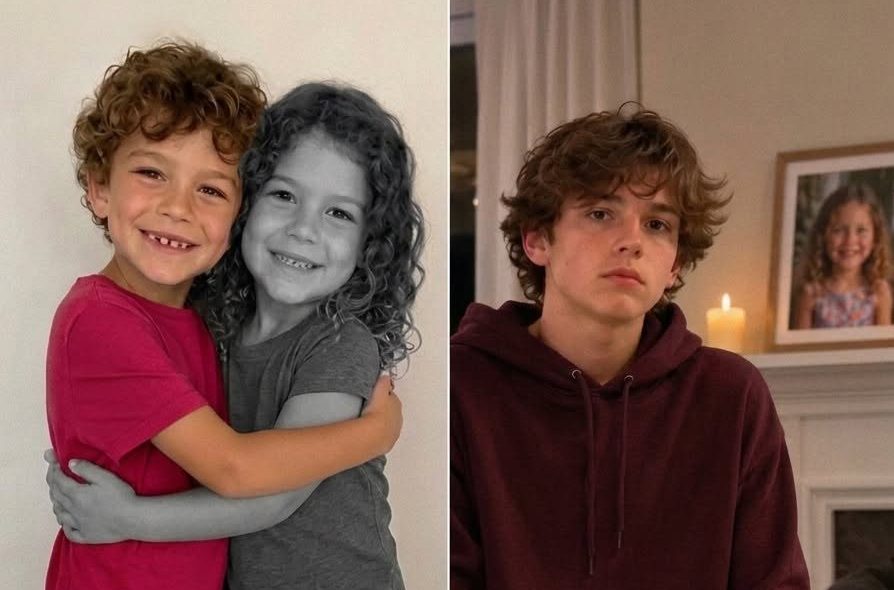
And I I couldn’t breathe. For eight years, I had dreamed of hearing my son’s voice again. I had imagined a thousand different first words. Mama. I love you. I’m hungry. Anything.
But never those four words.
“Jeremy?” I whispered.
He didn’t look at me.
His eyes remained fixed on his father.
Richard slowly lowered his glass.
“What did you say?”
Jeremy swallowed. His lips trembled. His voice sounded unfamiliar, rough from years of disuse.
“I said you’re lying.”
Richard pushed his chair backward.
“That’s enough.”
But Jeremy didn’t stop.
“You didn’t try to save her.”
The room became so quiet that I could hear the refrigerator humming in the kitchen.
My husband stood.
“He’s confused. He’s been through a lot. Janice’s death—”
“Don’t say her name.”
Jeremy’s voice cracked.
Richard stopped.
For the first time in eight years, I saw something in my son’s expression that I had never seen before.
Not grief.
Not sadness.
Fear.
But beneath the fear was something stronger.
Anger.
“Jeremy, sweetheart,” I said, moving closer. “What are you talking about?”
He finally turned toward me.
His eyes filled with tears.
“Mom, I saw him.”
My heart began pounding.
“Saw who?”
He pointed at Richard.
“Dad.”
Richard shook his head.
“No. No, this isn’t happening.”
Jeremy continued.
“That day at the lake. I saw everything.”
My mother covered her mouth.
I felt my knees weaken.
“Jeremy, what did you see?”
He closed his eyes.
And suddenly, my eight-year-old memories came flooding back.
The police officers at our door.
The wet clothes.
Richard’s shaking hands.
His story about the current.
The endless questions.
The empty coffin.
The funeral where my little boy stood without making a sound.
For eight years, I had believed my husband.
For eight years, I had believed that a terrible accident had taken my daughter.
Now my son was telling me something else.
“Tell me,” I whispered.
Jeremy looked at his father.
“He took Janice behind the old boat house.”
Richard slammed his hand against the table.
“STOP!”
Jeremy flinched.
I stepped between them.
“Don’t you dare shout at him!”
Richard stared at me.
“Janice drowned. You know that. We all know that.”
Jeremy shook his head.
“No.”
He reached into his pocket.
His fingers were trembling.
Then he placed something on the table.
A small, faded pink hair clip.
I recognized it immediately.
Janice had worn it almost every day.
It was shaped like a butterfly, with one wing slightly broken.
I had searched for that hair clip after the accident. I remembered asking the police whether they had found it.
They hadn’t.
I picked it up.
“Where did you get this?”
Jeremy’s eyes filled again.
“I kept it.”
“Where?”
“In my room.”
I looked at him.
“For eight years?”
He nodded.
“Why didn’t you show me?”
His lips trembled.
“Because Dad told me not to.”
Richard moved toward the door.
My father stood up.
“Richard, sit down.”
“I don’t have to explain myself to anyone.”
My father stepped into his path.
“You will tonight.”
Richard looked around the room, searching for someone who would defend him.
Nobody moved.
Then Jeremy spoke again.
“There’s something else.”
He reached into his pocket and pulled out a small folded piece of paper.
It was yellow with age.
The handwriting was unmistakably Janice’s.
I unfolded it.
There were only seven words.
Mom, if something happens, ask Daddy.
My vision blurred.
I read it again.
Then again.
“What does this mean?” I whispered.
Jeremy began crying.
“I found it in her backpack after we came home.”
Richard’s face had turned completely white.
“That’s not what you think.”
I looked at him.
“Then tell me what it means.”
He said nothing.
For the first time since I had known him, my husband looked like a stranger.
Jeremy wiped his cheeks.
“Mom, there’s a reason I stopped talking.”
I reached for his hand.
“What reason, baby?”
He looked down at the pink hair clip.
“Because Dad came into my room that night.”
My stomach tightened.
“What did he do?”
Jeremy took a shaky breath.
“He told me that if I ever told anyone what happened at the lake, you would disappear too.”
I felt something inside me break.
Richard started shaking his head.
“He’s making this up. He’s been traumatized. You can’t believe—”
“ENOUGH!” I screamed.
It was the first time I had ever shouted at my husband like that.
Jeremy grabbed my hand.
Then he whispered something that changed everything.
“Dad didn’t lose Janice in the water, Mom.”
He looked directly at Richard.
“He left her there.”
And Richard finally began to cry.
But he wasn’t crying like a grieving father.
He was crying like a man who had just realized that his secret was no longer buried.
PART 3: THE SECRET BURIED BENEATH THE OLD BOATHOUSE
Nobody slept that night.
Richard locked himself in the bedroom.
I stayed downstairs with Jeremy.
For hours, I sat beside him on the couch, holding his hand as though he were still the little boy who used to crawl into my bed after a nightmare.
“Why didn’t you tell me?” I finally asked.
He stared at the floor.
“I wanted to.”
“Then why?”
“Because he said you’d die.”
I pressed my hand against my mouth.
Jeremy continued slowly.
“He said accidents happen. He said nobody would believe me because I was little. He said if I talked, he’d tell everyone I pushed Janice into the water.”
“Oh, sweetheart.”
I pulled him into my arms.
He began sobbing.
Not the silent crying I had seen throughout his childhood.
This was different.
It was the sound of eight years of terror finally escaping a child’s body.
“I tried to tell you,” he whispered. “So many times.”
I held him tighter.
“I know. I’m sorry.”
“I thought if I stayed quiet, he’d leave you alone.”
I couldn’t speak.
At thirteen, my son had carried a responsibility that should never have belonged to a child.
He had believed that his silence was protecting me.
And I had mistaken that silence for grief.
“Tell me what happened at the lake,” I said gently.
Jeremy took a long breath.
Then he began.
Eight years earlier
It had been a warm Saturday afternoon.
Richard had promised the twins a day at the lake.
Janice had been excited since breakfast.
She wore her yellow dress, white sandals, and the little pink butterfly clip.
Jeremy remembered everything.
They had brought sandwiches.
Richard had rented a small boat.
At first, everything was normal.
The twins played near the water while Richard unloaded the cooler.
Then Janice wandered toward the old boathouse.
Jeremy followed her.
He remembered hearing voices.
His father was arguing with Janice.
He couldn’t understand everything, but he remembered his sister crying.
Then he heard Richard say:
“You’re going to ruin everything.”
Janice answered:
“I’m telling Mom.”
Jeremy said he had hidden behind a stack of wooden boards.
He was too frightened to move.
Then Richard grabbed Janice’s arm.
She struggled.
There was a loud splash.
Jeremy ran toward the water.
He saw Janice in the lake.
She was reaching for the wooden edge.
“Daddy!” she screamed.
Jeremy said Richard stood there for several seconds.
Then he looked around.
He didn’t jump in.
He didn’t reach for her.
He simply watched.
Jeremy started running toward the water, but Richard caught him.
“Stay here!”
Jeremy fought against him.
“She’s drowning!”
Richard held him so tightly that Jeremy couldn’t move.
Then, after what seemed like forever, Richard finally entered the water.
But he didn’t reach the place where Janice had disappeared.
He returned alone.
When he came out, he told Jeremy:
“Your sister slipped.”
Jeremy cried.
“Go get her!”
Richard shook him.
“Listen to me carefully. You saw nothing.”
Then he looked at his son.
“If you tell your mother, she’ll lose you too.”
Jeremy said that was the moment he stopped feeling like a child.
He was five years old.
And he believed his father could make his mother disappear.
The evidence
When Jeremy finished, I could barely sit upright.
I wanted to run upstairs and confront Richard.
I wanted to scream.
I wanted to ask why.
But my son wasn’t finished.
“There is something else, Mom.”
He stood and walked toward the stairs.
I followed him to his bedroom.
He opened the bottom drawer of his desk.
Inside was a small wooden box.
He removed several drawings, an old photograph, and a folded newspaper clipping.
Then he showed me a tiny digital recorder.
“What’s this?”
“Grandpa gave it to me.”
I remembered my father giving Jeremy an old recorder for his tenth birthday. He had said it might help him express himself.
I had assumed Jeremy never used it.
He nodded.
“I started recording things because I couldn’t tell anyone.”
My hands trembled.
“Can I listen?”
He nodded again.
I pressed the button.
At first, there was only static.
Then I heard Richard’s voice.
“Nobody can ever know what happened.”
Another voice answered.
My husband’s brother, Daniel.
“What about the boy?”
Richard replied:
“He won’t talk. I’ve made sure of that.”
I stopped breathing.
The recording continued.
Daniel asked:
“And the girl?”
Richard’s voice became quieter.
“She’s gone. There’s nothing we can do now.”
Then the recording ended.
I sat on the edge of Jeremy’s bed.
I had spent eight years believing that my husband was a grieving father.
But there had been conversations.
Secrets.
Warnings.
And my son had been listening to them alone.
I hugged Jeremy.
“Why didn’t you give me this before?”
He looked at me.
“Because I didn’t know if it was enough.”
“It is enough to make us ask for the truth.”
He shook his head.
“No, Mom. There’s more.”
He pulled another object from the box.
A small silver key.
“What’s that?”
“Janice gave it to me.”
I stared at him.
He explained that, before the lake trip, Janice had found a key in their father’s desk.
She had told Jeremy it opened something near the old boathouse.
He had kept it because it was the only thing his sister had given him that day.
I looked at the key.
And suddenly, I remembered something.
The police had never searched the old storage room behind the boathouse.
Richard had told them it was locked and unsafe.
The next morning, I called the police.
I also called my father.
And for the first time in eight years, I told someone that I no longer believed my husband’s story.
The return to the lake
Two police officers arrived that afternoon.
Jeremy refused to leave my side.
Richard came downstairs when he heard the doorbell.
He looked at the officers.
Then at Jeremy.
Then at me.
“You’re making a terrible mistake,” he said.
I answered quietly.
“No. I made a terrible mistake eight years ago. I believed you without knowing the truth.”
One officer asked Richard to accompany them for questioning.
He protested.
But when they mentioned the recording and the handwritten note, his expression changed.
The old boathouse was searched later that day.
The silver key opened a small storage compartment beneath a damaged wooden cabinet.
Inside were old papers, a photograph, and a sealed envelope.
The envelope contained a letter.
It was written by Janice.
I recognized her uneven handwriting immediately.
The letter was addressed to me.
My hands shook so badly that the officer had to help me unfold it.
It read:
Dear Mommy,
Daddy gets angry when I ask him questions.
He says I should not tell you things about his work.
I don’t like when he shouts at Jeremy.
If I ever get lost, please remember I love you.
I love Jeremy too.
Love, Janice.
I pressed the paper against my chest.
My little girl had been frightened.
And I had never known.
The investigation continued for months.
The recordings, the letter, the conflicting statements, and Jeremy’s testimony led investigators to reopen the case.
Richard was questioned repeatedly.
His brother Daniel eventually admitted that Richard had told him a different version of the events years earlier.
But the most important evidence came from an old witness.
A fisherman who had been near the lake that afternoon.
He had seen Richard arguing with a little girl near the boathouse.
He had also seen the boy being held back.
He had never come forward because he had assumed the police knew everything.
Now, eight years later, he finally told them what he remembered.
The case was no longer considered a simple accident.
And Richard’s carefully maintained story began to collapse.
THE COMPLETE ENDING: THE DAY THE TRUTH FINALLY CAME HOME
Three months later, the police called me.
They had found new evidence.
I went to the station with Jeremy.
Richard had been arrested.
The investigation had established that his original account was false and that he had concealed crucial information about Janice’s disappearance.
The authorities were still working to establish exactly what happened during those final moments at the lake.
But one thing was now clear.
My daughter had not simply slipped away in an unfortunate accident.
Her father had lied about what he knew.
And he had spent eight years frightening a little boy into silence.
When I saw Richard during the proceedings, he looked older.
Smaller.
He tried to speak to me.
“Janice’s death was an accident,” he said.
I stared at him.
“You had eight years to tell the truth.”
He lowered his eyes.
“I was scared.”
I shook my head.
“You weren’t the only person who was scared, Richard.”
I looked toward Jeremy.
“You made a five-year-old boy carry your fear.”
Richard began crying.
But I no longer felt responsible for comforting him.
I walked away.
Jeremy’s second first word
The following weeks were difficult.
Jeremy began seeing a new therapist who specialized in childhood trauma.
There were days when he spoke freely.
Other days, he barely said anything.
His voice returned slowly, just as his trust did.
One afternoon, I found him sitting in the garden.
He was holding Janice’s photograph.
I sat beside him.
“Thinking about your sister?”
He nodded.
Then he looked at me.
“Mom?”
I smiled through my tears.
“Yes, baby?”
“Do you think she was scared?”
The question broke my heart.
I took his hand.
“I don’t know exactly what she felt in those final moments. But I know she loved you. And I know she knew you loved her.”
Jeremy looked down.
“I should have saved her.”
I immediately turned toward him.
“No.”
His eyes filled.
“I was right there.”
“You were five years old.”
“But I could have—”
“No, Jeremy.”
I held his face between my hands.
“Listen to me. You were a little boy. You were not responsible for what happened. You were not responsible for your father’s decisions. And you were never responsible for saving anyone from an adult who chose to do something wrong.”
He started crying.
I pulled him into my arms.
For a long time, neither of us spoke.
Then he whispered:
“I miss her.”
“I miss her too.”
“Can we still celebrate her birthday?”
“Every year.”
He nodded.
And then, for the first time in eight years, my son smiled when he said his sister’s name.
“Janice would have liked that.”
One final anniversary
A year later, I held our annual family gathering again.
The same house.
The same dining table.
The same photograph on the mantelpiece.
But something was different.
Richard was no longer part of our family celebrations.
My parents came.
My brother came.
A few close friends came.
And Jeremy sat beside me.
He had grown taller.
He was still quiet sometimes, but now his silence was his choice.
Not something forced upon him.
Not a prison.
Not a promise made out of fear.
Before dinner, he stood up.
Everyone turned toward him.
He held Janice’s photograph.
“I want to say something.”
My mother began crying before he even finished his sentence.
Jeremy looked around the room.
“I used to think talking about Janice would make everything worse.”
He paused.
“But not talking made me feel like she was disappearing.”
I reached for his hand.
He continued.
“I remember her laugh. I remember how she stole my toys. I remember how she always wanted the bigger piece of cake.”
Everyone laughed softly through their tears.
“She was annoying sometimes.”
His voice broke.
“But she was my best friend.”
He looked at the photograph.
“I wish I could tell her what happened. I wish I could tell her I tried. But I hope she knows I never forgot her.”
Then he turned toward me.
“Mom, I’m sorry I didn’t talk to you.”
I shook my head.
“Oh, sweetheart.”
He smiled faintly.
“You don’t have to be sorry.”
He nodded.
Then he placed the photograph back on the mantelpiece.
And for the first time in nine years, our family celebrated Janice’s life without being afraid of the truth.
The letter I found years later
Several years passed.
Jeremy grew into a thoughtful young man.
He loved reading, studied hard, and eventually began volunteering with children who had experienced trauma.
He never became a particularly talkative person.
But he learned that his voice mattered.
One afternoon, while cleaning his old bedroom, I found a small envelope tucked inside the wooden box.
It was addressed to me.
The handwriting was Jeremy’s.
I opened it carefully.
Dear Mom,
I know you sometimes wonder why I didn’t speak.
I want you to know that I heard you every night when you read to me.
I heard you when you told me you loved me.
I heard you when you cried in the hallway because you thought I couldn’t hear.
I wanted to answer.
I wanted to tell you that I loved you too.
But I was scared.
I thought my silence could keep you safe.
I know now that it couldn’t.
You saved me by listening when I finally found my voice.
And I think Janice would be happy that we can say her name again.
Love,
Jeremy.
I held the letter against my heart.
Then I looked at the photograph of my twins.
Two little faces.
Two little smiles.
One child whose life ended far too soon.
And another who had spent eight years believing he had to disappear inside himself to survive.
I had once thought the worst day of my life was the day I buried my daughter.
I was wrong.
The worst day was the day I realized my living child had been suffering beside me, and I hadn’t understood why.
But the most important day was the day he finally spoke.
Not because he accused his father.
Not because he revealed a secret.
But because he trusted me enough to tell the truth.
And that was something no one could ever take away from him again.
Sometimes children don’t need us to have all the answers. They need us to make them feel safe enough to ask the questions.
And sometimes, the bravest words a child can ever say are simply:
“Mom, I need you to listen.”
THE END.