ENDING I packed my entire life into two worn suitcases and a backpack that I had purchased from a thrift store down the street. River Valley State was two hours away by bus, but my parents did not offer
to drive me because they said they were too exhausted from the trip to Boston.
“Call us if you need anything at all,” my mother said while she hugged me in the driveway with one arm because she was busy holding a coffee mug.
I almost laughed at the empty offer because we both knew that I would never call them for help after what had happened in that living room. My father handed me an envelope, and for one brief and wild second, I hoped that he had changed his mind about my tuition.
When I opened it later at the bus station, I found two hundred dollars in cash and a note that told me to be smart with my emergencies. I kept the money because I was not a fool, but I tore the note into tiny pieces and watched them blow across the pavement.
I arrived at River Valley State under a gray and rainy sky with nothing but my luggage and a bank balance that made my stomach turn into knots. The campus was full of families carrying mini-fridges and mothers crying into their children’s shoulders, but I dragged my bags toward my housing alone.
Since the dorms were too expensive, I had rented a tiny room in an old house where the stairs sagged and the kitchen always smelled like burnt onions. My room was barely large enough for a mattress and a desk, and the floor slanted so much that my chair rolled away if I didn’t wedge a book under the wheels.
My alarm went off at four-thirty every morning so that I could unlock the doors of a campus cafe called Morning Current by five o’clock. I learned how to make complex latte orders while my brain was still half-asleep and my feet were already beginning to throb from the standing.
“Double oat latte with extra heat for the lady in the red coat,” I would say with a forced smile while the steam burned my skin.
Classes filled the rest of my days, and I sat in the front row of every economics lecture and statistics lab as if my life depended on every word. I could not afford to skip a single session because I was paying for every minute of my education with my own sweat and exhaustion.
On the weekends, I took shifts cleaning the residence halls and scrubbing bathrooms after parties because I had learned that humiliation has no power when the rent is due. There were days when I felt strong and capable, but there were many more days when I felt like a machine held together by caffeine and pure panic.
I found out that the third floor of the library was the quietest place to study after nine o’clock and that the vending machines sometimes gave out free snacks if you hit them just right. I never told my parents about the struggle because I knew they would only use my hardship as proof that I had made a poor choice.
“We told you that this would be difficult for you,” I could almost hear my father saying in his calm and judgmental voice.
When Thanksgiving arrived, the campus emptied out almost overnight as students headed home to their families in cars filled with laundry and laughter. I stayed behind in the cold and quiet house because a bus ticket back to Minneapolis was a luxury that I simply could not justify.
I called home on Thanksgiving afternoon and heard the sound of bright laughter and clinking glasses in the background of the kitchen.
“Happy Thanksgiving, honey,” my mother said in a way that made me feel like an item she had forgotten to pick up from the grocery store.
“Can I speak to Dad for a moment?” I asked while looking at the cup of instant noodles that sat on my scarred wooden desk.
I heard her move the phone away and tell my father that I was on the line, but his muffled voice replied that he was too busy carving the turkey.
“He will have to call you back later because he is right in the middle of dinner,” my mother lied as she returned to the phone.
He did not call me back that night, and when I opened my social media, I saw a photo of the three of them sitting at a table lit by expensive candles. Brooke was wearing a new sweater and my father had his arm around her while they both smiled for the camera.
I counted only three plates on the table and stared at the image until my phone screen went dark and the silence of my room felt heavier than ever. My second semester was even more of a grind as the coursework became harder and my body began to give in to the constant lack of sleep.
One morning at the cafe, the room suddenly tilted and the sound of the espresso machine narrowed into a long and dark tunnel. I tried to grab the counter but missed, and the next thing I knew, my manager Brenda was kneeling on the floor in front of me with a look of deep concern.
“You just fainted in front of a dozen customers, Maya,” she said while handing me a glass of cold water.
“I am perfectly fine and I can get back to work right now,” I mumbled while trying to stand up despite the world spinning around me.
“You are not going back to work because you look like a ghost, and I am going to fire you if you don’t go home and sleep for ten hours,” Brenda threatened.
I went home and slept for fourteen hours straight, but I woke up feeling panicked about the wages I had lost during those hours of rest. That was the same semester I started taking an introductory economics class with a man named Professor Robert Maxwell.
He was a legendary figure on campus who was known for his brutal questions and his total lack of interest in students who did not put in the work. I admired him immediately because he was precise and brilliant, even though his red pen could slice through a weak argument in a matter of seconds.
I wrote a paper for his class about labor mobility and the hidden subsidies of family wealth, and I worked on it during every spare second I had between my shifts. I argued that merit was often a mask for privilege, and I used data to show how some students started the race with a massive head start.
When he returned the papers, I saw an A-plus at the top of my page, which was something I had never seen him give to anyone else before.
“Please stay after class for a moment, Miss Sullivan,” he said without looking up from his notes as the other students began to file out.
I approached his desk with my heart hammering against my ribs because I was afraid that he had found some sort of mistake in my calculations.
“This paper is exceptional work, but I want to know where you studied before you came to River Valley State,” he said while tapping the pages.
“I just went to a regular public high school in Minneapolis,” I replied while shifting my weight from one tired foot to the other.
He studied me for a long time with a patient silence that made me feel like I was under a microscope, but his gaze was not unkind.
“What kind of support do you have at home for your studies?” he asked in a voice that was surprisingly gentle.
“I do not have any support because my parents are not involved in my education at all,” I admitted before I could stop myself.
He nodded slowly and asked me how many hours I worked each week, and when I told him the truth, his jaw tightened with a visible flash of anger.
“Why are you doing this the hard way?” he asked while leaning back in his chair.
“My father told me that my sister was a better investment and that I wasn’t worth the cost of a private university,” I said while the old shame washed over me.
Professor Maxwell did not look sorry for me; instead, he looked like he wanted to set something on fire, which was a reaction I had never expected.
“Do you know why your paper was so good?” he asked while pulling a thick folder out of his desk drawer.
“I assume it was because I followed your instructions,” I answered honestly.
“It was good because you understand effort as a reality rather than an inspirational slogan on a poster,” he said while pushing the folder toward me.
I saw the words Vanguard Fellowship on the cover and felt a wave of dizziness because I recognized the name of the most prestigious award in the country.
“I want you to apply for this because it supports students who show promise under significant constraints,” he said with a firm nod.
“I don’t think I can win something that big because I don’t have the right resume or the right background,” I argued while looking at the daunting paperwork.
“People like your sister are told the world belongs to them, but people like you are told to be grateful for the crumbs,” he said while looking me in the eye.
I carried that folder home like it was made of glass and left it on my desk for three days without having the courage to actually open it. On the fourth night, the rain was hitting my window so hard that I couldn’t sleep, so I finally sat down and started reading the application requirements.
It asked for a personal statement about a moment that changed how I understood myself, and I realized that I couldn’t write the usual polished lies that other students used. I wrote about the living room and the sound of my father’s calm voice and the way my mother looked at her lap while I was being discarded.
I wrote about the smell of espresso at five in the morning and the way my hands shook when I realized that I was completely on my own. Professor Maxwell helped me edit the draft, and he kept telling me to stop protecting the people who had not protected me when I needed them.
The recommendation letters from Brenda and my other professors were so kind that I cried into a sink full of dirty coffee mugs when I read them. I submitted the application on a Wednesday afternoon and felt a strange sense of peace as I watched the confirmation page load on the library computer.
Waiting for the results was its own kind of torture, but I kept my head down and continued cleaning bathrooms and making lattes while the weeks passed by. The email arrived at five in the morning while I was standing in the dark cafe waiting for the coffee to brew for the morning rush.
“Congratulations, Maya Sullivan, you have advanced to the finalist round,” the email read.
I leaned against the counter and laughed until I couldn’t breathe, and when Brenda found me, she started screaming with joy until the customers started knocking on the window. Professor Maxwell coached me for the interview in empty classrooms and forced me to speak with a confidence that I didn’t know I possessed.
“Confidence is not the same thing as arrogance, and you need to stop hiding your hard work as if it were a secret,” he told me during a practice session.
The interview was conducted over a video call with five serious people who asked me deep questions about economics and the meaning of true success.
“Success is not about proving my father wrong, because that would still make him the center of my story,” I told them at the very end of the call.
I walked outside and sat on the grass feeling completely empty, but for the first time in my life, I felt like someone had truly seen the real me. The final decision came on a Tuesday morning in April while I was walking across the campus with a coffee that I had treated myself to for the first time in months.
“We are pleased to inform you that you have been selected as a Vanguard Fellow for the class of 2025,” the email stated in bold letters.
I sat down on a bench and pressed my hands against my face while the world continued to move around me as if nothing had changed. The fellowship covered everything, including my tuition and a living stipend that meant I could finally stop scrubbing floors and start focusing on my future.
Professor Maxwell told me that I could choose to spend my final year at any of the partner universities, and I saw Oakwood University on the list. I didn’t choose it for revenge, but I chose it because I didn’t want to avoid a place just because my family happened to be there.
I transferred to Oakwood in the fall of my senior year and walked onto the campus with my head held high and a gold medallion hidden under my coat. The school was beautiful and full of students who looked like they had never had a bad day in their lives, but I didn’t feel like I was out of place.
I avoided the areas where I knew Brooke spent her time because I wanted to have my own life for a while before the inevitable collision occurred. One Thursday evening in the library, I was studying near a window when I heard a familiar voice say my name with a tone of utter disbelief.
“Maya? How on earth are you here in this library?” Brooke asked while standing there with an iced coffee and a designer bag.
“I transferred here for my senior year,” I replied while calmly closing my textbook.
“Our parents never said a single word about this, and I don’t understand how you are paying for an expensive school like this,” she said while her face turned red.
“I won the Vanguard Fellowship, and they are paying for everything,” I explained while watching the shock register in her eyes.
She sat down across from me and looked like her world had been turned upside down because she knew exactly how prestigious that fellowship was.
“Why didn’t you tell us that you were doing so well?” she whispered.
“I wanted this achievement to be mine alone before I shared it with anyone else,” I said while standing up to gather my things.
My phone started vibrating as soon as I left the building because I knew that Brooke had already called our parents to tell them the news. I ignored the calls from my mother and the texts from my father because I was not ready to let them back into my life quite yet.
“Maya, you need to call us right now so we can talk about this,” my father’s text message read, but I turned my phone off and went to sleep.
He called me the next morning while I was walking between classes, and I decided to answer because I was no longer afraid of his calm and judgmental voice.
“Your sister tells me that you are at Oakwood and that you won a massive scholarship,” he said while sounding completely stunned.
“That is correct, and I did it all without your investment,” I replied while stepping under the shade of a large oak tree.
“I care about your future, Maya, and you should have told us that you were struggling so we could have helped you,” he lied.
“You told me that I wasn’t worth the money, and I remembered those words every single day for the last three years,” I said with a steady voice.
There was a long silence on the other end of the line as he realized that he could no longer use his logic to justify his past behavior.
“We will be there for graduation in a few months anyway, and we can talk about this in person,” he said before hanging up the phone.
I spent the rest of my senior year excelling in my classes and writing a thesis that won several awards within the economics department. In February, my advisor Dean Patricia Lowery called me into her office to tell me that I had been selected as the valedictorian for the entire university.
“You earned this through your own merit and hard work, and I am so proud to have you represent this class,” she said with a warm smile.
I did not tell my parents about the honor because I wanted them to find out when everyone else did during the commencement ceremony. On the morning of graduation, the sky was bright blue and the stadium was filled with thousands of people who were there to celebrate their children.
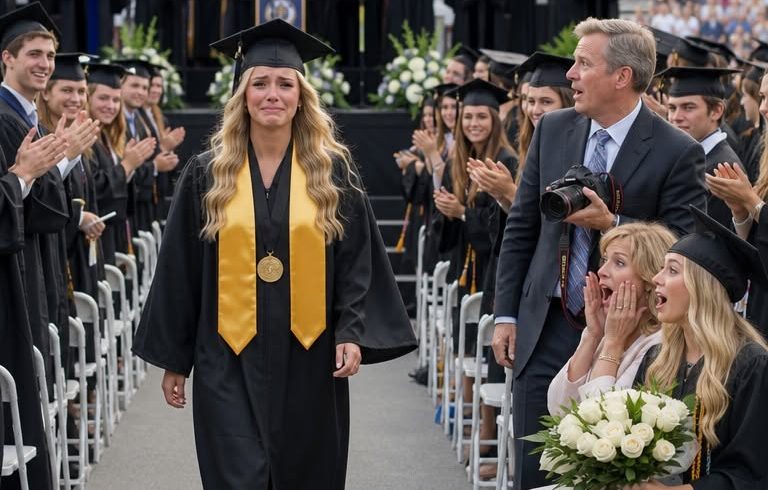
I saw my parents sitting in the front row with a bouquet of roses and an empty chair that was clearly being saved for Brooke’s friends. My father had his camera ready and my mother was smiling with pride, but they were still looking past the stage and toward the section where the graduates sat.
When the university president announced my name as the valedictorian, I saw the exact moment that the reality hit them like a physical blow. My father lowered his camera and my mother’s hand flew to her mouth as I walked to the podium in my black robe and gold honors sash.
“Four years ago, someone told me that I was not worth the investment,” I began while looking directly at the two people who had discarded me.
The stadium went silent as I told the story of my struggle and the lessons I had learned about worth and recognition being two very different things.
“Invisibility is not evidence of absence, and sometimes your strength is forming in rooms where no one is clapping for you,” I said to the crowd.
When I finished my speech, the entire stadium stood up to applaud, but my parents remained seated for a long time as if they were frozen to their chairs. After the ceremony, they approached me at the reception with looks of deep shame and regret that they couldn’t quite hide.
“I made a terrible mistake, and I am so sorry for what I said to you,” my father said while he struggled to look me in the eye.
“It was not a mistake, Dad, it was a decision that you made based on how you valued me,” I corrected him with a calm and firm voice.
My mother was crying and telling me how proud she was, but I realized that her pride was only appearing now that everyone else was clapping for me.
“I am moving to Philadelphia in two weeks to start a job as an analyst, and I need some space from this family for a while,” I told them.
“Are you cutting us out of your life forever?” my mother asked through her tears.
“No, but I am setting boundaries that you will have to respect if you want to have a relationship with me,” I explained before walking away.
I moved into a tiny apartment in Philadelphia and started a life that was entirely my own, and eventually, the letters and calls from my parents started to change. They stopped making excuses and started to actually apologize for the neglect and the way they had favored Brooke for so long.
Brooke visited me that winter, and we sat in a cafe trying to build a bridge between two sisters who had been treated like rivals for our entire lives.
“I didn’t realize how much it cost you to be the quiet one,” she said while holding a cup of coffee.
“I’m just glad that we are finally talking about it,” I replied while realizing that I didn’t have to carry the anger anymore.
My parents eventually came to visit me as well, and we had a dinner where the conversation was honest and painful but ultimately necessary for our healing. I realized that my father’s decision in that living room didn’t define my value, but it only revealed the limits of his own vision.
I am no longer waiting for their permission to be successful or their investment to be worthy, because I have already invested in myself and found that the return is infinite.
THE END.