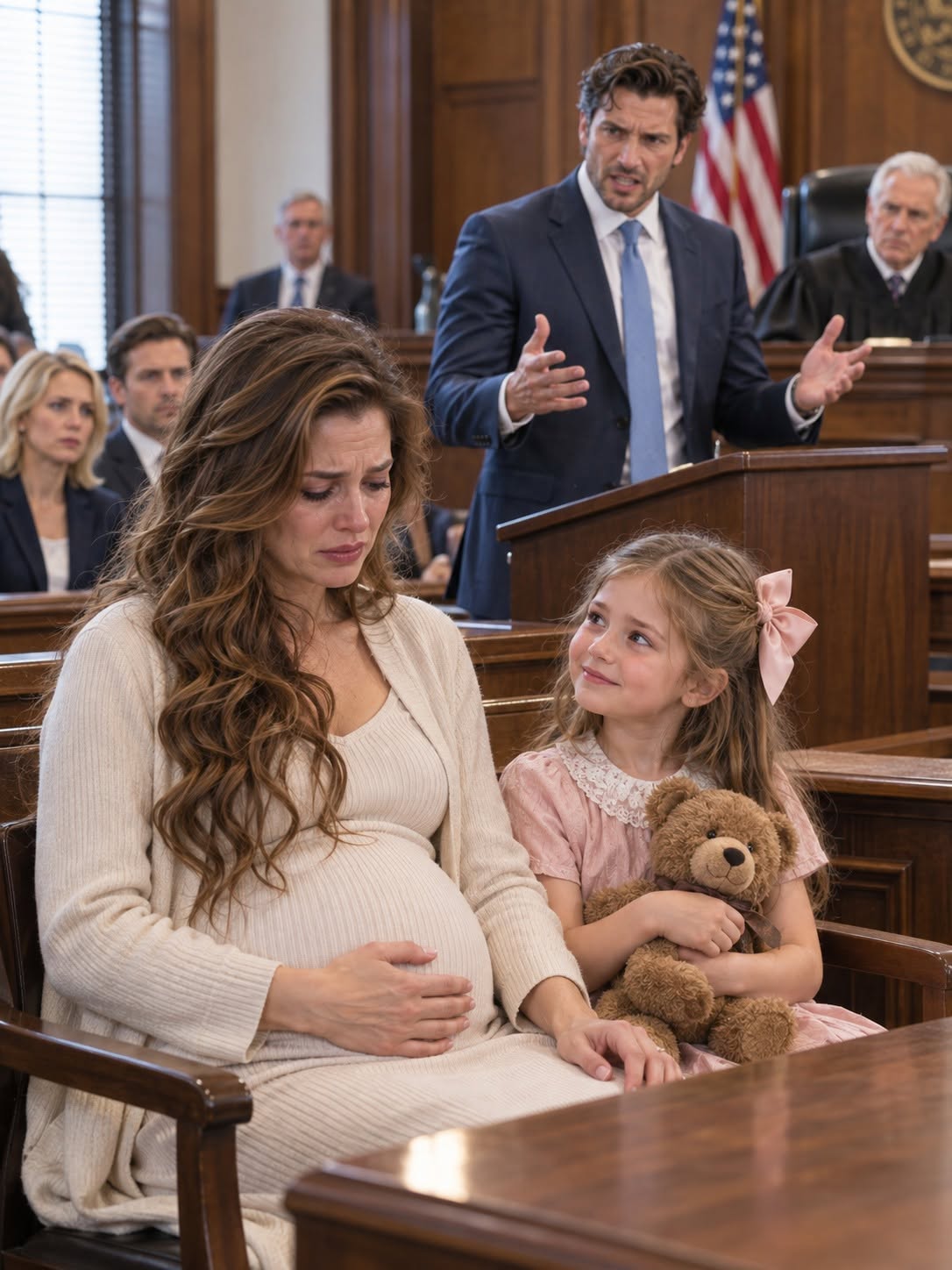
PART 1 — ROOM 302 The courtroom had become so quiet that I could hear the fluorescent lights buzzing above us. I stood beside my attorney with one hand resting over my eight-month-pregnant stomach.
Across the aisle sat my husband, Gabriel Albright.
His wedding ring was already gone.
Beside him sat Bianca Shepherd.
The woman he had been seeing behind my back.
She wore a dark burgundy dress, immaculate makeup, and an expression that told me she believed the difficult part was over.
I suppose I had helped create that impression.
Judge Rosalind Barrett looked down at the settlement proposal in front of her.
“Mrs.
Albright, this document indicates that you intend to waive any claim to the marital residence, the joint savings account, both vehicles, and any marital interest you may have in your husband’s business.”
My attorney, Samantha Croft, shifted beside me.
She had spent almost two weeks trying to convince me not to sign it.
I had stopped listening.
The affair had exhausted me.
The pregnancy had exhausted me.
The arguments had exhausted me.
Gabriel telling friends I had become emotional and unstable had exhausted me.
I wanted peace.
Nothing else.
“Yes, Your Honor.”
The judge did not look away.
“You understand what you are giving up?”
“Yes.”
Samantha stood.
“Your Honor, I want the record to reflect that my client is under considerable emotional stress, and I have advised her that—”
Judge Barrett lifted a hand.
“I understand, Ms. Croft.”
Then she looked at me again.
“I am asking Mrs. Albright.”
My throat tightened.
“I understand.”
“Why?”
I looked across the courtroom at Gabriel.
Then Bianca.
“I don’t want the house.”
Gabriel’s mouth tightened.
“I don’t want the savings.”
My voice remained quiet.
“I don’t want the car he drove to see her.
I don’t want money that disappeared while I was going to prenatal appointments alone.”
Bianca gave a short laugh.
Not nervous.
Cruel.
The judge’s eyes snapped toward her.
“Ms. Shepherd.”
Bianca covered her mouth.
“Sorry.”
“One more interruption and you will wait outside.”
Gabriel leaned toward Bianca and whispered something.
Then looked back at me.
I continued.
“I want the divorce.”
My baby shifted beneath my hand.
“And I want enough distance to have this child without spending the rest of my pregnancy fighting.”
Gabriel stood suddenly.
“This is exactly what she does.”
Judge Barrett’s expression hardened.
“Sit down.”
“She makes everything sound dramatic.”
“Mr. Albright.”
“She’s trying to make me look like some kind of monster.”
“Sit.”
He did.
I looked directly at him.
“You already took the part I cared about.”
For one second, even Bianca stopped smiling.
Then Judge Barrett closed the settlement folder.
“I am not approving this agreement today.”
I blinked.
Gabriel’s attorney rose.
“Your Honor?”
The judge looked toward the courtroom doors.
“Because something occurred immediately before we came on the record that this court cannot responsibly ignore.”
My stomach tightened.
Judge Barrett continued.
“A child was found crying in the hallway outside this courtroom.”
Gabriel’s face changed.
Completely.
And that was the first moment I understood that whatever was happening had nothing to do with the house.
PART 2 — DAISY
The child was Daisy.
Gabriel’s six-year-old daughter.
The little girl I had helped raise since she was three.
Her biological mother, Emma, had died after a serious illness when Daisy was two.
Gabriel and I met afterward.
We married when Daisy was three.
For the next three years, I packed her lunches.
Braided her hair badly until I learned.
Sat beside her bed through fevers.
Read the same rabbit book until I could recite it from memory.
She called me:
“Mommy Penelope.”
Gabriel allowed that when it made him look like we were a beautiful blended family.
During arguments?
He sometimes reminded me:
“You are not her mother.”
I had never forgotten how much those words hurt.
That morning, Gabriel had told me Daisy was at school.
“She doesn’t need to know anything about the divorce yet.”
I had agreed.
So when Judge Barrett said a little girl had been crying outside Room 302, my first thought was not Daisy.
Then the judge said:
“The child identified herself as Daisy Albright.”
I stopped breathing.
Gabriel leaned toward his lawyer.
Fast.
Urgent.
His attorney stood.
“Your Honor, I need a recess.”
The judge nodded.
“You’re going to get one.”
That surprised everyone.
No dramatic refusal.
No child marched immediately to the witness stand.
Judge Barrett looked toward both attorneys.
“This child will not be questioned in open court.”
Relief hit me first.
Then fear.
“Court services has already contacted the appropriate child-protection personnel.”
Gabriel stood halfway.
“How did she even get here?”
His attorney pulled him back down.
The judge continued.
“We are recessing this matter until we understand why a six-year-old child arrived at a divorce hearing in distress and what, if anything, she is trying to report.”
Bianca’s face had gone white.
I noticed.
So did Samantha.
PART 3 — HOW DAISY GOT THERE
We learned twenty minutes later.
Gabriel’s mother had picked Daisy up from school early.
Not because Gabriel asked.
Because Daisy had called her from the nurse’s office complaining of a stomachache.
She had heard Gabriel and Bianca arguing the night before.
She knew there was a court hearing.
She became frightened.
Gabriel’s mother, unaware of the details, drove Daisy downtown believing Gabriel could calm her before his hearing.
Instead, Daisy refused to go near him.
She slipped away from her grandmother near the courthouse vending machines.
A court clerk found her crying.
Daisy asked:
“Is the judge the lady who decides who gets to live at our house?”
That question triggered everything that followed.
PART 4 — NOT A WITNESS YET
Judge Barrett did not question her privately.
That would have created problems.
Instead, court services arranged for a child-protection investigator and a trained forensic interviewer to meet Daisy in a separate child-friendly room.
A guardian ad litem was contacted.
Both legal teams were informed.
Gabriel was told not to approach Daisy.
Neither was I allowed inside the interview.
At first, that hurt.
Then Samantha said:
“This is exactly how it should happen.”
I nodded.
Daisy did not need adults feeding her words.
Including me.
Especially me.
PART 5 — GABRIEL’S REACTION
Gabriel paced outside the courtroom.
“This is insane.”
His attorney whispered:
“Stop talking.”
“She’s six.”
“Gabriel.”
“She misunderstands everything.”
“Stop.”
ianca stood several feet away.
Arms folded.
Her mouth tight.
I watched her.
She would not look at me.
That frightened me more than if she had laughed again.
PART 6 — THE FIRST DISCLOSURE
Nearly an hour later, Samantha was called into a conference room.
She returned fifteen minutes after that.
Her face had changed.
“What?”
She sat beside me.
“Daisy reported overhearing Gabriel and Bianca discussing documents.”
My stomach dropped.
“What documents?”
“She doesn’t understand them.”
Samantha kept her voice precise.
“She described papers being put into the tea box in your kitchen.”
I stared.
My tea box.
Wooden.
Blue ceramic handle.
Gabriel knew I opened it every evening.
“What else?”
“Daisy said Bianca told Gabriel you would be tired after the baby came and would sign things without reading them.”
The hallway tilted.
Samantha caught my wrist.
“Penelope.”
I took a breath.
“What things?”
“We do not know.”
PART 7 — “THE MEAN LADY”
Daisy had apparently called Bianca:
“The mean lady.”
Not because anyone coached her.
Because Bianca had once snapped at her for spilling juice on a white rug.
According to Daisy, she heard Bianca say:
“Once the baby comes, Penelope will be too tired to fight about any of this.”
Then something about:
“Getting her signature.”
And:
“The house.”
Daisy also said Bianca warned her:
“Do not repeat grown-up conversations.”
Whether that was ordinary impatience or intimidation would have to be investigated.
Then Daisy reported something more troubling.
“She said if I kept causing problems, Daddy could make me stay with Grandma.”
Not:
We’ll send you away forever.
Not yet.
Important not to exaggerate.
Still deeply inappropriate.
PART 8 — THE HEARING ENDS
Judge Barrett reconvened the attorneys.
Not the gallery.
No spectacle.
The proposed property waiver was withdrawn.
Samantha did it with my permission.
For the first time in weeks, I listened to her.
The judge entered temporary orders preventing either spouse from transferring, selling, encumbering, or disposing of significant marital assets outside ordinary expenses until further review.
Gabriel’s lawyer did not object to preserving the status quo.
He objected strongly to any implication his client had committed wrongdoing.
Fair.
Nothing had been proved yet.
Then the judge continued the divorce hearing.
No final ruling.
No child testimony.
No gavel of instant justice.
Just:
Stop.
Preserve.
Investigate.
That alone changed everything.
PART 9 — I WANT DAISY
My first question was:
“Can Daisy come with me?”
Samantha hesitated.
That answer hurt before she spoke.
“Gabriel is her biological parent.”
“I have raised her for three years.”
“I know.”
“Her mother is dead.”
“I know.”
“She calls me Mom.”
“I know.”
“Then?”
Samantha’s voice softened.
“That does not automatically make you her legal parent.”
I closed my eyes.
Of course.
I had never adopted Daisy.
We had discussed it.
Gabriel always said:
“Later.”
He worried Emma’s parents might object.
Then life got busy.
Then I became pregnant.
Later.
Again.
Now that unfinished legal reality terrified me.
PART 10 — TEMPORARY SAFETY PLAN
Child-protection staff interviewed Gabriel’s mother too.
She had no idea Daisy was carrying any secret.
She cried.
Eventually a temporary safety plan was created.
Daisy would stay with my sister Valerie for the night.
Why not me?
Because I was a direct party in the divorce and investigators wanted to avoid accusations that I was influencing Daisy immediately after disclosure.
It was careful.
Painful.
Correct.
I hugged Daisy only after the investigator said I could.
She buried her face against my stomach.
“I’m sorry.”
I held her tighter.
“You have nothing to be sorry for.”
“Are you mad?”
“Never at you.”
“Is the baby okay?”
“Yes.”
That was all we discussed.
No questions about Gabriel.
No questions about Bianca.
I wanted answers.
Daisy was not an evidence machine.
She was six.
PART 11 — THE TEA BOX
Police did not race to my house because a child said:
tea box.
Instead, investigators interviewed me.
I described the box.
Who lived in the house.
Who had access.
The financial concerns I already knew about.
Gabriel’s recent behavior.
My missing statements.
Password changes.
Then my attorney arranged for me to retrieve essential belongings from the house under agreed supervision.
The tea box was still there.
Empty.
That fact proved almost nothing.
Still, the description matched Daisy’s account.
PART 12 — THE CAR
Gabriel had a locked briefcase in his vehicle.
Daisy had not mentioned it.
No family-court judge ordered police to break into his trunk.
Investigators developed additional evidence.
Messages.
Financial irregularities.
Daisy’s interview.
Then sought lawful authority through the proper process.
Days later, the briefcase was seized.
Inside were copies of draft legal documents.
That was when my fear became something more concrete.
PART 13 — THE DRAFTS
Not one magical document that would instantly strip me of everything.
Several drafts.
A proposed postnuptial property agreement.
A broad financial release.
A quitclaim deed concerning the house……