I used to believe that the worst thing that could happen to a person was losing the one they loved. I was wrong. Sometimes, the worst thing is believing
you have finally found safety—only to discover that the person who offered it had been keeping a life-changing secret from you.
My name is Sarah.
I grew up in foster care.
I learned very young not to expect permanence.
Families came and went. Some were kind. Some were cold. Some treated me like a temporary responsibility rather than a child.
By the time I turned eighteen, I had learned one rule:
Never depend on anyone.
Then I met Michael.
He was working as a mechanic at a small garage when I brought in my old car.
I couldn’t afford the repairs.
He fixed it anyway.
“You can pay me when you can,” he said.
I laughed.
“What if I can’t?”
“Then bring me coffee.”
That was how our story began.
Michael had also grown up without parents.
We understood each other in a way neither of us could explain.
We married when I was twenty-three.
We didn’t have much money.
I worked at a grocery store, and Michael worked at the garage.
Our apartment was small.
Our furniture was secondhand.
But every night, we ate dinner together.
And when our daughter, Emily, was born, we thought we’d finally found the family neither of us had ever had.
For six beautiful years, we were happy.
Then Michael became sick.
At first, it was just tiredness.
Then the pain started.
Doctors discovered cancer.
We fought.
We sold our car.
We emptied our savings.
Michael underwent treatment after treatment.
I held his hand through every appointment.
But cancer didn’t care how much we loved each other.
One year after his diagnosis, Michael died.
I was thirty-four years old.
Emily was only one.
I remember sitting beside his hospital bed after everyone had left.
I held his cold hand and whispered,
“You promised you’d come home.”
He didn’t answer.
After his funeral, reality came quickly.
The medical bills were enormous.
The rent was overdue.
My savings were gone.
I had a one-year-old daughter and no family to call.
That’s when I found a housekeeping job at a large estate.
The owner was a wealthy seventy-two-year-old widower named Richard Hale.
I almost didn’t take the job.
The estate was enormous, and I felt completely out of place.
But Richard surprised me.
He wasn’t arrogant.
He wasn’t demanding.
On my first day, I accidentally dropped an expensive vase.
I stood frozen, expecting to be fired.
Instead, Richard walked over and said,
“Are you hurt?”
“No.”
“Then forget the vase.”
I stared at him.
“You’re not angry?”
“It was an ugly vase anyway.”
I laughed for the first time in weeks.
Richard smiled.
From that day forward, he treated me with kindness.
He remembered Emily’s name.
He asked about her.
Sometimes, when I couldn’t find childcare, I brought her with me.
Richard would sit in the garden and tell her stories.
He taught her chess.
She called him Grandpa Richard.
And slowly, the enormous house stopped feeling frightening.
It became the only place where I felt safe.
But my financial situation kept getting worse.
My wages barely covered rent.
Emily became sick with a recurring infection, and I couldn’t afford all her medicine.
Then my landlord gave me an eviction notice.
“You have thirty days,” he said.
I begged.
“Please. Just give me more time.”
He shook his head.
“I’ve already given you three months.”
I walked home carrying Emily and cried the entire way.
That night, I sat on the floor beside her bed.
I had no savings.
No family.
No husband.
No place to go.
I was terrified that my daughter would experience the same instability I had known as a child.
The next morning, Richard found me crying in the kitchen.
“What happened?”
I tried to hide it.
“Nothing.”
“Sarah.”
I looked at him.
“My landlord is evicting us.”
He was silent.
Then he said something I never expected.
“Marry me.”
I thought I had misheard him.
“What?”
“I know how it sounds.”
“Richard, you’re seventy-two.”
“And you’re thirty-five.”
I stared at him.
He continued gently.
“I’ve fallen in love with you.”
I couldn’t speak.
“I don’t expect you to pretend I’m a young man,” he said. “I don’t expect some fairy tale. I just know that when you’re here, this house feels like a home.”
I looked toward the hallway where Emily was sleeping.
Then I thought about the eviction notice.
I hated myself for thinking about money.
But I was desperate.
Richard seemed to understand.
“You don’t have to answer today.”
I looked at him.
“What happens to Emily?”
“She stays here.”
“And me?”
“You stay too.”
“What about the marriage?”
“We make it real in whatever way we can.”
I cried that night.
I told myself I was accepting because I needed a home for my daughter.
But somewhere inside me, I knew there was more.
I cared about Richard.
So I said yes.
We married quietly.
There was no huge wedding.
No newspaper announcement.
Just a small ceremony with a few friends.
The years that followed were nothing like I expected.
Richard was patient.
Kind.
He never treated me like a servant.
He helped Emily with her homework.
He attended her school plays.
He taught her chess.
When she had nightmares, he sat beside her bed.
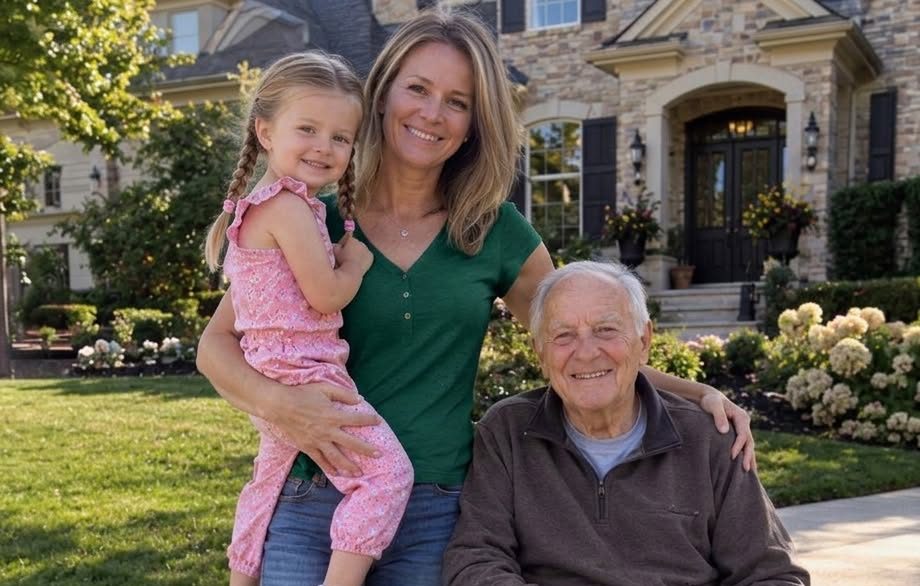
When Richard eventually needed a wheelchair, I pushed him through the gardens every afternoon.
Sometimes we’d sit beneath an old oak tree.
“You saved me,” I once told him.
He shook his head.
“No, Sarah. We saved each other.”
I believed him.
For five years, I loved that man.
Then, one winter morning, Richard died peacefully in his sleep.
I held his hand until the funeral director arrived.
Emily was sixteen by then.
She cried beside me.
We buried him beneath the oak tree.
I thought my life had fallen apart again.
But I wasn’t afraid.
I still had the house.
I assumed Richard had left everything to me.
After all, he had no children.
No siblings.
No close relatives.
He had repeatedly told me that the estate would be taken care of.
The day after the funeral, there was a knock at my door.
It was Richard’s lawyer.
Mr. Lawson.
He carried a thick briefcase.
“May I come in?”
“Of course.”
He sat at the dining table.
I made coffee.
He didn’t touch it.
Instead, he opened his briefcase.
“Sarah, there are things you need to know.”
My stomach tightened.
“About the will?”
“Yes.”
I smiled nervously.
“I assume everything goes to Emily and me.”
Mr. Lawson looked at me for several seconds.
Then he said,
“Richard knew you would fall for it.”
I froze.
“What?”
“He knew you would marry him because you needed a home.”
My face went cold.
I felt humiliated.
“So he thought I was a gold digger?”
“No.”
“Then what are you saying?”
Mr. Lawson sighed.
“His will leaves you nothing.”
I couldn’t breathe.
“Nothing?”
“Not the estate.”
“Not the house?”
“No.”
I stood.
“You’re telling me that after five years of marriage, after everything I did for him, I’m being thrown out?”
“No.”
“Then what does that mean?”
He reached into his briefcase.
And pulled out a sealed envelope.
“He told me to give you this after his funeral.”
I stared at it.
“What’s inside?”
“I don’t know.”
“Then why did you say he knew I’d fall for it?”
“Because that’s what he wanted you to believe.”
He placed the envelope in front of me.
“Open it.”
My hands trembled as I broke the seal.
Inside was a handwritten letter.
The handwriting was unmistakably Richard’s.
I read the first line.
Dear Sarah,
My eyes filled with tears.
Then I continued.
If you’re reading this, I’m gone. And I know you’re angry. You probably think I used your desperation to make you marry me.
I looked at Mr. Lawson.
He said nothing.
I continued reading.
The truth is that I was afraid you would never marry me if you knew who I really was.
My heart began pounding.
Richard’s letter continued.
Five years before I met you, I discovered that my business partners were stealing from me. I spent years fighting them in court. During that time, I realized something about wealthy people: everyone assumes they want your money.
So I changed my life. I stopped trusting people who knew my name. I lived quietly. I employed people through agencies. I never told anyone the full extent of my wealth.
Then came the sentence that made me stop breathing.
But when I met you, I didn’t see a woman chasing money. I saw a mother terrified that her daughter would grow up the way we did.
I cried.
The next paragraph was even more shocking.
I knew you were considering marriage because you needed security. I also knew that wasn’t the reason you stayed.
If you married me only for money, you would have left the moment I became sick. Instead, you pushed my wheelchair. You made my coffee. You sat beside me when I couldn’t sleep. You never once asked how much I was worth.
My tears fell onto the page.
Then I reached the final paragraph.
So I didn’t leave you my estate.
I whispered,
“Why?”
The answer was on the next page.
Because I didn’t want to give you a fortune. I wanted to give you something nobody could ever take away.
My hands shook as I turned the page.
There was only one sentence:
“The house is not mine anymore. It’s yours.”
I looked up.
Mr. Lawson smiled.
“Keep reading.”
There was a second document behind the letter.
A property deed.
My name was on it.
The entire estate had been transferred into a trust for me and Emily six months before Richard died.
The house.
The land.
Everything.
But there was more.
Richard had also established a college fund for Emily.
A trust for her future.
And a charitable foundation in Michael’s name.
I covered my mouth.
“He knew?” I whispered.
“He knew everything,” Mr. Lawson said.
“He knew about Michael?”
“Yes.”
“Why didn’t he tell me?”
“Because he wanted you to choose him without knowing what you might inherit.”
I cried harder.
Then Mr. Lawson handed me one final note.
It read:
Sarah, I didn’t marry you to give you a house. I married you because I loved you. The house is simply my way of making sure that when I’m gone, the little girl you fought so hard to protect will never have to wonder where home is.
I pressed the letter against my heart.
For years, I’d thought Richard had rescued me.
Now I understood.
He hadn’t rescued me.
He had trusted me.
And there was a difference.
Months later, Emily and I moved into the estate permanently.
We kept Richard’s study exactly as it was.
His chessboard remained on the table.
Every Sunday, Emily played a game there.
One afternoon, she asked me,
“Mom, do you think Grandpa Richard knew we’d be okay?”
I smiled through my tears.
“Yes.”
“How?”
“Because he made sure we’d never have to be afraid of losing our home again.”
Emily looked toward the oak tree.
“Do you miss him?”
“Every day.”
She took my hand.
“I do too.”
We walked outside together.
The same garden where Richard had once pushed his wheelchair.
The same tree where we’d sat together.
The same place where he had told me,
We saved each other.
I finally understood what he meant.
I had entered his house believing I was accepting a lifeline.
But I had unknowingly become part of a family.
Richard didn’t leave me his fortune because he wanted to reward me for marrying him.
He left it because, in the five years we had together, he had learned that I wasn’t staying for his money.
I had stayed because I loved him.
And when he died, he made sure that love would continue protecting the little girl I had spent my entire life trying to protect.
I still have the letter.
It’s framed beside the photograph from our wedding.
And underneath it, I wrote a single sentence of my own:
“Sometimes the person who looks like your lifeline is actually the person who teaches you that you were strong enough to survive all along.”