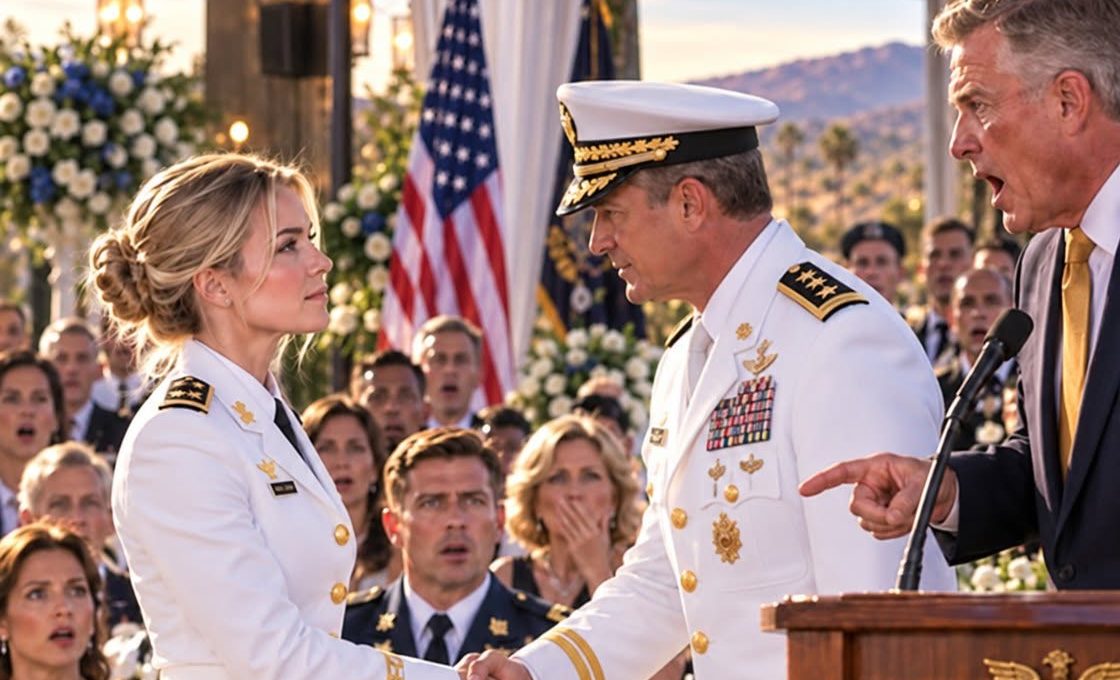
The officer’s question settled over the pavilion, leaving a silence that felt entirely different from the one my father had created. A moment earlier, people had been looking at me with uncertainty.
Now their attention shifted between the officer standing beside my table and the retired colonel holding the microphone.
My father straightened.
“I’m sorry, Colonel.
I don’t believe we’ve met.”
“Colonel Thomas Whitmore,” the officer replied.
“Army Network Enterprise Technology Command.
I believe you know my commanding general.”
My father’s expression changed almost imperceptibly.
He knew the name.
More importantly, he knew the command.
“Of course,” he said, recovering his composure.
“I wasn’t aware we had someone from your organization attending this evening.”
Whitmore offered a courteous nod.
“I was invited by the installation commander.”
Then he turned toward me.
“Captain Kincaid.
May I have a word?”
For the first time that evening, I felt myself breathe.
“Of course, sir.”
My father glanced at Garrett.
“Captain?”
Whitmore looked back at him.
“Yes, sir.
Your daughter is a captain in the United States Army Reserve.
And unless something has changed in the last forty-eight hours, she remains in good standing.”
A murmur passed through the pavilion.
My father’s fingers tightened around the microphone.
“That’s not what I was told.”
Whitmore’s expression remained measured.
“I can’t speak to what you were told, Colonel.
I can only speak to the information I’m authorized to confirm.”
He paused, giving my father an opportunity to put the microphone down.
My father hesitated.
Then he switched it off.
I was grateful for that small decision.
Despite everything he had said about me, I had no desire to watch my father become the evening’s entertainment.
I wanted the truth to emerge, but I had spent too much of my life having my career discussed at family gatherings.
I didn’t intend to spend another evening doing the same thing.
Whitmore leaned slightly toward me.
“There’s a conference room inside the community center.
Would you prefer to speak there?”
I nodded.
“Yes, sir.”
Then I looked toward my mother.
She was still sitting with her water glass between her hands.
“Mom, would you come with us?”
Her eyes lifted.
“Of course, sweetheart.”
Garrett rose immediately.
“Addie, I’d like to come too.”
Hearing my childhood nickname from him startled me more than anything that had happened at the podium.
He hadn’t used it in years.
I looked at him for a long moment.
“Okay.”
My father stepped down from the stage.
“Then I assume I should be there.”
Whitmore glanced at me, leaving the decision where it belonged.
I thought about saying no.
There had been years when my father’s presence turned every conversation into something I needed to survive rather than enjoy.
But this was not a misunderstanding that could be corrected by talking around him.
“Yes,” I said eventually.
“I think you should.”
We walked out of the pavilion together, five people connected by a family history that suddenly seemed full of things none of us understood.
Behind us, the barbecue continued.
People began speaking again.
The evening hadn’t stopped for our family.
It only felt that way.
The conference room had beige walls, a rectangular wooden table, and a window overlooking the mountains.
Someone had left a coffee service on a sideboard.
A folded American flag rested in a display case near the door.
I chose a chair facing the window.
Garrett sat across from me.
My mother sat beside him, leaving an empty chair between herself and my father.
Whitmore remained standing until everyone had settled.
“I want to establish something before we begin,” he said.
“This is a family conversation, not an official proceeding.
There are matters I cannot discuss here, including details of operational systems and personnel investigations.”
My father folded his arms.
“Then I’m not entirely sure why we’re here.”
“Because you made a statement tonight about Captain Kincaid’s military status that was factually incorrect.”
Whitmore placed a small folder on the table.
“Captain, are you comfortable confirming your current status to your family?”
I looked at the folder.
For years, I had been careful about what I said, partly because of my work and partly because I had grown tired of defending ordinary truths to people determined not to believe them.
But my rank was not a secret.
Neither was my service.
“Yes, sir.”
Whitmore nodded.
“Captain Adelaide Kincaid currently holds a commission in the Army Reserve.
Her military records do not reflect a dishonorable discharge.
She has served in positions supporting communications and operational network programs, and she has completed multiple overseas assignments.”
My mother covered her mouth.
Garrett stared at me.
My father was the first to speak.
“Then why did she tell us she was working for a contractor?”
“Because I was,” I answered.
Everyone looked at me.
“I worked for a defense contractor in a civilian technical capacity while maintaining my Reserve commission.
Later, I accepted a federal position.
Some of my assignments involved supporting deployed units.
Others involved systems development, testing, and network security.”
I rested my hands on the table.
“None of that meant I had left the Army.”
My father shook his head.
“You never explained that.”
“I tried.”
He looked at me.
I remembered the afternoon he had first dismissed my work.
It was four years earlier, during Thanksgiving at my parents’ house outside Tucson.
Garrett had recently returned from an overseas assignment, and my father had spent most of dinner asking about leadership challenges, logistical problems, and the responsibilities of commanding soldiers.
When he finally turned to me, he asked what I was doing.
I told him I had been assigned to a communications integration project.
He laughed.
“So you’re fixing computers now?”
I explained that the work was more complicated.
He waved his fork.
“Adelaide, your brother is leading soldiers.
There’s nothing wrong with technical work, but don’t pretend it’s the same thing.”
After that, explaining became something I did less and less.
Now, sitting across from him, I realized I remembered the exact pattern on the Thanksgiving tablecloth.
I wondered whether he remembered the conversation at all.
“You told me my work didn’t count,” I said.
My father looked down.
“I don’t recall saying that.”
“I know.”
For some reason, those two words hurt more than I expected.
Whitmore quietly closed his folder.
“I believe the family should have some time to talk.
Captain, I’ll remain nearby.
There is also a professional matter I need to discuss with you privately before I leave.”
I nodded.
“Thank you, sir.”
He paused at the door.
“One more thing, Major Kincaid.”
Garrett looked up.
“Yes, sir?”
“Your sister’s civilian position gave her responsibilities that did not necessarily correspond to her military rank.
I would encourage everyone here not to confuse the visibility of an assignment with its importance.”
Garrett straightened.
“Understood, sir.”
Whitmore left.
The door clicked shut.
And suddenly there was nobody in the room but us.
My mother broke the silence.
“Adelaide, why didn’t you tell me?”
I looked at her.
There was no accusation in her voice, only a sadness that made me wish we were having this conversation somewhere other than a military conference room.
“Tell you what, Mom?”
“That you were still serving.
That you were going overseas.”
“I did tell you I was traveling for work.”
“But not where.”
“Sometimes I couldn’t.”
She nodded slowly.
“Were you safe?”
Garrett shifted in his chair.
I answered carefully.
“I worked with people who took my safety seriously.”
My mother gave a small, unhappy laugh.
“That sounds like something someone says when they don’t want their mother to worry.”
“It probably is.”
For the first time that evening, she smiled.
Only briefly.
But it was enough to remind me that I had once called her every Sunday, sometimes just to tell her what I was cooking for dinner.
Somewhere along the way, our conversations had become shorter.
I had blamed work.
She had blamed distance.
Neither of us had discussed the real reason.
Garrett leaned forward.
“Addie, were you involved with the expeditionary network modernization program?”
I studied him.
“Why?”
“Because Colonel Whitmore mentioned network authority.”
My father looked between us.
“What does that mean?”
Garrett ignored the question.
“Were you working with the teams that developed the communications packages for forward command posts?”
“Some of them.”
His expression changed.
“Which ones?”
“I can’t discuss specific configurations.”
“I’m not asking for classified information.”
“I know.”
He leaned back.
For a moment, I saw the boy who used to sit on my bedroom floor while I helped him with algebra.
Garrett had always been bright, energetic, and determined to prove himself.
When we were children, he followed me everywhere.
When I joined the Army, he wrote me letters about wanting to wear the same uniform.
Our father had been delighted when Garrett eventually chose a combat-arms career.
My technical assignments were less interesting to him.
Over time, Garrett and I had stopped talking about our work in any meaningful way.
We still exchanged birthday messages.
We still attended family holidays when we could.
But the closeness we once shared had quietly disappeared.
Now he looked at me with an expression I couldn’t quite identify.
“During my last deployment,” he said, “we had a major communications problem.”
I remained silent.
“Our primary system kept dropping connections between the headquarters and several supporting elements.
It happened during a period when we were coordinating a lot of movement.”
I remembered the general period he meant.
I remembered more than that.
But I waited.
“We had technicians working around the clock,” he continued.
“Everybody assumed it was a hardware problem.
Then a support team sent us a configuration package with instructions that seemed completely different from what we’d been trying.”
He rubbed his jaw.
“It worked.”
I looked toward the window.
The mountains were darkening against the evening sky.
Garrett continued.
“We never met the people who developed it.
We received the package, implemented it, and finally got the network stable.”
“Good,” I said.
He studied my face.
“Was that you?”
I could have given him the answer he wanted.
After all, the essential truth had already been suggested in front of the entire pavilion.
But technical systems were rarely the work of one person.
And I had learned to be careful about taking credit that belonged to a team.
“I helped with a family of systems that supported units like yours,” I said.
“Some of the technical documentation and approved configurations originated with teams I worked on.”
Garrett looked down.
“That’s not exactly a no.”
“No.”
He sat back, absorbing it.
My father finally spoke.
“If she had this much responsibility, why wasn’t she promoted?”
The question changed the atmosphere.
My mother looked at him.
“Marshall.”
But he continued, quieter now.
“I’m trying to understand.
Garrett made Major.
Adelaide has been eligible for years.
If her record is what you say it is, something doesn’t add up.”
I felt the familiar tightness in my chest.
There it was.
The measurement he had always used.
Rank.
Dates.
Comparisons.
As though two careers could be laid side by side and judged by counting the insignia.
Garrett looked uncomfortable.
“Dad, promotion isn’t that simple.”
My father turned toward him.
“You know what I mean.”
“Yes,” Garrett answered.
“Unfortunately, I do.”
The room became very still.
He looked at me.
“Addie, is there something I should know?”
I glanced at our father.
For months, I had imagined telling them everything.
I had pictured the exact words I would use.
But now that the opportunity had arrived, I found myself wanting something different.
I didn’t want to win an argument.
I wanted them to understand what had happened.
And I wanted to be certain I could trust them with the truth.
“There are things about my promotion history that are under administrative review,” I said.
“I can’t discuss the entire process yet.”
My father’s face tightened.
“So there is a problem.”
“There was a problem with the process.”
“What kind?”
I looked at him.
“The kind that begins when people outside an officer’s chain of command try to influence decisions they don’t have the authority to make.”
He went quiet.
Garrett slowly turned toward him.
My mother closed her eyes.
Nobody asked another question.
Not yet.
Whitmore found me outside twenty minutes later.
I had stepped onto a narrow walkway behind the community center, where the air smelled of creosote and cooling asphalt.
The mountains were nearly black.
In the distance, I could hear the muffled sounds of the family event winding down.
Whitmore came to stand beside me.
“You handled that with a great deal of restraint.”
I gave a tired smile.
“I’ve had practice.”
He didn’t respond immediately.
Then he said, “I’m sorry your family learned about your service this way.”
“Apparently, so am I.”
He leaned against the railing.
“I heard enough at the pavilion to know the conversation was becoming uncomfortable.
I hope you understand that I came over because the discharge allegation needed to be corrected, not because I intended to discuss your assignments in public.”
“I understand.”
He glanced at my collar.
“Still wearing the pin.”
I touched the small bronze emblem.
It had been given to me by a joint technical team after a particularly demanding assignment.
No classified symbolism.
No secret rank.
Just a modest recognition from people who had spent months solving problems together.
I wore it because it reminded me of them.
“Most days,” I said.
Whitmore smiled.
“Your old team still talks about that project.”
“That’s either encouraging or deeply concerning.”
“A little of both.”
For several moments, we watched the last sunlight disappear.
Then his expression grew serious.
“There’s something you need to know about your promotion review.”
I turned toward him.
“The second inquiry is complete?”
“The fact-finding portion is.
The administrative review is still being finalized.”
My pulse quickened.
For almost two years, I had lived with unanswered questions about my career.
The first delay had come after a routine promotion review identified an unfavorable memorandum questioning my judgment.
The memorandum had not come from anyone who had directly supervised me.
It contained vague concerns about my ability to handle increased responsibility, but no documented performance failures.
The second delay followed another series of questions raised during the next review cycle.
By then, I had begun wondering whether I was missing something.
Maybe I wasn’t as good at my job as my supervisors thought.
Maybe the people who praised my work were simply being kind.
Maybe there was some legitimate concern nobody wanted to discuss with me.
Then an officer who had once supervised me contacted my current command.
He had received an unusual telephone call.
The caller was my father.
And the officer had preserved his notes.
A second officer had received a similar call months later.
Those calls became part of an administrative inquiry after I requested a review of the information being considered in my promotion process.
I knew the allegations.
I knew their source.
What I didn’t know was how much damage they had actually caused.
Whitmore took a moment before continuing.
“The review has identified two instances of inappropriate outside contact relating to your promotion eligibility.”
I stared at him.
“Both calls?”
“Both.”
“Were they considered?”
“That’s one of the issues being addressed.”
He looked toward the empty parking lot.
“I don’t want to suggest that the calls alone determined either outcome.
Promotion boards consider many factors, and some decisions involve administrative timelines that are difficult to reconstruct.
But there is enough concern about the handling of those communications to warrant corrective review.”
I appreciated his precision.
It would have been easy to tell me what I wanted to hear.
Instead, he was telling me what he could establish.
“Will I have to make a formal statement?”
“Possibly.
You’ll receive notice through the proper channels.”
I nodded.
Then I asked the question I had been carrying for months.
“Do I have to involve my father?”
Whitmore looked at me with sympathy.
“His contacts are already part of the record.
If you’re asking whether you have to confront him personally, no.”
I pressed my palms against the railing.
“I’m not interested in punishing him.”
“I know.”
“I just want my record evaluated fairly.”
“That’s a reasonable request.”
For a moment, neither of us spoke.
Then Whitmore opened the folder he had brought from the conference room.
“There’s another matter.
Your civilian program director has submitted a recognition package for the network modernization work you completed before your last assignment.”
I raised an eyebrow.
“Whitmore, you know how I feel about awards.”
“Yes.
I’ve had the pleasure of reading several emails explaining it.”
Despite myself, I laughed.
He continued.
“The package includes a sanitized account of a deployment support incident.
Several units provided statements describing the operational value of the work.”
I looked at him.
“Which units?”
“One was your brother’s.”
My smile faded.
“What?”
He nodded.
“Major Kincaid’s former command submitted a detailed report about the communications disruption he mentioned.”
I thought back to the conference room.
Garrett’s expression when he asked whether I had been involved.
“Does he know my name was on the technical documentation?”
“Not necessarily.
His unit would have seen the approved support material, not every person who developed it.”
Whitmore closed the folder.
“But there’s something in his report that I think you should read.”
I returned to the conference room to find my mother standing beside the window.
Garrett and my father were gone.
She turned when I entered.
“Your brother took your father home,” she said.
“I told them I wanted to wait for you.”
I set my folder on the table.
“You didn’t have to do that.”
“I know.”
She looked unusually small in the large room.
My mother had always been a capable woman.
She had organized military spouse committees, managed moves across three continents, and somehow raised two children while my father was away for months at a time.
She knew how to repair a leaking faucet, balance a household budget, and make an unfamiliar house feel like home within forty-eight hours.
But when it came to my father, she often deferred to him.
For years, I had mistaken that for agreement.
Now I wasn’t sure.
“Adelaide,” she said, “I owe you an apology.”
I pulled out a chair.
“Mom—”
“Please.
I’d like to finish.”
I sat.
She joined me.
“I knew your father had been speaking to people about your career.
I didn’t know exactly what he said, and I certainly didn’t know about those telephone calls.
But I knew he was unhappy about your promotion.”
She looked at her hands.
“And I knew he had started telling people you had left the Army.”
I felt something inside me sink.
“You knew?”
“Yes.”
“Why didn’t you say anything?”
“Because every time I tried, he told me I didn’t understand the situation.
He said you were embarrassed, and that pressing you for details would only make things worse.”
She shook her head.
“I accepted that explanation because it was easier than questioning it.”
I watched her carefully.
She continued.
“When you stopped calling as often, I told myself you were busy.
When you missed Christmas, I told myself you were working.
I never asked whether being home had become difficult for you.”
Her voice trembled.
“I’m sorry.”
For years, I had imagined my mother choosing a side.
I had wanted her to interrupt my father at dinner.
To correct him when he dismissed my work.
To tell him that his daughter deserved the same pride he gave his son.
But sitting across from her now, I recognized how much I had wanted something even simpler.
I wanted her to call and ask how I was doing.
Not what rank I held.
Not when I would be promoted.
Just how I was doing.
“Mom,” I said softly, “I didn’t need you to understand my job.”
Her eyes filled.
“I know.”
“I needed you to believe me when I said I was doing it.”
She reached across the table.
I let her take my hand.
“I believe you,” she said.
It was late.
Years late.
But it mattered.
We drove to her house in separate cars.
The streets outside the installation were quiet, lined with low buildings and desert landscaping.
The familiar lights of Sierra Vista appeared ahead of me.
I had driven this route dozens of times.
As a teenager, I had watched my father navigate these roads on our way to family dinners with other military families.
I remembered Garrett falling asleep against the car window and my mother reminding us to thank our hosts.
I remembered feeling that our family belonged to something important.
Tonight, I wondered when belonging had become a competition.
My parents’ house sat at the end of a residential street, its front porch illuminated by a warm yellow light.
Garrett’s truck was already in the driveway.
My father was in his study when we entered.
I could hear the quiet murmur of the television.
Garrett stood in the kitchen, still wearing his dress uniform jacket, though he had removed his tie.
He looked at me.
“Can we talk?”
My mother touched my shoulder.
“I’ll make tea.”
I followed Garrett onto the back patio.
The air had cooled, and a mild breeze moved through the mesquite tree beside the fence.
For a while, we sat without speaking.
Then Garrett said, “I should have said something tonight.”
I looked at him.
“At the pavilion?”
He nodded.
“When Dad started talking, I knew parts of what he said couldn’t be right.”
“Which parts?”
“The dishonorable discharge, for one.
I knew you’d remained in the Reserve after taking your civilian position.”
I waited.
He stared at the concrete beneath his shoes.
“I didn’t know what had happened with your promotion.
Dad kept saying you’d had some kind of problem with your command.
Eventually I stopped asking.”
“Why?”
He thought about it.
“Because I was getting promoted.
And I didn’t know how to celebrate something good in my own life when every family dinner turned it into a comparison.”
I looked out into the yard.
Garrett continued.
“I should have talked to you instead of listening to everybody else.”
“Yes,” I said.
He nodded.
“I know.”
There was no dramatic apology.
No speech about becoming a better brother.
Just an acknowledgment that he had made a choice, and that the choice had consequences.
I found I appreciated that more than I expected.
He leaned forward.
“Can I ask you something?”
“Sure.”
“Did you know my unit was having trouble overseas?”
I hesitated.
“I knew there were units experiencing communications problems.
I couldn’t always see which formations were using the systems we supported.”
“But you knew I was deployed.”
“Yes.”
“And you helped anyway.”
I turned toward him.
“Garrett, I would have helped whether you were there or not.”
He smiled faintly.
“I know.
That’s sort of the point.”
I thought about the nights I had spent in windowless technical facilities, drinking terrible coffee and reviewing network diagrams with exhausted colleagues.
I remembered troubleshooting problems that seemed almost impossible to reproduce.
I remembered engineers celebrating when a system held steady through a test cycle.
And I remembered how satisfying it was to know that somewhere, people who would never learn our names could do their jobs more safely and reliably because ours had been done well.
Garrett looked at me.
“I used to think you didn’t want to talk about your deployments because they weren’t interesting.”
I laughed softly.
“Some of them were extremely boring.”
“That’s not what I meant.”
“I know.”
He looked embarrassed.
“I assumed you were avoiding the subject because you didn’t have much to say.”
“Sometimes I was avoiding it because I was tired of trying.”
He nodded.
We sat quietly.
Then he said something that surprised me.
“I was jealous of you when we were younger.”
I turned.
“Of me?”
He smiled.
“You were good at everything I wanted to be good at.
Dad asked you to help with everything.
You could fix the computer, change a tire, figure out why the garage door wasn’t working.
You won that scholarship.
You got accepted into that engineering program.”
I shook my head.
“Garrett, Dad practically threw a party when you got your commission.”
“Exactly.”
He looked toward the kitchen window.
“I spent a lot of years thinking I had to become the kind of officer he understood.
You became the kind of officer you wanted to be.”
I considered that.
“I’m not sure I always knew what I wanted.”
“Maybe not.
But you didn’t let him decide everything.”
A light came on in the upstairs bedroom.
Garrett looked back at me.
“Do you remember the radio you built for my science fair?”
I smiled.
“You built it.
I just helped with the circuit.”
“You made me redo the entire thing because the solder joints looked terrible.”
“They did look terrible.”
He laughed.
For a moment, we were fourteen and ten again.
Then his expression softened.
“Addie, I’m proud of you.”
I looked down.
I had imagined hearing those words from my father for so long that I hadn’t realized how much I needed to hear them from Garrett.
“Thank you,” I said.
He reached over and squeezed my shoulder.
We stayed outside until my mother called us in for tea.
The next morning, I woke in my old bedroom.
I hadn’t intended to stay the night, but my mother had insisted, and the drive back to my apartment had seemed unnecessarily long.
The room looked much as it had when I was in college.
The furniture had been replaced, and the walls were a different color, but a wooden bookshelf still stood beside the window.
On the bottom shelf was a photograph of Garrett and me at my commissioning ceremony.
I was twenty-two.
He was eighteen.
His arm was around my shoulders, and we were both laughing at something outside the frame.
I picked up the photograph.
It had been so easy to be close before we started measuring ourselves against different expectations.
Downstairs, I found my mother making pancakes.
She looked delighted to see me.
“Blueberries?”
“Obviously.”
She smiled.
My father was sitting at the kitchen table with a newspaper.
He glanced up.
“Morning.”
“Morning.”
For several seconds, neither of us knew what else to say.
Then he folded the paper.
“Adelaide, I’d like to apologize for last night.”
I stopped beside the coffee maker.
My mother turned off the stove.
My father looked uncomfortable.
“I shouldn’t have made those remarks in public.”
I waited.
He continued.
“I was operating under an incorrect understanding of your service status.”
I poured coffee into a mug.
“That’s part of it.”
He looked up.
“What do you mean?”
“You told people I had been dishonorably discharged.
You never asked me whether it was true.”
He rubbed his forehead.
“I believed I had reliable information.”
“From whom?”
He didn’t answer immediately.
“People I spoke with.”
“People who knew my record?”
He looked away.
I set the coffee pot down.
“Dad, I’m not asking you to discuss classified assignments.
I’m asking why you believed I would lie to you about something like that.”
My mother carried a plate of pancakes to the table.
My father stared at his folded newspaper.
“I thought you were embarrassed about not being promoted.”
“I was disappointed,” I said.
“That’s not the same thing.”
He nodded without looking at me.
I sat across from him.
“There’s something else we need to discuss eventually.
But not over breakfast.”
His expression changed.
“The calls?”
I felt my stomach tighten.
He knew.
Of course he knew.
I had wondered whether he understood that his conversations with my former supervisors were being reviewed.
Now I had my answer.
“Yes,” I said.
My father looked at my mother.
She set the pancake platter down carefully.
“I think,” she said, “we should all eat first.”
It was such an ordinary suggestion that I almost smiled.
For once, we followed it.
Garrett joined us an hour later.
He arrived carrying a box from the bakery near the main gate, apparently having decided that pancakes were insufficient for a family experiencing a difficult morning.
My mother greeted him at the door.
He placed the box on the counter.
“Peace offering.”
“For whom?”
I asked.
“Everyone.
Especially me.”
He handed me a cinnamon roll.
I accepted it.
My father excused himself to take a telephone call, leaving the three of us at the kitchen table.
Garrett pulled out his phone.
“I was thinking about our conversation last night.”
“That sounds dangerous.”
He smiled.
“I remembered something from the deployment report.”
My mother looked between us.
“The communications problem?”
“Yeah.”
He opened an old email he had located through his authorized personal archive of unclassified correspondence.
“I wrote a note to my former battalion commander after the network was restored.
He wanted a summary of what had happened and how the support teams responded.”
I took a sip of coffee.
“Okay.”
“There was an engineering point of contact mentioned in the follow-up documentation.
I didn’t recognize the name at the time.”
My heart began to beat faster.
“What name?”
Garrett looked at me.
“A.
Kincaid.”
I set down my mug.
My mother leaned forward.
“That was Adelaide?”
“Possibly,” Garrett said.
“I remember thinking it was an unusual coincidence.
But there are plenty of Kincaids in the military, and it never occurred to me that my sister might be one of the people working on our systems.”
I smiled.
“That’s fair.”
He studied me.
“So it was you.”
I thought carefully about what I could say.
“I was one of the technical leads associated with that support effort.”
Garrett slowly shook his head.
“I cannot believe I missed that.”
“You were busy.”
“Still.”
He looked at the old email again.
“There was something else in the report.
Our commander wanted to formally recognize the technical team, but the initial response said some personnel couldn’t be identified in the unit’s administrative paperwork.”
“That happens.”
“I know.
But apparently a revised recognition package was prepared later.”
I looked at him.
“How much later?”
“After we redeployed.”
He scrolled.
“Wait.
I think I still have the correspondence.”
My mother returned to the stove, giving us space.
Garrett continued reading.
Then his expression shifted.
“What?”
I asked.
He looked up.
“Addie, did you ever receive a letter of appreciation from our battalion?”
“No.”
“Not even through your program office?”
“Not that I remember.”
He turned the phone toward me.
The email was dated almost two years earlier.
It contained a request from his former battalion commander asking that the technical support team be considered for recognition.
At the bottom was a reference to a supporting memorandum.
The name on that memorandum was mine.
And beside it was a notation I had never seen.
Administrative review pending.
I stared at those three words.
Garrett frowned.
“Does that mean anything?”
I felt the familiar machinery of my memory turning.
Two years earlier.
The first promotion delay.
The unfavorable memorandum.
The inquiries about my judgment.
I had always believed those matters began with a telephone call from my father.
But the dates did not quite match.
The recognition memorandum appeared to have entered an administrative review before his first documented call.
I looked at Garrett.
“Can you send me the unclassified reference information?
Not the operational material.
Just the administrative tracking number.”
“Of course.”
He studied my face.
“What is it?”
“I’m not sure yet.”
And that was the truth.
On Monday morning, I returned to work.
The familiar routine was a relief.
My office was in a secure facility where conversations about family disputes had no place beside network diagrams and project schedules.
I spent most of the morning reviewing a test report.
At eleven, my supervisor, Dr.
Miriam Chen, knocked on the open door.
“Do you have a minute?”
Miriam was a civilian program director in her late fifties, with silver-rimmed glasses and a reputation for asking questions that exposed every weakness in a technical proposal.
She had supervised me for three years.
She also knew more about my promotion situation than nearly anyone outside the formal review process.
“Come in.”
She closed the door.
“I heard about Saturday.”
I sighed.
“News travels.”
“Whitmore called.
He wanted to make sure you were doing all right.”
“I’m fine.”
She gave me a look.
“Adelaide.”
I smiled faintly.
“I’m working on being fine.”
“That sounds more believable.”
She sat across from me.
“Your recognition package is moving forward.
There’s some administrative documentation I want you to review before it goes to the next level.”
I hesitated.
“Does it include the support report from Garrett’s battalion?”
“Yes.”
“Can I see the unclassified administrative summary?”
She nodded.
“Of course.
You’re named in it.”
She opened her folder and slid a document across the desk.
It was a sanitized summary of work performed during a network reliability project.
Most of it was familiar.
Dates.
Technical milestones.
Testing procedures.
Descriptions of improved system resilience.
Then I reached the final page.
Under supporting documentation was a reference to an earlier recommendation for civilian technical recognition.
I knew that recommendation existed.
What I hadn’t known was why it had never been completed.
A handwritten notation had been carried forward into the scanned administrative file.
Hold pending personnel clarification.
I looked up.
“Miriam, who requested this hold?”
She frowned.
“That’s one of the questions the administrative office has been trying to answer.”
“Was it connected to my promotion review?”
“Possibly.
The two processes shouldn’t have been linked, but somebody appears to have treated an unverified concern about your military record as a reason to delay the civilian recognition package.”
I sat back.
For two years, I had assumed my stalled promotion and missing recognition were separate disappointments.
Now I wasn’t so sure.
Miriam continued.
“The review team has requested the original routing history.”
“Can I see it?”
“When it’s cleared for release to you.”
She paused.
“Adelaide, there is something I want you to understand.”
I looked at her.
“Your work has never been in question here.
We documented it, we evaluated it, and we continued assigning you responsibility because you earned our confidence.”
I swallowed.
“Thank you.”
“I’m not telling you this to make you feel better.
I’m telling you because I don’t want you to confuse an administrative problem with an assessment of your abilities.”
For the first time in months, I felt the distinction clearly.
Someone else’s doubts had occupied so much space in my mind that I had allowed them to crowd out years of evidence.
Miriam rose.
“And for what it’s worth, your brother’s former commander wrote an unusually thoughtful recommendation.”
I looked at her.
“Did he?”
“He described the technical support effort as a model of cooperation between deployed units and stateside specialists.”
She smiled.
“He also mentioned a young major who insisted that the recognition request not be forgotten.”
I stared at her.
“Garrett?”
She nodded.
“Apparently.”
That evening, I called my brother.
He answered on the second ring.
“Hey, Addie.”
“Did you know you pushed for my recognition two years ago?”
There was a pause.
“What?”
“Your battalion’s technical support recommendation.
Miriam told me you kept following up on it.”
“Oh.
That.”
I sat down on my apartment sofa.
“You never mentioned it.”
“I didn’t know it was you.”
He sounded almost embarrassed.
“Our commander wanted the team recognized.
The original recommendation got stuck somewhere.
I sent a couple of follow-up emails before I transferred.”
“Why?”
“Because those people helped us, Addie.
Somebody needed to make sure their work was acknowledged.”
I closed my eyes.
For years, our father had insisted that Garrett and I occupied entirely different places in the Army.
He was the leader.
I was the technician.
He made the decisions.
I supported them.
But during one of the most important assignments of my career, my brother had unknowingly done something our father had never done.
He had looked beyond the visible hierarchy and recognized the people whose work made his own possible.
“You did a good thing,” I told him.
He laughed softly.
“I’m pretty sure that’s supposed to be my line.”
“Garrett.”
“Yeah?”
“Thank you.”
He became quiet.
Then he said, “You’re welcome, sis.”
After we hung up, I sat there for a long time.
Outside my apartment window, the city lights flickered against the mountains.
I thought about the report.
The missing recognition.
The two promotion delays.
And the administrative notation dated before my father’s first documented telephone call.
Something in the sequence still didn’t make sense.
I opened my laptop and began organizing the dates.
For once, I wasn’t trying to prove that I deserved something.
I was trying to understand what had happened.
Three days later, Miriam called me into her office.
Whitmore was already there.
A second person sat beside him: Lieutenant Colonel Evelyn Brooks, an attorney assigned to advise the administrative review team.
Brooks introduced herself and explained the limits of what she could share.
The room felt formal, but nobody seemed interested in making the conversation more difficult than necessary.
Miriam gestured toward a chair.
“Adelaide, we’ve received the original routing history.”
I sat down.
Brooks opened a folder.
“The inquiry into the outside contacts is separate from the review of your personnel records.
However, in reconstructing the timeline, we identified an earlier document that may help explain why questions about your eligibility first appeared.”
My pulse quickened.
“An earlier document?”
She nodded.
“It was submitted through an administrative channel approximately six weeks before the first documented telephone call from your father.”
I looked at Whitmore.
He remained silent.
Brooks continued.
“The document identified a potential conflict involving a member of your family and your assignment to a technical support program.”
My mind went blank.
“A conflict?”
“An alleged concern about whether your family relationship could affect your professional independence.”
I stared at her.
“My family relationship with whom?”
She turned a page.
“With your brother, Major Garrett Kincaid.”
I blinked.
“That doesn’t make sense.
Garrett and I weren’t even assigned to the same command.”
“We understand that.
The allegation was not supported by the assignment records we reviewed.”
“Who submitted it?”
Brooks looked down at the document.
“The initial referral was unsigned.
It appears to have originated outside your command, and the routing history is incomplete.”
I felt a familiar frustration rising.
Another anonymous concern.
Another bureaucratic shadow.
But Brooks wasn’t finished.
“There is one additional piece of information.
The referral included a quotation from an old family conversation about your decision to accept your technical assignment.”
I looked at her.
“What conversation?”
She read the quotation aloud.
Adelaide has never been comfortable taking direction from her younger brother.
She would rather work behind the scenes than accept that he has surpassed her.
I stared at the table.
I recognized the sentiment.
Not because I had ever said it.
But because my father had.
At a family dinner.
Two years earlier.
The evening Garrett told us he had been selected for promotion to Major.
I remembered congratulating him.
I remembered my father raising his glass.
And I remembered stepping outside afterward because I was tired of answering questions about when I would receive the same promotion.
When I returned, my father had been talking to someone on the telephone.
I hadn’t thought anything of it.
Until now.
Brooks placed a copy of the administrative referral in front of me.
“The review team has not established who submitted this.
Your father’s later contacts are documented, but we cannot assume he authored the earlier referral.”
I nodded, barely hearing her.
Then my eyes fell on the bottom of the page.
There was a handwritten routing note.
It contained a name I recognized immediately.
Not my father’s.
Not Garrett’s.
It belonged to Brigadier General Daniel Mercer.
The officer who had once supervised my first overseas technical assignment.
The man who had encouraged me to apply for the position that changed my career.
And, according to the notation, the person who had asked for the referral to be preserved rather than discarded.
I looked up.
“Why would General Mercer keep this?”
Whitmore exchanged a glance with Brooks.
Then he answered.
“Because he was concerned someone might be trying to influence your career through an allegation they couldn’t substantiate.”
I looked down again.
At the bottom of the referral, beneath the original routing note, Mercer had written one sentence.
Preserve this document.
Captain Kincaid may need it someday.
And beside that sentence was a date.
Six weeks before my father’s first recorded call.
For the first time, I understood that someone had recognized the problem long before I knew it existed.
What I didn’t understand was why nobody had told me.
Or why the man who had quietly protected the evidence had never spoken to me about it.
PART 3
The Honor He Couldn’t See: The Truth That Finally Brought Us Home
“Why preserve it?”
I asked General Mercer.
“Because the language concerned me,” he answered.
“A professional complaint generally identifies specific conduct, dates, or documented performance concerns.
This document contained none of those things.
Instead, it described your relationship with your father and brother and suggested that your personal feelings might interfere with your duties.”
He paused.
“I had supervised you.
I knew your work.
Nothing in that document resembled the officer I had observed.”
I looked down at the memorandum.
“Then why did it follow me?”
“That,” he said carefully, “is something the administrative review must establish.”
I leaned back against the sofa.
For years, I had been trying to understand why my career had taken such a different path from the one I had expected.
I had reviewed my evaluations, requested additional feedback, and accepted assignments that would broaden my experience.
I had wondered whether I needed another qualification, a different position, or more visible leadership responsibilities.
Now I was beginning to understand that I had been searching for answers in the wrong places.
“Sir, did you ever speak to my father about me?”
Mercer was quiet for a moment.
“Yes.”
My heart sank.
“When?”
“Shortly after that referral arrived.
He contacted me to discuss what he described as concerns about your professional development.”
I closed my eyes.
“Did he mention the referral?”
“Not directly.
But some of his language was similar enough that I remembered the document.”
“What did you tell him?”
“I told him that your professional evaluations belonged to your supervisors and that any concerns involving your performance should be addressed through established channels.”
I could picture my father receiving that answer.
He would have remained polite.
He would have thanked Mercer for his time.
Then he would have hung up feeling that an old colleague had refused to understand him.
Mercer continued.
“I also told him something I believed he needed to hear.
Your military career was yours to manage, not his.”
I stared at the mountains beyond my apartment window.
“I’m guessing he didn’t appreciate that.”
“No,” Mercer said gently.
“I don’t believe he did.”
For a while, neither of us spoke.
Then I asked him the question that mattered most.
“Why didn’t you warn me?”
His answer came slowly.
“At the time, I believed the appropriate response was to ensure that the allegation wasn’t used against you.
I didn’t want to burden you with an unsubstantiated document, particularly when we had no evidence that it had affected any official decision.”
He sighed.
“In retrospect, I should have ensured that you were informed through the proper channels once the concern began appearing in subsequent administrative correspondence.”
I appreciated that he didn’t offer an elaborate explanation.
He simply acknowledged that a decision made with good intentions had left me without information I needed.
“Thank you for keeping the document,” I said.
“You’re welcome, Adelaide.”
“And for being honest with me.”
He paused.
“There’s something else I want you to remember.
Your promotion delays are part of your history, but they are not a complete description of your career.”
I swallowed.
“I know.”
“Do you?”
I looked at the bronze pin resting on the little dish beside my front door.
I thought about the deployments, the colleagues, the projects that had taken months to complete, and the people who depended on systems they would never know I had helped develop.
“Yes, sir,” I said.
And this time, I believed it.
The following Saturday, my brother came to visit.
Garrett arrived carrying two large coffees and a brown paper bag from a bakery near my apartment.
He had exchanged his dress uniform for jeans, worn boots, and a University of Arizona T-shirt.
It was the most relaxed I had seen him in years.
“Breakfast,” he announced.
I stepped aside.
“Did Mom send you?”
“No.
But she told me to remind you that you still have a casserole dish at her house.”
“I haven’t borrowed a casserole dish from Mom in ten years.”
“Apparently, she’s been keeping track.”
I laughed and followed him into the kitchen.
He unpacked breakfast while I found plates.
For a few minutes, we talked about ordinary things.
His plans for the next assignment.
My increasingly unsuccessful attempts to grow tomatoes on the balcony.
Our mother’s new enthusiasm for birdwatching.
It was surprisingly pleasant.
Then Garrett put down his coffee.
“Dad called me yesterday.”
I looked up.
“How is he?”
“Quiet.”
“That must be unusual.”
Garrett smiled faintly.
“He’s been spending a lot of time in his study.”
I recognized the pattern.
Whenever my father encountered a problem he couldn’t solve immediately, he retreated into familiar territory.
His study was filled with military books, photographs, framed certificates, and carefully arranged reminders of a career that had defined nearly everything about him.
When Garrett and I were young, the room had seemed almost sacred.
We weren’t forbidden from entering, but we knew not to move anything.
Our father could remember the precise date of an exercise conducted twenty years earlier, yet sometimes forgot which of us had a birthday coming up.
It was easy to understand why he had struggled with retirement.
Without a command to lead or a schedule to follow, he had gradually turned his attention toward our lives.
Garrett had welcomed his advice.
I had resisted it.
And somewhere along the way, my father’s concern about my career had become something neither of us knew how to discuss.
“He asked about your work,” Garrett said.
I raised an eyebrow.
“Really?”
“Specifically, he asked whether I had ever met anyone who worked on the network systems from my last deployment.”
“What did you tell him?”
“The truth.
I told him I hadn’t met most of the engineers, but I had enormous respect for what they accomplished.”
Garrett took a sip of coffee.
“Then I told him that the people who developed those systems weren’t supporting me personally.
They were supporting the mission.
Just like everyone else.”
I smiled.
“He probably liked that part.”
“He did.”
“And the rest?”
Garrett looked at me.
“I told him he needed to stop thinking about your career as the opposite of mine.”
Something softened inside me.
For most of our lives, Garrett and I had been treated as though there were only one kind of success available in our family.
If he succeeded, I had somehow fallen behind.
If I accomplished something, our father found a way to explain why Garrett’s responsibilities were different.
Neither of us had chosen that arrangement.
But we had both allowed it to shape our relationship.
“Thank you,” I said.
Garrett nodded.
“There’s something I want to ask you.”
“Go ahead.”
“If the review corrects your record, would you want to be considered for promotion again?”
I thought about it.
Six months earlier, I would have answered immediately.
Of course I wanted to be promoted.
I had invested years in my military education, professional development, and leadership responsibilities.
I had earned strong evaluations and taken assignments that required considerable personal sacrifice.
I wanted those years to count.
But the events of the previous weekend had changed the way I understood the question.
“Yes,” I said eventually.
“I would.”
Garrett smiled.
“Good.”
“But not because I need to catch up with you.”
His smile faded into something more thoughtful.
“You never had to.”
“I know that now.”
We finished breakfast together.
Before leaving, Garrett stopped in my doorway.
“Addie?”
“Yeah?”
“Whatever happens with the review, don’t disappear on us again.”
I studied him.
“I’m not making any promises about every family gathering.”
“Fair.”
“But I’ll try.”
He grinned.
“I’ll take it.”
Two weeks later, my mother called.
She sounded unusually nervous.
“Adelaide, would you be willing to come to dinner on Sunday?”
I was reviewing a technical report at my kitchen table.
“Is Dad going to be there?”
“Yes.”
I set down my pen.
“Does he want me there?”
There was a pause.
“I think he does.
But I don’t want you coming because you feel obligated.”
That was new.
My mother had spent years arranging family gatherings around my father’s preferences.
She had always believed that bringing everyone together was the best way to keep us close.
Sometimes it worked.
Other times, it simply placed all our disagreements around the same dinner table.
“What about you?”
I asked.
“What about me?”
“Do you want me there?”
Her answer came immediately.
“Very much.”
I smiled.
“Then I’ll come.”
Sunday arrived with clear skies and the kind of gentle autumn weather that made southern Arizona feel entirely different from the desert of summer.
My mother’s front porch was decorated with small pumpkins and a wreath of dried flowers.
The familiar scent of rosemary greeted me as I entered.
She was making roast chicken.
It had been my favorite family dinner when I was a child.
Garrett was already there, standing at the kitchen counter and attempting to slice bread with considerably more enthusiasm than precision.
“Your brother has apparently forgotten how knives work,” my mother informed me.
“I’m providing irregular slices,” Garrett said.
“It gives the bread character.”
I took the knife from him.
“Move over, Major.”
He saluted.
“Yes, Captain.”
My mother laughed.
For a moment, everything felt easy.
Then my father appeared in the doorway.
He wore a blue button-down shirt and the same reading glasses he had owned for years.
“Adelaide.”
“Dad.”
He glanced at the bread.
“Good to see you.”
“You too.”
It wasn’t an entirely comfortable exchange.
But it was a beginning.
Dinner went better than I expected.
My father asked Garrett about his upcoming assignment but didn’t turn the conversation into a discussion of promotion opportunities.
He asked me about my apartment.
My mother talked about the pair of hummingbirds visiting her garden.
Garrett told an embarrassingly detailed story about getting lost during a hiking trip with several friends.
For almost an hour, we sounded like an ordinary family.
Then my father set down his fork.
“Adelaide, would you mind speaking with me after dinner?”
I looked at him.
“About what?”
“Your career.
And some things I should have told you.”
Garrett glanced at me.
My mother remained still.
I took a moment before answering.
“All right.”
After dinner, I helped my mother carry dishes into the kitchen.
She touched my arm.
“You don’t have to have that conversation tonight.”
“I know.”
“Whatever he says, I want you to know that I’m glad you’re here.”
I smiled.
“So am I.”
When I entered the study, my father was standing beside his desk.
He had taken down a framed photograph from the bookshelf.
It was a picture of him at my commissioning ceremony.
I stood beside him in my new uniform, smiling so broadly that my eyes were nearly closed.
He handed it to me.
“Do you remember this?”
“Of course.”
“You were so excited that morning.
You barely ate breakfast.”
I laughed softly.
“I was afraid I’d be late.”
“You checked your uniform about twelve times.”
“Fourteen.”
He smiled.
Then the expression disappeared.
“I was proud of you.”
I looked at the photograph.
“I know you were.”
“I don’t think I told you often enough.”
I had no answer.
He gestured toward the chair opposite his desk.
“Please, sit down.”
I did.
My father took his usual seat, then seemed to reconsider.
Instead of sitting behind the desk, he moved to the chair beside mine.
For the first time, we weren’t separated by the enormous wooden surface that had dominated so many childhood conversations.
He clasped his hands.
“I’ve spent the last two weeks thinking about what happened at the pavilion.”
I waited.
“And about what you said regarding those telephone calls.”
I felt myself become very still.
He looked at the carpet.
“I made them.”
“I know.”
“I believed I was helping.”
I studied his face.
“Helping whom?”
He looked up.
It was such a simple question.
Yet he seemed genuinely uncertain how to answer.
Finally, he said, “I believed you were making choices that would damage your career.”
“Because I accepted the technical assignment?”
“Partly.”
He rubbed his forehead.
“When you were first commissioned, you talked about commanding soldiers.
You had plans.
You were ambitious.
Then you began moving into technical positions, and suddenly I couldn’t understand where you were going.”
I thought about my first years in uniform.
I had indeed imagined a conventional career.
But I had discovered that I loved solving technical problems.
I loved working with engineers, communications specialists, and operational planners.
And I loved the satisfaction of building something that made another person’s job possible.
My ambitions hadn’t disappeared.
They had changed.
“I tried to explain that to you,” I said.
“I know.”
“No, Dad.
You didn’t listen.”
He nodded slowly.
“That’s true.”
I looked at the photograph in my hands.
He continued.
“When Garrett made Major, I started wondering whether you were falling behind because you’d chosen the wrong path.”
“And you thought calling my supervisors would help?”
“I thought they might encourage you to take different assignments.”
I shook my head.
“You questioned my judgment and my suitability for promotion.”
He looked ashamed.
“Yes.”
For a while, we sat in silence.
Then I asked, “Did you send the original referral?”
He lowered his eyes.
I already knew the answer before he spoke.
“Yes.”
The word was almost a whisper.
I felt a strange sense of relief.
Not because the truth made anything easier.
But because I no longer had to wonder.
“Why didn’t you sign it?”
“I was told that an informal concern could be forwarded without making it an official complaint.”
“Who told you that?”
“A former colleague.
I asked him how to raise a concern about an officer’s professional development.”
I took a breath.
“Did you tell him that officer was your daughter?”
“Yes.”
“And did he know I hadn’t asked you to intervene?”
My father looked down.
“I don’t know what he understood.”
I let the silence remain.
Then he said, “I see now that I crossed a line.
I confused being your father with having the right to direct your career.”
I studied him.
It was the first time I had heard him describe what happened without finding another explanation to hide behind.
“Dad, you didn’t just question my choices.
You questioned my character.”
He swallowed.
“I know.”
“People who had never worked with me were asked to consider whether I was reliable.
I spent two years wondering why my professional record didn’t seem to reflect the work I was doing.”
His eyes filled.
“I didn’t understand how those concerns might be used.”
“I believe that.”
I set the photograph on the small table beside me.
“But not understanding doesn’t mean it didn’t matter.”
He nodded.
“No.
It doesn’t.”
I looked at the man who had taught me to polish my shoes, prepare for inspections, and take responsibility when I made a mistake.
He had taught me those lessons so thoroughly that I had carried them into every part of my career.
Now he was struggling to practice one of them himself.
“I’ve contacted the administrative review office,” he said.
I looked up.
“What?”
“I told them I submitted the original referral and made the subsequent calls.
I’ve offered to provide a written statement.”
My chest tightened.
“When?”
“Last Thursday.”
“Why didn’t you tell me?”
“Because I wanted to complete it before asking you for anything.”
He paused.
“I don’t expect that statement to undo what happened.
And I understand that your promotion review may take some time.”
I watched him carefully.
“What made you change your mind?”
He glanced toward the doorway.
“Your brother.”
That surprised me.
“Garrett?”
My father nodded.
“He came over last week.
We talked for nearly three hours.”
I imagined Garrett sitting across from our father in this same room, trying to explain what our respective careers meant without making either of us the measure of the other.
“He told me about the communications system his unit depended on,” my father continued.
“And he explained what your team did.”
He gave a small, rueful smile.
“I realized I had spent years asking Garrett about his responsibilities while barely understanding yours.”
I looked away.
My father continued.
“Then your mother asked me something.”
“What?”
He took a breath.
“She asked whether I would have questioned your judgment if your name hadn’t been Kincaid.”
I looked toward the closed study door.
My mother had finally asked the question I had wanted someone to ask for years.
My father looked at me.
“I couldn’t give her an answer I was proud of.”
We sat quietly.
Then he said, “I’m sorry, Adelaide.”
The words were simple.
No qualifications.
No explanations.
Just an apology.
I had imagined hearing them so many times that I had expected to feel something immediate.
Relief.
Vindication.
Perhaps even happiness.
Instead, I felt tired.
And strangely peaceful.
“Thank you, Dad.”
He looked uncertain.
“Do you think you can forgive me?”
I thought carefully before answering.
“I want to.”
He nodded.
“But I need some time.
And I need to know that when we disagree about something in the future, you’ll talk to me instead of trying to change things behind my back.”
“I understand.”
I stood.
He rose too.
For a moment, we faced each other awkwardly.
Then he opened his arms.
I stepped forward.
My father hugged me.
It wasn’t a dramatic moment.
Nobody made a speech.
Nobody cried loudly.
But when I felt his hand rest gently against the back of my shoulder, I remembered being a little girl waiting for him to return from an assignment.
And for the first time in a long while, I allowed myself to remember the good things without pretending the difficult ones hadn’t happened.
The administrative review continued through the winter.
My father’s statement became part of the record, along with the original referral, the documented telephone calls, and the professional evaluations submitted by my supervisors.
The process was slower than I would have liked.
There were records to reconstruct, procedures to verify, and decisions that required careful consideration.
At times, I became impatient.
I had spent years trying to move forward, and now my future seemed dependent on people reviewing documents from the past.
Miriam noticed my frustration one afternoon.
She found me staring at an email containing yet another request for information.
“Coffee?” she asked.
I looked up.
“Is it that obvious?”
“Only to people who’ve worked with you for three years.”
We walked to the break room.
She poured two cups and handed me one.
“What’s bothering you?”
“I thought once everything was documented, I’d feel better.”
“And you don’t?”
“Some days.”
I leaned against the counter.
“I spent so long wanting somebody to acknowledge what happened that I didn’t think about what I’d do afterward.”
Miriam nodded.
“That’s understandable.”
“What if the review doesn’t change anything?”
She considered the question.
“Then you’ll have to decide what you want your next chapter to look like.”
I looked at her.
“And if it does?”
“Same question.”
I laughed.
“That’s not particularly comforting.”
“I know.”
She smiled.
“But Adelaide, your life is bigger than one promotion decision.”
I stared into my coffee.
For years, I had allowed the delay to define how I thought about myself.
Every new assignment came with a quiet question.
Would this be enough?
Every successful project left me wondering whether it would finally make a difference.
Even my family’s approval had become entangled with the same uncertainty.
Now, for the first time, I began considering a different possibility.
What if I continued pursuing advancement because I wanted the responsibilities that came with it?
Not because I needed it to prove my father wrong.
Not because Garrett had already achieved it.
And not because a delayed promotion had somehow diminished everything I had accomplished.
The idea was surprisingly liberating.
In February, Garrett invited me to visit his unit.
He had arranged for me to attend an unclassified professional development session about cooperation between operational units and technical support organizations.
The presentation would be given by several officers and civilian specialists.
He wanted me to participate in a discussion afterward.
“Are you sure?”
I asked when he called.
“Absolutely.”
“Garrett, I don’t want your soldiers thinking you brought your sister in to give a lecture.”
“They won’t.”
“How do you know?”
“Because I told them you’re going to explain why I keep breaking things.”
I laughed.
“That sounds more realistic.”
The event took place in a modest auditorium.
There were approximately sixty people in attendance, most of them junior officers and noncommissioned officers preparing for new assignments.
I spoke about communication between technical teams and the people using their systems.
I discussed the importance of reporting problems clearly, understanding operational requirements, and respecting expertise that might come from outside a traditional command structure.
Nothing about the presentation was especially glamorous.
But the questions were thoughtful.
A young lieutenant asked how an operational leader could establish trust with technical specialists when they didn’t fully understand the underlying technology.
I considered my answer.
“Start by being clear about what you need to accomplish,” I said.
“You don’t have to understand every technical detail to ask good questions.
But you do have to respect the people who do.”
Garrett, sitting near the front, smiled.
Afterward, several soldiers approached me.
One was a communications sergeant who had used a newer version of a system my team helped develop.
He talked enthusiastically about improvements that had made his job easier.
I listened with genuine pleasure.
There was something deeply satisfying about hearing from the people who actually used the equipment.
When everyone had left, Garrett walked me to the parking lot.
“You were good in there.”
“I’m glad somebody thinks so.”
He laughed.
“Dad would have enjoyed it.”
I stopped beside my car.
“Would he?”
Garrett considered that.
“I think he’s beginning to understand why he should.”
I smiled.
It wasn’t quite the same thing.
But it was progress.
Spring arrived with an unexpected telephone call.
I was at work when Whitmore’s name appeared on my phone.
“Captain Kincaid,” he said.
“Do you have a moment?”
“Of course, sir.”
“I wanted to let you know that the administrative review has reached a determination.”
I sat up straighter.
He explained that the review had identified procedural errors in the handling of unsubstantiated outside information.
The referral and subsequent contacts should not have been treated as credible assessments of my professional performance.
Corrective action had been approved to address the affected portions of my personnel record.
My promotion eligibility would receive reconsideration through the appropriate process.
I listened without interrupting.
The result did not automatically grant me a promotion.
Whitmore was careful about that.
But it meant my record could be evaluated without the unsupported concerns that had complicated the earlier reviews.
When he finished, I stared at the wall.
“Captain?”
“I’m here, sir.”
“Do you have any questions?”
I took a breath.
“Just one.
Is it really over?”
“The administrative inquiry is complete.
The promotion reconsideration is a separate process, but you will receive formal notification regarding the next steps.”
I nodded.
“Thank you, sir.”
After we ended the call, I sat quietly for several minutes.
Then I opened a new email.
I wrote to Mercer.
I thanked him for preserving the original document.
I wrote to Brooks and expressed my appreciation for the care taken during the review.
And I sent Miriam a short message.
The record correction has been approved.
Her reply arrived almost immediately.
Good.
Now finish that test report.
I laughed so hard that the engineer in the next office knocked on my door to see what was happening.
I told Garrett that evening.
He answered from his kitchen, where he was apparently attempting to make dinner.
“That’s fantastic, Addie!”
I smiled at the excitement in Garrett’s voice.
“It’s a record correction, not a promotion.”
“I know.
But it means they’ll finally have the right information.”
“That’s what I’m hoping.”
“Have you told Mom and Dad?”
“Not yet.”
Garrett became quiet.
“Are you going to?”
I looked at the framed photograph on my bookshelf.
It was the picture of us at my commissioning ceremony, the same one my father had shown me during our conversation in his study.
For years, every important development in my career had come with a question about how my father would react.
Would he approve?
Would he compare it with Garrett’s accomplishments?
Would he find some reason to believe I should have done more?
But tonight, I realized I wasn’t afraid of telling him.
I simply wanted a little time to appreciate the news for myself.
“Tomorrow,” I answered.
“Tonight, I think I’m going to order dinner and enjoy not having anything to explain.”
Garrett laughed.
“That sounds like an excellent plan.”
“By the way, what are you cooking?”
There was a suspicious silence.
“Chicken.”
“Garrett.”
“What?”
“Why does it sound like you’re standing beside a smoke detector?”
“Because some of us are willing to take culinary risks.”
I laughed until my eyes watered.
It felt good to laugh with my brother again.
The following Sunday, I drove to my parents’ house.
My mother was working in the garden when I arrived.
She wore an enormous straw hat and gardening gloves that had once been yellow but were now almost entirely brown.
“Adelaide!”
She hurried toward me, brushing dirt from her hands.
I hugged her.
“You look busy.”
“Your father decided we needed a vegetable garden.”
I looked toward the neat rows of newly planted vegetables.
“Dad?”
She smiled.
“I know.
I’ve been trying to convince him for twenty years.”
“What’s changed?”
My mother glanced toward the house.
“He’s discovering that retirement is more pleasant when he stops treating it like an assignment.”
I laughed.
Inside, my father was reading at the kitchen table.
He looked up when I entered.
“Addie.”
I stopped.
He hadn’t called me that in years.
“Hi, Dad.”
He closed his book.
“Your mother said you had something you wanted to tell us.”
I sat down.
“The administrative review is complete.”
My mother immediately joined us.
My father straightened.
“And?”
“They found that the outside information was improperly handled.
They’re correcting the affected records, and my promotion eligibility is going to be reconsidered.”
For several seconds, neither parent spoke.
Then my mother reached for my hand.
“Oh, sweetheart.
That’s wonderful.”
My father looked at me.
“I’m glad.”
I could see he wanted to say more.
He seemed to be searching for words that wouldn’t turn the moment into a discussion about himself.
Finally, he said, “You deserved a fair review from the beginning.”
I nodded.
“Yes.
I did.”
He lowered his eyes.
“I know my statement can’t give you those years back.”
“No,” I said gently.
“It can’t.”
My mother squeezed my hand.
“But it helped,” I continued.
“And I appreciate that you made it.”
My father looked up.
There was relief in his expression, but something else too.
An understanding that forgiveness wasn’t a single conversation, and that repairing a relationship required more than acknowledging one mistake.
“Your mother and I have been talking,” he said.
I smiled.
“That sounds promising.”
He gave a small laugh.
“We realized we know surprisingly little about the work you’ve been doing.”
I raised an eyebrow.
“Some of it is going to stay that way.”
“Of course.”
He paused.
“But we’d like to understand whatever you’re comfortable sharing.”
I looked from him to my mother.
For the first time, their curiosity didn’t feel like an examination.
It felt like an invitation.
So I told them about my colleagues.
About the engineer who brought homemade cookies to every difficult testing session.
About the young specialist whose clever troubleshooting idea saved our team days of work.
About the long hours spent resolving problems that nobody outside the project would ever notice.
And about the satisfaction of knowing our systems helped people do their jobs.
My father listened.
He asked questions.
And when he didn’t understand something, he asked me to explain rather than assuming he already knew the answer.
It was a small change.
But it was the kind of change I had wanted for a very long time.
Three months later, I received the official notification.
My promotion record had been reconsidered through the appropriate process.
I had been selected for promotion to Major.
I read the message twice.
Then a third time.
Outside my office window, the afternoon sunlight illuminated the desert mountains.
A familiar breeze stirred the trees near the parking lot.
Everything looked exactly as it had an hour earlier.
Yet something important had changed.
For years, I had imagined this moment.
I had pictured calling my parents, seeing my father’s approval, and finally standing beside Garrett without feeling as though I needed to explain why our careers had taken different paths.
But sitting at my desk with the notification in my hands, I discovered that the first person I wanted to tell was myself.
I had done it.
Not by becoming the officer my father had imagined.
Not by trying to duplicate my brother’s career.
But by continuing to do work I believed in, even when its value wasn’t immediately visible to the people closest to me.
I allowed myself a few quiet moments.
Then I called Miriam.
She answered immediately.
“What’s broken?”
I laughed.
“Nothing, for once.”
“That’s suspicious.”
“I’ve been selected for Major.”
There was a pause.
Then she said, “Well, it’s about time.”
I smiled.
“Thank you.”
“Congratulations, Adelaide.
Now, before you become insufferable, remember that your project review is still on Thursday.”
“Wouldn’t dream of forgetting.”
When I hung up, I called Garrett.
He answered on the second ring.
“Hey, sis.”
“Major Kincaid.”
“Speaking.”
I smiled.
“Which one?”
There was a brief silence.
Then he shouted so loudly that I had to move the phone away from my ear.
“ADDIE!”
I laughed.
He laughed too.
And for a few wonderful seconds, neither of us could say anything else.
The promotion ceremony took place six weeks later.
I chose a small gathering at Fort Huachuca.
There would be no elaborate reception, no large audience, and no attempt to turn the occasion into something it wasn’t.
I invited the people who had stood beside me.
Miriam came with two members of our technical team.
Whitmore attended.
Mercer traveled in from out of state.
My mother arrived carrying enough tissues to suggest she expected the ceremony to last several hours.
And Garrett appeared in dress uniform, looking considerably more excited than I felt.
My father came too.
He wore a dark suit and carried a small wooden box.
When he approached me before the ceremony, I noticed his hands were trembling slightly.
“Adelaide, may I give you something?”
“Of course.”
He opened the box.
Inside were a pair of gold oak leaves.
I looked at him.
“Dad, you didn’t have to buy these.”
“I didn’t.”
He smiled faintly.
“They were mine.”
I stared at the insignia.
My father had worn those oak leaves when he was promoted to Major many years earlier.
I remembered seeing them in old photographs, long before I understood the difference between military ranks.
He carefully lifted one from the box.
“I kept them because I thought someday one of my children might want them.”
I looked at Garrett.
He was smiling.
“Dad gave me a different pair when I was promoted,” he explained.
“Apparently he’s been saving these for you.”
My father cleared his throat.
“I’d be honored if you’d wear them.”
For a moment, I couldn’t speak.
It would have been easy to treat the gift as a symbol that everything had been repaired.
But relationships didn’t work that way.
The past had happened.
The missed conversations and difficult years were real.
Still, this moment was real too.
I closed the box gently.
“I’d like that, Dad.”
His eyes brightened.
“Thank you.”
When the ceremony began, I stood between my father and Garrett.
My mother watched from the front row.
Miriam stood beside Whitmore, holding a small camera.
As my father attached one oak leaf and Garrett attached the other, I felt the familiar weight of the uniform settle differently on my shoulders.
The insignia represented a new rank.
But the people standing beside me represented something I had once believed our family might never recover.
Trust.
Not perfect trust.
Not the kind that erased mistakes.
The kind built through honesty, patience, and the willingness to keep showing up.
After the ceremony, Mercer approached me.
“Congratulations, Major Kincaid.”
“Thank you, sir.”
He smiled.
“I hope you know the promotion isn’t the most important thing you’ve accomplished.”
I glanced toward my family.
“I think I’m beginning to understand that.”
He followed my gaze.
“Good.”
Then he shook my hand and went to speak with Whitmore
That evening, we gathered at my parents’ house for dinner.
My mother had prepared roast chicken, garlic mashed potatoes, and the blueberry pie she always made for special occasions.
Garrett arrived carrying two bottles of sparkling cider and announced that, as the family now had two majors, we should probably start charging admission to dinner.
My father laughed.
A year earlier, I would have wondered whether the joke concealed another comparison.
Tonight, I simply laughed with them.
Something had changed.
Not suddenly, and certainly not perfectly.
But enough.
After dinner, my mother brought out an old family photo album.
We gathered around the living room coffee table as she turned its yellowing pages.
There was Garrett at eight years old, wearing a bicycle helmet much too large for his head.
There was me at twelve, standing beside the homemade radio I had built for the school science fair.
And there was my father, considerably younger, kneeling between us on the front lawn of our old house.
I studied the photograph.
He looked happy.
Not like a colonel inspecting two future military careers.
Just a father with his children.
“Remember that radio?”
Garrett asked.
“Of course.
You broke it three times.”
“I was conducting experiments.”
“You were trying to pick up baseball games from California.”
My mother laughed.
My father picked up the photograph.
“You spent almost an entire weekend working on that thing.”
I nodded.
“You told me I could fix it if I was patient enough.”
He looked at me.
“Did I?”
“Every time I wanted to give up.”
He smiled.
“I guess you remembered.”
“I remembered a lot of things, Dad.”
He held my gaze.
For once, I didn’t need to explain what I meant.
Later, when Garrett volunteered to wash the dishes, my father asked whether I’d join him on the back porch.
The desert evening was pleasantly cool.
Beyond the fence, the Huachuca Mountains stood dark against a sky scattered with stars.
We sat in the same wooden chairs we had used when I was in college.
For a while, neither of us spoke.
Then my father said, “I owe you something besides an apology.”
I turned toward him.
“What?”
“An explanation.
Not an excuse.”
He rested his hands on his knees.
“When I retired, I thought I was prepared for it.
I’d spent my entire adult life knowing exactly where I belonged and what was expected of me.”
He looked out toward the mountains.
“Then suddenly, nobody needed Colonel Kincaid to make decisions anymore.”
I listened.
“Your brother was following a path I understood.
I knew which assignments mattered, which schools he needed, and what the next promotion might require.”
“And I wasn’t.”
“No.
You were doing work I didn’t understand.
And instead of admitting that, I decided you must have made a mistake.”
He shook his head.
“I thought if I could convince you to return to the career I had imagined, everything would make sense again.”
I considered his words.
“You could have just asked me whether I was happy.”
“I know.”
“I was, Dad.
Even when things were difficult, I loved my work.”
He looked down.
“I wish I’d understood that sooner.”
I studied him for a moment.
“Do you know what hurt the most?”
He shook his head.
“It wasn’t being passed over.
It wasn’t even finding out about those calls.”
His expression tightened.
“It was realizing you believed the worst about me without ever asking whether it was true.”
He was silent for a long time.
Then he said, “I don’t expect you to forget that.”
“I won’t.”
He nodded.
“But I don’t want it to be the only thing I remember about us, either.”
He looked at me.
“Neither do I.”
We sat together as the evening grew quieter.
Eventually, he asked about the technical team I would be leading on my next assignment.
And for the first time in years, I found myself looking forward to answering one of his questions.
In the months that followed, our family settled into a different rhythm.
My mother stopped treating every holiday as an obligation that had to be fulfilled regardless of how anyone felt.
Sometimes Garrett visited my apartment instead of our parents’ house.
Sometimes my father called simply to ask how my week had gone.
Occasionally, we disagreed.
He still had strong opinions about military careers, and I still had little patience for unsolicited advice.
But something important had changed.
He had begun asking whether I wanted his opinion before offering it.
And I had begun telling him when I didn’t.
It turned out that honest conversations were considerably easier when neither person was trying to win.
Garrett and I grew closer too.
We spoke regularly, shared stories about work when circumstances permitted, and developed an increasingly competitive tradition of sending each other terrible photographs of our cooking.
He was still convinced his chili was better than mine.
He was wrong.
But I let him believe it.
That autumn, I accepted a new assignment involving the development and integration of communications systems for deployed units.
It would require long hours, occasional travel, and responsibilities that were both demanding and deeply satisfying.
Before accepting, I called my family.
Not because I needed their permission.
Because I wanted to share the news.
My father listened as I explained the opportunity.
Then he asked, “Is it what you want?”
I smiled.
“Yes.”
“Then I’m happy for you.”
Six ordinary words.
Once, I would have given almost anything to hear them.
Now they felt like something even better.
A promise that we could move forward without returning to the same old arguments.
Nearly a year after the evening at the pavilion, I attended another family event at Fort Huachuca.
It was a smaller gathering, organized to recognize military personnel, civilian specialists, and families whose contributions supported the installation’s mission.
Miriam had encouraged me to attend because several members of our technical team were receiving recognition.
Garrett came with me.
My parents arrived shortly before the ceremony.
As we entered the pavilion, I recognized the long wooden tables, the mountains beyond the installation, and the flagpole near the stage.
For a moment, I remembered sitting alone with an untouched plate of brisket while my father stood behind a microphone.
I hadn’t realized how clearly I still remembered that evening.
Garrett noticed me looking around.
“You okay?”
I nodded.
“Just remembering.”
He glanced toward the stage.
“Quite a difference from last time.”
“Yeah.”
He smiled.
“Better company this year.”
I nudged him with my elbow.
“Debatable.”
He laughed.
My mother joined us carrying a small program.
“Adelaide, you’re mentioned in here.”
I looked at her.
“Mom, I’m part of the organizing team.
Of course I’m mentioned.”
She smiled.
“I know.
But I still like seeing your name.”
My father stood beside her.
He glanced at the program, then at me.
“So do I.”
And that was enough.
During the ceremony, several technical specialists received awards for their contributions to communications modernization.
One of them was a young engineer named Rebecca Torres, who had joined our team only eighteen months earlier.
She had developed an innovative troubleshooting procedure that significantly reduced the time required to diagnose certain network failures.
When her name was called, she looked genuinely astonished.
I watched her walk toward the stage, shaking hands with the senior officers before accepting her award.
Afterward, she found me near the refreshments table.
“Major Kincaid?”
“Rebecca.
Congratulations!”
She smiled nervously.
“Thank you.
I wanted to tell you that I probably wouldn’t have submitted that proposal if you hadn’t encouraged me.”
“Nonsense.
You did the work.”
“But you made sure people saw it.”
I looked at her.
For a moment, I thought about the years I had spent wondering whether anyone saw my own contributions.
Then I smiled.
“That’s part of my job.”
Rebecca glanced toward the stage.
“I hope someday I can do that for somebody else.”
“You will.”
She thanked me again and hurried away to join her colleagues.
I watched her go, feeling a satisfaction that no promotion certificate could quite reproduce.
My father approached me a few minutes later.
“I heard what she said.”
I smiled.
“Rebecca’s a terrific engineer.”
“She seems to think you’re a pretty good leader.”
I looked at him.
“I have a good team.”
He nodded.
Then he said something I hadn’t expected.
“I used to think leadership was mostly about being the person out front.”
I glanced toward the stage.
“And now?”
He followed my gaze.
“Now I think I might have missed some important things happening behind the scenes.”
I smiled.
“There’s a lot of that in the Army.”
He laughed softly.
“Yes.
Apparently there is.”
My mother came over and slipped her arm through his.
“Are you two ready?
Garrett says he’s starving.”
I looked across the pavilion.
My brother was already standing near the buffet, examining the food with the seriousness of a man planning a military operation.
“Some things never change,” I said.
We walked toward him together.
At the table, Garrett pulled out a chair for Mom.
Dad sat beside her.
I took the seat across from them, beneath the warm pavilion lights.
Nobody asked why I wasn’t wearing a higher rank.
Nobody questioned whether my work mattered.
Nobody needed a comparison to explain where I belonged.
My father lifted his glass.
For one brief second, I remembered the last time he had made a toast in this pavilion.
Then he looked at Garrett.
“At my son, who has become an officer I’m very proud of.”
Garrett smiled.
My father turned toward me.
“And my daughter, who taught me that there’s more than one way to serve.”
He paused.
“And to the people who make sure we remember that.”
My mother reached for his hand.
Garrett raised his glass.
I raised mine too.
It wasn’t the public vindication I had once imagined.
It was better.
It was a family finding its way back to one another.
That night, after everyone had gone home, I stood on my apartment balcony watching the lights of Sierra Vista.
The desert air smelled faintly of rain.
Somewhere in the distance, a dog barked.
Inside, my phone buzzed with a message from Garrett.
He had sent a photograph of the two of us standing beside our parents beneath the pavilion.
Mom was smiling broadly.
Dad had an arm around each of us.
Garrett was making a ridiculous face.
And I was laughing.
Underneath the photograph, he’d written:
Two majors.
One very proud mother.
And Dad finally learning how to smile for pictures.
I laughed and saved the photograph.
Then another message appeared.
This one was from my father.
I enjoyed tonight.
I’m very proud of you, Adelaide.
Not because of the rank.
Because of the person you’ve become.
I read it twice.
There had been a time when those words would have felt like the answer to every question I’d carried for years.
Tonight, they meant something different.
I was grateful for them.
But I no longer needed them to believe in myself.
I thought about everything that had happened since that first evening at the pavilion.
The unexpected arrival of Colonel Whitmore.
The administrative review.
The discovery of General Mercer’s memorandum.
My brother’s recognition request.
My mother’s apology.
The long conversation with my father in his study.
And finally, the promotion that had once seemed so important that I had nearly allowed its absence to define me.
All those moments had brought me here.
But the most important change hadn’t come from the Army.
It had come from learning that I could value my family’s love without allowing their expectations to determine my worth.
I could forgive my father without pretending his mistakes hadn’t mattered.
I could be proud of Garrett without comparing our careers.
And I could appreciate my own accomplishments without needing every person in the room to understand them.
My phone buzzed one final time.
A message from Mom.
Sunday dinner next week?
Your father wants to try making your favorite blueberry pie himself.
I’ve told him he needs supervision.
I smiled.
Then I typed my reply.
I’ll be there.
Tell Dad I’ll bring the ice cream.
I put down my phone and looked toward the mountains.
Years earlier, I had left home believing that one day, if I achieved enough, my father would finally see me for who I was.
I had spent too much time waiting for that day.
Now, at forty-two, I understood something I wished I could have told my younger self.
The people we love don’t always understand the lives we choose.
Sometimes they need time, humility, and the courage to acknowledge their mistakes.
Sometimes we need to decide how much room we’re willing to give them to change.
And sometimes, after years of misunderstanding, a family discovers that the greatest achievement isn’t the title someone earns.
It’s the trust they learn to rebuild.
I went inside and placed the photograph Garrett had sent me beside the picture from my commissioning ceremony.
Two moments, separated by twenty years.
In the first, my father was smiling because he believed he knew exactly what kind of officer his daughter would become.
In the second, he was smiling because he had finally learned to appreciate the officer she had chosen to be.
I straightened the frames.
Then I turned off the light.
For the first time in a very long while, I wasn’t wondering whether I had made my father proud.
I knew that I had made myself proud.
And tomorrow, there was good work waiting to be done.